
Does your toddler’s bedroom is a cluttered mess of plastic toys, cartoon characters, and furniture they cannot use independently? Every morning starts with a battle just to get them dressed?
The room is designed for adults, not for the small person who actually lives in it!
A Montessori toddler bedroom changes this completely. It is designed around your child’s size, independence, and natural curiosity.

These 26 ideas will help you create a bedroom that genuinely supports your toddler’s development every single day.
1. Start With a Floor Bed for Maximum Independence
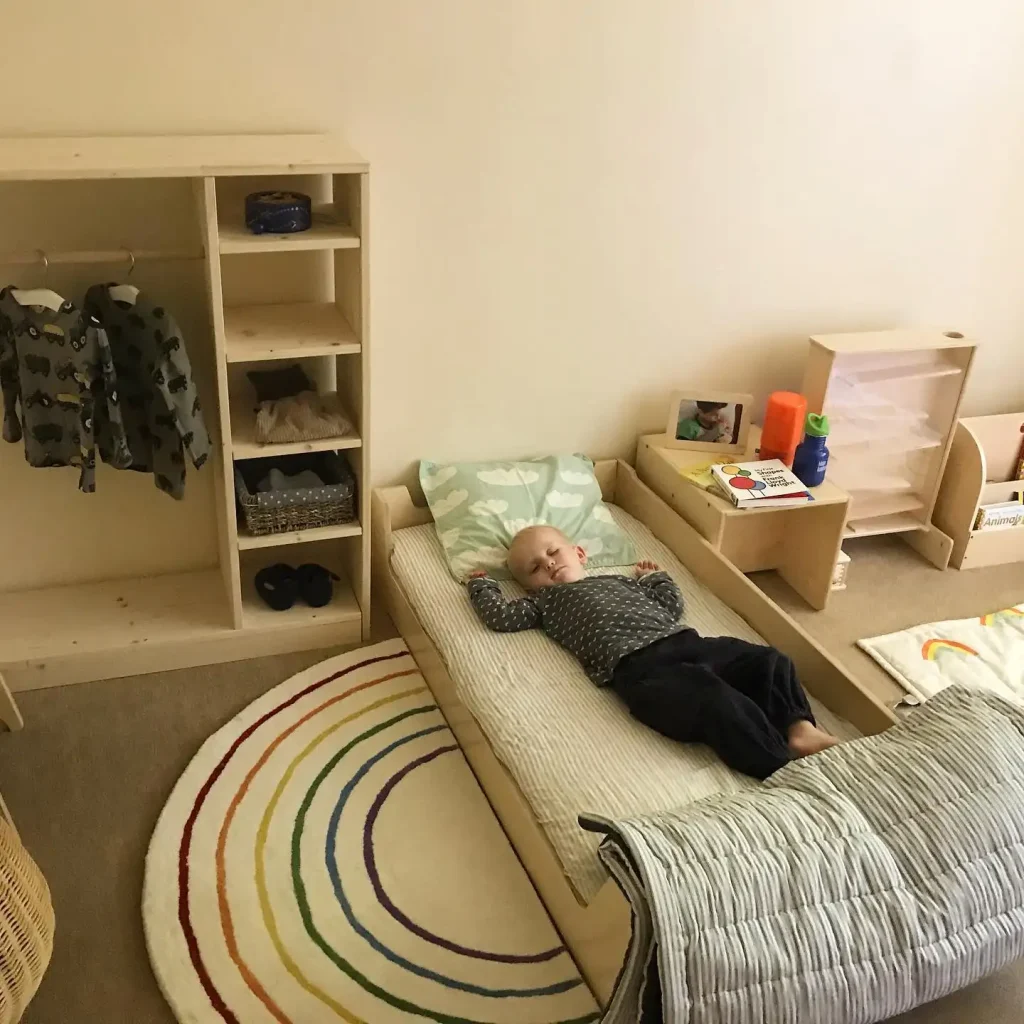
The Montessori floor bed is the most fundamental and most transformative element of any Montessori bedroom. A low mattress on the floor allows toddlers to get in and out of bed completely independently. This simple change eliminates the daily struggle of lifting children in and out of cribs.
Floor beds also eliminate fall risk entirely. Toddlers can explore freely at night without danger. The independence this creates builds genuine confidence from the very beginning.

| Floor Bed Option | Best Age |
|---|---|
| Mattress directly on floor | Birth to 18 months |
| Low wooden Montessori frame | 18 months to 5 years |
| Small platform bed frame | 3 years and up |
| House-shaped bed frame low | 2 to 6 years |
2. Keep Everything at Child Height
Everything in a Montessori bedroom must be accessible to the child without adult help. Shelves, hooks, mirrors, and storage should all sit at the toddler’s eye level. When children can reach their own things they develop independence and responsibility naturally.
Mount hooks at 60 to 70 centimeters from the floor for coats and bags. Install low shelving at 30 to 50 centimeters from the ground for toys and books. A child-height mirror helps with self-dressing and body awareness.

| Child-Height Element | Recommended Height |
|---|---|
| Clothing hooks | 60–70 cm from floor |
| Toy shelves | 30–50 cm from floor |
| Full-length mirror | Floor to child’s head height |
| Book display | 20–40 cm from floor |
3. Use Open Low Shelving for Toy Rotation
Open low shelving is the cornerstone of Montessori bedroom organization. Each item sits individually visible and accessible on its own shelf space. This prevents the chaos of deep toy boxes where nothing is findable.
Crucially, only display a small number of toys at any one time. Rotate toys every one to two weeks. Fewer choices actually increases concentration and deeper play quality.
| Toy Shelf Organization Rule | Benefit |
|---|---|
| Maximum 6–8 items per shelf | Reduces overwhelm |
| Each item in its own space | Teaches order and respect |
| Rotate every 1–2 weeks | Maintains interest and novelty |
| Natural wood or neutral shelves | Reduces visual clutter |
4. Create a Dressing Area at Toddler Level
A dedicated child-height dressing area teaches toddlers to dress themselves. Include a small mirror, a low drawer or basket for clothing, and a small stool for sitting while putting on shoes. This functional corner creates genuine self-care independence.
Lay out two clothing choices the night before in accessible baskets. Toddlers who choose their own clothes are more willing to wear them cooperatively. The decision-making process itself builds valuable early cognitive skills.

| Dressing Area Element | Child Independence Benefit |
|---|---|
| Low clothing drawers | Independent clothing selection |
| Small seating stool | Seated dressing stability |
| Child-height mirror | Self-assessment, body awareness |
| Two-choice clothing basket | Age-appropriate decision making |
5. Choose a Calming Neutral Color Palette
Montessori bedroom color philosophy prioritizes calm over stimulation. Neutral tones like warm white, soft beige, sage green, and natural wood create a restful, focused environment. Bright primary colors and cartoon themes are intentionally avoided.
Calm colors support better sleep and deeper independent play. They also provide a neutral backdrop that does not compete with natural materials and real-world objects. The room itself becomes calming rather than exciting.

| Montessori Color Choice | Room Effect |
|---|---|
| Warm white walls | Maximum brightness, calm |
| Soft sage green | Natural, soothing |
| Warm beige or cream | Cozy, grounded |
| Natural wood tones | Warmth, organic connection |
6. Add a Reading Nook With Child-Sized Seating
A dedicated reading nook creates a special, purposeful space for books and quiet activity. A small floor cushion, a bean bag, or a tiny armchair positioned beside a low bookshelf creates an inviting reading corner. Children who have a dedicated book space use books far more regularly.
Keep the nook simple and uncluttered. Soft lighting from a low lamp adds warmth and coziness. A small canopy or teepee overhead creates a sense of cozy enclosure that children find deeply appealing and comforting.

| Reading Nook Element | Design Purpose |
|---|---|
| Low floor cushion or bean bag | Child-accessible comfortable seating |
| Open-front bookshelf | Books displayed face-out |
| Small soft rug | Defines the reading zone |
| Gentle warm lamp | Cozy, non-harsh lighting |
7. Display Books Face-Out on Low Shelves
Standard bookshelves show only book spines which toddlers cannot read or recognize. Montessori bookshelves display books face-out so children see the cover illustration. This dramatically increases toddler engagement with books independently.
Use simple picture ledges or forward-facing bookshelf units mounted low on the wall. Rotate the book selection regularly to maintain curiosity and interest. Keep only five to eight books visible at one time for maximum focus.

| Book Display Method | Toddler Engagement Level |
|---|---|
| Spine-only traditional shelf | Low — cannot identify books |
| Face-out picture ledge | Very high — immediate recognition |
| Rotating selection of 5–8 | Sustained long-term interest |
| Books at eye level | Maximum independent access |
8. Use Natural Materials Throughout the Room
Montessori philosophy strongly emphasizes natural materials over plastic. Wood, cotton, linen, wool, and wicker create a warm, sensory-rich environment. These materials are also more beautiful, more durable, and more environmentally responsible.
Replace plastic toy bins with wicker baskets. Choose wooden furniture over MDF or plastic alternatives. Natural cotton bedding and linen curtains complete the sensory-rich natural material palette throughout the room.

| Natural Material | Montessori Application |
|---|---|
| Solid wood | Furniture, toys, shelving |
| Wicker and rattan | Storage baskets, toy bins |
| Cotton and linen | Bedding, curtains, cushions |
| Wool | Rugs, play mats |
9. Create a Floor-Level Art and Activity Area
A low table and small chairs positioned at the center of the room creates a dedicated workspace for drawing, painting, and hands-on activities. The table height should allow the toddler to sit comfortably with feet flat on the floor. This ergonomic consideration supports focus and extended concentration.
Keep art supplies in low accessible containers on adjacent shelves. A small art tray with three or four current art materials is more focused than overwhelming art supply bins. Rotate materials regularly to keep the activity area fresh and inviting.

| Activity Area Essential | Child Development Benefit |
|---|---|
| Child-height table and chairs | Proper ergonomics, focus |
| Open art supply trays | Independent material access |
| Washable floor covering | Mess management |
| Simple rotating materials | Sustained creative engagement |
10. Install a Full-Length Child-Height Mirror
A floor-length mirror mounted securely to the wall at child height supports body awareness and self-recognition. Toddlers spend significant time observing themselves and practicing dressing, expressions, and movement. This simple addition supports physical and emotional development.
Position the mirror near the dressing area for maximum practical use. A safe, shatter-resistant mirror is essential for a toddler’s bedroom. Frame it simply in natural wood to maintain the calm Montessori aesthetic throughout.

11. Use Soft, Warm Lighting Instead of Harsh Overhead Lights
Montessori bedroom lighting should be warm, diffused, and ideally controllable. Harsh bright overhead lighting disrupts natural sleep rhythms and creates an overstimulating environment. Soft lamp lighting at low levels is dramatically better for toddler rest and calm.

Add a small floor lamp or table lamp beside the reading nook. Install a dimmer switch for the main overhead light if possible. A small nightlight provides gentle orientation lighting during nighttime wakings without fully disrupting sleep. Explore soft ceiling fabric ideas for ceiling treatments that diffuse light beautifully in a Montessori bedroom.
| Lighting Type | Montessori Benefit |
|---|---|
| Warm white lamp (2700K) | Calming, sleep supportive |
| Dimmer switch overhead | Adjustable to activity |
| Small reading lamp | Focused task lighting |
| Gentle nightlight | Safe orientation, non-disruptive |
12. Introduce a Sensory Exploration Basket
A sensory exploration basket is one of the most classically Montessori bedroom ideas. Fill a natural wicker basket with five to eight carefully chosen objects of different textures, weights, and materials. Babies and young toddlers explore these objects with genuine concentration.

Change the basket contents regularly to maintain interest and provide new sensory experiences. Include objects like a smooth river stone, a wooden ring, a piece of soft fabric, a small pine cone, and a metal spoon. Natural objects from the environment are always preferred over plastic alternatives.
| Sensory Basket Object | Sensory Experience Offered |
|---|---|
| Smooth river stone | Weight, cool temperature, smooth |
| Wooden ring or block | Natural texture, grain |
| Soft fabric piece | Different textile textures |
| Small pine cone | Irregular texture, natural scent |
13. Create a Nature Table or Window Display
A small nature table near the window connects the indoor bedroom to the natural world outside. Display seasonal natural objects — a fallen leaf, an acorn, a flower, a feather — on a simple low tray or shelf. Children who observe nature objects develop deep scientific curiosity.
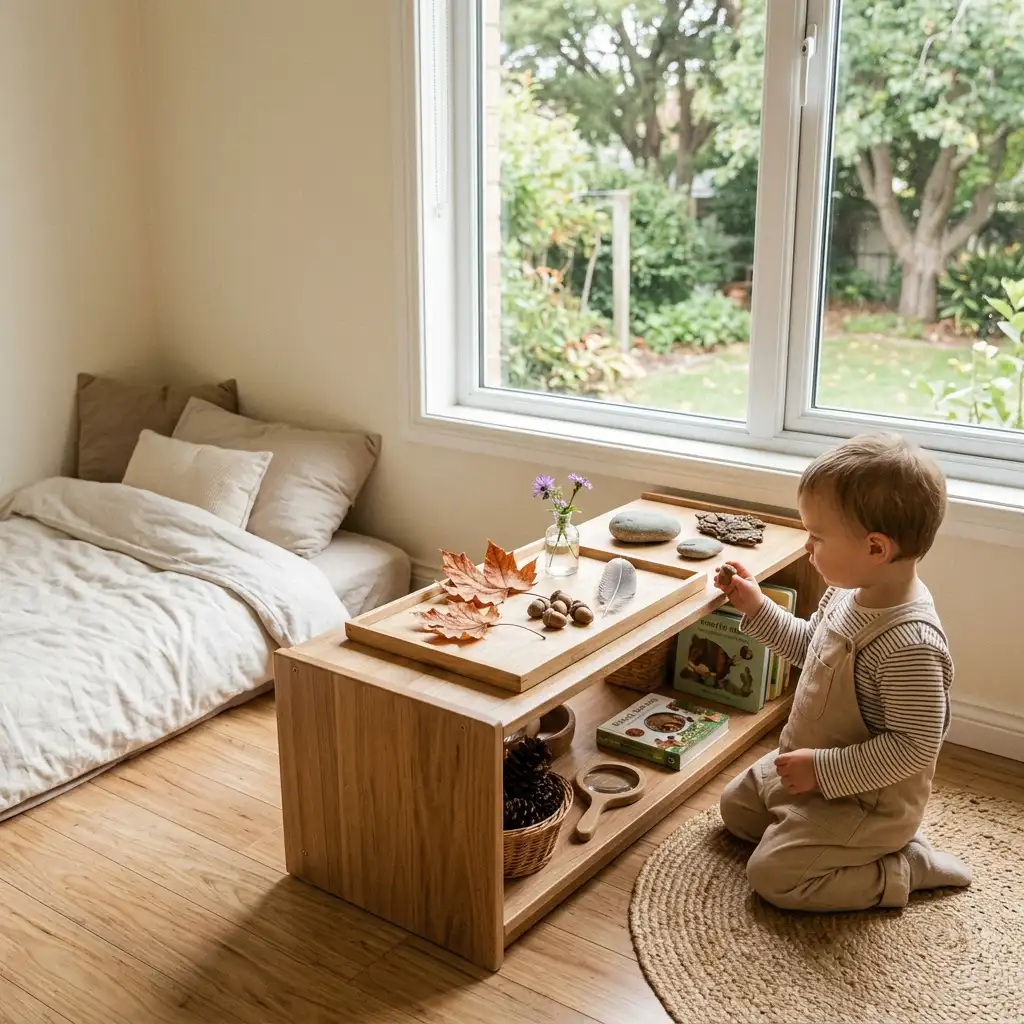
Change the nature table display with the seasons. Let the child contribute objects they find on walks and outdoor trips. This simple, low-cost feature creates one of the most genuinely educational elements of the whole Montessori bedroom.
| Seasonal Nature Table | Objects to Display |
|---|---|
| Autumn | Leaves, acorns, conkers, pine cones |
| Winter | Bare branches, stones, feathers |
| Spring | Flowers, new leaves, seeds |
| Summer | Shells, pebbles, pressed flowers |
14. Limit Toys and Rotate Regularly
The single most counterintuitive Montessori principle is that fewer toys produce better, longer, more focused play. When children have too many toys available simultaneously they flit between objects without engaging deeply with any. Reducing to 10 to 15 total visible toys dramatically improves play quality.

Store the majority of toys in accessible but closed storage — a wardrobe, a lidded basket, or a separate storage space. Rotate new toys in every week or two when interest in current toys decreases. Children greet returning toys with the enthusiasm of new ones.
| Toy Rotation Benefit | Research-Backed Outcome |
|---|---|
| Fewer choices visible | Deeper, more focused play |
| Regular rotation | Sustained interest over time |
| Child sees rotation happening | Ownership, anticipation |
| Natural objects included | Open-ended creative play |
15. Use a Low Clothing Rail for Independent Dressing
A child-height clothing rail at approximately 60 to 70 centimeters allows toddlers to choose and retrieve their own clothing completely independently. Hanging clothes at child level makes self-dressing achievable from 18 months onwards with practice. This one element dramatically reduces morning battles over clothing choices.

Hang only current season clothing that actually fits. Keep no more than five to seven outfit options to make morning choices manageable and quick. A rail with a short curtain in front creates a simple wardrobe effect without the expense of full furniture.
| Clothing Rail Setup | Practical Benefit |
|---|---|
| Height: 60–70 cm | Fully reachable by toddler |
| Maximum 5–7 outfits | Quick, manageable morning choice |
| Current season only | Reduces overwhelm |
| Two choices prepared nightly | Faster and calmer mornings |
16. Add a Small Indoor Plant
A small, safe indoor plant in a toddler’s bedroom teaches responsibility and creates a living connection to nature. Toddlers who help water a plant develop early nurturing instincts and basic scientific understanding of living things. Choose a non-toxic, easy-care variety that tolerates some neglect.

A small spider plant, a parlour palm, or a pothos in a low terracotta pot suits the Montessori bedroom beautifully. Position it at a height the child can see but not easily knock over. Give the child a small watering can and make watering a weekly shared ritual. Find the best low-maintenance, child-safe plants from bathroom plants that work equally well in a toddler bedroom environment.
| Child-Safe Bedroom Plant | Care Level |
|---|---|
| Spider plant | Very easy, very forgiving |
| Parlour palm | Easy, low light tolerant |
| Boston fern | Moderate, loves humidity |
| Money plant (Pothos) | Very easy, grows quickly |
17. Create a Cozy Sleep Space Around the Floor Bed
The floor bed area should feel like a special, defined sleep space rather than a mattress simply placed on the floor. Create a cozy sleep environment using a simple fabric canopy, a low wooden headboard, or a small teepee frame mounted above the mattress. This defines the sleep zone clearly within the bedroom.

Use simple, natural fabric curtains or a linen canopy in a muted tone. Avoid heavily themed or character-printed canopies that increase visual stimulation at sleep time. The sleep area should feel distinctly calmer and more enclosed than the play area of the room. Get bedroom canopy inspiration from dorm room ideas for creative, low-cost bed canopy approaches that work beautifully above a Montessori floor bed.
| Sleep Space Defining Element | Benefit |
|---|---|
| Simple fabric canopy above | Defines sleep zone, cozy |
| Low wooden headboard | Visual anchor for bed area |
| Soft rug beneath mattress | Warmth, visual definition |
| Calm artwork above | Peaceful visual focus |
18. Choose Open-Ended Toys Over Single-Purpose Ones
Montessori toy philosophy strongly prioritizes open-ended toys over single-purpose electronic toys. Open-ended toys are those that can be used in multiple ways and do not have a predetermined outcome. Building blocks, wooden animals, fabric dolls, and stacking rings are classic examples that support unlimited creative and developmental play.

Single-purpose electronic toys that make noise and light up produce passive engagement rather than active creativity. Replace these with simple, beautiful, natural material toys that the child gives meaning to through their own imagination. These toys support dramatically richer developmental outcomes.
| Open-Ended Toy | Developmental Benefits |
|---|---|
| Wooden building blocks | Spatial reasoning, creativity |
| Fabric or wooden dolls | Social, emotional play |
| Stacking and sorting sets | Fine motor, early mathematics |
| Simple wooden vehicles | Imaginative, narrative play |
19. Install a Pegboard for Changing Art Displays
A simple painted pegboard mounted at child height in the bedroom creates a rotating gallery for the child’s own artwork. Being able to see their creations displayed with care communicates genuine respect for the child’s creative work. Displaying artwork is itself a powerful motivator for continued creative activity.

Use simple clips or hooks on the pegboard to change displays quickly and easily. Involve the child in choosing which artwork to display. Including the child’s artwork in the bedroom decoration makes the room feel genuinely theirs rather than designed and decorated by adults.
20. Use a Wicker Laundry Basket at Child Height
A small wicker laundry basket placed in an accessible location teaches toddlers to put their dirty clothing away independently. This practical life skill is central to Montessori philosophy. A child who can manage their own laundry from an early age develops organization and responsibility that persists into adulthood.

Position the basket beside the dressing area for the most intuitive placement. Keep it small enough that the child can lift and carry it when reasonably full. A natural wicker or fabric laundry bin complements the Montessori material palette beautifully while serving a genuinely functional educational purpose.
21. Create a Small Practical Life Corner
Practical life activities are central to the Montessori approach and can be incorporated into the bedroom beautifully. A small tray with a simple practical life activity — pouring dried beans between two containers, polishing a wooden object, or buttoning and zipping frames — provides purposeful, focused independent activity. These activities build concentration and fine motor skills powerfully.

Rotate practical life activities on the tray weekly. Keep each tray activity self-contained and complete so the child can begin and finish independently. Practical life activities are consistently among the most engaging and most beneficial elements of any Montessori bedroom setup.
| Practical Life Tray Activity | Skill Developed |
|---|---|
| Pouring dried beans or rice | Fine motor, concentration |
| Buttoning and zipping frame | Self-care independence |
| Polishing a wooden object | Care of environment |
| Simple wooden lock and key | Problem solving, fine motor |
22. Keep the Room Uncluttered and Visually Calm
Visual clutter is one of the most significant barriers to the deep independent play that Montessori environments aim to support. Too many things visible simultaneously fragments attention and prevents the sustained concentration that children are genuinely capable of when properly supported. An uncluttered room is not a sparse room — it is a thoughtfully edited one.

Remove everything that does not actively serve the child’s current developmental stage. Store, donate, or rotate excess toys and materials regularly. The visual calm of a properly uncluttered Montessori bedroom communicates to the child’s nervous system that this is a safe, manageable, and focused environment for learning and rest.
23. Add a Small Table Lamp for the Reading Nook
A small table lamp or clip-on reading light beside the reading nook creates the perfect independently accessible light source for quiet reading time. The child can switch this light on and off independently which gives them genuine control over their own environment. Control over the environment is a core Montessori principle.

Choose a lamp with a warm-toned bulb (2700K) that creates a cozy, inviting reading atmosphere. A lamp with a simple rocker switch rather than a dimmer is easiest for toddler fingers to manage. Position it at a safe distance from the reading cushion with no accessible cord for safety reasons throughout.
24. Use Washable, Natural Fiber Rugs for Play Zones
Area rugs in a Montessori bedroom serve multiple purposes simultaneously. They define specific activity zones visually, provide comfortable floor-level play surfaces, and add warmth and texture to the room. Natural fiber rugs in cotton, jute, or wool complement the Montessori material palette beautifully.

Use a larger rug to define the primary play area and a smaller rug beneath or beside the floor bed for the sleep zone. Washable cotton rugs are the most practical choice for a toddler bedroom where spills and mess are daily occurrences. Neutral tones and simple patterns keep the visual environment calm and focused.
| Rug Placement | Zone Defined |
|---|---|
| Large central rug | Primary play and activity space |
| Small rug beside floor bed | Sleep zone definition |
| Reading nook rug | Quiet reading and book area |
| Art table rug (washable) | Creative activity zone |
25. Incorporate a Simple Low Wardrobe or Clothing Storage
A small, low wardrobe or chest of drawers that the child can open and access independently completes the Montessori dressing area. Standard adult-height furniture is completely inaccessible to toddlers and creates dependence rather than the independence Montessori environments aim to cultivate. Low, child-scaled furniture respects the child’s actual physical capabilities.

Choose a simple wardrobe with lightweight doors that toddler hands can open easily. Drawer handles that are easy to grip and pull reduce frustration and increase successful independent dressing. Keep clothing organized by category — tops in one drawer, bottoms in another — using simple picture labels that toddlers can read visually before they can read words. Find smart, affordable organization solutions from linen closet organization that apply directly to organizing a toddler’s Montessori wardrobe space.
| Low Wardrobe Feature | Independence Benefit |
|---|---|
| Height: maximum 100 cm | Fully accessible to toddler |
| Lightweight door panels | Easy for small hands to open |
| Large drawer handles | Successful independent opening |
| Picture category labels | Pre-reading visual system |
26. Keep the Ceiling Calm and Uncluttered
Most children’s bedroom ceilings are overlooked and left completely plain. In a Montessori bedroom the ceiling is another opportunity for calm, beautiful visual interest that the child experiences from floor level. A simple fabric mobile, a few hanging natural objects, or a gentle ceiling paint treatment in a soft tone adds beauty without overstimulation.

Hang a simple Montessori-style mobile — geometric shapes in black and white for babies or gentle wooden shapes for older toddlers — above the floor bed position. Avoid cluttered or loud ceiling decorations that stimulate rather than calm. A simple, beautiful ceiling element rewards the child’s gaze from their sleeping position with genuine visual peace. Explore sloped ceiling ideas for creative ceiling treatments that maintain the calm Montessori aesthetic beautifully in rooms with non-standard ceiling shapes.
| Calm Ceiling Treatment | Developmental Benefit |
|---|---|
| Simple geometric mobile | Visual tracking, concentration |
| Single hanging wooden element | Focused visual interest |
| Soft painted tone ceiling | Visual calm, room harmony |
| Simple fabric canopy | Defined sleep space from above |
Frequently Asked Questions
What is a Montessori toddler bedroom?
A Montessori toddler bedroom is a child-led space designed entirely around the toddler’s size, independence, and developmental needs. Key features include a floor-level bed, child-height furniture and storage, a calm neutral color palette, natural materials, limited and rotated toys, and everything positioned for independent access. The goal is a space that empowers the child to manage their environment without constant adult assistance.
What age is a Montessori floor bed appropriate for?
A Montessori floor bed is appropriate from birth. Newborns placed on a firm, flat mattress on the floor can observe their environment freely and safely. As toddlers from 12 to 18 months begin to move independently, the floor bed allows them to get in and out without falling. Most children use a low floor bed or low platform bed comfortably until ages five or six.
How many toys should be in a Montessori toddler bedroom?
Montessori philosophy recommends displaying only 10 to 15 carefully chosen toys at any one time in a toddler bedroom. The remainder are stored out of sight and rotated in regularly. Fewer visible toys produce longer, deeper, and more creatively engaged play. Quality of toys matters far more than quantity — a few beautiful, open-ended natural toys outperform dozens of single-purpose plastic ones.
What colors are best for a Montessori toddler bedroom?
Montessori toddler bedrooms prioritize calm, muted, natural tones over bright, stimulating primary colors. Warm white, soft sage green, warm beige, and natural wood tones are the most authentically Montessori color choices. These calm colors support better sleep, deeper independent play, and a more focused sensory environment than brightly colored or character-themed rooms.
How do I transition my toddler from a crib to a Montessori floor bed?
Transition gradually by starting with the floor mattress beside the existing crib. Allow the child to explore and sleep on the floor mattress voluntarily before removing the crib. Keep the transition positive and unhurried. Most toddlers embrace the floor bed enthusiastically once they experience the freedom of getting in and out independently. Childproof the room thoroughly before making the transition permanent.
Conclusion
A Montessori toddler bedroom is one of the most genuinely impactful investments you can make in your child’s development. Every design choice — from the floor bed to the child-height shelves to the natural material toys — communicates deep respect for your toddler’s capabilities and genuine trust in their independence.
Start with the elements that require the least investment — clearing clutter, lowering hooks, rotating toys — and build from there. You do not need to implement everything at once to see immediate, significant benefits. Even three or four Montessori principles applied thoughtfully will transform how your toddler uses their bedroom and how confidently they move through their daily routines.