
Sometimes linen closet becomes a mess. Sheets are stuffed in randomly. Towels are piled on top of each other. Something falls out every time you open the door.
It does not have to be this way. A few simple changes turn that closet into a space where everything has a place. You open the door and find what you need in seconds.
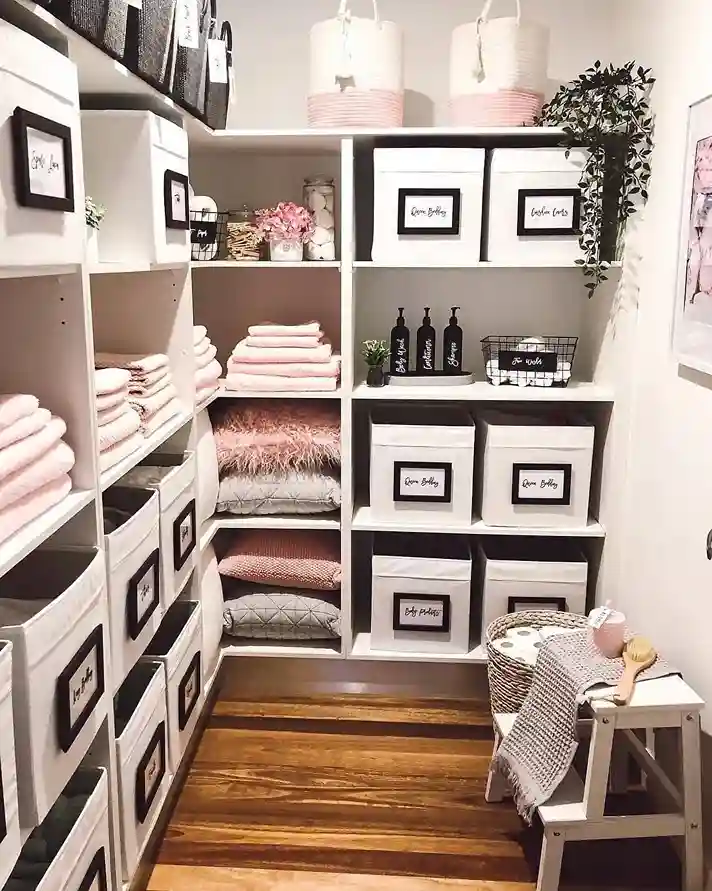
These 27 ideas work in any linen closet. Some take an afternoon. Some take ten minutes. All of them make the closet easier to use.
1. Start With a Complete Emptying and Audit
Pull everything out of the linen closet before doing anything else. Every sheet, towel, tablecloth, and miscellaneous item comes out completely. You cannot organize a closet properly while items are still inside it.
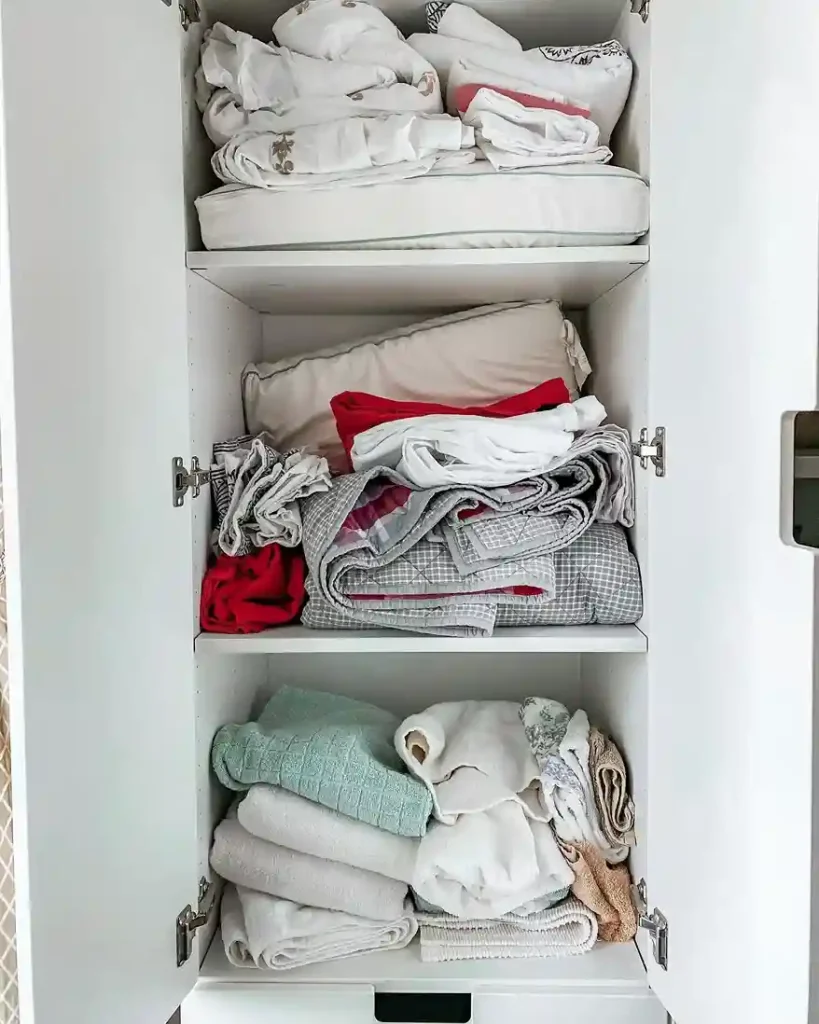
Audit every item ruthlessly. Towels with permanent stains get donated or repurposed as cleaning rags. Sheets missing their matching pieces get donated. Bedding sets that no longer fit any bed in the home leave the house entirely.
Count what remains. Most households need far fewer linens than they keep. Two complete sets per bed and three towels per person is more than adequate for most families. Edit down to these quantities and the organization challenge immediately becomes manageable.
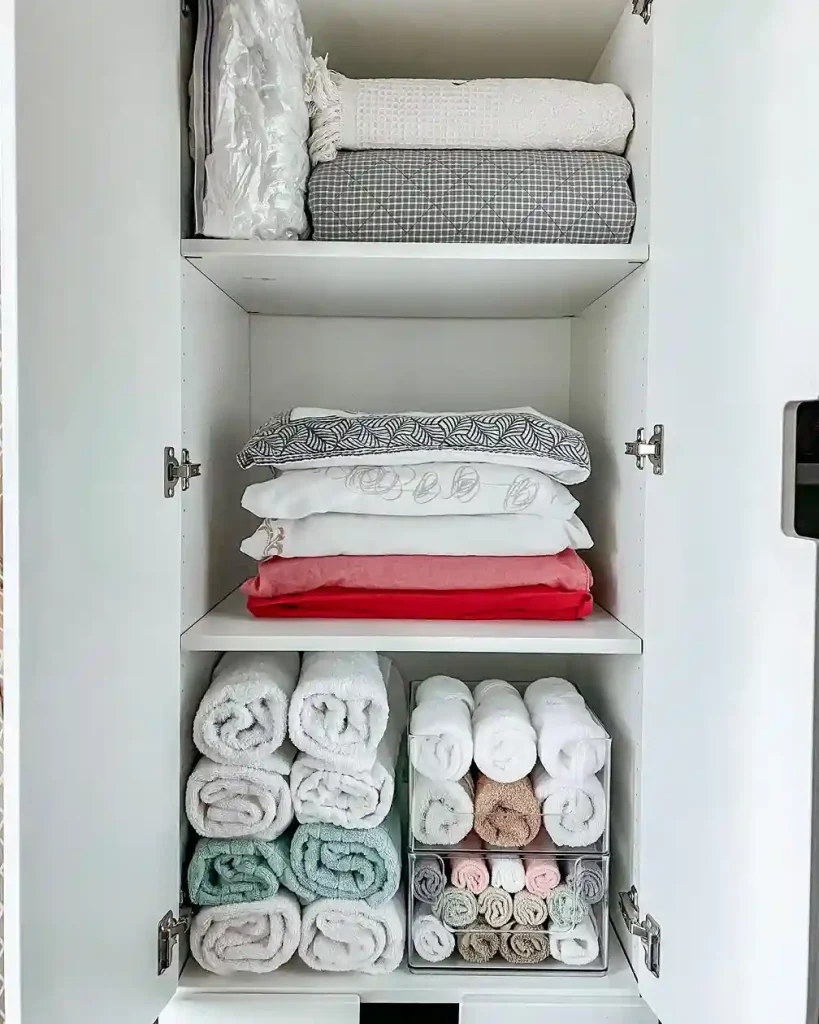
2. Measure Every Shelf Before Buying Any Organizer
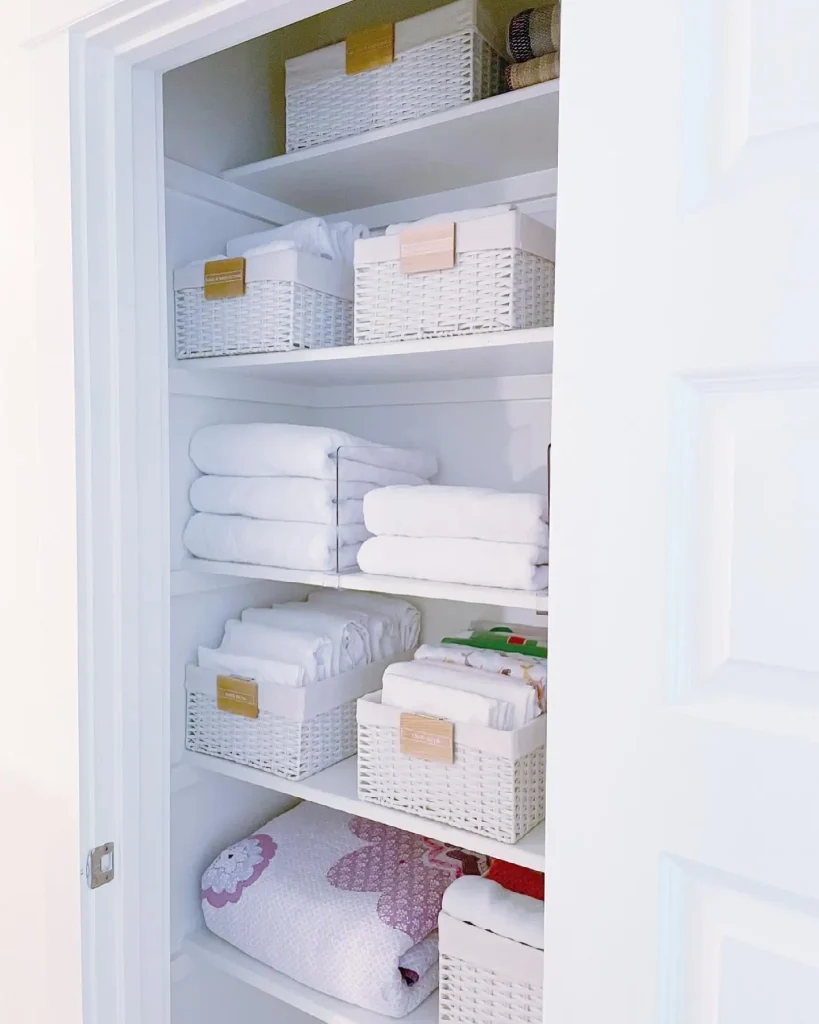
Organizers that do not fit the shelf dimensions waste money and frustrate every use. Measure the depth, width, and height of every shelf before purchasing a single bin or basket.
The closet labeled white wicker baskets that fit the shelves exactly. No wasted gap space. No struggle to close the door. The baskets look deliberate because they are.
What to measure:
- Depth of each shelf, front to back
- Width of each shelf, side to side
- Height of the space between shelves
Bring measurements to the store or keep them on your phone when shopping online. Shelves are rarely exactly the dimension listed. A shelf described as 12 inches deep may actually be 11.5 inches. That half-inch matters when fitting bins snugly side by side.
3. Categorize All Linens Before Assigning Shelf Positions
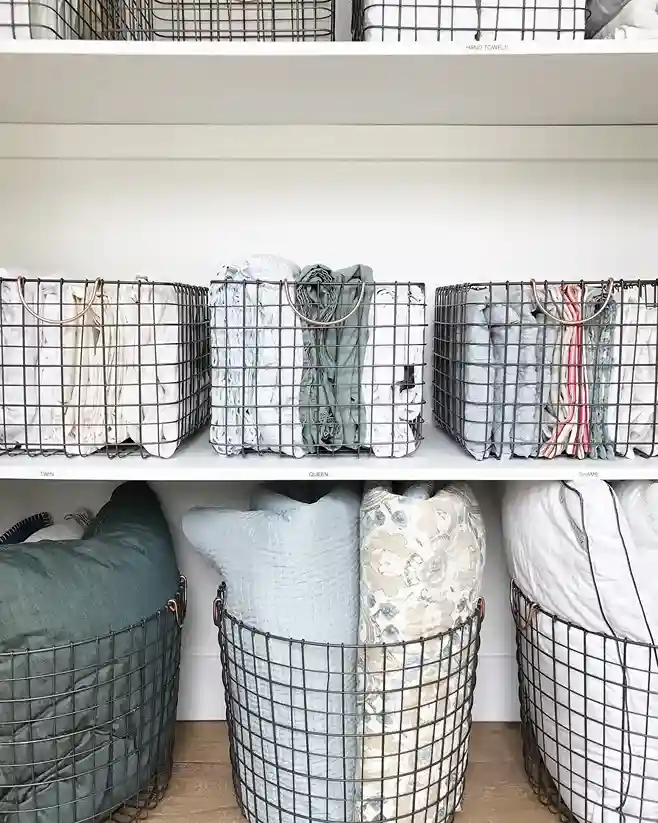
Every item in the linen closet belongs to a category. Defining the categories before assigning shelf positions is the planning step most people skip, and the skip that causes most linen closet organization to fail within weeks.
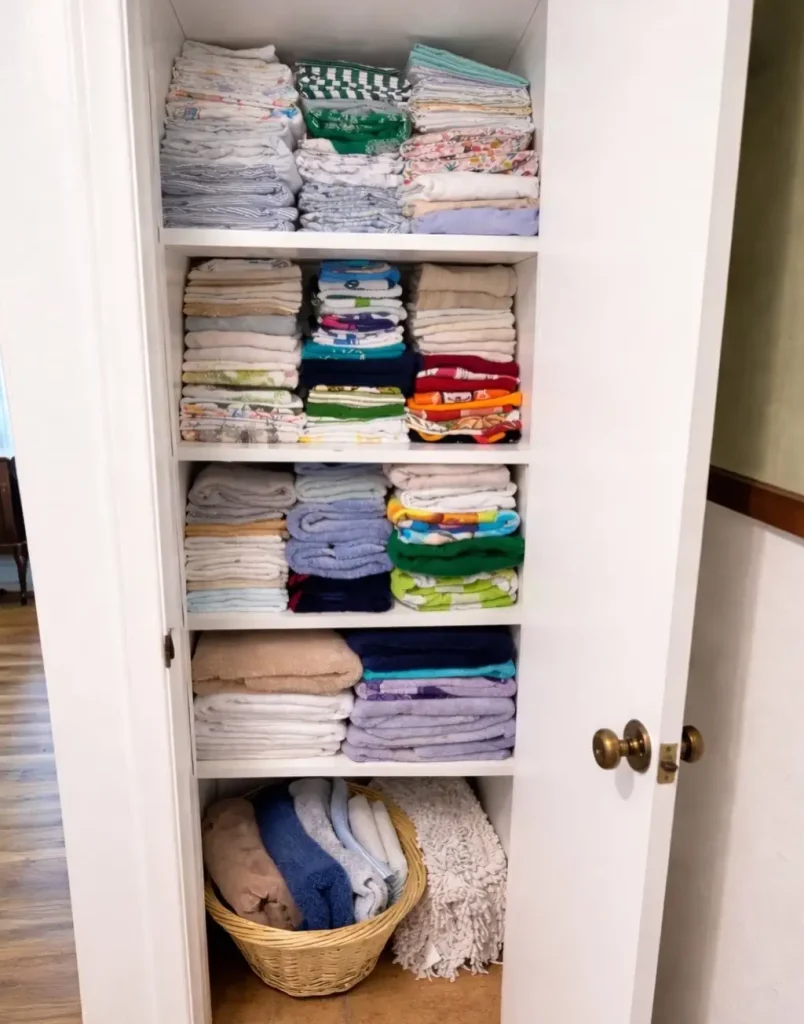
The closet above shows the categorization in action. Folded linens grouped by color and size. Rolled towels in a separate section. A wicker basket on the bottom shelf for larger items. Each category has its own zone.
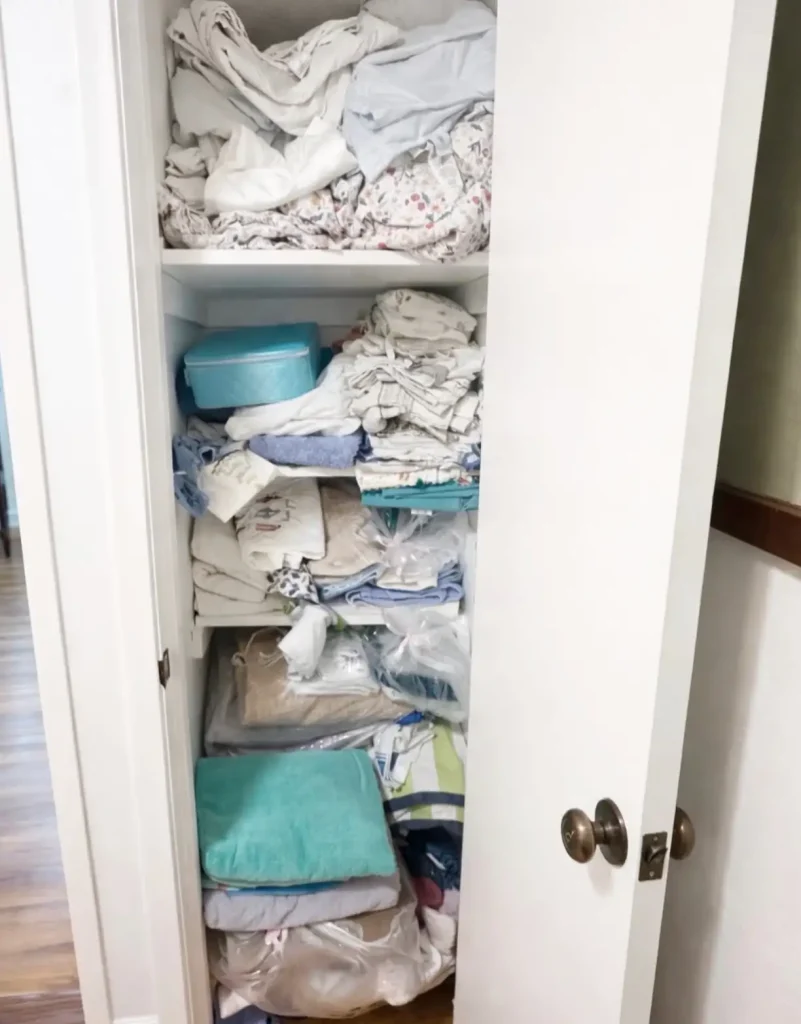
Standard categories:
- Bed sheets by room
- Bath towels
- Hand towels and washcloths
- Extra blankets and throws
- Tablecloths and placemats
- Toiletry overstock
- Seasonal bedding
Write your specific categories on paper before a single item goes back into the closet.
4. Fold Sheets Using the Burrito or Bundle Method
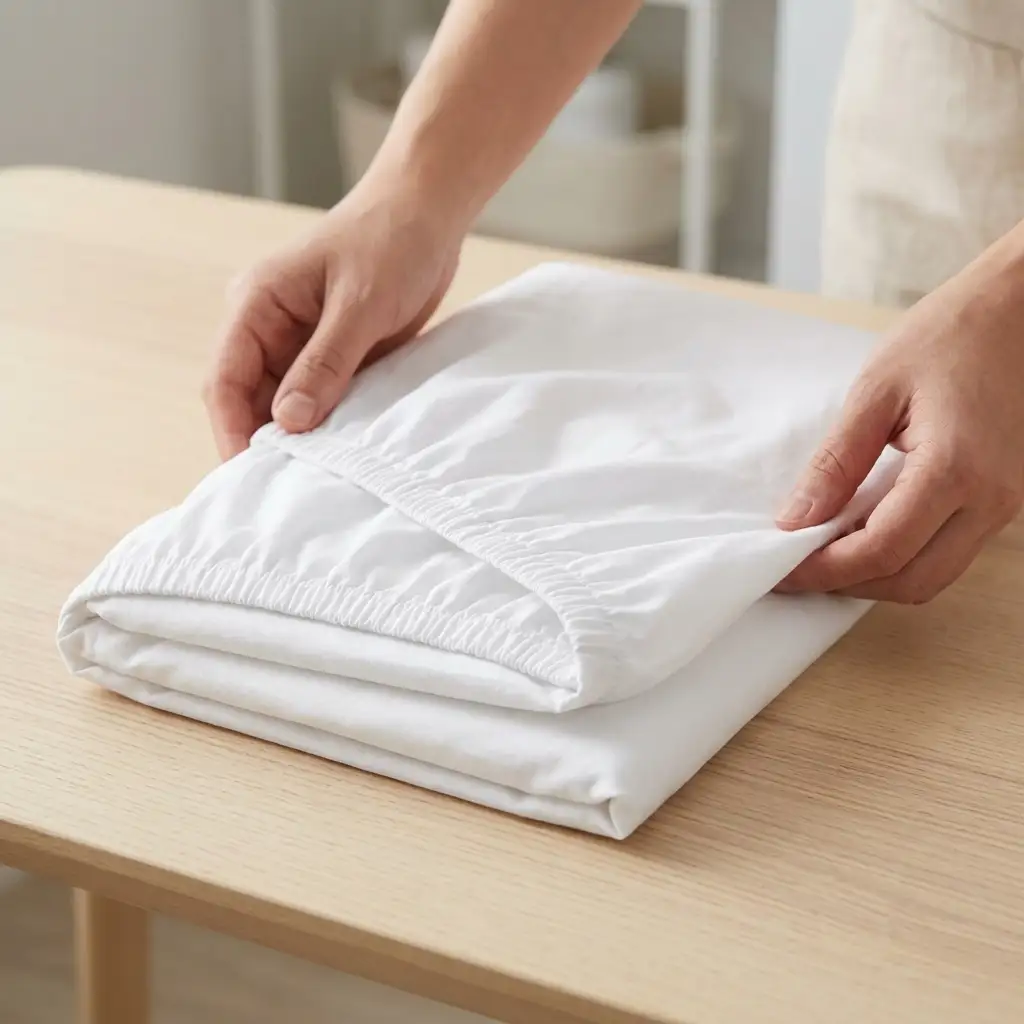
Folding technique determines how organized the linen closet stays between resets. A poorly folded sheet stack collapses into chaos immediately. A well-folded stack stays neat for weeks.
The image above shows the fold in progress. A fitted sheet spread flat on a wooden table, edges aligned, the elastic corners tucked inward. The finished fold will be a tight, even rectangle with no wrinkles.
The burrito method:
- Fold the sheet in thirds lengthwise
- Roll it tightly from one end into a compact cylinder
- Store the cylinder upright in a bin
The bundle method:
- Fold the fitted sheet, flat sheet, and pillowcases as a set
- Tuck the entire bundle inside one pillowcase
- The pillowcase holds the set together
Pull out one pillowcase and the complete set comes with it. No searching for matching pieces.
5. Use Uniform Bins and Baskets Throughout
Mismatched containers create visual chaos regardless of how well the contents are organized. Uniform bins and baskets immediately create a sense of deliberate order. The eye sees consistency and registers the closet as organized.
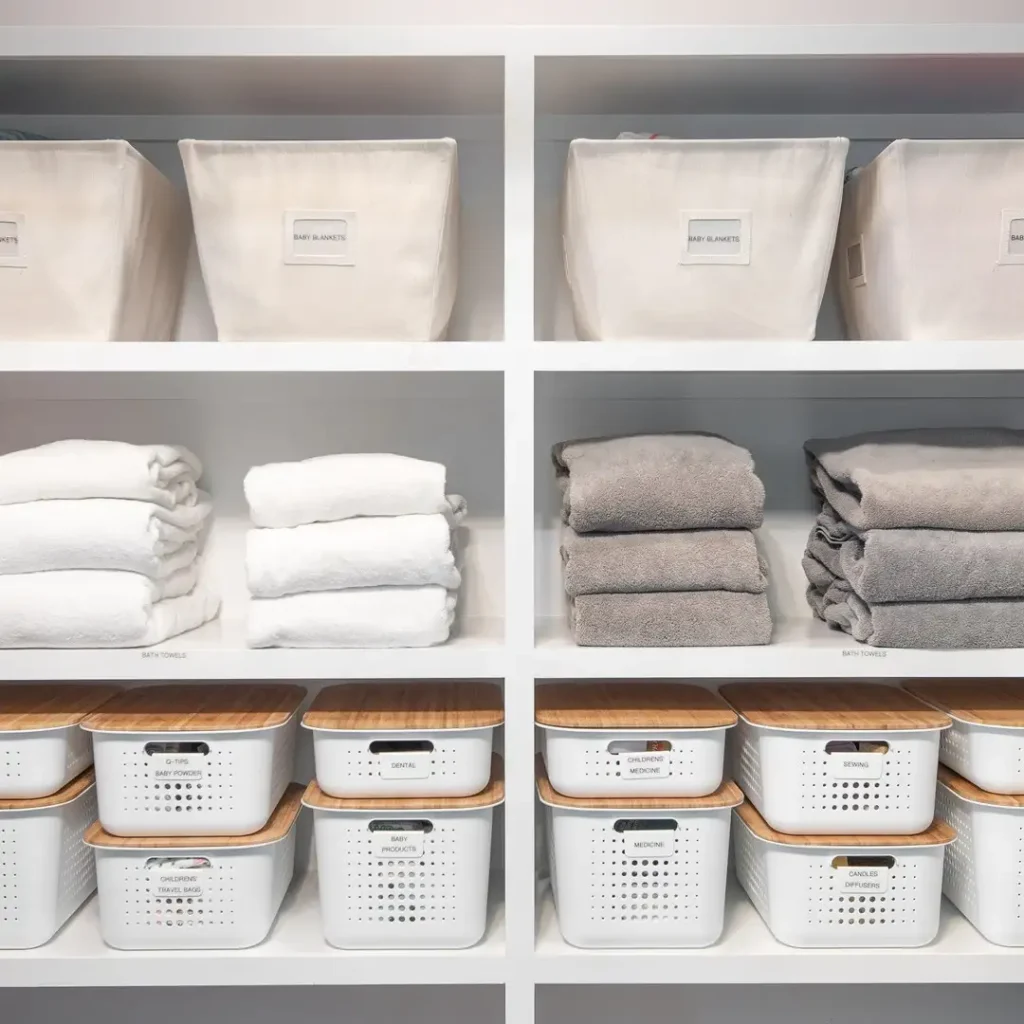
The closet matching white canvas bins with small labels on the front. Stacked towels in white and grey. A row of bamboo-lid storage boxes below with consistent style and color. The result is calm and considered.
Bin material options:
- Natural wicker: warm and organic
- White canvas: clean and modern
- Grey linen: calm and sophisticated
- Clear acrylic: maximum visibility
- Wire baskets: industrial and modern
Pick one style and one color family. Use it throughout.
6. Label Every Bin, Basket, and Shelf Section
Labels are the maintenance system that keeps linen closet organization working long-term. Without labels, every household member guesses where things belong and the system deteriorates. With clear labels, anyone can find and return any item correctly.
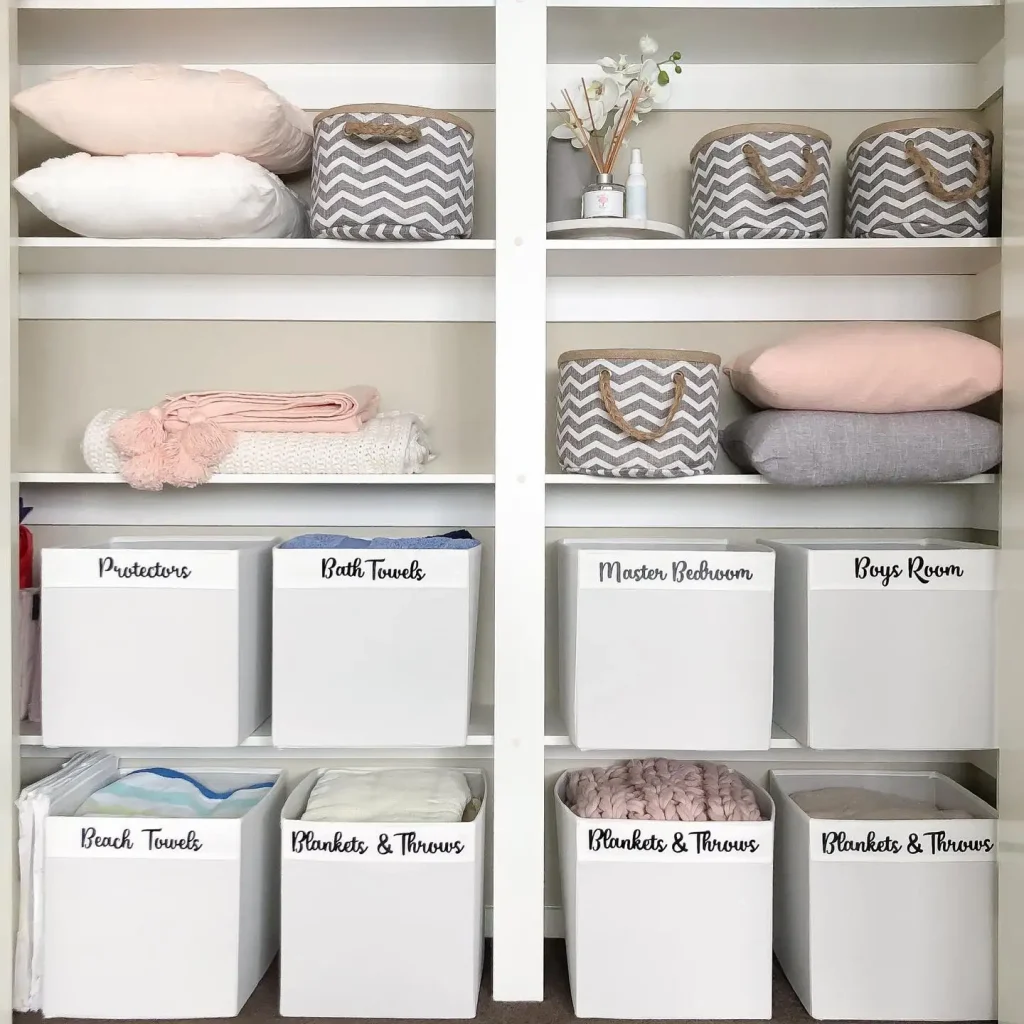
The closet here has the full system. Cube bins labeled Protectors, Bath Towels, Beach Towels, Blankets and Throws, Master Bedroom, and Boys Room. The labels are consistent in style and placement. Anyone opening that closet knows exactly where every towel or sheet belongs.
Label every bin on the front face at eye level. Label shelf edges for sections that do not use bins. A label maker produces the most professional results. Handwritten labels work equally well and add a personal touch.
7. Add a Second Shelf to Double Storage Capacity
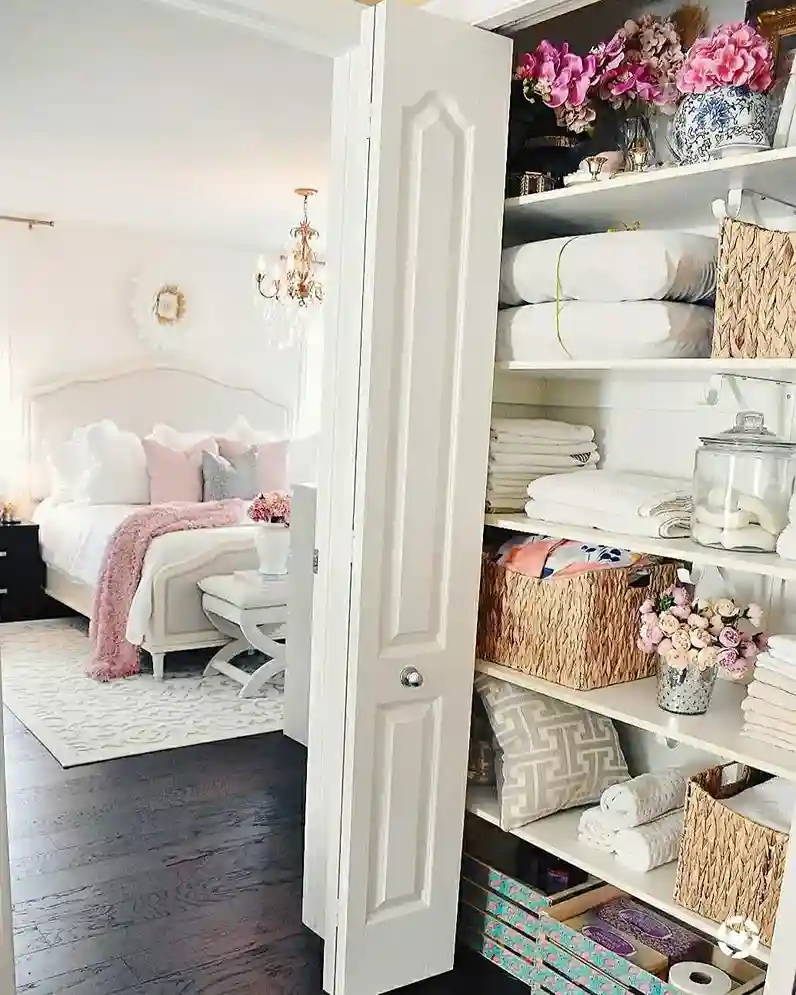
Most linen closets come with fixed shelves spaced too far apart. The gap between shelves wastes vertical space. A simple additional shelf installed between existing shelves doubles storage capacity in that section.
The shelves are evenly spaced. Folded white linens, wicker baskets, and stacked towels fill each shelf to its capacity. Nothing feels crowded. Nothing feels wasted.
Two ways to add shelf capacity:
- A freestanding shelf riser (a small shelf on legs that sits on top of an existing shelf), $15 to $30, no tools required
- Repositioning existing adjustable shelf brackets to new holes, usually free
The riser adds a full extra shelf of storage immediately.
8. Store Towels Folded Vertically Like Files
Stacking towels horizontally creates a pile that collapses when a towel is removed from the middle. Folding towels in thirds and storing them vertically, standing upright like file folders, solves this immediately.
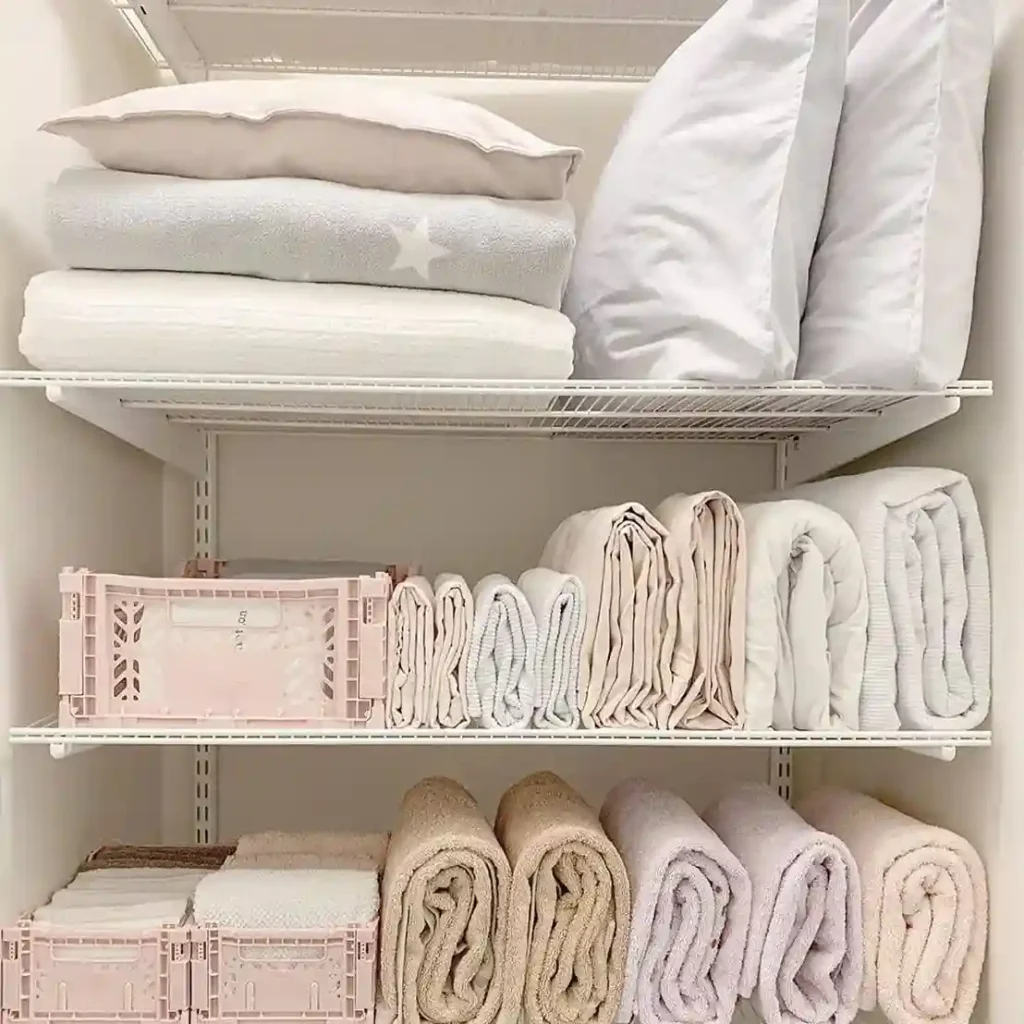
Wire shelves get a bad name, but they work when you use the right fold. This closet stands folded sheet sets on their edges instead of stacking them flat, so each set reads like a book on a shelf. You can pull one out without touching the others.
Pillows and comforters stay up top where the shelf is deepest. Small pink crates at the bottom hold hand towels and washcloths. The whole system works because nothing relies on height. Everything relies on being able to see the front edge.
9. Use Pull-Out Drawers for Deep Closet Shelves
Deep closet shelves create an accessibility problem. Items pushed to the back become permanently inaccessible in practice. Pull-out drawer inserts solve the deep shelf problem completely. Every item at the back slides forward into easy reach.

A linen closet can look like furniture if you treat it that way. This setup uses dark metal shelving with slim LED strips under every shelf, which lights the towels instead of hiding them.
Woven baskets get small stone colored labels on the front, marked king, queen, full, hand, bath, and face, so the whole family knows where things go.
The bottom bay uses a small wooden dresser with brass pulls, and a hanging rod on the right holds robes. Wallpaper on the back wall turns the closet into a feature instead of an afterthought.
Slim LED strips under each shelf wash the towels without heat.
Stone tags on the basket fronts: king, queen, full, hand, bath, face.
Wooden dresser with brass pulls for folded items and small gear.
Botanical wallpaper makes the closet feel like a styled room.
For complete closet shelving and organization ideas including pull-out storage solutions that maximize the depth of every closet shelf, explore these closet shelving ideas for every shelving approach that creates maximum accessible storage in any closet configuration.
10. Sort Sheets by Room for Effortless Bedmaking
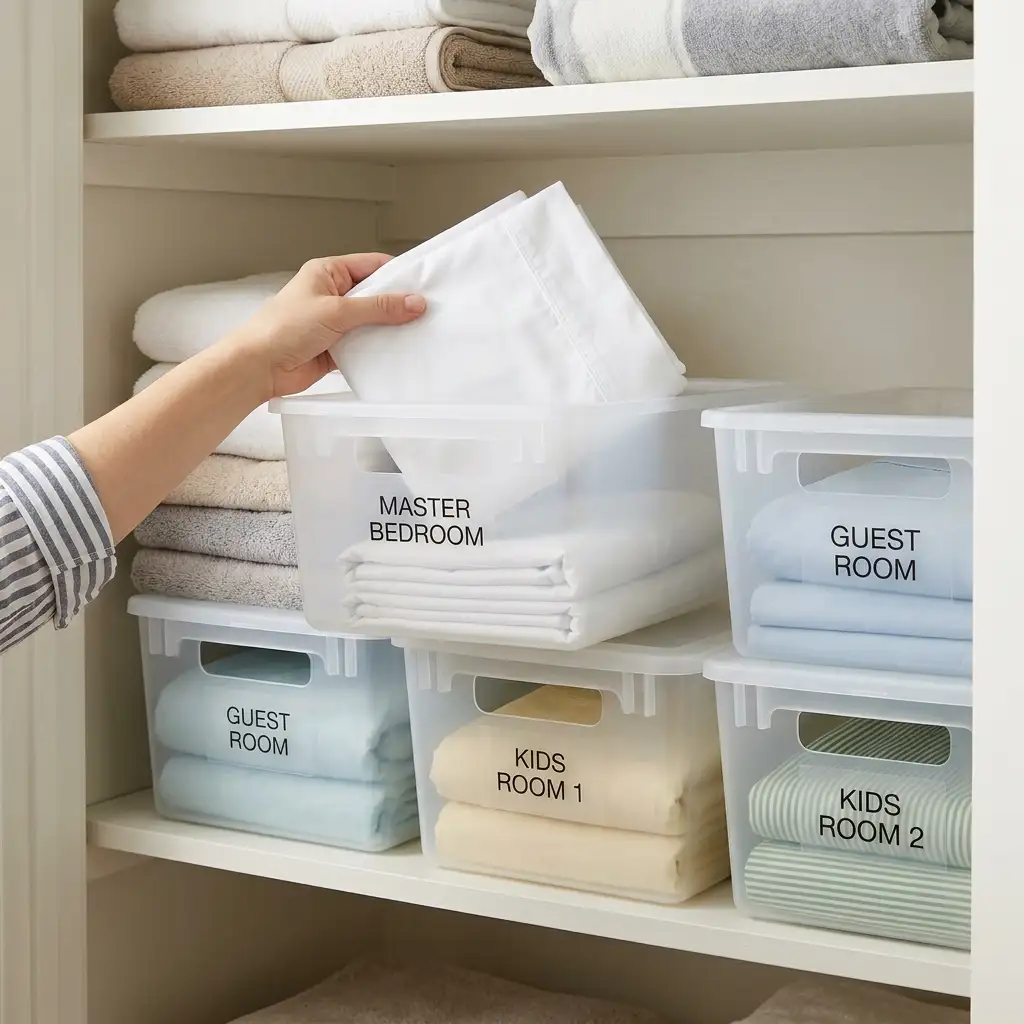
Sorting bed sheets by room rather than by size transforms the sheet-finding experience. Instead of searching through a pile of similar sheets, you open the Master Bedroom bin and the correct sheets are the only option inside.
The closet above shows the system clearly. Clear bins labeled Master Bedroom, Guest Room, Kids Room 1, and Kids Room 2. A hand places a folded white sheet into the Master Bedroom bin. The Guest Room bin holds light blue sheets. The Kids Room bins hold cream and green striped sheets.
Why this works:
- Bedmaking becomes a single-reach operation
- An empty bin signals the sheets are in the wash
- A full bin confirms the backup set is ready
The system makes sheet management effortless, regardless of who is making the bed.
11. Organize Towels by Person or by Bathroom
Two organizational approaches suit bathroom towel storage. Organizing by bathroom groups all towels for a specific bathroom together — master bath towels in one section, guest bath in another. Finding towels for a specific bathroom is instantaneous.
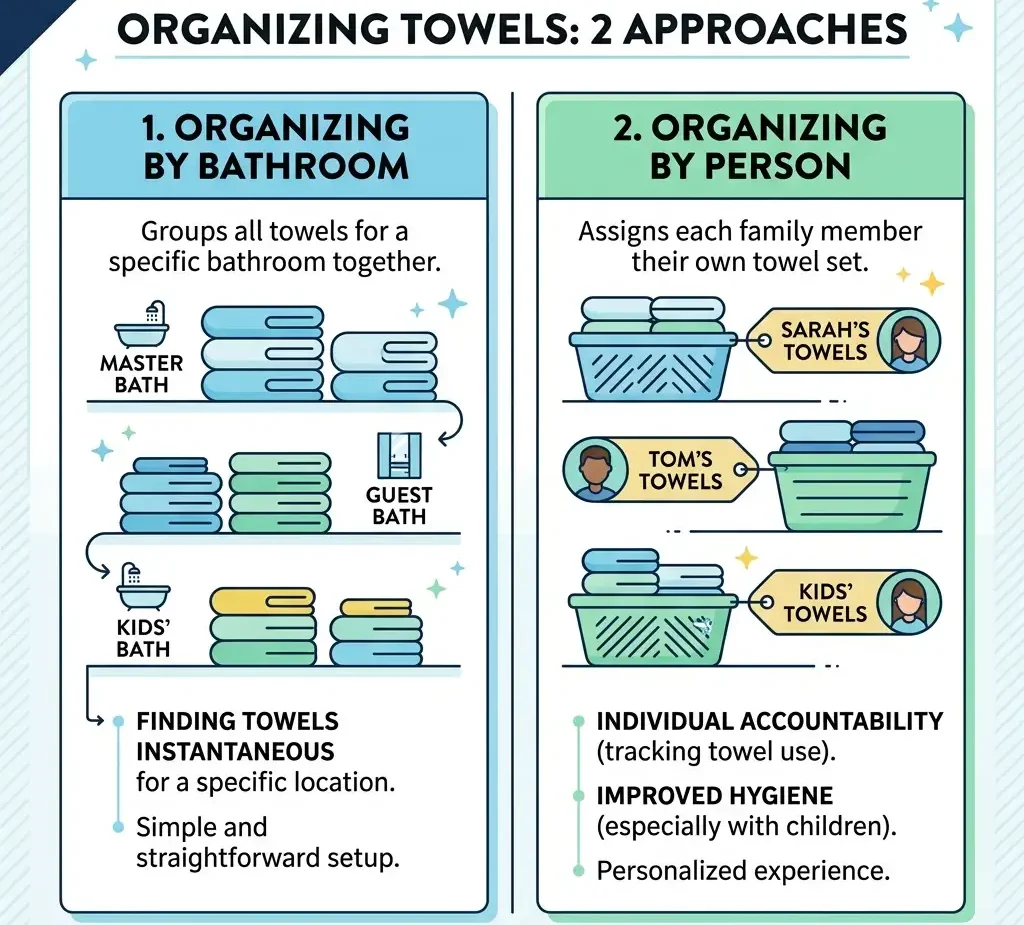
Organizing by person assigns each family member their own towel set. Each person’s towels live in a labeled section. This approach suits households where individual towel accountability matters — particularly useful for tracking towel use and hygiene in families with children.
- By bathroom: suits two-bathroom homes or frequent guest hosting
- By person: suits families with children learning personal responsibility
- By color: suits visually organized households where towel sets are color-coded per bathroom
- By size: suits large households with extensive towel collections needing size-based organization
- Mixed approach: towels by bathroom, hand towels and washcloths by person
12. Use the Door Back for Additional Storage
The back of the linen closet door is usable storage space that most linen closets completely ignore. An over-door organizer adds storage for toiletry overflow, cleaning supplies, first aid items, and small accessories without consuming any shelf space.
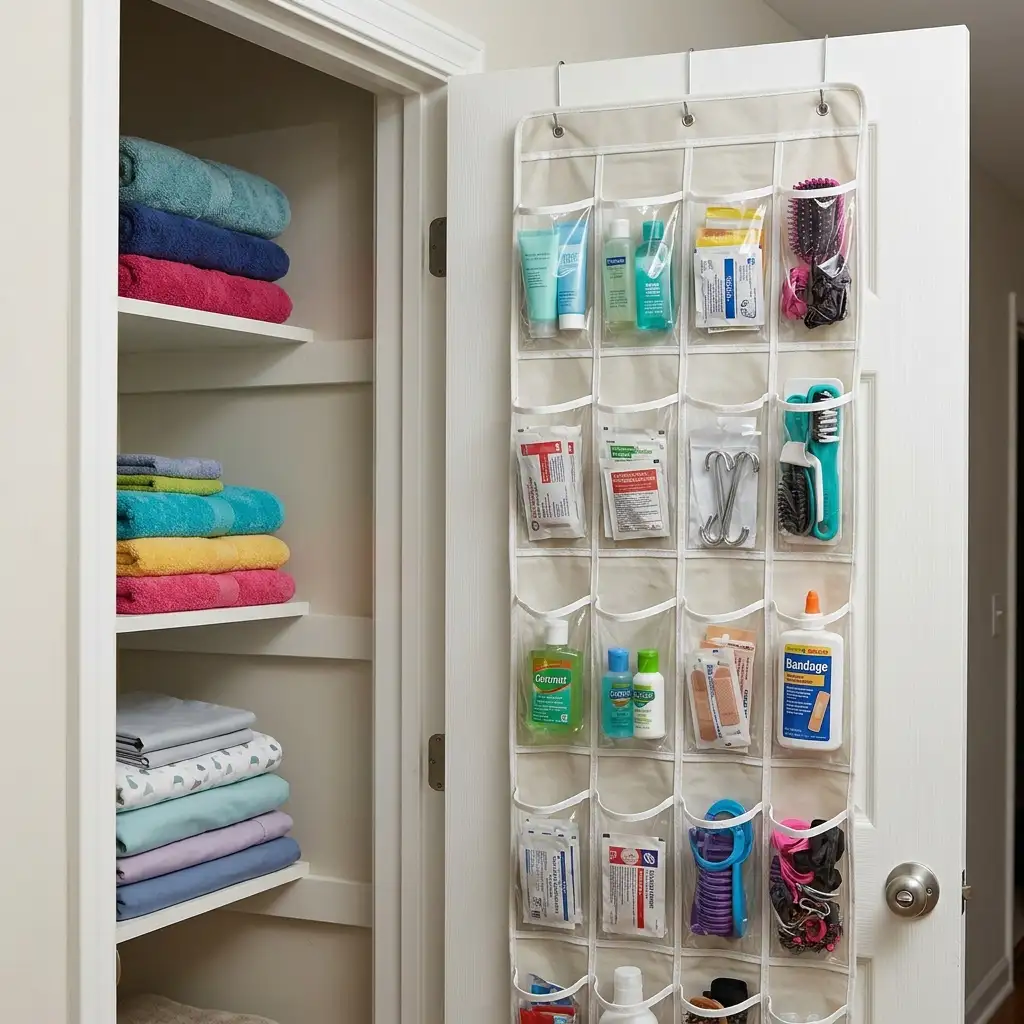
An over-door pocket organizer with multiple clear pockets suits small items that get lost on open shelves. Travel-sized toiletries, medicine packets, extra hooks, and small accessories all organize perfectly in door-back pockets.
A mounted spice rack on the door back holds small toiletry bottles, first aid items, and cleaning product bottles upright and visible. The slotted design of spice racks prevents bottles from tipping and keeps everything clearly organized in a minimal footprint.
13. Fold Towels in a Hotel Style for a Luxurious Look
Hotel-style towel folding creates a linen closet that looks genuinely beautiful every time it is opened. The precision and care of hotel folding transforms functional towel storage into something that feels polished and intentional.
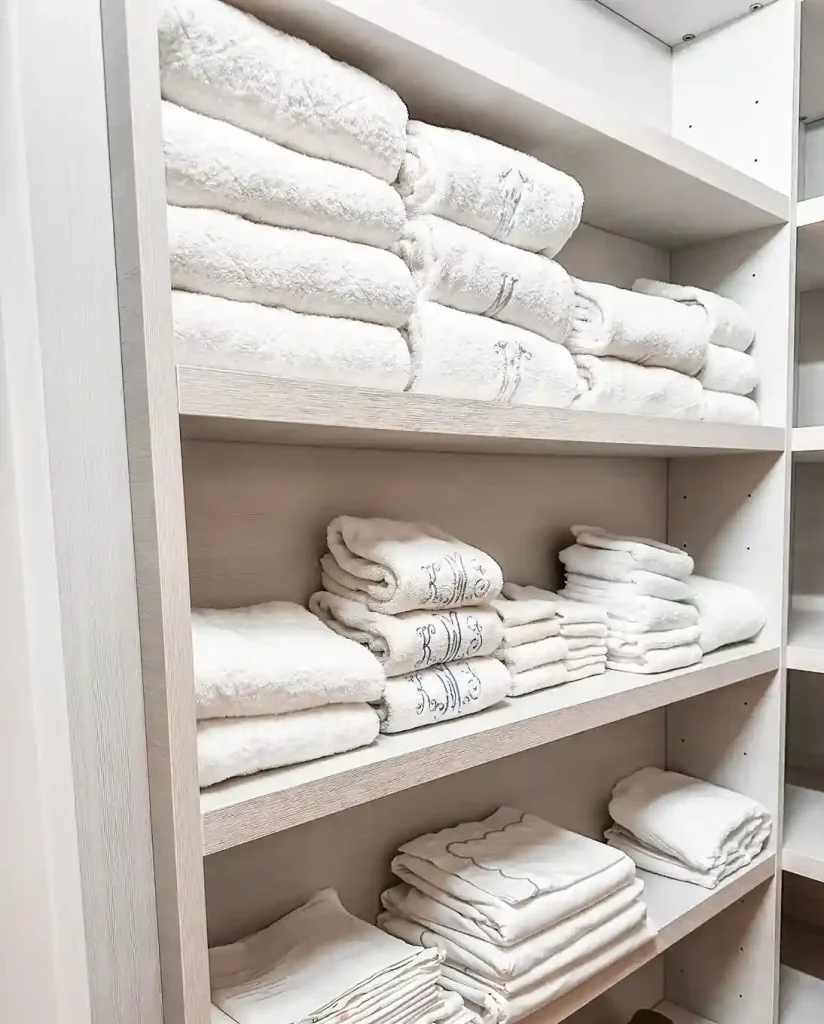
The closet above shows the technique in full display. White towels folded in identical thirds and stacked with folded edges facing forward. Rows of white sheets folded to the same dimensions below. Every item the same size and shape. Every stack aligned.
How to fold hotel style:
- Fold each towel in thirds lengthwise
- Then fold in thirds again crosswise
- The finished towel is a tight, even rectangle
- Stack with folded edges facing forward
The uniform presentation across all towels creates visual consistency. A linen closet with hotel-folded towels looks boutique-quality. The closet becomes a pleasure to open rather than a source of stress.
14. Store Extra Blankets in Vacuum Storage Bags
Extra blankets and seasonal bedding are the bulkiest items in any linen closet. They consume disproportionate shelf space. Vacuum storage bags compress bulky items to a fraction of their original volume — a king-sized duvet compresses to the size of a standard pillow.
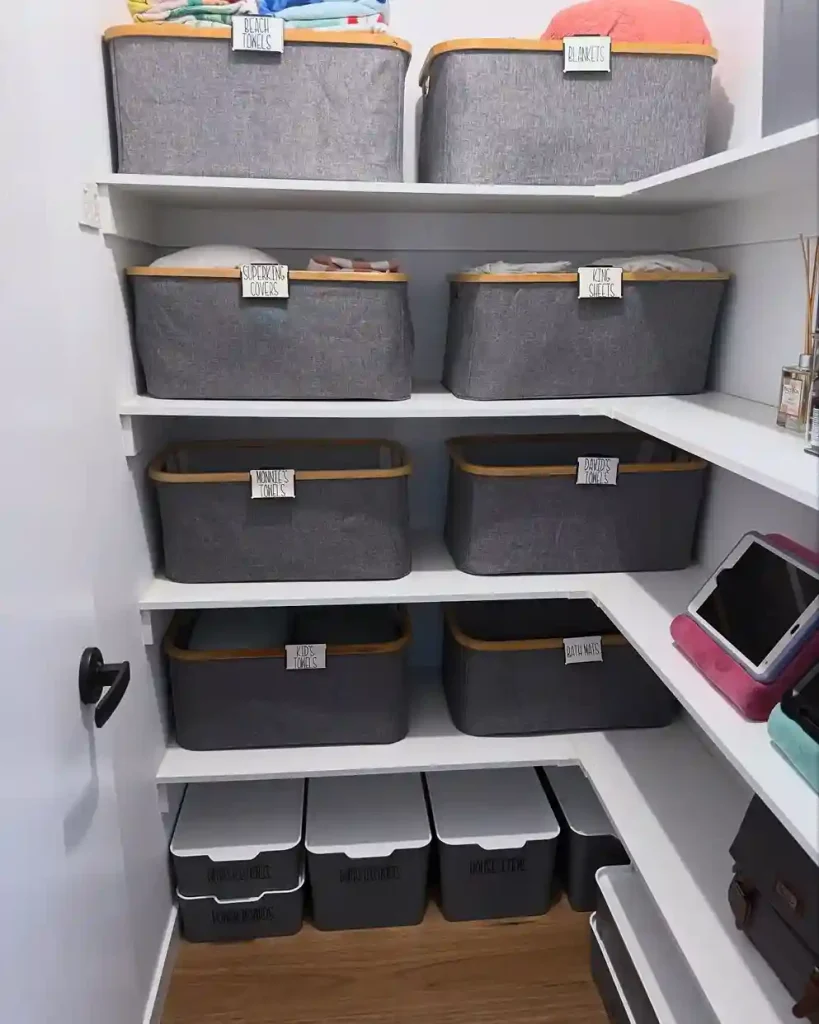
A small closet can hold a lot when every item lives in a labeled bin. This setup stacks gray fabric bins two high and two wide across three shelves, each one tagged in handwriting so anyone in the house can put things back where they belong.
The top row holds beach towels and blankets, the middle rows handle sheet sets and personal towels by name, and the bottom shelves use dark drawers for electronics and small house items. The mixed sizes keep the shelf depth working for you instead of against you.
15. Add Wire Shelf Dividers to Prevent Stack Collapse
Wire shelf dividers stand upright on a shelf and create separate compartments between stacks of towels and sheets. Each stack is contained within its divider section and cannot topple into neighboring stacks regardless of how full the shelf becomes.
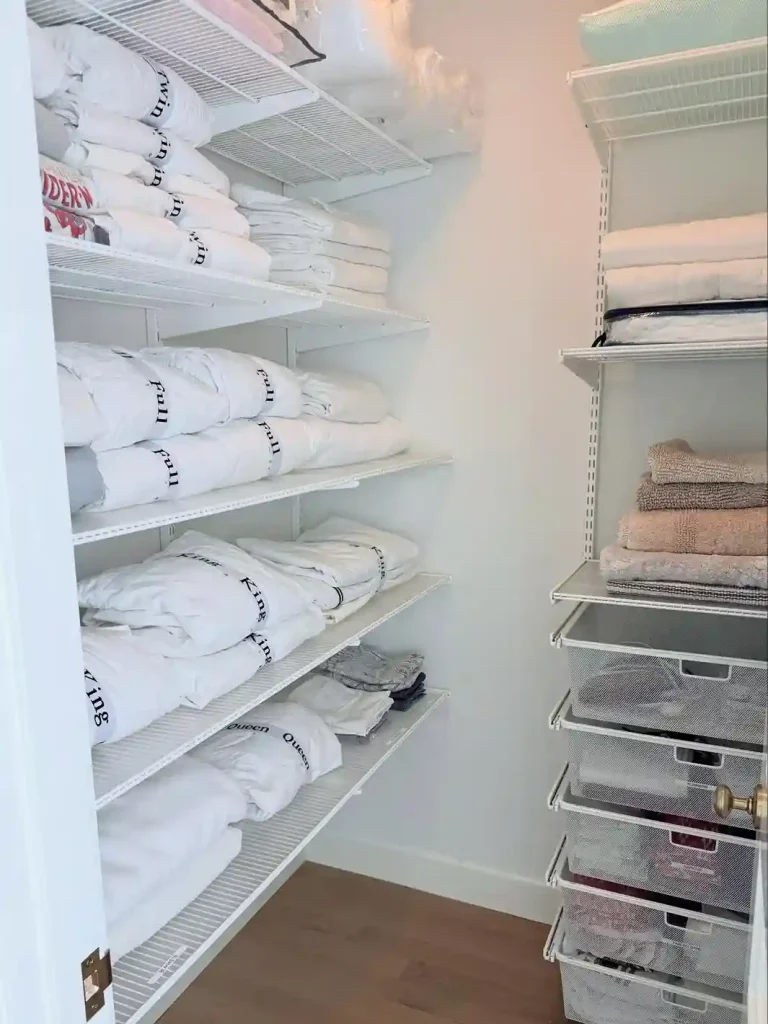
The closet above shows a well-structured wire shelving system. Folded towels on the top shelves. Rolled white towels labeled with text. Mesh pull-out drawers on the right for additional storage. Everything in its own compartment.
Shelf divider options:
- Wire clip-on dividers that attach to shelf edges
- Acrylic standing dividers that sit on the shelf surface
- Bamboo bookend dividers
- Adjustable rail dividers mounted to the shelf sides
A set of four dividers costs $10 to $20 and immediately solves the collapsing stack problem.
16. Create a Dedicated Guest Linen Section
A dedicated guest linen section ensures hospitality is effortless. Guest towels, guest bed sheets, extra pillowcases, and a spare blanket all live together in a clearly labeled guest section. Preparing the guest room takes five minutes regardless of notice.
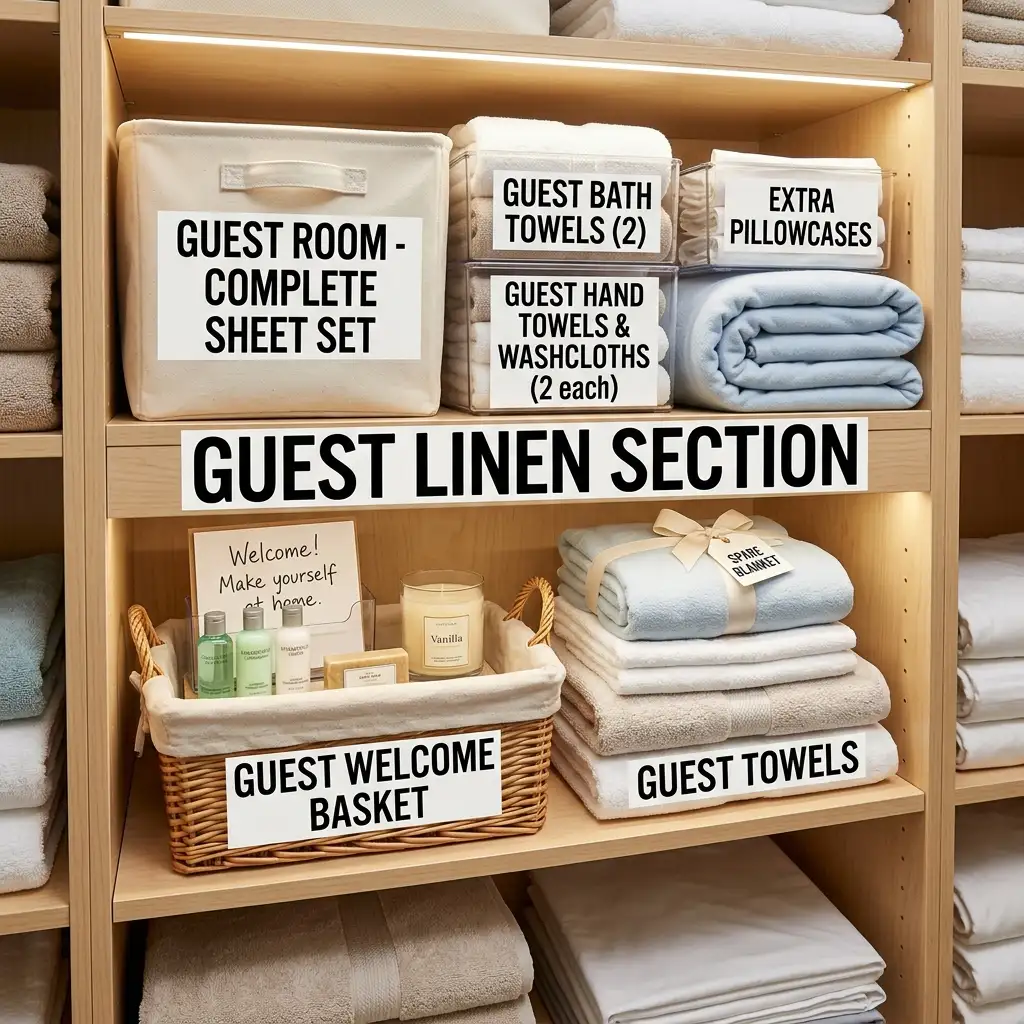
The closet above shows a complete guest section. A canvas bin labeled Guest Room Complete Sheet Set. Clear bins labeled Guest Bath Towels, Guest Hand Towels and Washcloths, and Extra Pillowcases. A wicker basket labeled Guest Welcome Basket holding toiletries, a candle, and a card. A spare blanket tied with ribbon on the right.
What belongs in a guest section:
- A complete sheet set
- Two bath towels, two hand towels, two washcloths
- A light blanket or throw
- Toiletry samples and a small candle
The guest section stays replenished after every stay. The next guest always finds everything ready.
17. Use Baskets With Handles for Easy Retrieval
Baskets with handles are significantly easier to retrieve from high shelves than baskets without handles. A single pull brings the basket forward without disturbing neighboring baskets or dislodging items from the shelf.
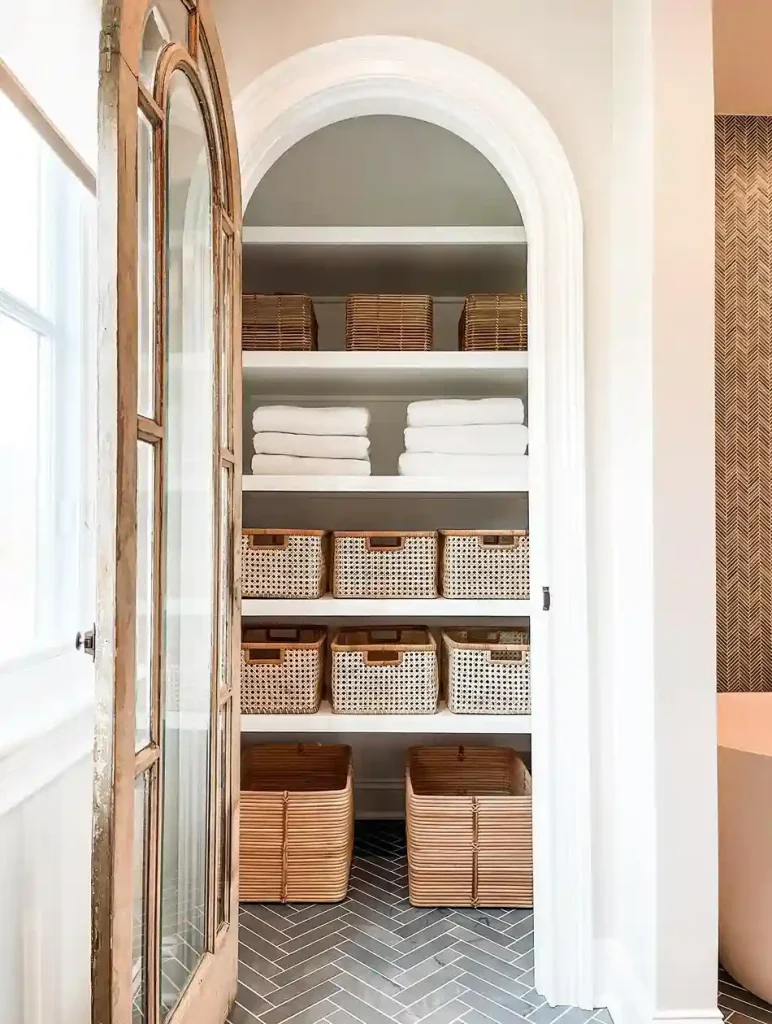
The closet above uses this principle throughout. Stacked white towels on the top shelves. Woven baskets with sturdy handles on the lower shelves. The handles make retrieval easy even for the lowest shelves where reaching is simple.
Handle style options:
- Leather handles age beautifully over time
- Cotton rope handles suit a natural, casual aesthetic
- Metal handles suit a more polished, modern style
- Folding side handles let baskets sit flush against neighbors
Position handled baskets on the shelves you access most frequently. The most-used items benefit most from easy retrieval.
18. Store Tablecloths and Placemats Together
Tablecloths and placemats are notoriously difficult to store well. Folded tablecloths crease badly on shelves. Hanging them creates storage challenges in a standard closet. Rolled storage reduces creasing while remaining accessible.
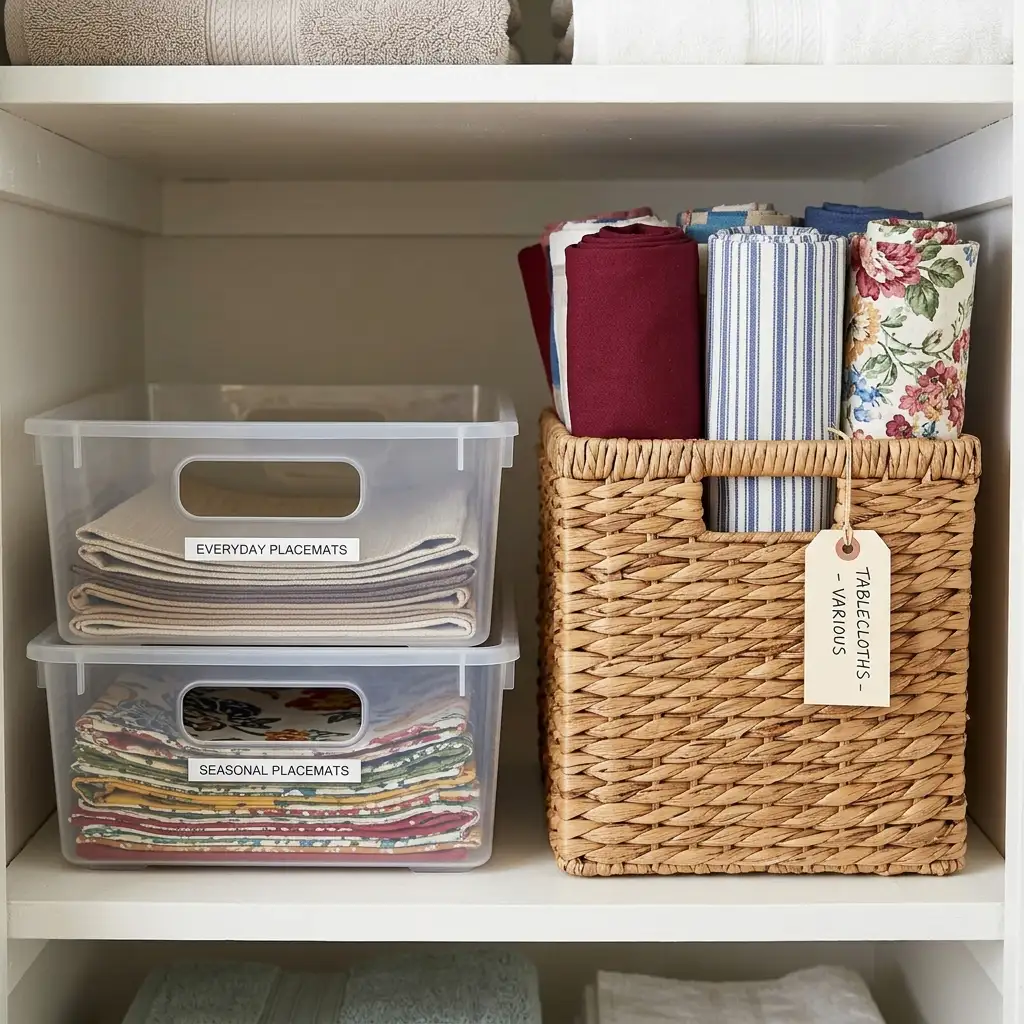
The shelf above shows the right approach. Two clear bins labeled Everyday Placemats and Seasonal Placemats hold folded placemats flat. A wicker basket on the right holds rolled tablecloths standing upright with a tag reading “Tablecloths – Various.”
Why rolling works:
- No creases that require ironing before use
- Identification visible from above
- Rolled tablecloths take less shelf space than flat-folded
- Consistent presentation looks deliberate
Store the tablecloth basket and placemat bins beside each other for a complete table setting zone.
19. Organize Cleaning Supplies Within the Linen Closet
Many linen closets also store cleaning supplies — extra toilet paper, paper towels, cleaning cloths, and spare cleaning products. These items need their own dedicated section to prevent them from encroaching on linen storage space.
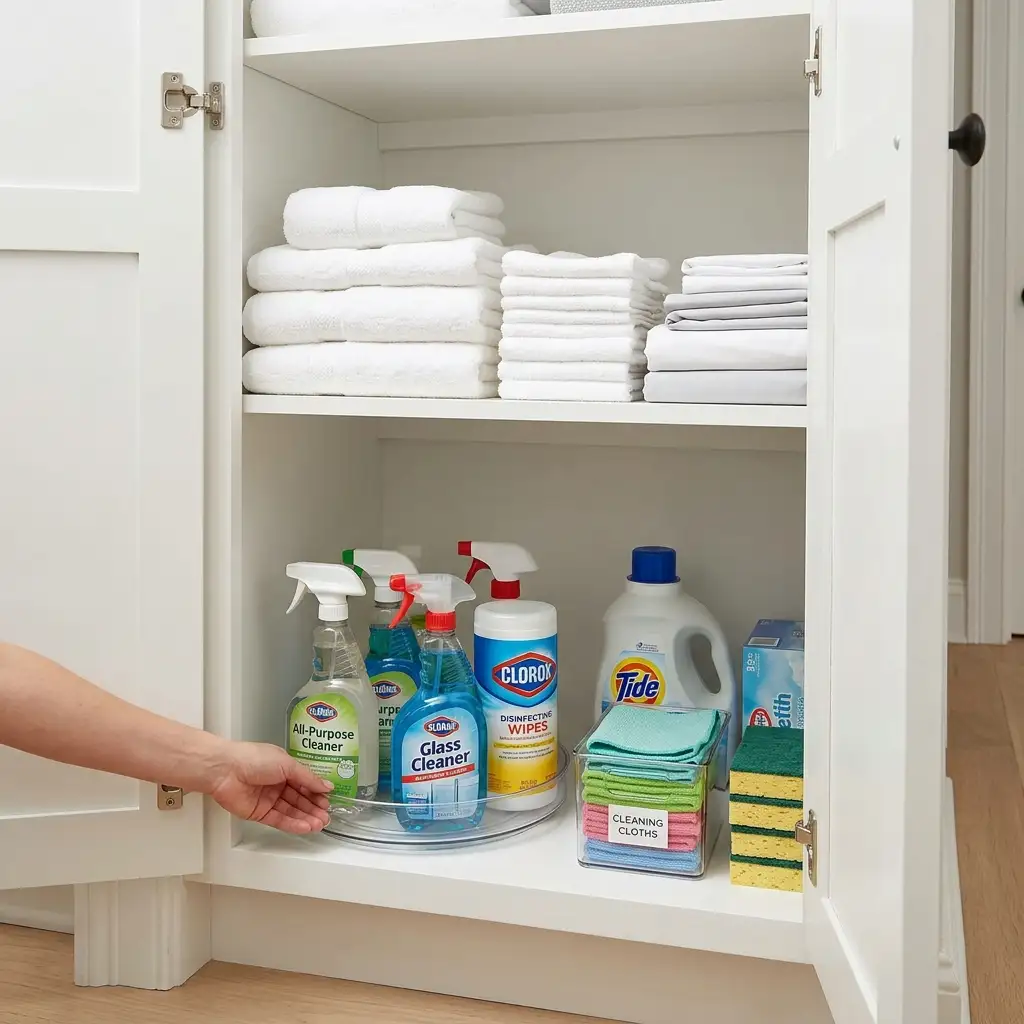
Assign the lowest shelf to cleaning supplies. It is the least convenient shelf for retrieving soft linens but perfectly positioned for heavier cleaning product bottles. A turntable (lazy Susan) on the cleaning supply shelf allows access to items at the back without reaching or removing everything in front.
For complete laundry room and cleaning supply organization ideas that connect naturally to a well-organized linen closet cleaning section, explore these laundry room ideas for organization systems that keep cleaning supplies tidy, accessible, and separate from the linens stored alongside them.
20. Keep a Donation Bag Hanging Inside the Closet
A small cloth bag hanging from a hook inside the linen closet door collects items for donation on an ongoing basis. When a towel becomes too worn to use, it goes directly into the donation bag rather than back onto the shelf. The closet never accumulates items that should have left months ago.

When the bag fills, it goes to a charity shop immediately. No sorting session required. No decluttering day needed. The ongoing donation bag prevents the gradual accumulation of unusable items that causes most linen closets to fill beyond their useful capacity.
This same principle applies throughout the home. A donation bag in every closet creates a continuous, low-effort declutter habit that keeps every storage space operating at its optimal capacity without requiring periodic major declutter sessions.
21. Install Better Lighting Inside the Closet
A dark linen closet is an unusable linen closet in practice. If you cannot see clearly what is on each shelf, you cannot find what you need. Poor lighting forces you to pull multiple items out before finding the right one.
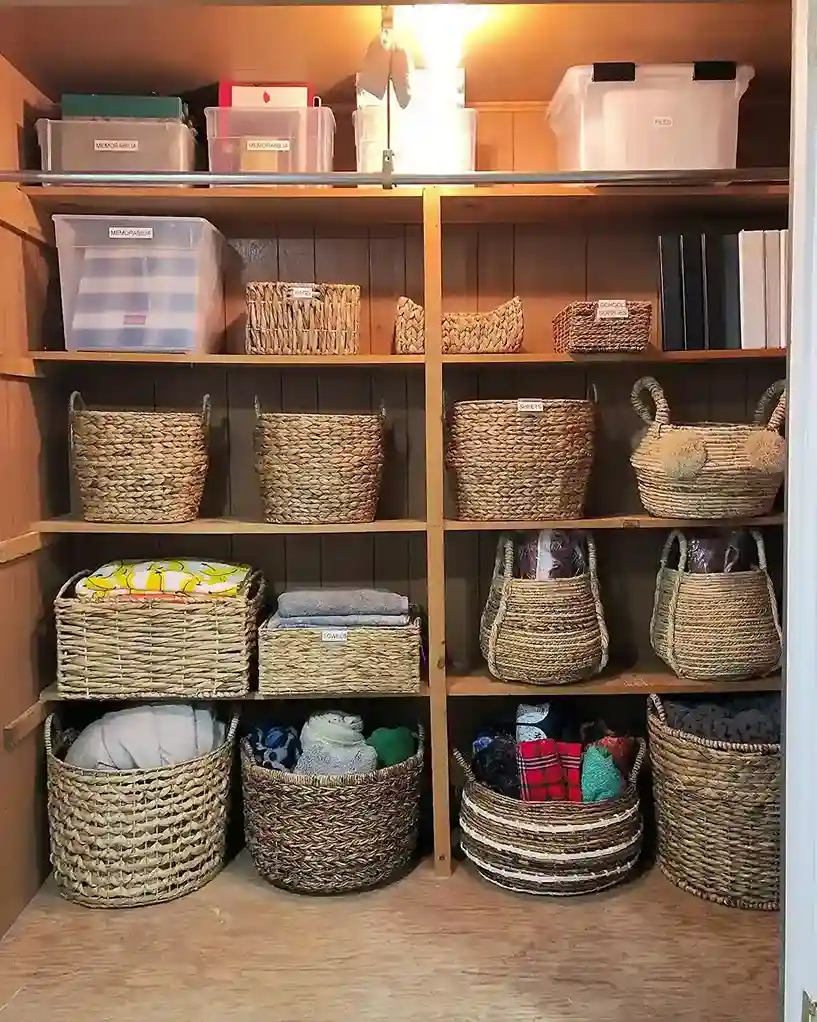
The closet above uses wicker baskets in every size. Larger baskets hold folded towels and sheets. Smaller baskets hold bags and school supplies. Clear plastic bins on the top shelf hold memorabilia and files. The mix works because the wicker dominates the visible shelves.
Why wicker works well:
- Air circulation prevents mustiness in stored linens
- The natural tone warms up an all-white closet
- The texture reads as organized in a way plastic does not
- Baskets are easier to pull forward than deep shelf stacks
Choose a consistent basket style. Mixed wicker looks collected. Uniform wicker looks designed.
22. Decant Toiletry Overstock Into Clear Bins
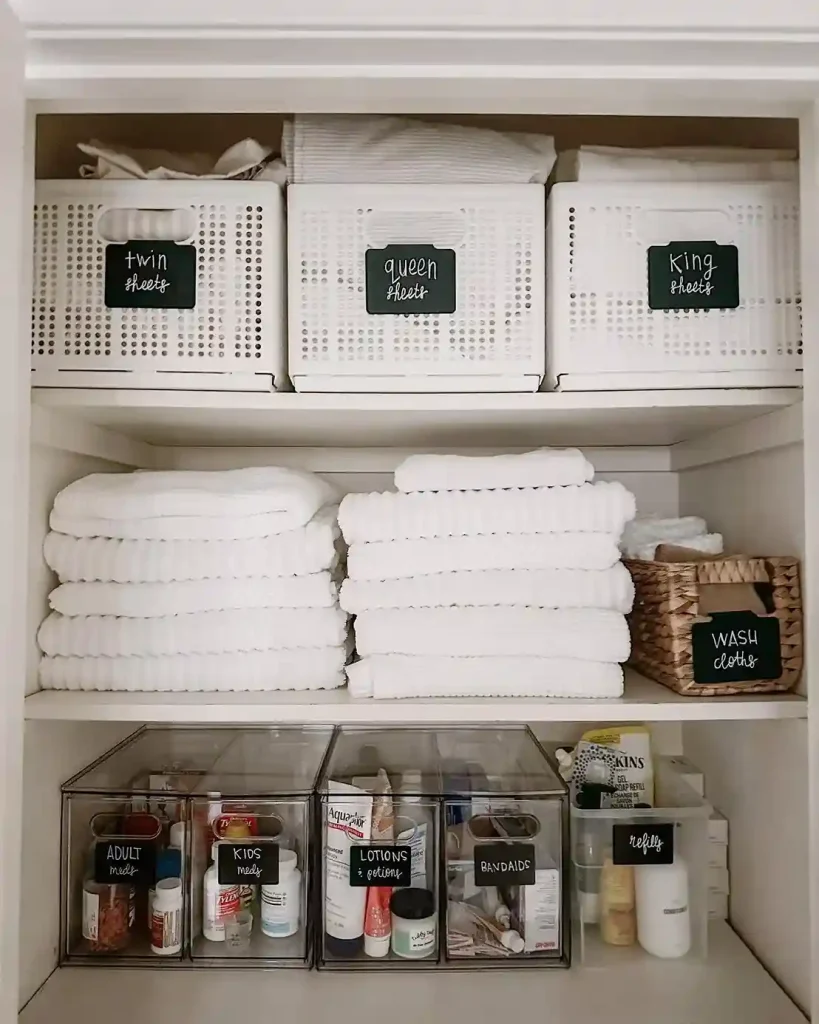
Toiletry overstock belongs in the linen closet but rarely stores well there. Individual product bottles in random sizes create visual chaos on any shelf.
The closet above handles it cleanly. White perforated bins hold sheet sets labeled by bed size. Folded towels and hand towels stack below. Clear acrylic bins on the bottom shelf hold medications, lotions, bandaids, and refills. Each bin has a chalkboard label on the front.
How to organize toiletry overstock:
- Decant into a dedicated clear bin labeled by category
- Organize by product type within the bin
- Group adult and kids medications separately
- Keep refills in their own labeled bin
The clear bin allows visual stock monitoring without opening it. A quick glance confirms whether more shampoo needs purchasing. This prevents duplicate purchases and ensures nothing runs out unexpectedly.
23. Use a Slim Rolling Cart for Narrow Linen Closets
A narrow linen closet — less than 18 inches deep — suits a slim rolling cart more than standard bins. A rolling cart with multiple tiers fits in narrow spaces and pulls out to provide access to items on every tier simultaneously.
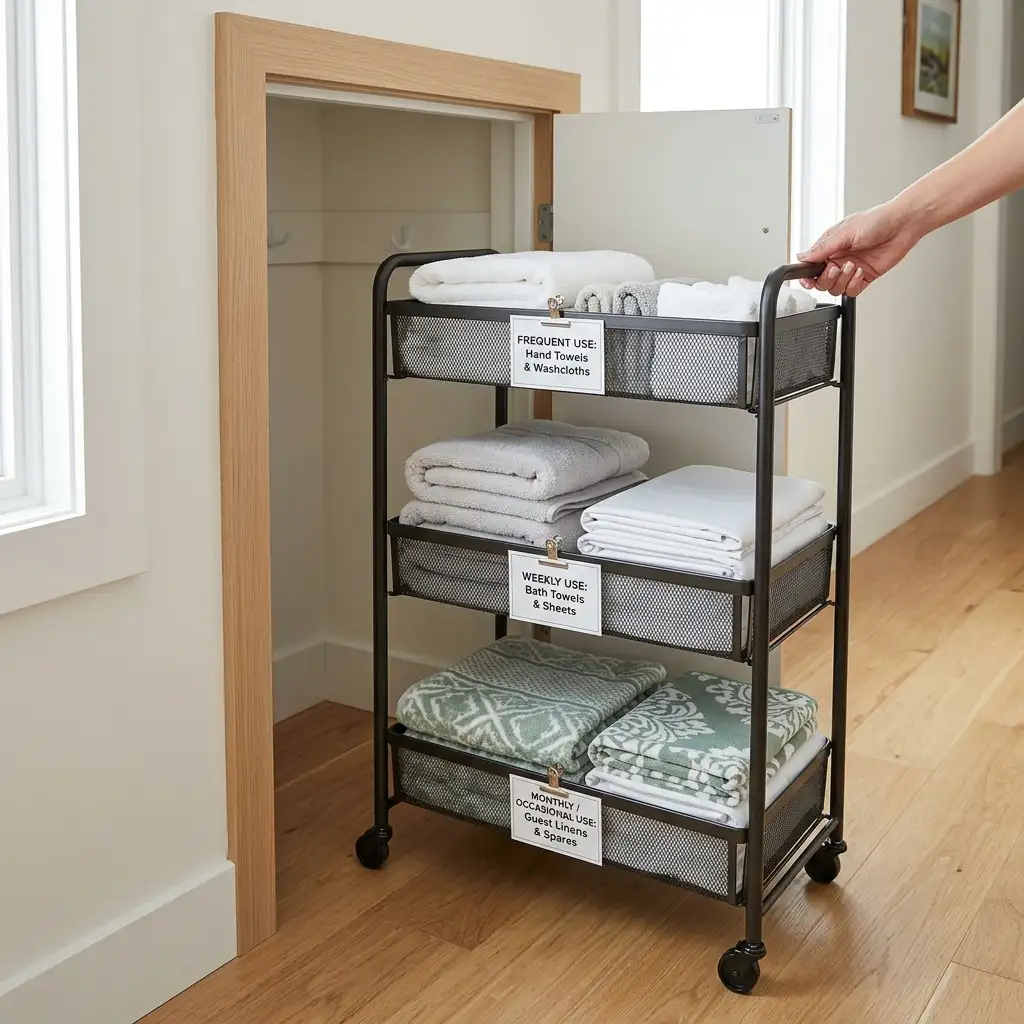
IKEA RÅSKOG carts in the narrower dimensions fit inside closets as shallow as 16 inches while providing three full tiers of storage. The cart wheels forward for access and pushes back into the closet when not in use. This approach works even in broom-closet-depth spaces that standard bins cannot suit.
Label each tier clearly. Top tier for most frequently needed items. Middle tier for weekly-use items. Bottom tier for monthly or occasional items. The rolling cart becomes a fully functional mobile linen storage unit that brings everything to you rather than requiring you to reach into a narrow space.
24. Create a Beautiful Display in a Open Linen Closet
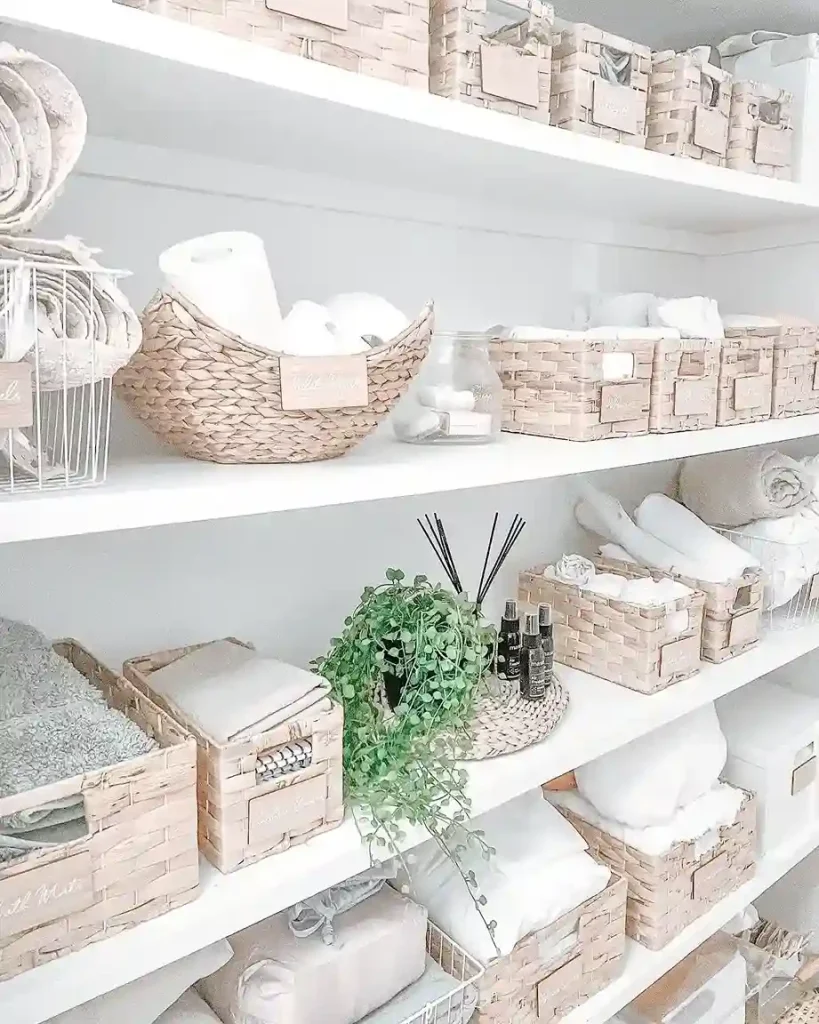
An open linen closet, one without a door, must look beautiful at all times because it is always visible. Every folded item, every bin, and every basket becomes a design element in the room.
The closet above shows what this looks like. Woven baskets with wooden labels on every shelf. Toilet paper, bath mats, guest towels, hand towels, bath towels, cushion covers. A eucalyptus plant trailing down the middle shelf. Small bottles of essential oils and diffusers on a tray. Everything is beautiful and everything is useful.
What makes an open linen closet work:
- Consistent basket style and label format
- Linen colors that coordinate across the closet
- One or two decorative elements like a plant or candle
- Even spacing between baskets
- Nothing that would look out of place in a styled room
The color cohesion of the linens themselves creates the visual appeal of the display.
25. Maintain the System With a Post-Laundry Routine
The linen closet organization system succeeds or fails based on the post-laundry routine. Sheets and towels returned to the wrong location after washing slowly destroy any organization system regardless of how well it was initially designed.
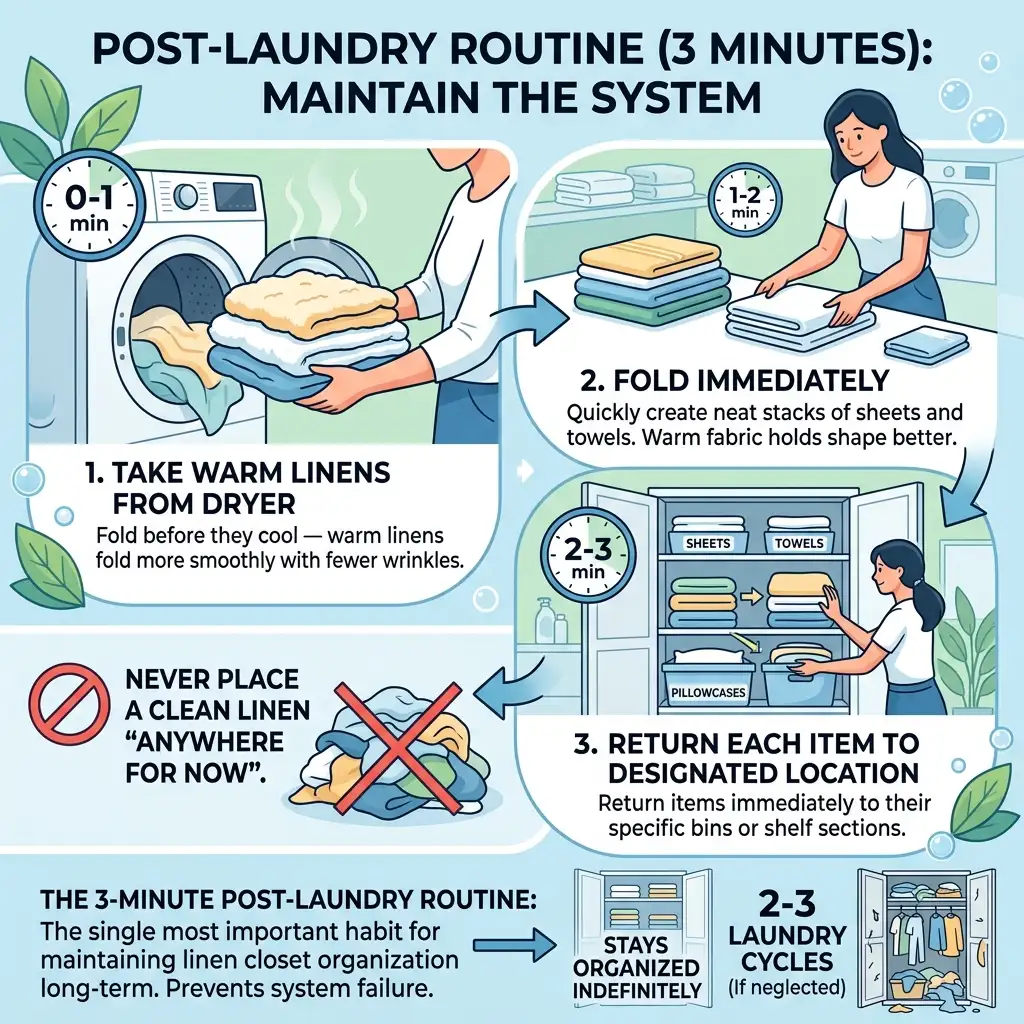
Create a post-laundry routine that takes three minutes. Fold linens before they cool from the dryer — warm linens fold more smoothly with fewer wrinkles. Return each item immediately to its designated bin or shelf section. Never place a clean linen “anywhere for now.”
The three-minute post-laundry routine is the single most important habit for maintaining linen closet organization long-term. A system maintained consistently after every wash cycle stays organized indefinitely. A system that is tidy once and then neglected returns to chaos within two to three laundry cycles.
26. Refresh the Closet With Drawer Liners and Sachets
Drawer liners on linen closet shelves add a finishing touch that makes the closet smell fresh and look beautiful. Lightly scented drawer liners — lavender, cedar, or fresh linen fragrance — keep stored items smelling clean between uses.
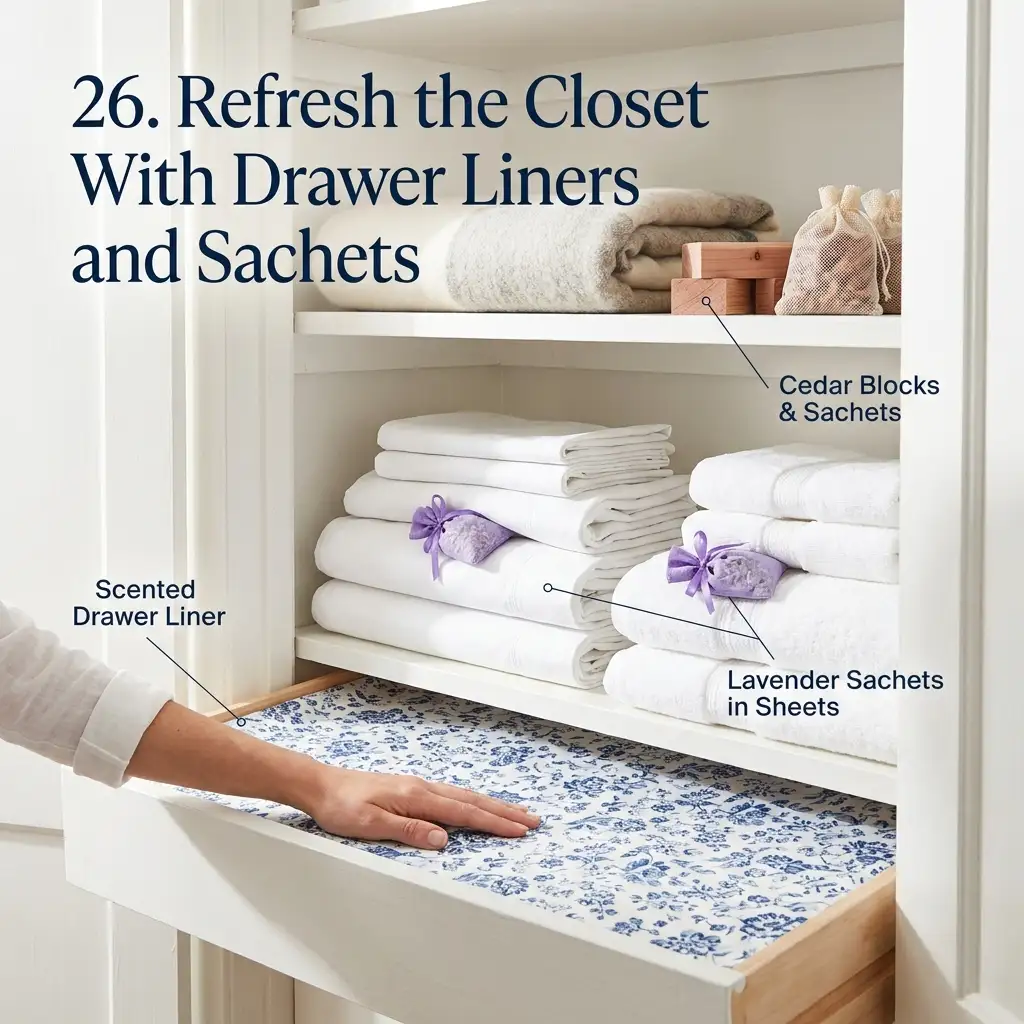
Cedar sachets or cedar blocks placed on shelves naturally repel moths without any chemicals. This is particularly important for closets storing wool blankets and quality textiles. Replace cedar sachets annually to maintain their effectiveness.
Small lavender sachets placed between folded sheet sets add fragrance to the bedding and make the act of making a bed genuinely pleasant. The subtle lavender scent that transfers to clean sheets creates a spa-like sleeping experience. A linen closet that smells beautiful is a linen closet that gets maintained carefully.
27. Review and Reset the System Every Six Months
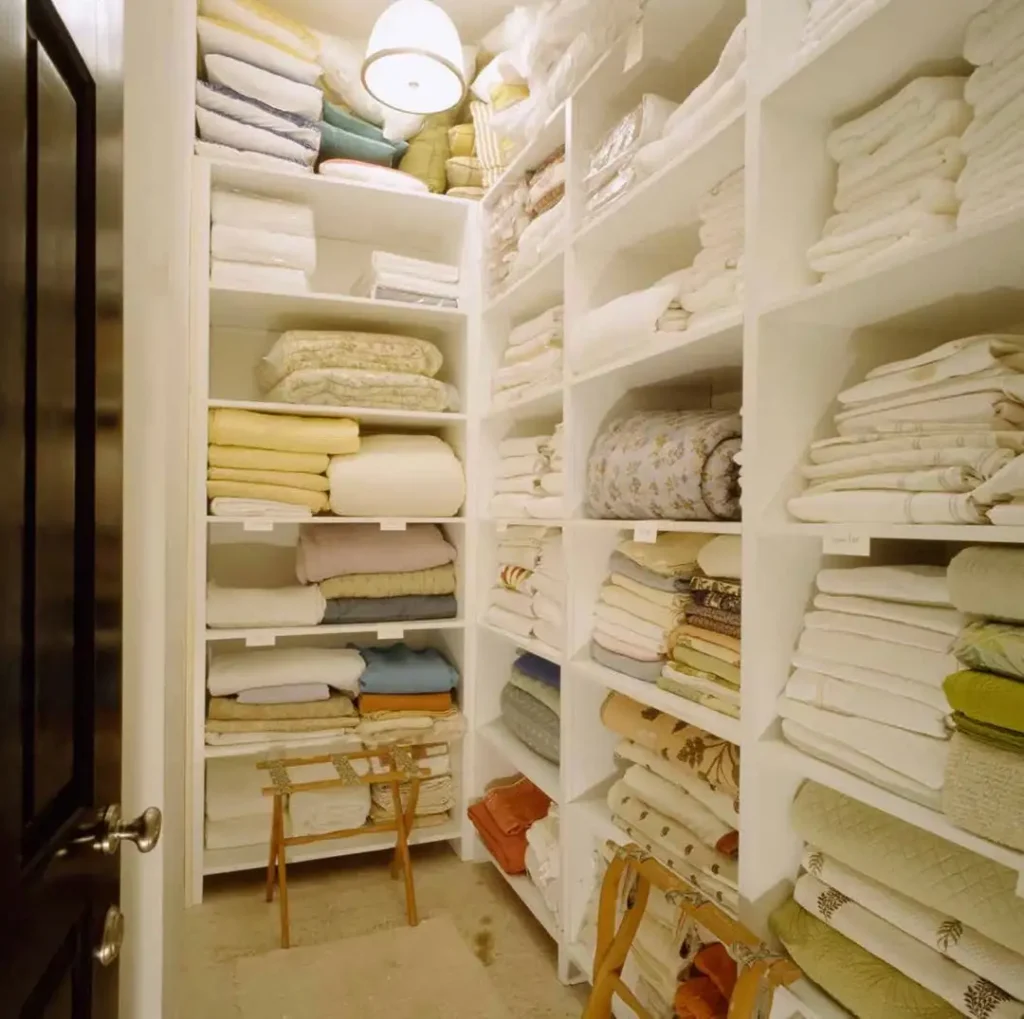
A linen closet organization system requires a full review every six months to stay genuinely effective. Household needs change. Linen quantities change. New items enter the closet and old items should leave. A six-month review catches these changes before they undermine the system.
The closet above is a full walk-in linen storage room. Floor-to-ceiling white shelving with folded linens organized by color and size. Wooden folding racks stored on the floor. A pendant light providing clear visibility. Everything labeled and organized for easy access.
Six-month review tasks:
- Empty and evaluate all items
- Discard worn or unused linens
- Adjust shelf positions if needed
- Clean all shelf surfaces
- Replace sachets and liners
- Restock and reorganize
Schedule the review at the change of seasons, once in spring and once in autumn. Each review takes 30 to 60 minutes. The biannual review is the maintenance investment that makes the system last for years.
Frequently Asked Questions (FAQs)
Q1: How many sets of sheets do I actually need?
Two complete sets per bed is the ideal number for most households. One set is on the bed and one set is clean and ready in the linen closet. A third set suits households that prefer to wash and replace sheets on the same day without waiting for the first set to dry. More than three sets per bed adds storage burden without meaningful benefit.
Q2: What is the best way to fold a fitted sheet?
The burrito method is the most practical approach. Fold the sheet in thirds lengthwise, then roll it tightly from one end into a compact cylinder. The cylinder stores upright in a bin without unrolling. Alternatively, tuck the entire sheet set inside one pillowcase for a complete bundle system.
Q3: How do I prevent towels from smelling musty in the linen closet?
Ensure towels are completely dry before folding and storing. Even slightly damp towels develop mildew smell within days. Add cedar sachets or activated charcoal blocks to absorb moisture. Leave a small gap between stacked towels for air circulation. A lavender sachet between folded towels adds fresh fragrance.
Q4: How do I organize a linen closet that is shared with cleaning supplies?
Assign entirely separate shelf sections to linens and cleaning supplies. Never mix categories. Position cleaning supplies on the lowest shelf since they are typically heavier and less frequently needed. Use clearly labeled bins for each category so every household member can return items to the correct section.
Q5: How do I keep my linen closet organized when I have a large family?
Color-code towels per family member and per bathroom. Each person has a designated color and returns their towels to the correct labeled section after laundry. Sort bed sheets by room rather than by size. Use clearly labeled bins for every category. Implement a post-laundry routine that returns every item to its designated home immediately.
Conclusion
A beautifully organized linen closet is one of the most quietly impactful improvements you can make to your home. It saves time on laundry day. It makes bedmaking effortless. It eliminates the low-level daily stress of a closet that does not work. And every time you open it, it looks genuinely beautiful.
Start with the emptying and the audit. Edit ruthlessly. Measure carefully. Choose uniform bins and label everything clearly. Then maintain the system with a three-minute post-laundry routine.
The linen closet you create through these 27 steps becomes one of the most functional and most satisfying spaces in your entire home.