
By Ambar Mitchell · Updated July 2026 · 21 min read
A porch swing bed isn’t just furniture. It’s an invitation—to slow down, to linger, to turn your porch into the most-used room in the house.
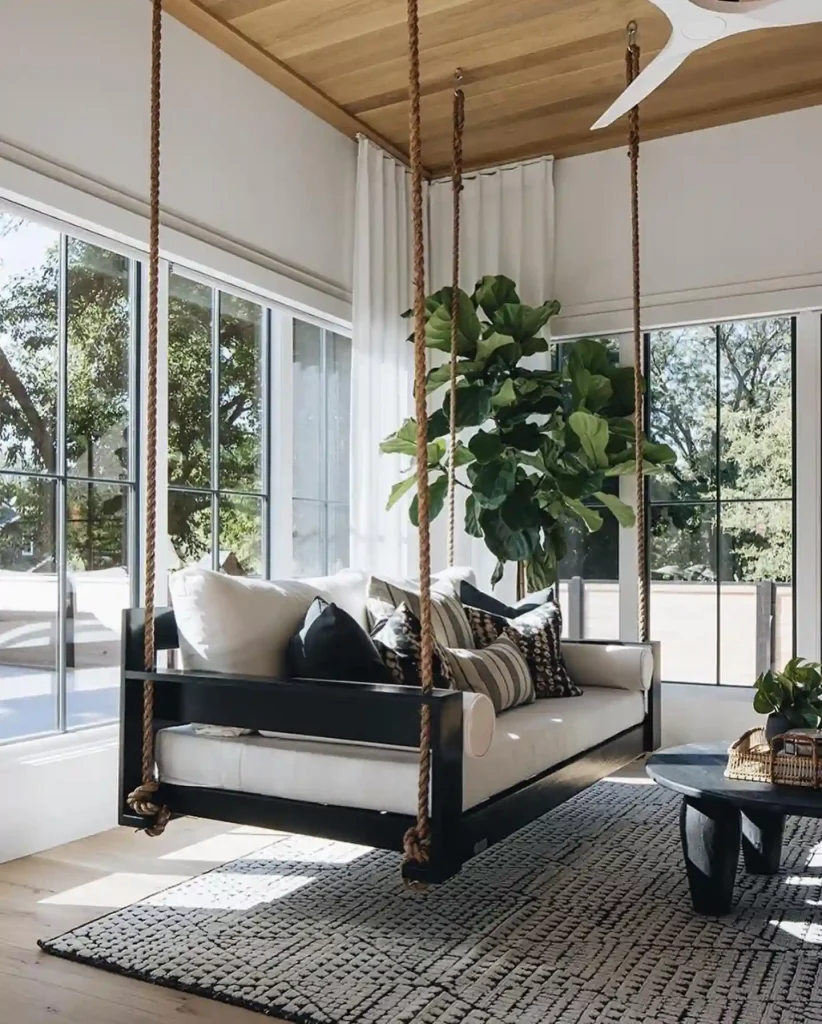
Credits: @amystormandco
Unlike a standard bench or rocking chair, it offers something closer to a floating daybed: deep cushions, gentle sway, and enough space to stretch out with a book, a nap, or a quiet conversation. It changes how you use your outdoor space, not by adding more seating, but by creating a destination you actually want to be in.
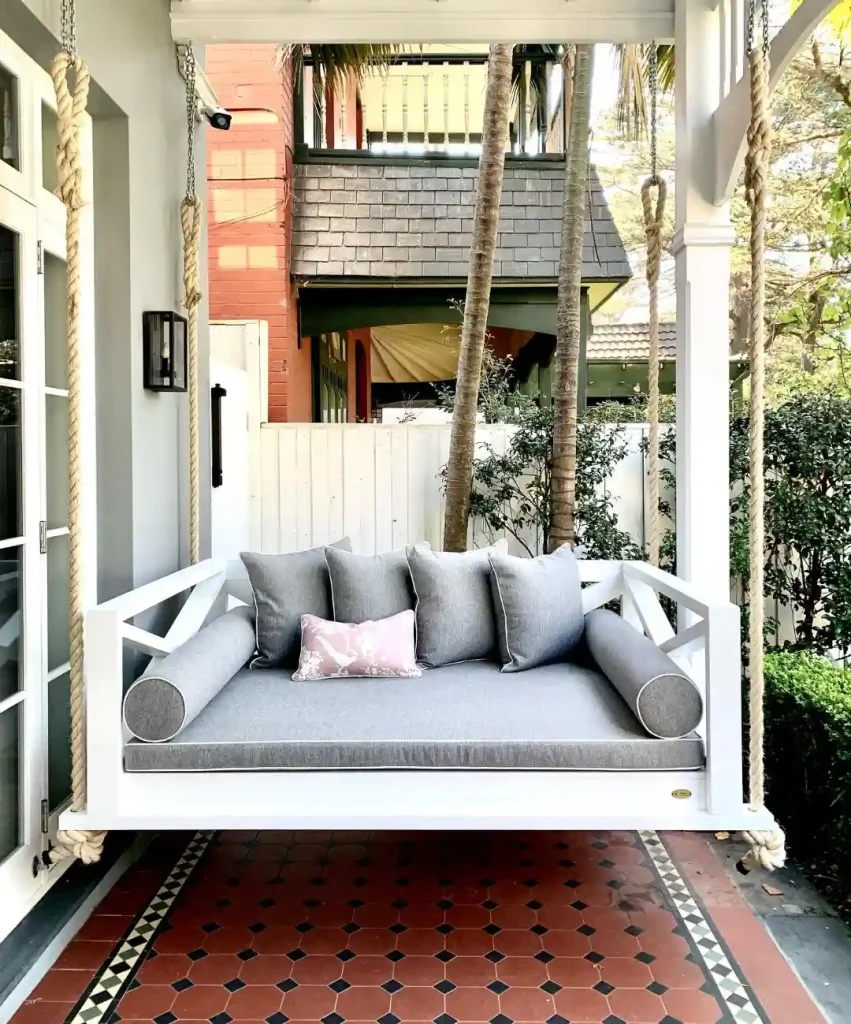
Credits: @cartia_collective
This guide covers everything you need to know—from design styles and sizing to hanging safety and styling tips. Whether you’re buying ready-made or building your own, you’ll find practical advice to help you choose the right swing bed for your space and avoid the common mistakes that turn a dream into a headache.
What Exactly Is a Porch Swing Bed?
A porch swing bed — also called a hanging daybed, swing daybed, or bed swing — is a suspended outdoor lounging platform, larger than a traditional porch swing but hung the same way: from ceiling joists or an overhead structure using chains, ropes, or purpose-built hardware.
Where a traditional porch swing is a bench-style seat, a porch swing bed is wide enough to lie down on. Most are designed to fit a twin, full, or queen-size mattress or thick cushion, and most are built from wood — cedar, teak, pine, or acacia — with a slatted or solid platform base.
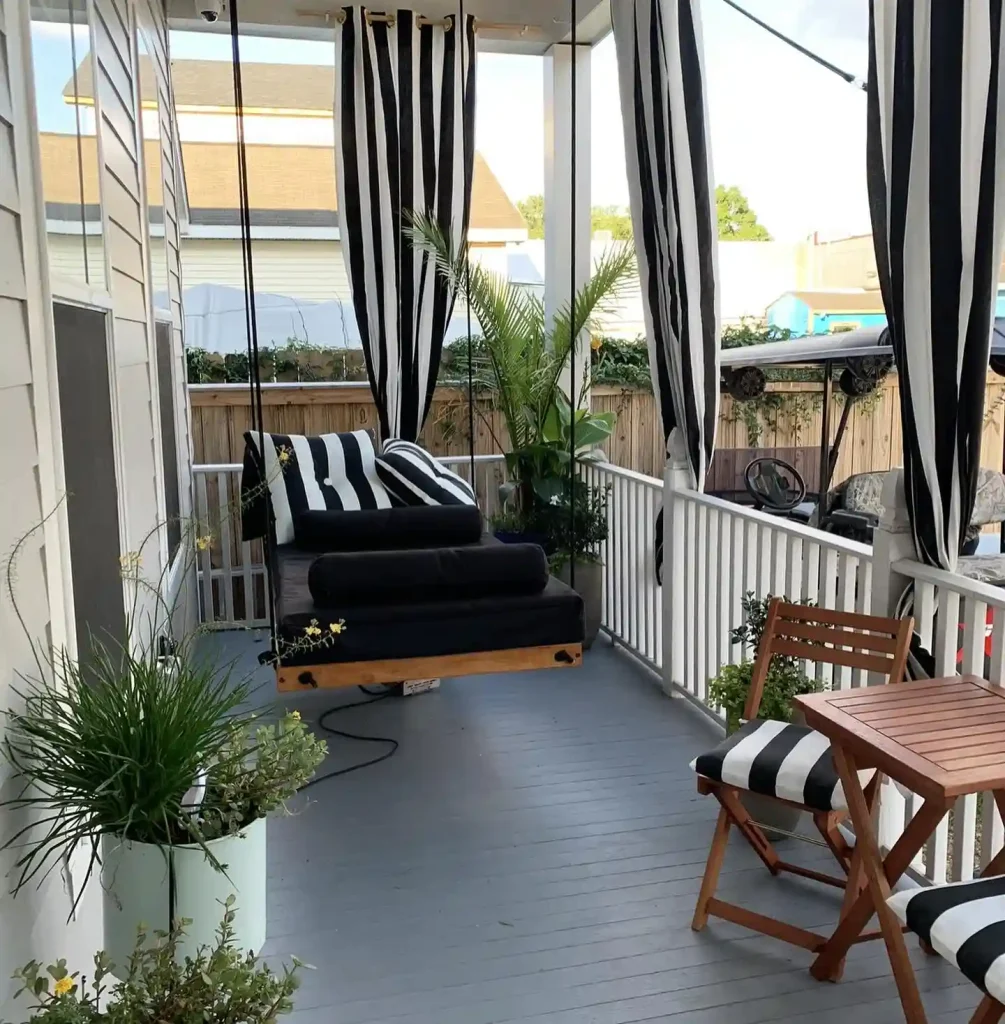
Credits: @krewebrand
The result is something that functions like an outdoor bed, a daybed, a sofa, and a swing all at once. Which is exactly why people who have them tend to use their porch more than any other space in the house.
They range from simple DIY weekend projects using $40 worth of lumber to handcrafted teak frames that run $2,000 to $6,000 or more. I’ll cover the full range throughout this guide.
Part 1: Swing Bed Ideas by Style
1. Classic White Farmhouse Swing Bed
The most iconic look: a white-painted wood frame, cream or ticking-stripe cushions, layered throw pillows in cream and soft gray, a chunky knit throw folded at the foot, hung with white or natural rope from a painted porch ceiling.
This is the porch swing bed you’ve seen on Pinterest approximately ten thousand times, and it’s popular for a reason. It’s genuinely beautiful, it photographs well, and it works with virtually any house exterior — white siding, brick, stone, or painted wood.
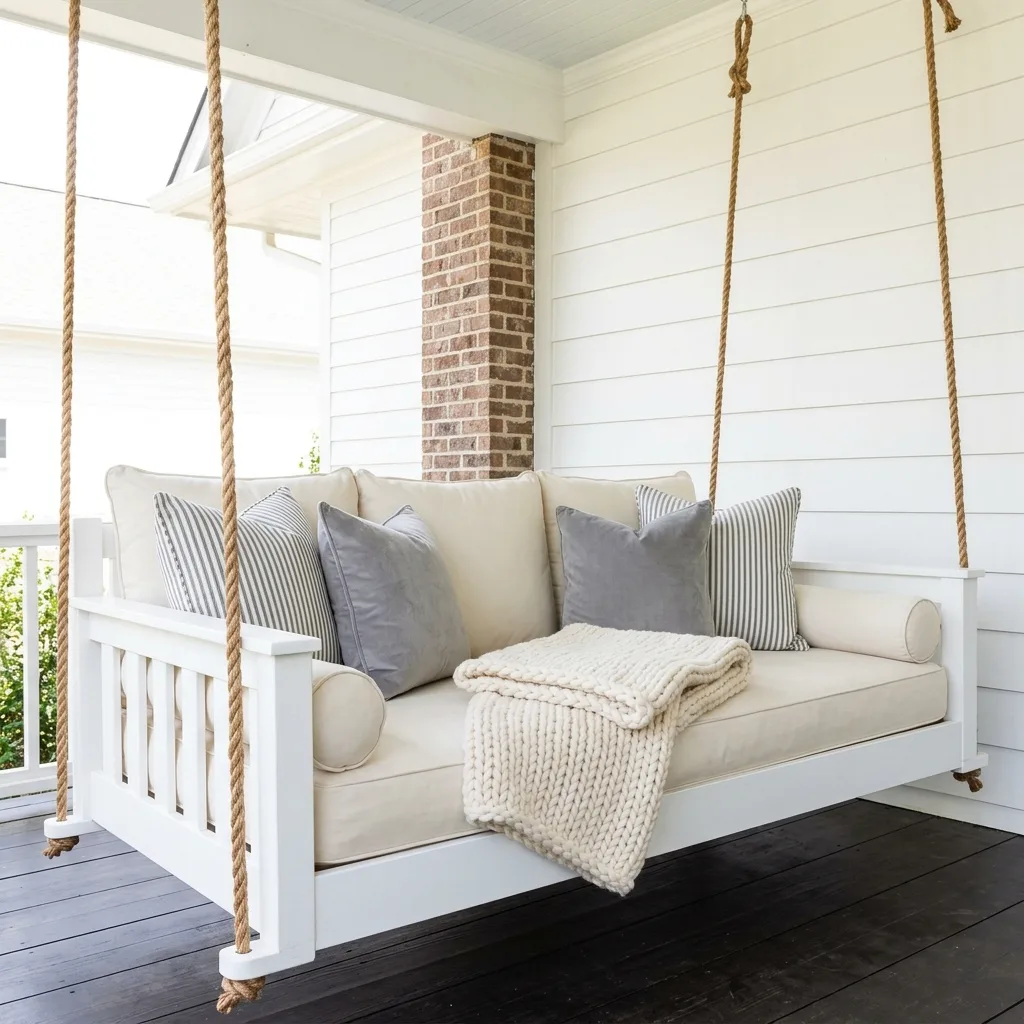
The secret to making it feel considered rather than copied is texture. Use linen for the main cushion cover, cotton for the throw pillows, and a chunky woven throw — the variation in fabric weight and weave is what stops all-white from looking flat.
What to add around it: A white ceiling fan overhead (both functional and visual), two hanging Boston ferns on either side, a small teak or wicker side table for drinks, and lantern-style pendant lights along the porch ceiling.
Best for: Traditional, farmhouse, or cottage-style homes. Front porches with white or neutral exteriors.
2. Natural Cedar with Rope Suspension
A cedar frame left in its natural color — or treated with a clear weatherproof sealant — hung with thick Manila or sisal rope from ceiling hooks. No paint, no stain beyond protection. Just the warm honey color of natural wood and the organic texture of natural fiber rope.
This is my personal favorite version because it ages so well. Cedar weathers to a soft silver-gray over time; natural rope develops its own character. The combination reads as both rustic and sophisticated — simple enough to work in almost any outdoor setting, distinctive enough to feel like a real design choice.
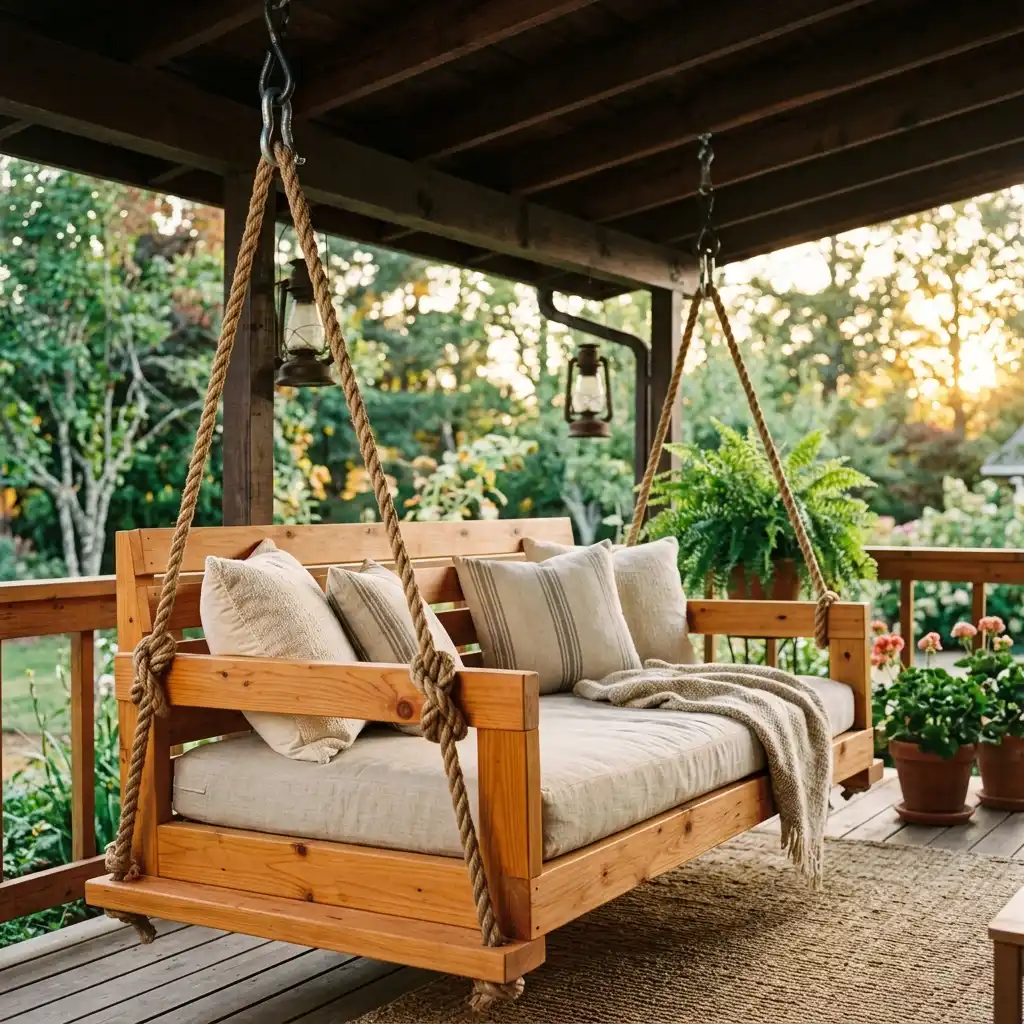
The cushion choice matters more here than in any other version. Natural linen in cream or warm white is the right call. Avoid bright white — it shows dirt quickly on an outdoor piece — and avoid anything with a busy pattern, which fights the natural texture of the wood and rope.
What to add: A linen throw, a woven basket or rattan side table, Edison bulb string lights overhead. Keep it simple — the materials do the work.
Best for: Craftsman, cottage, coastal, and contemporary farmhouse homes. Covered front or back porches.
3. Boho Rope Swing Bed
The bohemian version replaces clean cedar frames with macramé-wrapped details, fringe cushion edges, layered textile throws in warm earthy tones — terracotta, rust, mustard — woven wall hangings mounted to the adjacent house wall, and hanging lanterns or string lights strung above.
The key to pulling off boho without it looking chaotic is a disciplined color palette. Choose two or three colors and repeat them through every textile. Terracotta, cream, and olive. Dusty rose, warm sand, and sage. When the cushions, throw, and small rug all speak the same color language, layering feels collected rather than cluttered.
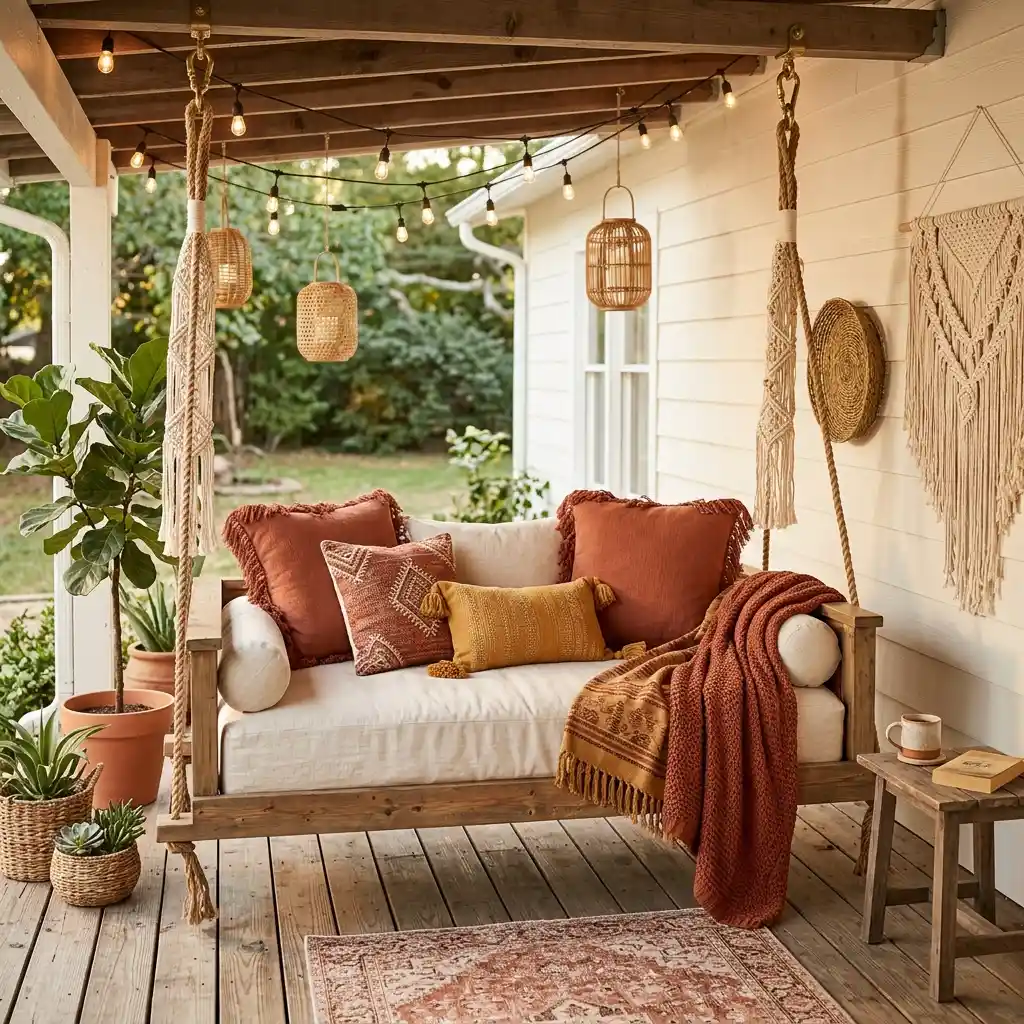
One thing I’ve noticed: the boho swing bed looks best when there’s at least one plant nearby. A trailing pothos in a hanging macramé planter, or a large rattan basket with a tall dried pampas grass arrangement. The organic texture of living or dried plants completes the look in a way that more furniture never quite does.
What to add: A macramé wall hanging on the porch wall behind the swing, a rattan pendant light or hanging lantern, a woven outdoor rug underneath.
Best for: Bungalows, craftsman homes, and any porch with eclectic or globally-influenced outdoor furniture already in place.
4. Coastal and Beach House Swing Bed
Navy and white stripe cushions, natural rope hanging, a weathered or driftwood-tone frame, pale blue or seafoam throw pillows, a string of warm lights overhead, hanging ferns on either side. You know this look. It works because it’s borrowed from a genuinely relaxing environment — the covered porch of a house near the water — and it imports that feeling wherever you put it.

For a coastal swing bed that doesn’t tip into nautical cliché, keep the stripe as your only strongly patterned piece and use solid neutrals for everything else. Too many patterns in the navy and white palette looks like a ship’s cabin. One strong stripe with solid cream and natural wood looks like an actual beach house.
The material choice matters for coastal aesthetics too. POLYWOOD in driftwood or gray tones, weathered cedar, or a combination of natural rope and acacia wood all read as genuinely coastal. Painted white pine reads as farmhouse even with coastal cushions.
What to add: A weathered gray or driftwood side table, a wicker basket for extra throws, a sea-blue planter with a trailing plant on each end of the porch.
Best for: Coastal homes, lake houses, and any porch that faces water or an open landscape view.
5. Modern Farmhouse Swing Bed
Black metal hardware, a dark walnut or ebony-stained wood frame, crisp white or warm cream cushions, minimal throw pillows with no fringe or fussiness, clean lines throughout. This is the sophisticated, design-forward version of farmhouse that’s everywhere in 2026.
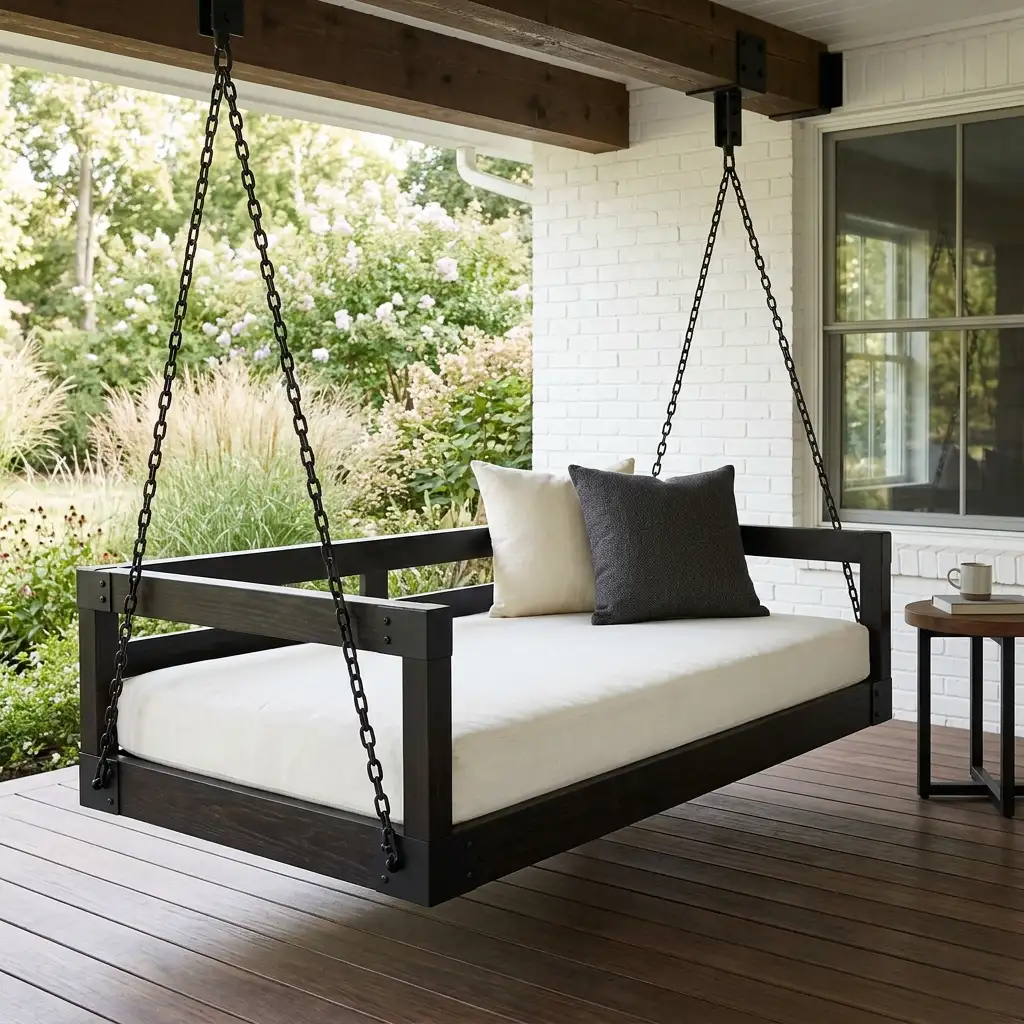
The key distinction from classic farmhouse is restraint. Modern farmhouse swing beds use one or two decorative pillows maximum, solid or very subtly textured cushion fabrics only, and black metal chains rather than rope for suspension. The hardware is visible and intentional — not hidden.
If you already have black window frames, black door hardware, or dark exterior accents on your home, this version of the swing bed ties in naturally.
What to add: Black metal lanterns, a geometric-pattern outdoor rug underneath, simple architectural plants (snake plant or ZZ plant) in matte black planters, warm Edison bulb string lights.
Best for: New construction farmhouses, contemporary homes, and any porch with existing dark exterior accents.
6. Luxury Teak Daybed Swing
At the premium end of the market, teak porch swing beds look less like outdoor furniture and more like boutique resort daybeds. Thick, high-quality cushions in Sunbrella performance fabric. Clean-lined teak frames with minimal visible hardware. Linen or outdoor velvet throw pillows in muted, sophisticated tones.
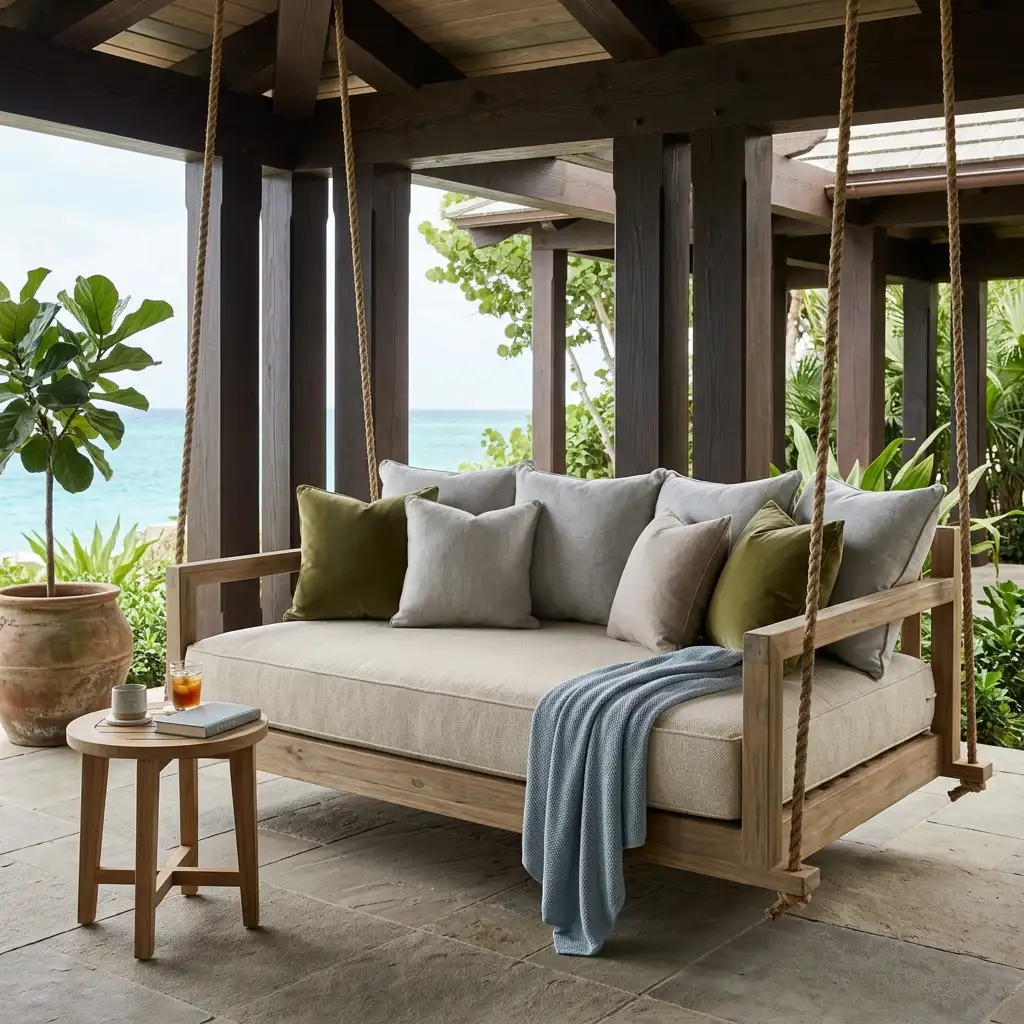
If you’re going the teak route, the place to not cut costs is the cushion fabric. The teak frame will last 20 years with almost no maintenance. Cheap cushions will need replacing in two seasons and will look bad before they need replacing. Sunbrella fabric is the professional standard for outdoor cushions — UV-resistant, water-resistant, and it holds color far longer than any standard outdoor fabric.
What to add: A teak side table at the same finish level, outdoor linen throw, simple concrete or matte black planters nearby. Keep everything at the same quality level as the frame — mismatched quality is more noticeable on premium pieces than on budget ones.
Best for: Contemporary, transitional, and high-end traditional homes with covered porches or patios.
7. Canopy Swing Bed
A canopy swing bed adds a fabric overhead covering — attached to the frame itself, not the ceiling — that provides shade, visual privacy, and a genuinely dramatic aesthetic. Some canopies are fixed; others are adjustable.
This works particularly well for uncovered porches, patios, or pergolas where there’s no ceiling overhead to provide shade. The canopy creates an enclosed zone within the outdoor space — a room within the porch — that makes the swing bed feel more private and more destination-like.

Sheer outdoor fabric panels on the sides of the canopy take this further. You can pull them closed for privacy and shade, or push them open when you want air and a view. The combination of swinging, shade, and the ability to close off the space makes a canopy swing bed genuinely one of the most comfortable outdoor furniture pieces you can own.
What to add: Outdoor sheer curtains threaded on a curtain rod along the canopy sides, string lights woven through the canopy frame, a small tray with a book and a candle for the full effect.
Best for: Uncovered patios, pergolas, open decks, and anyone who wants a private outdoor retreat in a space without ceiling structure.
8. Pergola Swing Bed
Hanging a swing bed from a pergola rather than a house ceiling opens up the concept to anyone without a covered porch. A pergola’s overhead beams function as the mounting structure, and the swing bed becomes the visual centerpiece of the entire outdoor space.
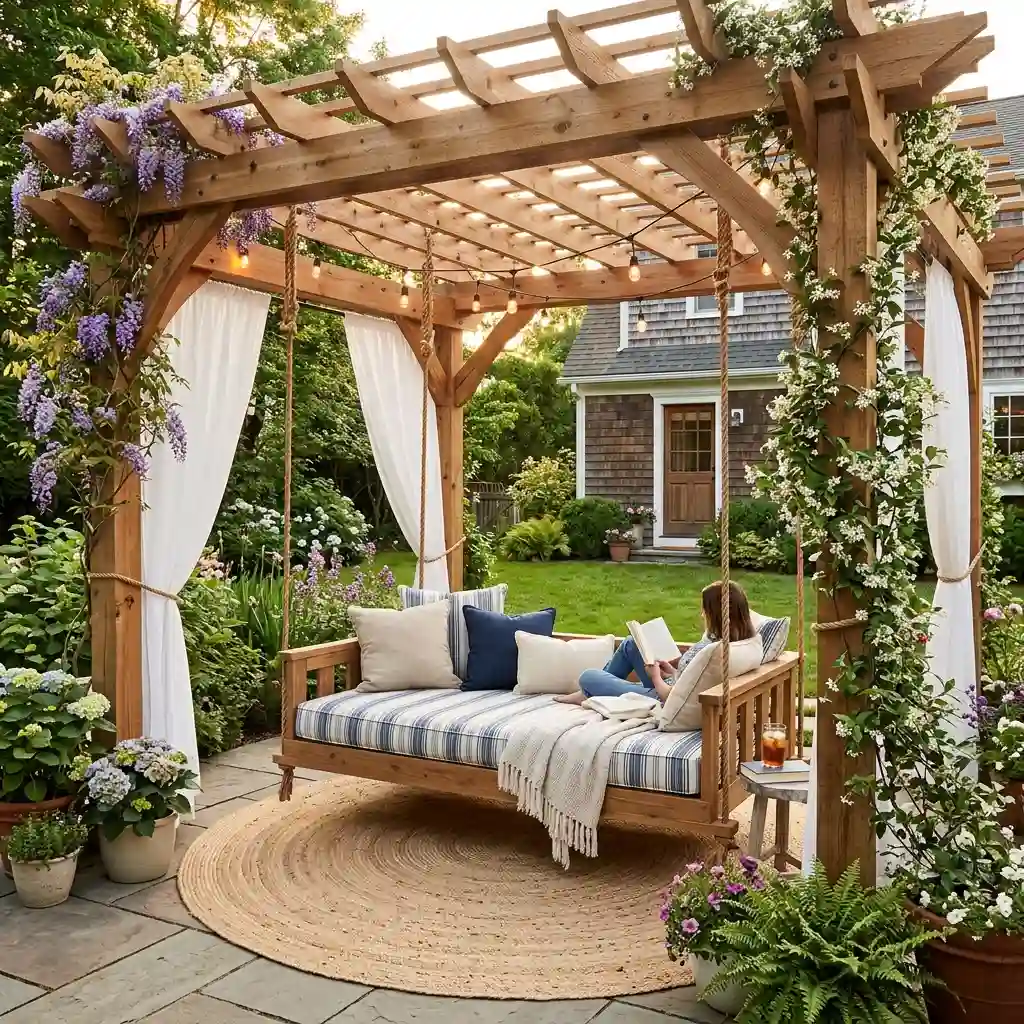
The pergola installation looks best when the pergola itself is invested in as a design element — not just a mounting point. Climbing wisteria or jasmine growing up and over the beams, string lights woven through the overhead structure, outdoor drapes on two sides for privacy, and a large outdoor rug underneath to define the space all contribute to making the swing bed feel like an actual outdoor room rather than furniture in a yard.
What to add: Climbing plants on the pergola structure (wisteria, climbing roses, or jasmine are classic choices), outdoor string lights overhead, weather-resistant outdoor curtains, and a large rug to anchor the space underneath.
Best for: Backyard patios without existing covered structures. Works with both freestanding and attached pergolas.
9. Pallet Wood DIY Swing Bed
The most budget-friendly approach on this list. Wooden pallets joined into a frame, sanded, sealed or painted, and hung with rope is a genuinely achievable weekend project that results in something that looks intentional and comfortable.
The most important pallet selection rule: only use heat-treated pallets (look for “HT” stamped on the wood, not “MB” which indicates methyl bromide treatment). Heat-treated pallets are safe for furniture use. Chemically treated ones are not.
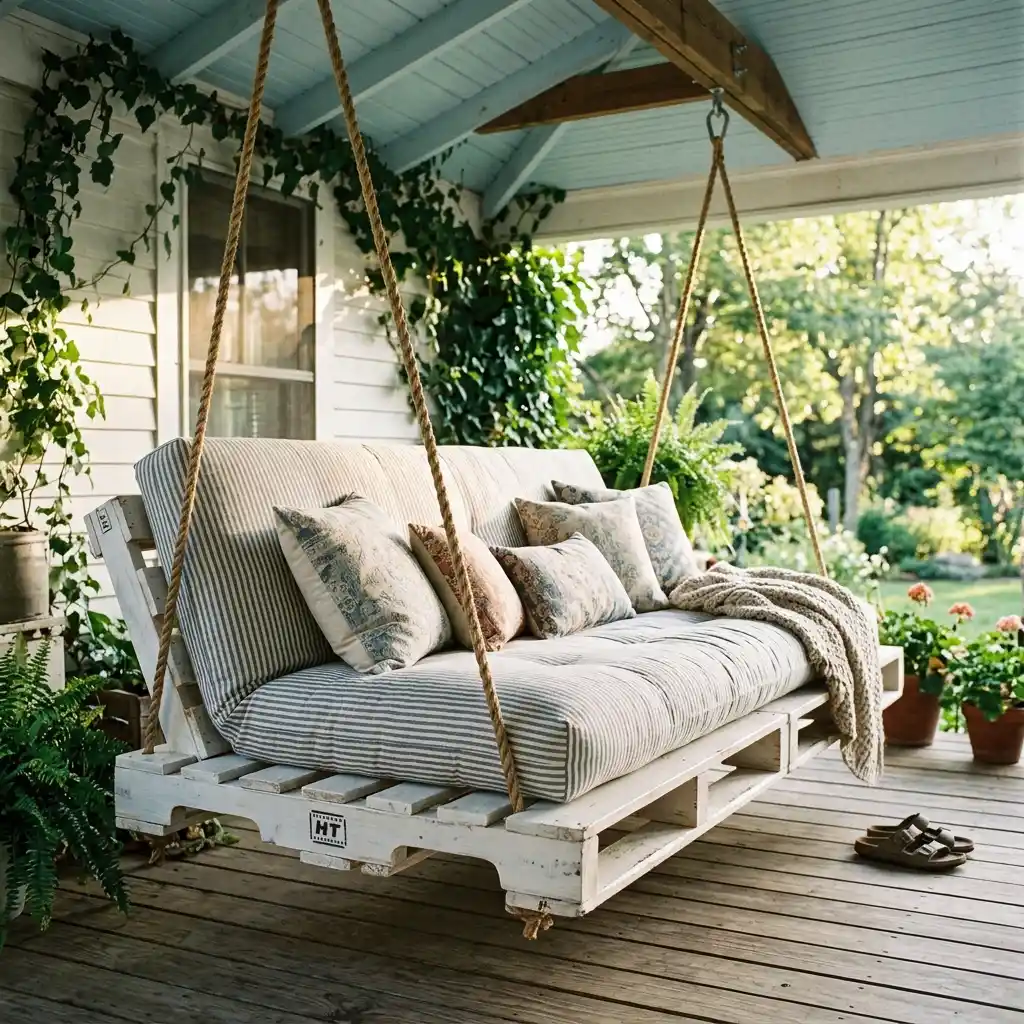
Beyond sourcing, pallets need thorough sanding — more than you think — to remove splinters and rough spots before they’re comfortable to sit on or near. A good orbital sander makes this step manageable. After sanding, two coats of exterior-grade paint or a weatherproof sealant are essential for longevity.
The budget version of this build — pallets, basic hardware, and a can of exterior chalk paint — genuinely can cost under $100. The cushion is where to invest the money you saved on the frame.
What to add: A quality outdoor cushion (this is not the place to cut costs — cheap foam cushions bottom out quickly), hanging plants on either side, and exterior paint in a color that ties to your porch’s existing palette.
Best for: Budget DIY builders, rental properties, and anyone who wants to test the concept before committing to a more expensive build.
10. Indoor-Outdoor Living Room Swing Bed
This approach treats the porch swing bed like indoor furniture rather than outdoor seating. Thick cushions that look more like sofa cushions than outdoor pads. Throw pillows in fabric that reads indoor. A small side table at coffee table height. An outdoor rug that looks like an actual area rug. Potted plants that frame the space like a living room.
The key insight behind this style is that the porch — particularly a covered porch — is genuinely an indoor-adjacent space in most climates. It doesn’t need to look like it’s prepared for rain at any moment. It can look like a room.

This works best on covered porches in mild climates, on screened porches, or on any porch used as genuine outdoor living space throughout the day.
What to add: A coffee table-height surface on one side, a basket of throws, a small outdoor lamp or lantern, and an area rug large enough to anchor the entire seating zone.
Best for: Covered porches in mild climates, screened porches, and any porch regularly used as an extension of the living room.
Part 2: Ideas by Setting
11. Front Porch Swing Bed
The front porch swing bed is the most visible version — it faces the street, it greets visitors, and it becomes part of your home’s character from the curb. For this reason, I’d keep the styling relatively clean. The swing bed is already a strong visual statement and doesn’t need much layering to make an impact.
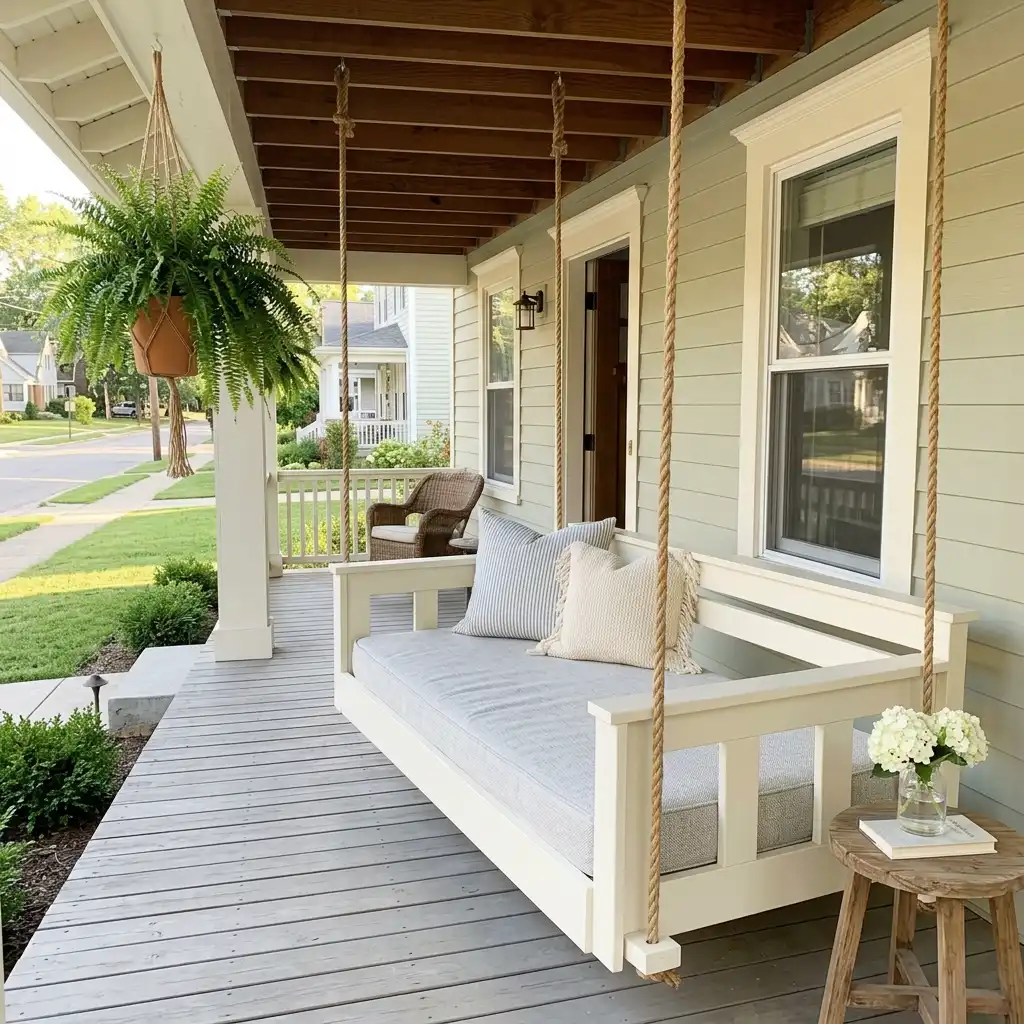
Two throw pillows, a small side table, and one hanging plant are usually exactly enough. Everything beyond that on a front porch starts reading as cluttered rather than styled.
12. Back Porch Swing Bed
The back porch version can be more personal, more layered, and more comfortable — because you’re not designing it for curb appeal, you’re designing it for yourself. This is where you put the extra throw blankets. The stack of books. The candle. The string lights you wouldn’t put on the front porch because you thought they’d look like too much.
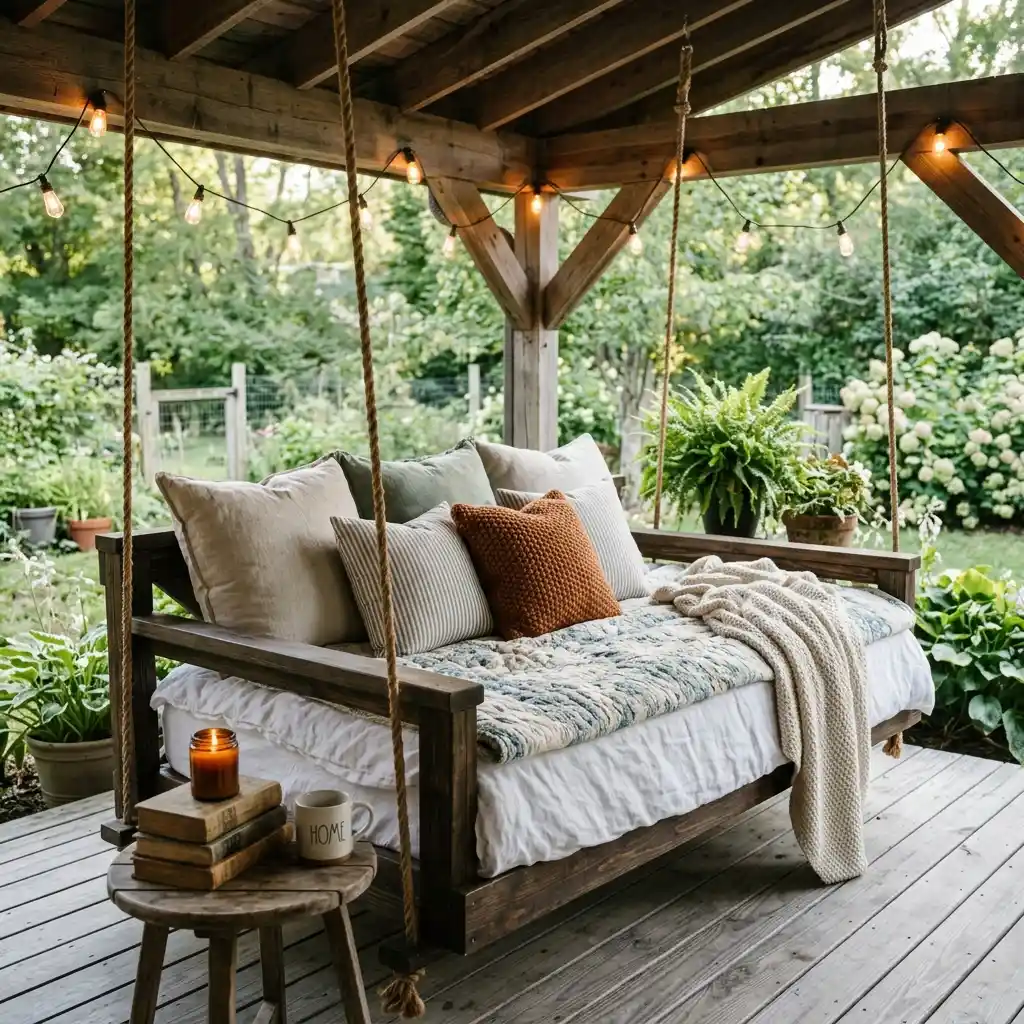
A back porch swing bed should feel lived in, not styled. It should feel like a room.
13. Screened Porch Swing Bed
A screened porch takes the swing bed concept to its most functional form. You get the outdoor air, the view, the breeze, and the gentle sway — without bugs, without direct sun, and in many climates, without rain.

On a screened porch you can also use slightly more delicate textiles than you’d risk in a fully open environment. Softer cushion fabrics, more delicate throw pillows, even a lightweight outdoor-rated duvet if you’re genuinely planning to sleep out there. Which, if your screened porch has the right view and the weather cooperates, you absolutely should.
14. Backyard Pergola Swing Bed
In a backyard without a covered porch, a pergola with a hanging swing bed creates what feels like a dedicated outdoor room — a distinct destination in the backyard that draws people away from the house and into the garden.
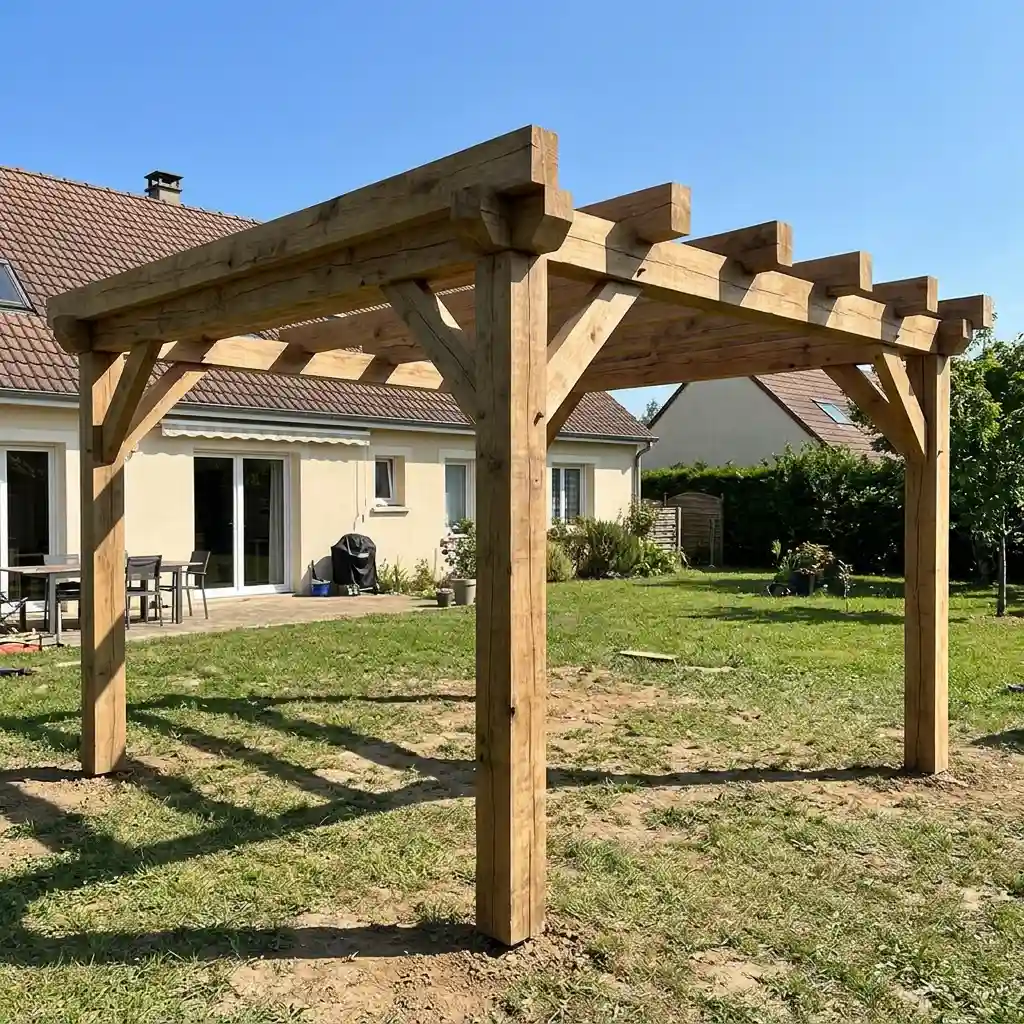
Plant the pergola with climbing jasmine or wisteria for overhead fragrance and shade. Hang warm-toned string lights through the beams. Place a large outdoor rug underneath. Add a small side table on each side of the swing. What you end up with looks and feels like a private outdoor room, and it genuinely becomes the most used space in the yard.
15. Tree-Hung Backyard Swing Bed
For properties with large, mature trees and strong horizontal branches, hanging a swing bed from a tree using heavy-duty rope is both achievable and spectacular-looking. The natural canopy overhead provides shade; the organic setting makes the swing feel completely unlike any porch installation.

This requires careful assessment before anything gets hung. The branch needs to be healthy, large enough — generally at least 8 inches in diameter at the attachment point — and free of disease or structural damage. If you’re not sure, ask a certified arborist before hanging anything significant from any tree. A healthy-looking tree can have internal rot that makes a branch genuinely dangerous under load.
When done safely, though, a tree-hung swing bed is the most beautiful version on this list.
Part 3: Styling Details That Make the Difference
16. The All-White Setup Done Right
All-white cushions, white throw, white or cream pillows, white or natural frame. Clean, understated, and harder to execute well than it looks — because it requires consistent cushion maintenance and careful texture variation to avoid looking flat.

The trick: use at least three different fabric textures within the white palette. Linen cushion cover, knit throw, cotton pillowcase, woven rug underneath. The textural variation is what stops all-white from looking like a showroom rather than somewhere you’d actually sit.
17. Warm Earth Tones
Terracotta, warm clay, dusty amber, and cream. This palette looks most cohesive with natural cedar frames, photographs beautifully in afternoon light, and ties naturally to the outdoor landscape better than any cool-toned palette.

If you’re not sure where to start with an earth-tone swing bed, start with one terracotta throw pillow against a cream main cushion. Add a warm amber or rust throw blanket. That combination alone reads as intentionally styled.
18. Navy and White Stripe
The most reliable coastal-preppy combination for porch swing beds. A navy stripe main cushion, white or cream throw pillows, white frame or natural wood, hanging ferns on either side. Classic, seasonless, and always correct.
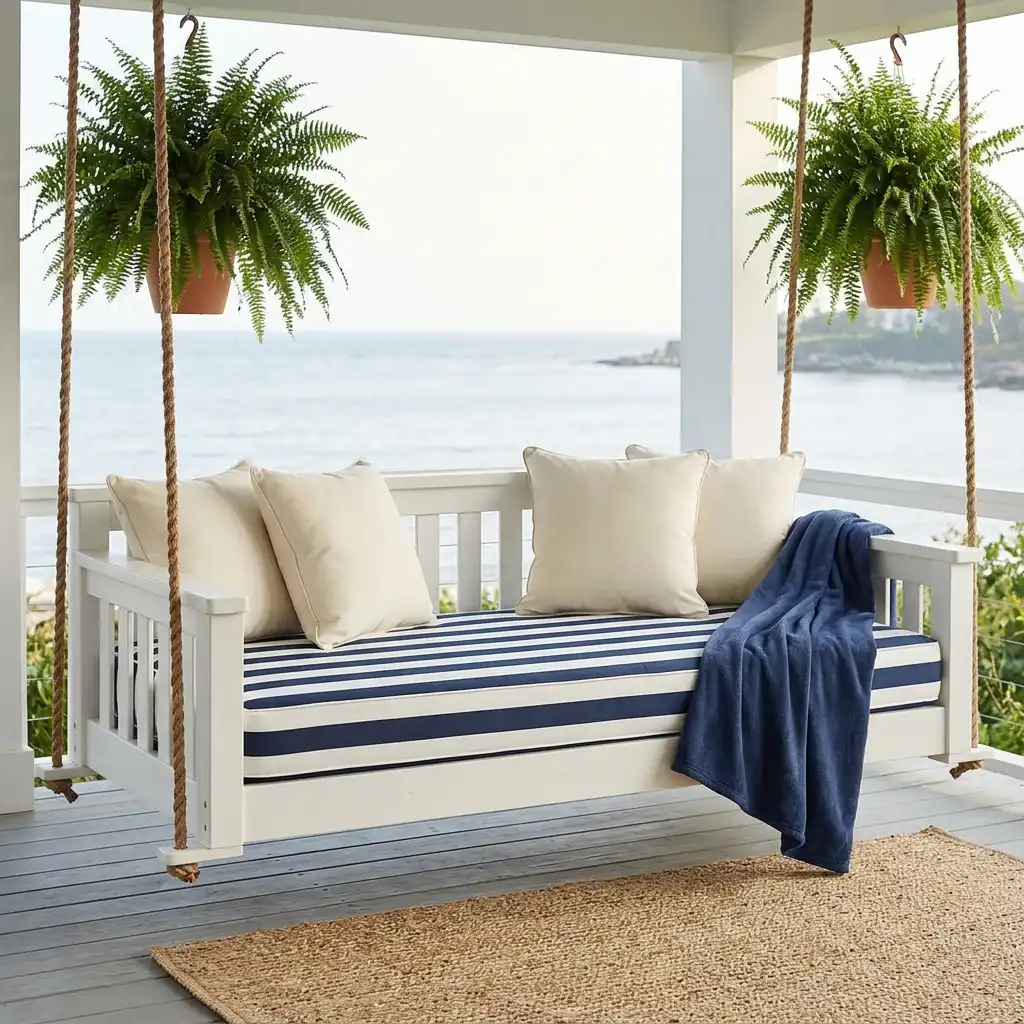
The one mistake people make with this combination: too many stripe directions. Use horizontal stripes on the main cushion and solid colors on everything else. Mixing horizontal and vertical stripes in the same palette creates visual noise rather than a pattern.
19. Olive and Cream Boho
Olive green cushion covers, cream and mustard throw pillows, a rust-toned woven throw blanket, wicker side table, and a macramé wall hanging nearby. This is the earth-tone boho combination that consistently looks collected and personal rather than assembled all at once from the same store.

The mustard pillow is the piece that makes this combination work — it bridges the olive and the rust without being too matchy.
20. Dark Frame with White Cushions
An espresso, ebony, or charcoal-stained wood frame with crisp white cushions and one or two solid throw pillows. High contrast, graphic, and sophisticated. This is the combination that reads as the most intentionally designed of anything on this list.

Use black metal chains rather than rope for the suspension hardware — the metal-on-dark-wood combination is the detail that makes this look finished. Add black lanterns on either side and one large architectural plant in a matte black planter.
21. String Light Canopy Overhead
Hang string lights from the ceiling above the swing bed in a canopy pattern — multiple parallel strands — so the bed sits underneath a ceiling of warm light. At night, this transforms the swing bed into something genuinely magical and costs about $30 in lights.
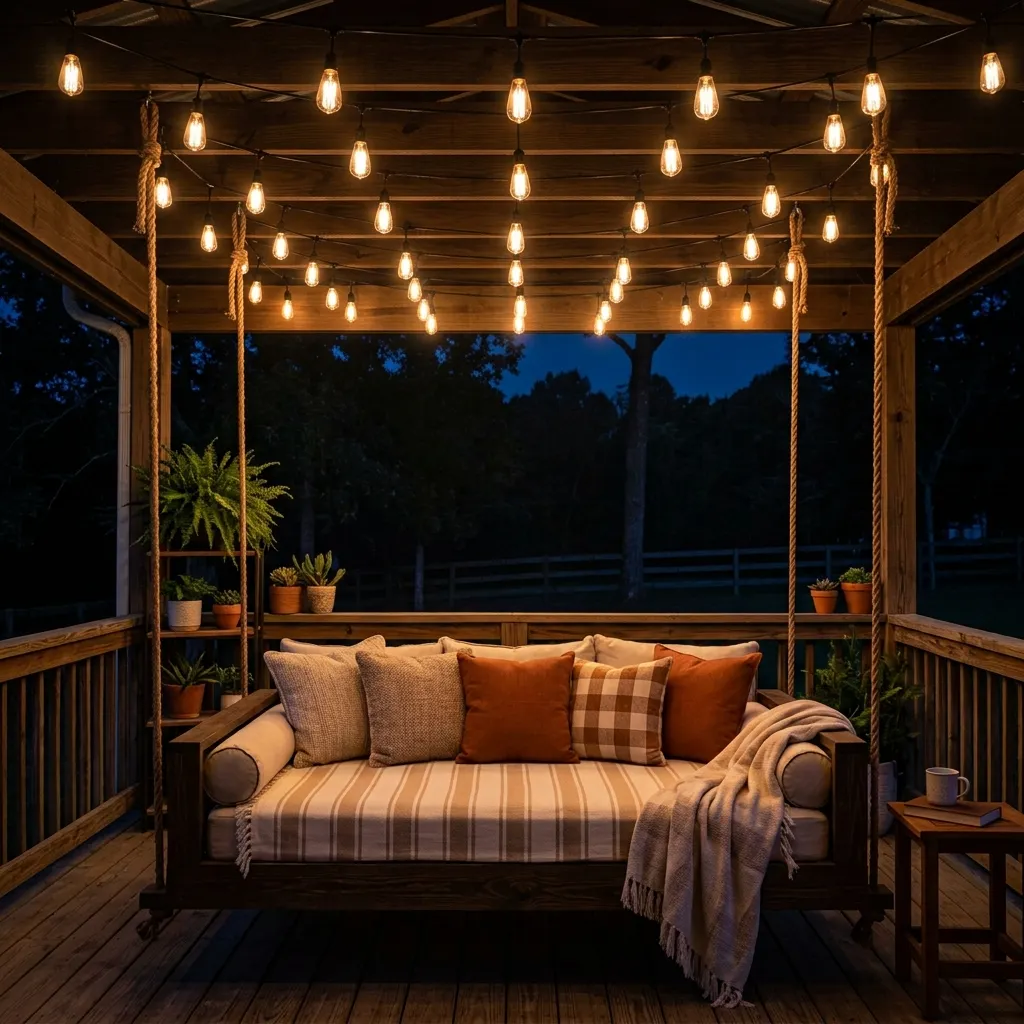
Edison-style bulb strings rather than twinkle lights is the right call here. Twinkle lights read as festive. Edison bulbs read as permanent and cozy.
22. Layered Plants on Both Sides
Two large Boston ferns hung at ceiling height on either side of the swing bed, with a trailing plant in a hanging planter between them. The effect is that the swing feels enveloped in greenery — softer, more private, and more beautiful than any amount of additional furniture would achieve.

For porches that don’t get enough light for real ferns, high-quality artificial ferns have become genuinely convincing options that require zero maintenance and look good year-round.
23. The Side Table You Actually Need
A porch swing bed without a side table is missing a critical element. You need somewhere to put your coffee, your book, and your phone when you inevitably fall asleep out there.
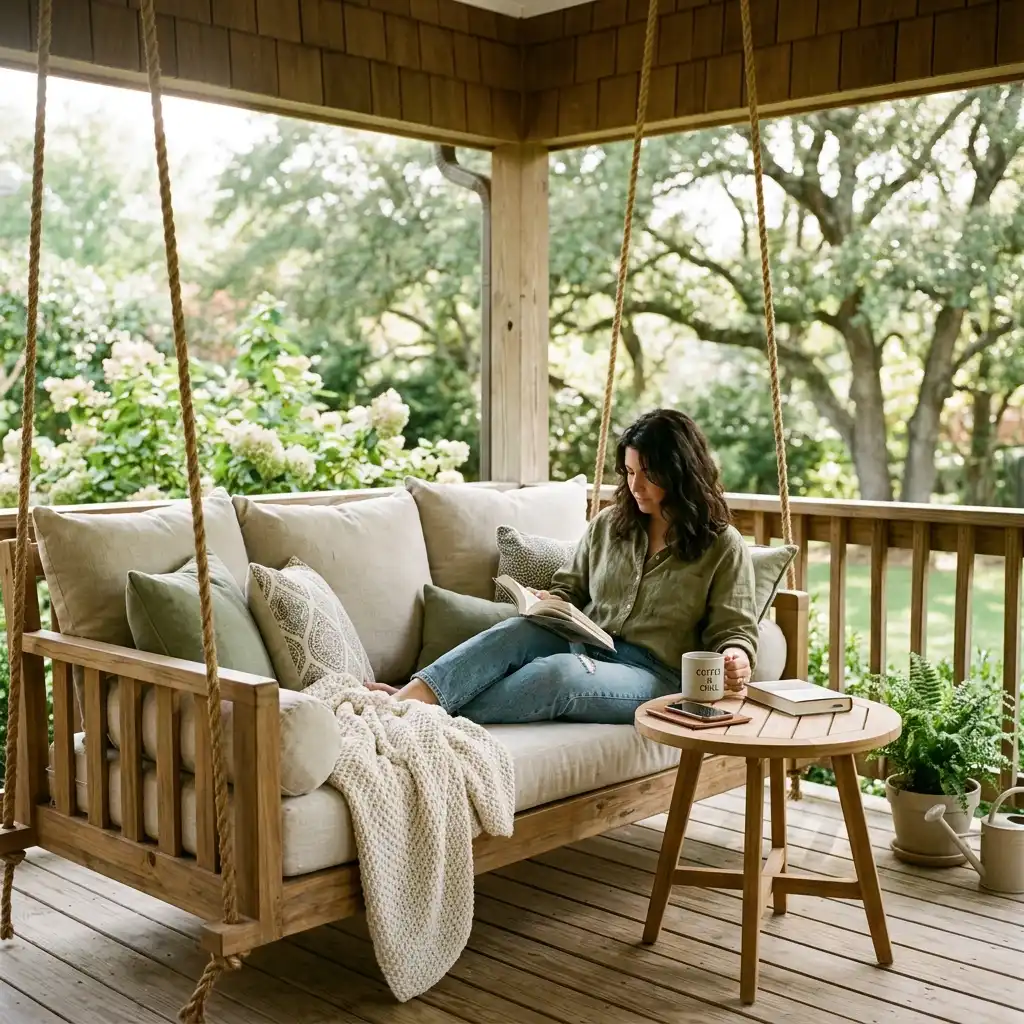
A small teak or wicker tray table, a wooden crate turned on its side, or a purpose-made outdoor side table at the right height — all work. The best option is something lightweight enough to pull close on whichever side you need it and push back when not in use. A table you have to climb over to get off the swing quickly becomes a table you stop using.
24. Outdoor Rug Underneath
A large outdoor rug placed under the swing bed does two things well: it visually defines the space (making the porch feel designed rather than just furnished), and it softens the floor surface for anyone getting on or off the swing barefoot.
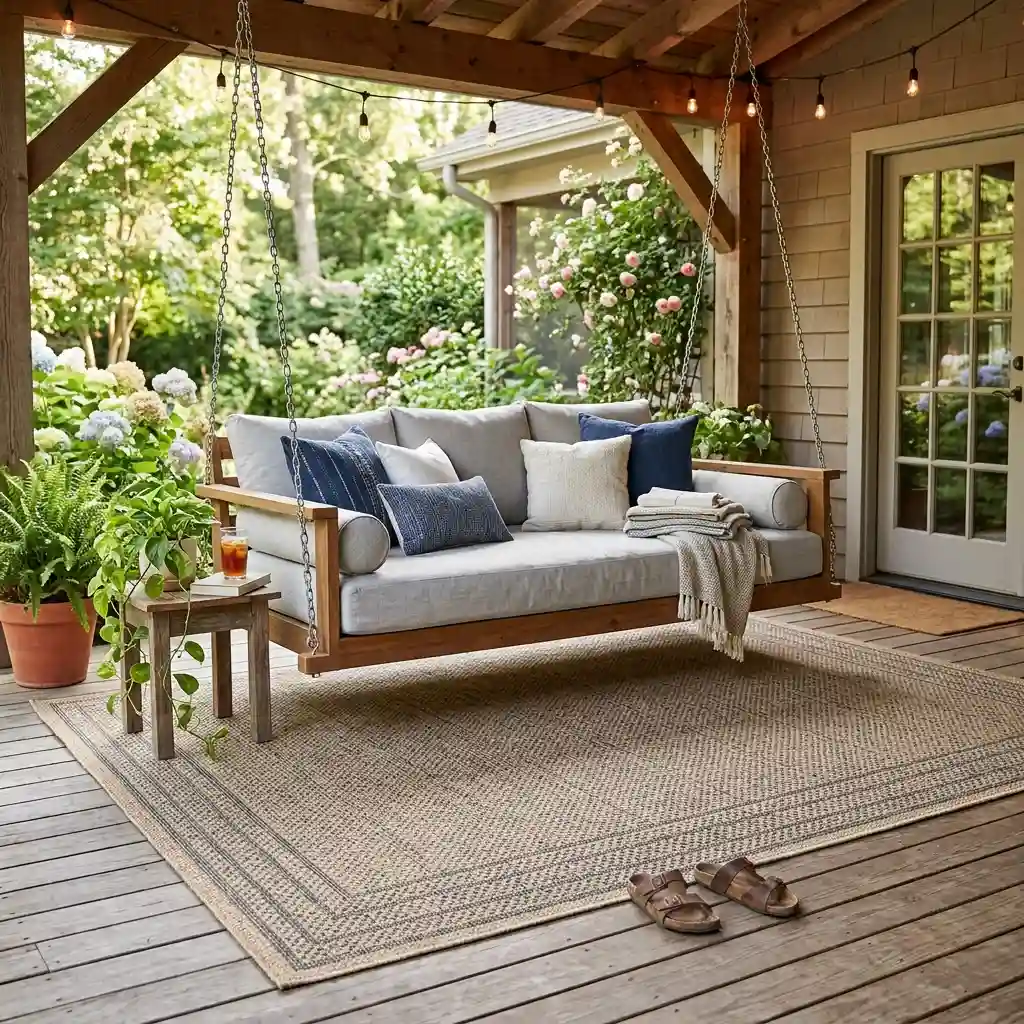
Choose a rug large enough to extend 18 to 24 inches beyond the swing frame on all sides. Natural fiber-look patterns, simple stripes, or geometric designs all work depending on your overall style. The rug should read as an area rug, not a doormat — size matters more than pattern.
25. Seasonal Refresh Strategy
The porch swing bed is one of the easiest pieces of furniture to restyle seasonally because only the cushion covers need to change. The frame stays the same year-round.
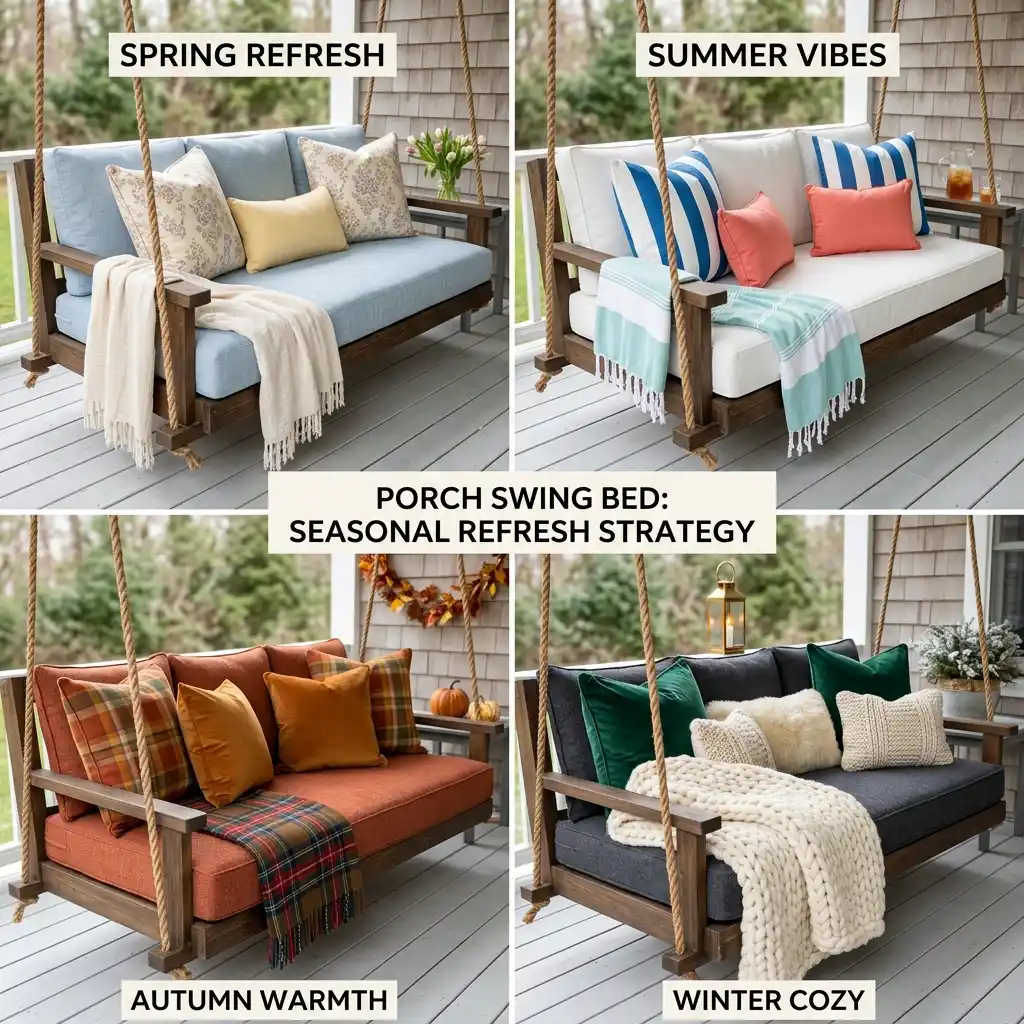
Spring and summer: light colors, linen and cotton, florals or simple stripes, lighter throw blankets. Fall: warm terracotta, amber, plaid throws, heavier cushion covers. Winter — or year-round in mild climates — heavier wool or flannel throws, deeper tones, velvet pillow covers.
A set of two or three different cushion cover sets costs far less than any other seasonal decor update, and the result each season looks genuinely fresh.
Before You Commit: Five Things to Check First
I want to give you these before the ideas, because they’ll save you significant frustration — and in one case, a serious safety problem.
1. Can your porch ceiling actually support one?
This is the most important question, and it’s the one people most often skip because they’re excited and it feels like a buzzkill. Don’t skip it.
A porch swing bed — frame, mattress, cushions, and one or two adults — easily weighs 400 to 600 pounds in use. Your ceiling joists need to handle that load plus the additional dynamic force created by swinging, which multiplies the effective load on the attachment points.
Most twin-size swing beds are rated to support 500 to 800 pounds when properly installed, but the limiting factor is almost always the porch structure itself, not the bed frame. You need solid, load-bearing ceiling joists — ideally 2×6 or 2×8 lumber — directly above your intended hanging points.
If you’re not certain about your structure, call a contractor before you buy or build anything. This is a genuine safety issue, not a technicality.
2. Do you have enough ceiling clearance?
For comfortable swinging, you need at least 8 to 9 feet of ceiling height. The swing bed surface itself typically hangs 10 to 12 inches off the floor — lower than a standard chair, which makes lying down feel natural and getting on and off easy. You also need 24 to 30 inches of clearance in front of and behind the bed, and 12 to 18 inches on each side.
Measure all of this before you pick a size.
3. Do you have enough porch depth?
Measure your porch from the house wall to the outer edge. A swing bed needs room to move freely in both directions. For a twin-size bed, plan for at least 5 feet of usable porch depth. If your porch is narrower than that, a wall-mounted swing — attached to the house at one end — limits the swing arc and works in tighter spaces without sacrificing the experience significantly.
4. What size mattress do you want to use?
Most porch swing beds are built around standard mattress dimensions. Twin (38 by 75 inches) is the most common for solo use and fits most covered porches. Full (54 by 75 inches) works for couples or anyone who wants more room. Queen is available but requires a genuinely large porch and serious structural support.
Build or buy your frame to match a specific mattress size first. Trying to find a mattress for a custom-sized frame afterward is an exercise in frustration.
5. What material makes sense for your climate?
Cedar is the most popular material for DIY builds. It’s naturally rot-resistant, insect-resistant, affordable, and takes stain or paint beautifully. It’s not as maintenance-free as teak in very wet climates, but it’s an excellent choice for most regions and holds up extremely well on a covered porch.
Teak is the premium choice. It requires almost no maintenance, resists weather and insects naturally, and develops a beautiful silver patina as it ages. The tradeoff is price — a teak swing bed frame typically costs two to three times what a comparable cedar build would.
Pine is the budget option — affordable and easy to work with, but it requires regular sealing or painting and doesn’t hold up as well in wet, humid environments without consistent maintenance.
Rattan and acacia combinations are popular for ready-made swing beds and give a softer, more resort-like look. The combination of woven rattan panels and solid acacia wood creates a warm, collected feel that reads less like outdoor furniture and more like something you’d find at a boutique hotel — especially in a light teak finish with neutral cushions.
How to Hang a Porch Swing Bed Safely: Step by Step
This is the section I want you to read most carefully. A swing bed that isn’t properly hung is a genuine safety risk — not a hypothetical one.
Step 1: Locate your ceiling joists
Use a stud finder to locate the ceiling joists above your intended hanging spot. These are the only structural elements strong enough to support a swing bed safely. Never hang anything from drywall, plywood ceiling panels, or decorative trim — only from solid structural wood joists.
The joists you’re looking for should be at least 2×6 lumber, ideally 2×8. If they’re smaller than that, or if they show any signs of rot or damage, you need a contractor to assess or reinforce before proceeding.
Step 2: Mark and measure your hanging points
The hanging points on the ceiling should mirror the corner positions of your swing bed frame. Measure carefully and confirm that the marked points sit directly over solid joist wood — not just near a joist. Drill a small test hole if you’re not certain, and use a screwdriver to confirm you’re hitting solid wood.
Mount the hanging points about 2 to 4 inches wider than the actual width of the swing frame on each side. This spacing improves weight distribution and prevents the chains or rope from rubbing against the frame as it swings.
Step 3: Install the hanging hardware
Use heavy-duty eye bolts or swing bed hangers rated for outdoor use — galvanized or stainless steel to prevent rust. Drill pilot holes slightly smaller than the bolt diameter, then thread the eye bolts in by hand first and finish with a wrench until they’re fully seated with no wobble.
Do not use standard screw hooks or light-duty hardware. The combined weight of the frame, cushions, mattress, and people creates significant dynamic load — especially while swinging. Hardware that’s adequate for a hanging plant basket is not adequate for a swing bed.
Step 4: Attach your chains or rope
Galvanized or stainless steel chain is the most secure suspension option and requires the least ongoing inspection. For an 8 to 9 foot ceiling, two 8-foot lengths of chain per side are typical.
If you prefer the look of rope — and rope does look better in most styles — use a minimum of 3/4-inch diameter Manila, sisal, or synthetic outdoor rope rated for the intended load. Natural fiber rope looks beautiful but needs more frequent inspection for wear than metal chain. Check it at the beginning of every season and after any period of heavy rain.
Step 5: Hang the bed and test it gradually
Once the bed is hung, test it incrementally. Start with just the frame swinging freely. Then add the mattress. Then sit on the edge. Then lie down fully. Then have a second person join you.
If anything feels unstable — any wobble in the ceiling hardware, any lean to one side, any creak from the joists — stop and investigate before using it further. A stable, properly hung swing bed should feel completely solid except for the deliberate, smooth swinging motion.
Step 6: Adjust the height
The ideal hanging height puts the surface of the swing bed 10 to 12 inches off the floor — low enough that getting on and off feels natural, high enough that the bed clears the floor during the swing arc. Adjust chain or rope length equally on all four corners until the bed hangs level.
Use an actual bubble level on the mattress surface once it’s placed to confirm it’s hanging evenly. Even a slight tilt is uncomfortable to lie on for any length of time.
Maintenance: Keeping It in Good Shape Season After Season
Inspect the hardware monthly during the season. A loose eye bolt that’s missed in a monthly check can fail suddenly. This inspection takes two minutes and is the most important maintenance step for safety.
Bring cushions inside when not in use for extended periods. Even performance outdoor fabric fades with prolonged UV exposure. Storing cushions inside between uses significantly extends their life — and keeps them cleaner.
Clean the wood frame with mild soap and a damp cloth two or three times per season. Don’t use pressure washers on wood swing beds — the force can open the grain and drive moisture into the wood.
Reapply wood treatment every one to two years. Cedar and pine need fresh sealant or stain annually in wet climates, every two years in drier ones. Teak can be left to weather naturally to a silver-gray, or maintained with teak oil once a year to preserve the warm honey color.
Cover the frame during winter or extended non-use with a weatherproof outdoor furniture cover. This single step extends the life of the wood significantly.
What to Budget
The cost range for porch swing beds is genuinely wide — here’s an honest breakdown:
DIY pallet build: $40 to $150 for materials, not including mattress or cushions. This is the starting point for anyone on a tight budget.
DIY cedar build: $200 to $500 for lumber, hardware, stain or paint, and fasteners. Not including mattress or cushion.
Mid-range ready-made swing bed: $400 to $900 for the frame, cushions sold separately.
Premium cedar or teak ready-made: $1,000 to $2,500, usually including basic cushions.
Luxury custom teak with Sunbrella cushions: $2,500 to $6,000 or more.
The cushion or outdoor mattress is typically a separate cost. A quality outdoor foam cushion cut to twin size runs $100 to $300. A purpose-built outdoor twin mattress for a swing bed runs $150 to $400. The hanging hardware — chains, eye bolts, carabiners — usually adds $40 to $80 on top of whatever you spend on the frame.
Frequently Asked Questions
How much weight can a porch swing bed hold?
Most commercially made swing beds support 500 to 1,000 pounds, but the actual capacity depends as much on your ceiling structure as on the bed itself. Always verify the weight rating of your specific product and confirm that your ceiling joists can handle the load before installation.
Can I hang a porch swing bed from a pergola?
Yes, as long as the pergola beams are structurally sound and properly anchored to the ground. The beams need to be large enough and deep enough in their footings to handle the dynamic load of a swing bed in use. When in doubt, have a contractor assess the pergola before installation.
What is the best wood for a DIY porch swing bed?
Cedar is the best choice for most DIY builders — naturally rot and insect resistant, easy to work with, widely available, and affordable. Teak is the better long-term choice if budget allows, but cedar on a covered porch with annual sealant lasts for many years.
What mattress or cushion should I use?
Use an outdoor-rated foam cushion covered in UV-resistant fabric, or a purpose-built outdoor mattress. Sunbrella fabric is the professional standard for outdoor cushions. A standard indoor mattress on an outdoor swing bed will absorb moisture, grow mildew, and deteriorate quickly — even under a covered porch.
How long does installation take?
For a DIY installation, plan for two to four hours spread across two stages: locating and installing ceiling hardware first, then hanging and adjusting the bed once the hardware is confirmed secure. Professional installation typically takes one to two hours.
Can I sleep on a porch swing bed overnight?
On a covered or screened porch in good weather, yes — and many people do. It’s one of the genuine pleasures of owning one. Use a sheet and a lightweight blanket, make sure the porch has reasonable bug protection, and accept that you’ll probably sleep better out there than you expected.
The Part Nobody Mentions
I want to end this guide with something that doesn’t appear in the product descriptions or the buying guides.
A porch swing bed changes how you use your home. Not in a small way. In a fundamental where-do-you-go-when-you-want-to-rest way.
The woman I mentioned at the beginning of this guide — the one who barely used her back bedroom since hanging the swing — wasn’t exaggerating. That happens to a lot of people. You buy a house for the rooms inside it. You discover that your favorite room is a twelve-square-foot patch of covered porch where a cedar frame full of linen cushions sways gently every time the wind moves.
It’s a genuinely good surprise. One of the better ones a home can offer.