
Your closet is a disaster. Clothes pile on the floor. Shelves overflow with items you cannot find. You waste minutes every morning searching for basic things. The closet that should make life easier makes it harder.
The right shelving system changes everything. It gives every item a dedicated home. It makes getting dressed effortless. It transforms wasted space into organized, beautiful storage.

These 36 closet shelving ideas work for every closet size, every budget, and every storage challenge.
1. Start With a Full Closet Audit

Before adding any shelving, remove everything. Every single item comes out. You cannot design a good system around clutter you should not be keeping.
The closet above shows what the end result looks like. Custom white cabinetry, double hanging rods, drawers, and a tie rack in the lower section. Nothing extra. Nothing unused. Every shelf and drawer earning its place.
Sort into three piles:
- Keep
- Donate
- Discard
Be ruthless. A closet organized around fewer items works better than one crammed with everything you have ever owned.
Then measure everything. Height floor to ceiling. Width wall to wall. Depth front to back. Door swing radius. Rod height. Corner space. These six numbers determine every shelving decision that follows.
The audit alone solves about 30 percent of the problem before you buy or build a single shelf.
2. Plan Zones Before Installing Anything

Every closet needs clearly defined zones. Planning these zones before installation prevents the most expensive mistakes.
The sketch above shows what a good zone plan looks like. Long hanging on the left. Short hanging in the middle. Shelving for folded clothes on the top right. Shoe zone below. Accessories zone on the right. All drawn to scale on graph paper before any materials are purchased.
The five zones every closet needs:
- Long hanging. Dresses and full-length trousers. 60 to 72 inches of height.
- Short hanging. Shirts, jackets, blazers. 36 to 42 inches. Can be doubled.
- Shelf zone. Folded sweaters, jeans, and accessories.
- Shoe zone. Racks or shelves in the lower section.
- Accessories zone. Near the door for quick daily access.
Draw your zone plan on paper before ordering anything. The plan becomes the blueprint for every shelving decision.
3. Install a Double Hang Rod System

A double hang rod system is the single most impactful upgrade for most closets. It doubles the hanging capacity by stacking two shorter rods where one tall rod used to hang.
What goes where:
Upper rod (36 to 42 inches of space): Shirts, tops, jackets, blazers.
Lower rod (28 to 36 inches of space): Folded trousers, skirts, shorts.
Full-height single rod (60 to 72 inches): Dresses and long coats.
Plan one double-hang section and one single-hang section. That combination suits the most people and the most wardrobes.
Cost: A basic double hang rod kit runs $20 to $60. Installation takes about an hour with a drill and a level.
4. Use IKEA PAX Wardrobes as a Shelving System

IKEA PAX wardrobes create the most affordable and most flexible custom closet system available. The modular frames accept dozens of internal fittings. Shelves, drawers, rods, and shoe racks in any combination.
The closet above is the PAX system fully assembled. Two hanging rod sections on the outer frames. Open shelving in the center with woven baskets and white storage bins. Upper cabinets with closed doors. Lower storage bins on the floor. This is what a well-organized PAX closet looks like.
How to configure a PAX closet:
- One frame for hanging. One frame for shelving and drawers. One frame for shoes if space allows.
- Mix and match internal fittings within each frame.
- Start with the frame widths (typically 19, 29, or 39 inches) and work outward.
Cost: A complete 3-frame PAX system for a standard closet runs $600 to $1,500 depending on fittings and finish. Significantly less than custom cabinetry at $3,000 to $8,000.
For complete IKEA organization and mudroom ideas that use the same IKEA system approach in entryways and storage zones throughout the home, explore these IKEA mudroom ideas for configuration strategies that apply directly to closet shelving design.
5. Install Floating Shelves for a Clean, Modern Look

Floating shelves give a closet a clean, architectural look. No visible brackets. No frames. The shelves look built in and custom. The floor below stays clear, which makes the closet feel larger.
Wire shelving is the more affordable cousin of floating shelves. The setup above uses white wire shelves with labeled bins for T-shirts, pajamas, and sweatpants. Clear shoe boxes line the bottom shelf so every pair is visible.
What works on floating shelves:
- Folded clothing
- Accessories in small bins
- Display items like handbags
- Small decorative touches
6. Add Adjustable Wire Shelving for Flexibility

Wire shelving systems are the most affordable complete closet solution. They install quickly, provide good visibility, and allow air circulation that solid shelves do not.
Custom light wood cabinetry with an island in the center. Marble top for folding and displaying. Drawers beneath. Hanging sections on both sides. LED lighting throughout.
Why wire shelving works well as a starter system:
- Easy to reconfigure as storage needs change
- Adjustable shelf heights at any point on the rail
- Good visibility of contents
- Air circulation prevents mustiness
7. Build a Walk-In Closet With Custom Shelving
A walk-in closet with custom shelving is the ultimate storage luxury. Every wall becomes a storage opportunity. Every inch is designed for a specific category of clothing or accessory. The result is a dressing room that functions better than any retail display.

Plan the walk-in layout with hanging zones on the two longest walls and shelving on the shorter walls or in a central island. Position a central island — if space allows — with a flat top for accessories display and drawers beneath for folded items.
For complete home organization and small space design ideas that inform a thoughtful walk-in closet layout, explore these small studio apartment ideas for space-planning strategies that maximize every wall and corner of a dedicated wardrobe space.
8. Install Angled Shoe Shelves for Maximum Display
Angled shoe shelves display shoes at a forward tilt that shows the full shoe rather than just the heel. They fit more pairs per shelf than flat shelves because the tilt reduces the footprint of each pair. They also look significantly more beautiful than flat shoe storage.

Standard angled shoe shelf depth is 7 inches per shelf. Two rows of angled shoe shelves occupy the same wall space as one row of flat shelves while displaying significantly more pairs. Install at least four rows of angled shoe shelves from a comfortable reach height down to the floor for maximum shoe capacity.
A full wall of angled shoe shelves from floor to ceiling creates a stunning boutique shoe display. Light the shoe shelves from above with LED strip lighting for a genuinely luxurious retail-inspired effect.
9. Use Pull-Out Drawers Within the Closet System

A shallow drawer with clothes folded flat solves the digging problem.
This drawer holds ribbed tanks, tees, and light tops in a single layer with the folded edges facing up, so you can see every piece at a glance. Nothing is stacked, so nothing gets lost at the bottom.
The drawer itself is shallow, which is the key. Deep drawers encourage piles. Shallow drawers force a single layer, and that single layer is what keeps everything visible.
10. Add a Closet Island for a Dressing Room Effect
A closet island transforms a large walk-in closet into a genuine dressing room. The island provides additional drawer storage, a flat surface for accessories display, and a central focal point that makes the closet feel like a considered, designed room.

Build a simple island from base kitchen cabinets topped with a butcher block, marble, or upholstered surface. Standard kitchen base cabinets at 24 inches deep work perfectly in a closet island application. Choose a countertop material that suits the closet’s overall aesthetic.
Position a mirror directly above the island surface for a vanity-like dressing area. Good lighting above the island surface makes jewelry selection, accessory pairing, and outfit final checks significantly easier. The island mirror and lighting combination creates a complete dressing station in one location.
11. Install a Reach-In Closet System for a Standard Bedroom Closet
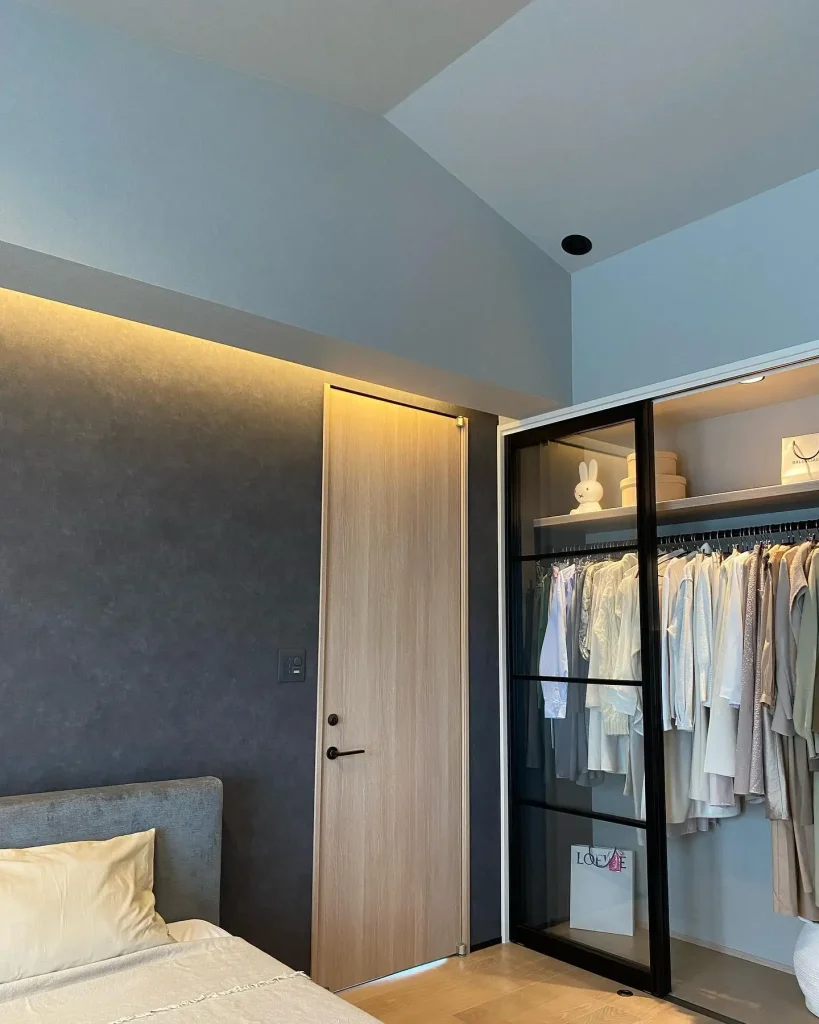
Glass front closet doors turn a wardrobe into display, but only if the inside stays tidy.
This setup keeps the color palette narrow, mostly whites, creams, and soft greens, so the interior reads as calm through the glass.
Slim LED strips run above the hanging rod and wash the clothes in warm light without heat.
A small shelf above the rod holds a few decorative pieces, and a single bag on the lower shelf ties the palette together. The trick is treating the inside like a shelf, not a storage bin.
12. Use Clear Storage Bins on Closet Shelves

Closet shelving works best when each zone has a single job.
This wall puts open shoe shelves at the top where you can see every pair, then a row of woven baskets in the middle for folded items and accessories, and hanging rods below with shoes lined up at the bottom.
The baskets give softness to all that white, and the open shelves up top let you grab a pair without opening anything. The mix of open and closed storage keeps the closet from feeling like a store.
| Zone | What goes there |
|---|---|
| Top open shelves | Shoes you want to see and grab quickly |
| Middle baskets | Folded items and small accessories |
| Double hang rods | Tops up top, pants and skirts below |
| Floor | Shoes and tall boots lined up in a row |
13. Add Lighting to Transform the Closet Experience
A dark closet is a disorganized closet. If you cannot see clearly what you own, you cannot find what you need. Proper closet lighting transforms the entire experience of using the space.

Adjustable closet shelving is only useful if you can see what is on the shelves.
This walk in uses vertical pilasters with peg holes, so you can move the shelves up or down as your storage needs change.
Slim LED strips run under each shelf, which lights the clothes below and kills the dark cave effect at the back of the closet. The finish is a light wood grain, which keeps the small space from feeling closed in.
A door mounted tie rack on the right uses the back of the door, which is often the most wasted surface in a closet.
14. Create a Shoe Wall for a Boutique Display
A dedicated shoe wall creates one of the most visually stunning closet features possible. Floor-to-ceiling shelves across one complete wall display the entire shoe collection in a way that makes it look like a high-end shoe boutique rather than a storage space.

If you have a collection worth showing, this is how to display it. The wall uses floor to ceiling cabinets with glass doors and brass handles, with warm LED lighting inside every section.
One bay is dedicated to shoes on angled shelves, another to handbags on flat shelves, and the middle bays hold hanging clothes behind glass.
A storage bench and rug sit in the middle. It looks like a boutique, but the system is simple. Shoes on angled shelves, bags on flat shelves, clothing in the middle, and lighting everywhere.
15. Build a Small Closet Into a Corner Space
Corner closets and awkward corner spaces present unique shelving challenges. Standard rectangular shelving wastes the corner area. Purpose-built corner solutions maximize every inch of the difficult-to-use corner zone.

A corner closet works best when it mixes open, closed, and semi open storage in one build.
This setup uses a tall glass door section on the left with open shelves and glass front drawers, closed panel doors in the middle for hanging, and a right bay with a rod, a shelf, and a pull out tray at the base.
The glass drawers let you see folded items without opening them, which cuts down on rummaging. Keep the color palette neutral and the drawer count low, and the corner reads calm even in a small room.
📌 Good To Know
Glass front drawers only work if you fold flat and keep one layer per drawer. Stacked items behind glass look like clutter, not storage.
16. Install a Barn Door on the Closet Opening
A barn door on a closet eliminates the swing clearance that a standard hinged door requires. The sliding door saves the floor space in front of the closet permanently. This extra floor space — typically 6 to 9 square feet — transforms how the bedroom or dressing area functions.

A closet does not need to be big to look finished. This recessed nook uses a stack of four deep white drawers with black handles at the base, two open shelves above for shoes, and a small display shelf at the top for a toolbox and a plant.
A wood barn door slides on a black rail across the opening, which hides everything when you want the room clean. The drawers hold folded items and small accessories, and the open shelves hold shoes you wear most often. It reads like furniture instead of a closet.
17. Add a Jewelry and Accessory Organization Section
Jewelry and accessories deserve a dedicated section of the closet system. Items stored haphazardly in a drawer become tangled, lost, and damaged. A dedicated organization section makes every accessory accessible and beautifully displayed.

A small drawer unit with velvet-lined compartments organizes jewelry by type. Necklaces hang from hooks on a mounted board. Bracelets stack in a shallow tray. Earrings organize in a dedicated earring holder. Each accessory category has an exact, designated home.
Wall-mounted jewelry organizers with hooks, rings, and compartments use the vertical space beside the main shelving run without consuming any shelf space. Position the accessory organization section at eye level near the mirror and good lighting for the easiest, most pleasant daily use.
18. Use Velvet Hangers Throughout for a Unified Look
Velvet hangers transform any closet instantly. They are thinner than wire or plastic hangers, creating significantly more hanging capacity in the same rod space. Their velvet surface prevents clothing from slipping off the hanger. And they look uniform and beautiful throughout the entire hanging section.

Replace all mismatched hangers with a uniform set of velvet hangers in a single color. Black velvet hangers create the most sophisticated, uniform appearance. Nude or blush velvet hangers suit lighter, more feminine closet aesthetics. The uniform hanger choice makes even a modest closet look intentional and well-organized.
19. Create a Kids’ Closet Shelving System
A children’s closet needs a shelving system that evolves with the child. What works for a toddler fails completely for a ten-year-old. A flexible system that adjusts over time saves money and prevents multiple complete reinstallations.

Position the lowest hanging rod at a height the child can reach independently from their current age. As the child grows, the rod position adjusts upward. Adjustable rail systems allow rod repositioning without any tools. The closet grows with the child.
For boys bedroom design ideas that include closet and storage considerations that suit different ages and interests throughout childhood, explore these boys bedroom ideas for complete room design that incorporates closet organization as a core element of a well-functioning child’s bedroom.
20. Install Pull-Out Trouser Racks
Pull-out trouser racks organize trousers without creasing them the way folded storage does. Each trouser pair hangs individually on its own rung. The rack pulls forward to provide access to all pairs simultaneously.

A pull-out trouser rack fits inside a standard closet section. The rack body mounts on drawer slides that pull it completely forward. The capacity depends on rack width, a 24-inch wide rack holds 10 to 14 pairs of trousers comfortably without crowding.
Pull-out trouser racks suit people with large trouser collections who value crease-free storage. They also suit suits and formal trousers that should never be folded. The investment in a quality pull-out trouser rack preserves the clothing stored on it.
21. Create a Linen Closet Shelving System

A linen closet requires different shelving than a clothing closet. Deep shelves hold bulky bedding and towels. Adjustable shelf heights accommodate everything from sheet sets to single pillowcases.
The linen closet above shows a complete system. Labeled storage boxes for queen bedding, guest room bedding, master bath, and guest bath. Folded towels stacked by size. Folded duvet covers and pillows on the top shelves. Everything labeled on the front. Everything visible.
How to plan a linen closet:
- Use labeled bins for sets that need to stay together
- Install shelves 12 to 16 inches apart
- Deeper shelves (16 to 20 inches) for folded duvets and pillows
- Shallower shelves (10 to 12 inches) for towels
- Label every shelf by category and room
22. Use a Closet for a Home Office Organization Zone
A closet converted entirely to a home office is one of the most space-efficient solutions for working from home in a compact home. The closet contains the entire workspace within a defined footprint. Closing the doors at the end of the workday ends the workday psychologically.

For complete home office design ideas covering desk setup, storage organization, and the shelving systems that make a closet office genuinely functional and inspiring, explore this comprehensive guide on home office ideas for every aspect of designing an exceptional workspace that fits within any closet footprint.
Install a desk surface across the full closet width at standard desk height. Add shelving above the desk for reference materials, equipment, and organizational supplies. Use the closet door backs for additional storage using over-door organizers and hooks.
23. Add a Belt, Tie, and Scarf Organization Section
Belts, ties, and scarves become chaotic quickly without dedicated organization. They tangle together, fall off hooks, and consume drawer space they do not need to occupy. A small dedicated section with appropriate storage solves this immediately.

An open wardrobe works when every category has a zone. This setup uses three bays, each with a top shelf, a hang rod, and a bank of drawers in the middle. The center bay swaps the hang rod for stacked shelves, which is where folded knits and jeans live.
The two outer bays use double hang rods, so tops sit above and longer pieces sit below. A small island in the middle gives you a folding surface and storage for socks and undergarments. A pouf sits on the other side for sitting while you pull on shoes.
24. Install a Craft Room Closet Shelving System
A craft room closet with dedicated shelving organizes supplies by type, size, and frequency of use. The closet becomes a highly functional supply storage zone that keeps the craft room floor and surfaces clear during active creative work.

For complete craft room storage and organization ideas including closet shelving systems that organize every category of craft supply effectively and beautifully, explore these craft room storage ideas for the full range of storage approaches that suit a dedicated craft closet.
Install adjustable shelving throughout the craft closet to accommodate changing supply heights and sizes. Use clear bins labeled by supply category on each shelf. Position current project supplies at the most accessible eye-level shelves. Store rarely used supplies on the highest and lowest shelves.
25. Design a Bedroom Closet for a Teen
A teen bedroom closet must balance adequate storage with the independence and personal expression that teenagers need. The system must be easy enough to maintain that the teenager actually uses it. An overly complex system collapses immediately.
For complete teen bedroom and storage design ideas that create well-organized, personally expressive spaces that teenagers genuinely love and use, explore these teen bedroom ideas for comprehensive room design that makes closet organization a natural and sustainable part of teenage daily life.

Include a mix of hanging space, shelving, and drawer storage in the teen closet. Ensure there is space for current fashion interests — plenty of hanging space for tops, a dedicated section for shoes, and visible shelf space for accessories and bags. A teen who can find and display what they love will maintain the organization system naturally.
26. Use Pegboard Inside the Closet Door
The back of a closet door is usable storage space that most closets completely ignore. A pegboard mounted on the door back creates flexible, customizable storage for accessories, bags, and small items without consuming any shelf space.

Pegboard is not just for garages. This closet uses a full wall of white pegboard above a slim shelf, which turns a blank surface into display and storage at the same time.
Clipboards hold notes and reminders, small gold hooks hang scissors and jewelry, and a vertical band of dowels stores rings and small hardware.
The shelf below holds white magazine files and stackable paper trays, and deep woven bins sit on the floor for overflow. The whole setup is cheap, movable, and easy to rearrange when your routine changes.
| Pegboard zone | What hangs there |
|---|---|
| Top half | Clipboards for lists, notes, and reminders |
| Middle band | Hooks for scissors, jewelry, and small tools |
| Narrow column | Dowels for rings and small hardware |
| Shelf below | Magazine files and stacked paper trays |
| Floor | Deep woven bins for overflow |
27. Create a Country-Style Closet With Open Shelving

A country or cottage-style closet uses open shelving, natural wood, wicker baskets, and linen bins to create a warm, characterful storage space.
The closet above uses natural pine shelving with simple iron bracket supports. Flannel and plaid shirts hang on wooden hangers. Folded sweaters and linens sit in labeled canvas bins. Woven baskets on the top shelf hold out-of-season items. A jute rug on the wood floor. Everything in warm, natural materials.
What makes a country closet work:
- A neutral, warm palette
- Natural wood shelving boards
- Iron bracket supports
- Wicker baskets for storage
- Linen storage bins with labels
- Wooden hangers throughout
28. Install a Slanted Ceiling Closet System
A slanted ceiling closet — common in attic bedrooms — requires specialized shelving solutions. The slanted ceiling eliminates vertical hanging space along the short wall and creates unusable triangular dead space beneath the slope.

For complete slanted ceiling bedroom design ideas including storage approaches that maximize the unique spaces created by angled ceilings in bedrooms and dressing areas, explore these slanted ceiling bedroom ideas for creative solutions that turn challenging architectural angles into valuable storage opportunities.
Position hanging rods along the tall wall where ceiling clearance is maximum. Install low shelving units beneath the slanted section where hanging is impossible. Built-in drawers fitted precisely into the triangular space beneath the slope use every cubic inch of the most difficult-to-organize space.
| Slanted Ceiling Zone | Usable Height | Best Use | Storage Type |
|---|---|---|---|
| Tall wall | Full height | Hanging clothing | Rods + shelving above |
| Mid slope | 48–60 inches | Short hanging + shelves | Double hang rods |
| Low slope | 24–48 inches | Drawers or low shelves | Built-in drawers |
| Under slope | Under 24 inches | Shoe storage | Angled shoe shelves |
29. Organize a Hall Closet for Maximum Function
A hall closet serves the entire household and handles the highest daily traffic of any closet in the home. Coats, bags, shoes, umbrellas, and household items all compete for space. Clear organization categories and dedicated zones prevent the chaos that most hall closets descend into.

Position hooks at the door entrance height for coats and bags. Add a lower hook rail for children’s coats and bags. Install a shelf above the hooks for hats, gloves, and seasonal accessories in labeled bins. A shoe rack on the floor beneath the hooks keeps footwear off the floor and out of the pathway.
A hall closet that works well reduces the clutter that migrates from the entrance into the rest of the home. Coats that have a hook stay on the hook. Shoes that have a rack stay on the rack. The well-organized hall closet is the first and most important organizational zone in any home.
30. Add a Laundry Hamper to the Closet System

A built-in or integrated laundry hamper within the closet system eliminates the freestanding hamper that consumes bedroom floor space.
The photo above shows the opposite of what you want. A freestanding wicker hamper overflowing with clothes sits in front of the closet. The closet itself is packed with clothes on hangers and shoes on the floor. This is what happens when there is no integrated system.
What an integrated hamper solves:
- Removes the freestanding hamper from the bedroom floor
- Hides laundry behind a cabinet door or drawer front
- Creates a two-section hamper for lights and darks
- Pre-sorts laundry so laundry day is faster
How to integrate a hamper:
- A dedicated lower section with two removable bags
- A pull-out drawer with a canvas liner
- A tilt-out cabinet door over a removable canvas bag
31. Use a Painted Closet Interior for Visual Impact
Most closet interiors are plain white or builder beige. Painting the closet interior in a beautiful, intentional color transforms the experience of opening the closet door. The interior becomes a beautiful designed space rather than a utilitarian storage cavity.

Choose a color slightly deeper than the bedroom wall color. Dusty sage green, deep navy, warm terracotta, and soft blush all create stunning closet interiors. The color pops beautifully when the closet door opens and creates a moment of genuine pleasure every morning.
For painted ceiling and wall color ideas that inspire beautiful closet interior color choices across every design style, explore these painted ceiling ideas for color approaches and painting techniques that translate directly to creating a beautifully painted closet interior.
32. Create a Hobby Closet for a Dedicated Creative Space
A closet dedicated entirely to a hobby — photography, art, music, or crafting — creates a genuinely organized creative supply zone. The dedicated closet keeps hobby supplies contained, organized, and out of the main living space while keeping them perfectly accessible for creative work.

For complete hobby room design ideas that inform the layout, shelving configuration, and organization approach of a hobby dedicated closet, explore these hobby room design ideas for the full design philosophy of organizing creative supplies effectively and beautifully.
Assign every shelf section to a specific supply category. Photography equipment on one shelf. Printing and paper supplies on another. Props and backgrounds on the lowest shelf for easy access. The organized hobby closet makes starting a creative session effortless rather than a ten-minute hunt for supplies.
33. Install Over-Door Organizers Everywhere
Over-door organizers are one of the most affordable and most immediately impactful closet improvements. They require no installation — the hook fits over any standard door. They add storage immediately without any modification to the closet itself.

Over-door shoe organizers add 24 to 36 shoe pockets to any closet door. Over-door pocket organizers hold accessories, scarves, and small items. Over-door mirror organizers combine a mirror with jewelry and accessory storage in a single door-mounted unit.
34. Create a Uniform Look With Matching Bins and Baskets
Matching bins and baskets create a visually cohesive closet that looks organized even when fully loaded. The visual consistency of matching containers makes the eye perceive order regardless of the variety of items stored within.

Choose bins and baskets in a neutral color, white, natural wicker, grey linen, or black that suits the closet’s overall palette. Label every bin clearly on the front face. The combination of matching containers and clear labels creates the most organized-looking and most efficiently functioning closet possible.
35. Design a Closet for a Home in a Small Space
A small home or apartment closet requires every inch to work harder than a standard closet. No space can be wasted. Every solution must be multi-functional and space-efficient simultaneously.

For complete small apartment design ideas including closet and storage strategies that maximize every available inch in the most compact living situations, explore these small apartment ideas for comprehensive approaches to living beautifully in small spaces with excellent organization throughout.
A compact closet in a small home benefits most from double-hang rods, pull-out drawers, and clear bins on every shelf. Vertical space is the most valuable resource — shelving must reach from floor to ceiling with no gaps. Every cubic inch stores something when the system is designed correctly.
36. Maintain the Closet System With a Seasonal Reset
An organized closet requires seasonal maintenance to stay organized long-term. A seasonal reset takes 30 to 60 minutes and prevents the gradual accumulation of disorder that makes most closets unusable within months of their initial organization.

Remove everything from the closet at the start of each season. Evaluate every item. Return the current season’s clothing to prime positions. Move off-season items to higher shelves or to secondary storage. Donate or discard anything that was not worn in the past season.
The seasonal reset also maintains the physical condition of the closet system. Check shelf anchors and rod supports. Tighten any loose screws. Clean the closet interior thoroughly. Wipe down shelves. A clean, maintained closet system functions better and lasts longer than one neglected between seasonal resets.
| Seasonal Reset Task | Time Required | Frequency | Impact |
|---|---|---|---|
| Remove and evaluate all items | 20–30 minutes | Twice yearly | Very High |
| Rotate seasonal clothing | 10–15 minutes | Twice yearly | Very High |
| Donate unused items | 5–10 minutes | Twice yearly | High |
| Clean interior surfaces | 10–15 minutes | Twice yearly | High |
| Check and tighten hardware | 5 minutes | Twice yearly | Medium |
Frequently Asked Questions (FAQs)
Q1: What is the most important first step in organizing a closet?
Decluttering is always the most important first step. Remove everything from the closet and evaluate every item before returning anything. Donating unused clothing and discarding damaged items reduces the storage challenge immediately. A well-designed shelving system built around fewer items always works better than one trying to accommodate every item you have ever owned.
Q2: What is the most affordable complete closet shelving system?
Wire shelving systems from ClosetMaid or Rubbermaid are the most affordable complete closet solutions. A basic kit covering a standard reach-in closet costs $50–$150. IKEA PAX wardrobes offer the best combination of affordability and flexibility for larger closets. Both systems install without professional help and provide genuinely significant storage improvement over a standard single-rod configuration.
Q3: How deep should closet shelves be?
Standard closet shelf depth is 12 inches for most clothing storage. Shoe shelves work best at 10 to 12 inches. Shelves for folded sweaters and jeans work better at 14 to 16 inches. Linen closet shelves need 16 to 20 inches for folded bedding. Always measure the specific items you need to store before determining shelf depth to avoid wasted depth or insufficient depth.
Q4: How do I organize a small closet with very little space?
Install a double-hang rod to double hanging capacity instantly. Add a shelf tower beside the hanging section for folded items. Use clear bins on every shelf to maximize organization within each shelf space. Use every door back with over-door organizers. Add lighting so every item is visible. These five changes transform even the smallest closet into a genuinely functional storage space.
Q5: How often should I reorganize my closet?
A full seasonal reset twice per year — spring and autumn — keeps most closets well-organized long-term. A quick weekly tidy of five minutes maintains the system between seasonal resets. An annual deeper review evaluates whether the shelving configuration still suits your current storage needs. Closets that evolve with your changing wardrobe and lifestyle stay organized far more easily than ones treated as permanent fixed systems.
Conclusion
A closet that works comes down to zones, not square footage. Give hanging clothes their rod, folded items their shelf, and accessories their wall. Add light where the shelves go dark, and keep the palette calm so the space feels easy to use.
Start with the one category that causes you the most daily friction. Give it a clear home you can see and reach, then build the rest of your closet shelving ideas around it.
Save this to your closet organization board so it is ready when you plan your next refresh.