
Walk into almost any home built between the 1950s and the early 1990s, and there is a very good chance you will find a bumpy, cottage-cheese-like ceiling overhead.
That is the popcorn ceiling, one of the most debated features in American residential design.
1. Keep it and paint it flat white.
2. Cover it with planks or new drywall.
3. Remove it, which means testing first.
I photographed images that show what popcorn ceilings actually look like in real homes, how they sit with the rest of the interior, and why so many owners end up deciding between keeping them, covering them, or removing them.
The Kitchen: Modern Appliances Under an Original Ceiling
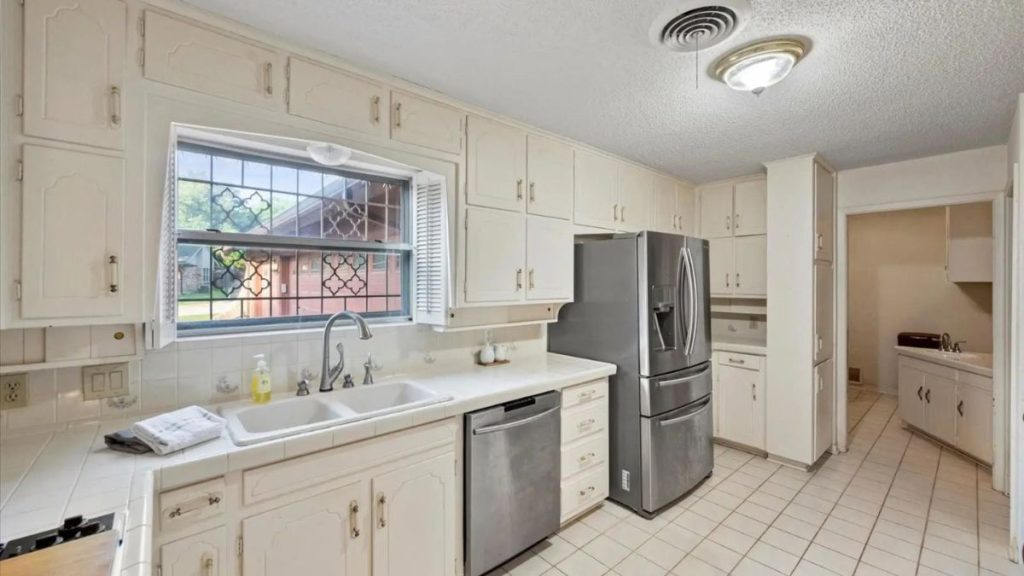
The kitchen photo is a study in contrasts. The room has a modern stainless steel French door refrigerator and a stainless steel dishwasher. Directly above them, across the entire ceiling, is a white popcorn texture that clearly dates to the original construction.
This is extremely common. Owners upgrade appliances and paint cabinets while leaving the ceiling untouched. In this kitchen, the ceiling looks sound. There are no visible water stains, cracks, or flaking areas, and the round HVAC vent and flush mount light sit cleanly within the texture.
The decorative leaded glass window and the raised panel white cabinets give this room a traditional character. Against that, the popcorn ceiling does not look out of place. It reads as a period feature. Put the same ceiling above flat panel cabinets and quartz counters and it would feel jarring. Here, the traditional style makes it work.
The Living Room: A Time Capsule
If the kitchen is a mix of eras, the large open living room is almost a pure time capsule, and the ceiling is central to that story.
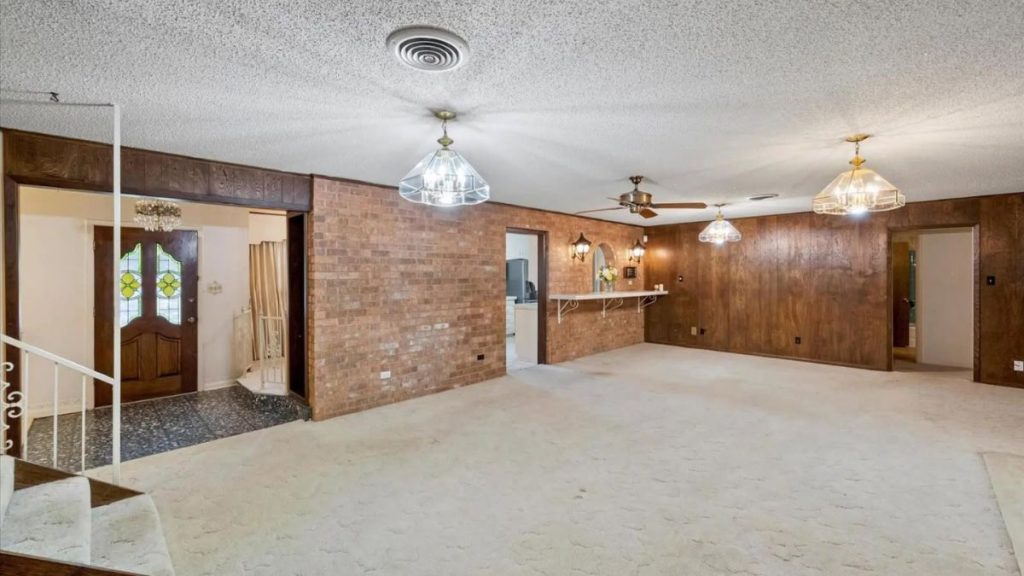
The texture here is thick and consistent across the whole expanse. Two glass pendant fixtures with brass fittings hang from it. A wood blade ceiling fan sits in the middle of the far section, and a circular HVAC vent is set into the ceiling near the front.
What makes the room striking is everything around the ceiling. The walls are dark wood paneling. A large interior brick wall divides the space. The floor is wall to wall beige carpet. The front entry door, visible through the brick opening, has green and yellow decorative glass.
Heavy, consistent texture that draws the eye the moment you walk in.
Wood paneling, brick, and carpet that belong to the same era as the ceiling.
In a room like this, the popcorn ceiling is not a standalone problem. It is part of one design vocabulary. Smooth the ceiling and you would still have the paneling, the carpet, and the fixtures. Change one without the others and the room often looks more confused, not less.
The Dining Area: Wood, Brick, and Texture in Harmony
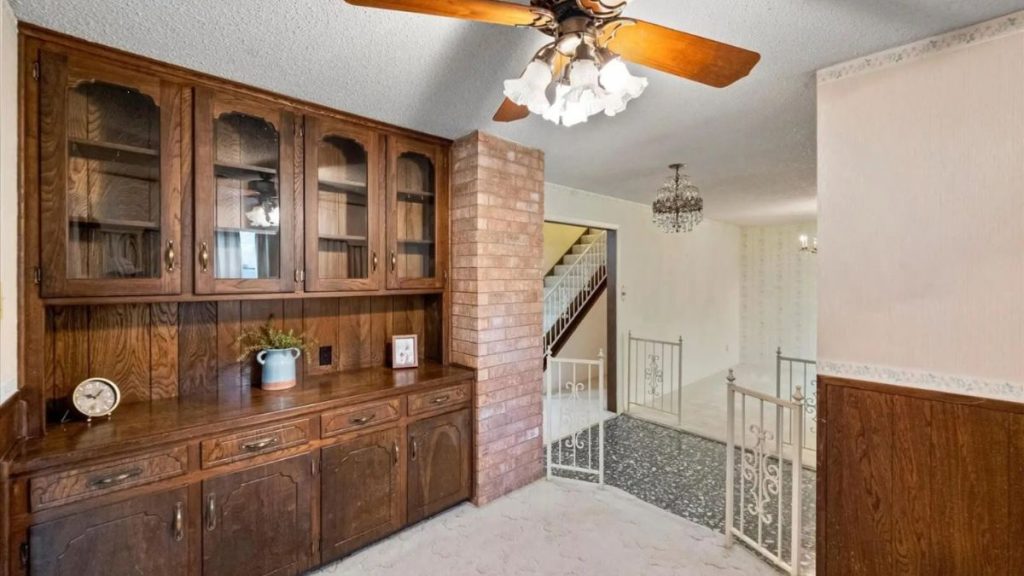
The third photo shows the dining or sitting area beside the main living space. The popcorn ceiling continues across, as it would in an open plan. A brass ceiling fan with frosted flower shaped shades hangs in the center, and a small crystal chandelier is visible in the adjoining hallway.
A large built in dark wood hutch runs nearly the full left wall. The brick pillar in the middle is the same brick used in the living room. A decorative wrought iron stair railing is visible near the entry.
The ceiling here looks clean and evenly textured, with no sagging or staining. That matters. A ceiling in good condition is an aesthetic question. A ceiling that is sagging, stained, or flaking is a different problem and should be looked at first.
The Asbestos Question
Any honest discussion of popcorn ceilings in older homes has to mention asbestos. Before 1978, many spray texture products in the United States contained asbestos fibers. Homes built before that point may still carry the original texture.
In an intact, undisturbed ceiling, the risk is generally considered low. Asbestos becomes dangerous when it is disturbed and fibers go airborne. That means scraping, sanding, or removing the texture without testing and precautions is the hazardous part.
⚠️ Watch Out
Never scrape a ceiling in an older home until a sample has been tested. A certified inspector can take the sample and send it to a lab, and that test is the cheapest step in the whole project.
Should You Remove It?
Looking at these rooms, the answer depends on condition first. If the texture is clean, firmly attached, and undamaged, as it appears to be in these photos, there is no urgent functional reason to remove it. The decision is purely aesthetic.
Cost is the second factor. Professional removal means scraping, patching and skim coating the drywall, then repainting, and pricing varies widely by region and by whether asbestos is present. Estimate your cost with popcorn estimate calculator.
Other options are worth considering. Painting the ceiling a crisp flat white makes the texture recede. Covering it with tongue and groove planks hides it entirely. A skim coat smooths the surface without a full tear out. Each one has its own cost and effort.
Final Thoughts
The homes in these photographs are honest, lived in American homes with clear fingerprints of their era.
The popcorn ceilings are not flaws so much as features, as consistent with the brick, the dark wood, the stained glass, and the brass fixtures around them.
Knowing what a popcorn ceiling is, where it came from, and how to approach it is the first step toward a smart decision about your own home.
Read more about popcorn ceiling in depth.
Frequently Asked Questions
Can I just paint over a popcorn ceiling?
Yes, but use a sprayer rather than a roller. A roller pulls at the texture and can cause pieces to flake off. Paint can also soften the material if it is applied too heavily, so thin coats work better than one thick pass. If the ceiling has never been painted, it will soak up the first coat unevenly. Painting does not remove the texture, but it can make a clean ceiling look fresher and more intentional.
How do I know if my popcorn ceiling has asbestos?
The only way to know is to have it tested. A certified inspector takes a small sample from several spots and sends it to a lab. You cannot tell by looking at it, and the age of the home is a guide but not a guarantee. If your home was built before 1978, testing is the right first step before any scraping or sanding.
Is it worth covering a popcorn ceiling instead of removing it?
Covering is worth considering when the ceiling is in good condition and you do not want the mess of scraping. Tongue and groove planks or a new layer of drywall can hide the texture completely. The trade off is lost ceiling height, so it works best in rooms with standard or high ceilings. If the ceiling is low or has water damage, removal or repair is usually the better path.