Green is having a moment in kitchen design, and it shows no sign of stopping.
The reason is simple: green sits at the intersection of natural and sophisticated in a way that most colors don’t.
Green connects a kitchen to the outdoors, works with almost every material from brass to timber to marble, and spans a shade range wide enough to suit any style of home, from a bold Victorian kitchen terrace to a minimal modern apartment.
The challenge for most people is knowing which green to choose and how far to commit.
Go too pale and the color disappears under artificial light.
Go too dark without enough contrast and the kitchen can feel heavy.

These green kitchen ideas show the full range, from a single painted island to floor-to-ceiling forest green cabinetry, from peel-and-stick rental solutions to zellige tile backsplashes that belong in a design magazine.
Every entry here is a real, workable idea with enough detail to help you decide whether it suits your space, your budget, and the style you’re building toward.
23 Green Kitchen Ideas That Prove This Color Works in Every Style of Home
1. Pair Olive Green Shaker Cabinets With Natural Rattan and Warm Wood

credits: @kasialiveingreen
Olive green is one of the most livable cabinet colors because it reads as a neutral in warm light but still adds real depth to a room.
This kitchen leans into that quality fully, pairing matte olive shaker cabinets with warm wood open shelving, a herringbone timber floor, and a tiered rattan pendant light that anchors the island.
The island itself matches the cabinetry and is topped in white, keeping it from feeling heavy.
Woven rattan bar stools, a round wood vase holding eucalyptus, and small potted plants scattered around the room reinforce the earthy, botanical mood without making the space feel overdone.
Under-cabinet lighting adds a warm amber glow that makes the whole kitchen feel inviting even in the evening.
2. Mix Sage Green Flat-Front Cabinets With a Wood-Grain Island for a Modern Two-Tone Kitchen
Two-tone kitchens work best when the contrast is deliberate rather than accidental.
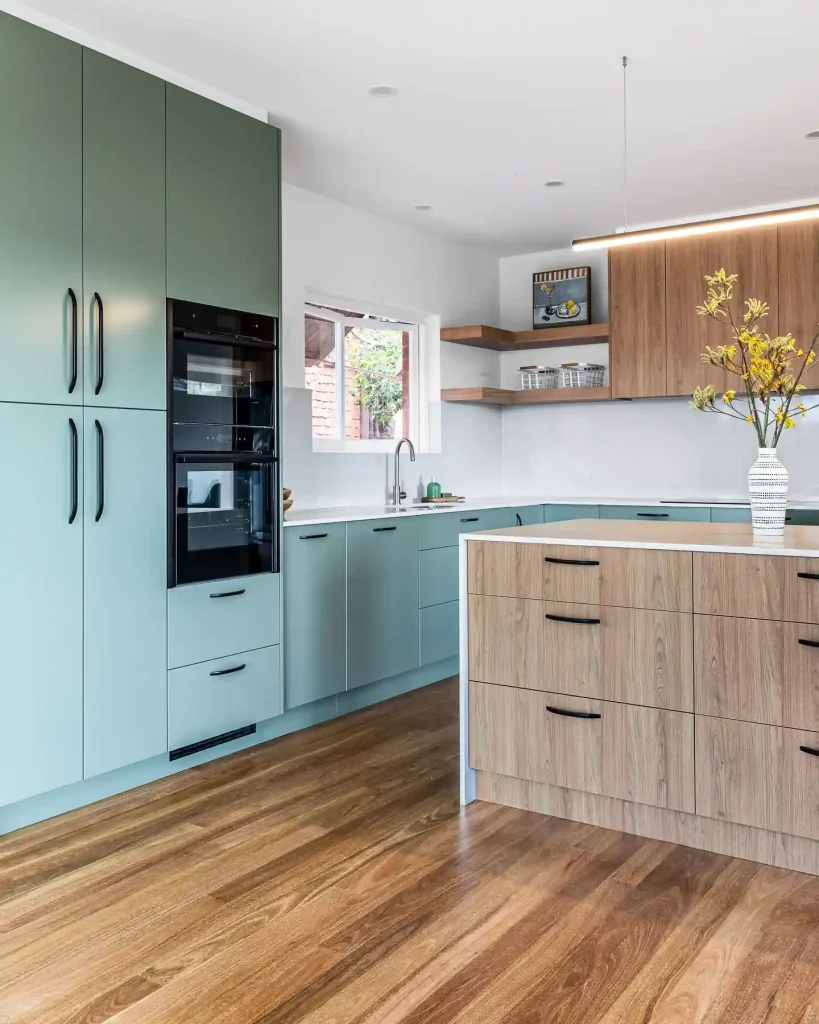
Here, flat-front cabinets in a soft sage-green cover the perimeter walls while the island takes on a warm wood-grain finish, creating a clear visual separation between cooking zone and gathering zone.
credits: @just_in_place_sydney
Black bar handles tie both finishes together without adding a third color.
The perimeter runs floor to ceiling with integrated appliances, keeping the wall of cabinetry sleek and uninterrupted. Floating wood shelves in the corner break up the upper cabinet run and add an informal display spot.
A slim LED light strip along the underside of the upper cabinets casts a clean warm line across the white countertop.
The cooler sage tone on the walls keeps the space feeling open while the wood island brings enough warmth to stop it feeling cold.
Flat-front sage green with black handles, running floor to ceiling with integrated appliances for a clean unbroken line.
Warm wood-grain finish with matching black handles and a white countertop, creating a natural contrast to the green walls.
3. Choose Deep Forest Green Cabinets
Deep forest green is the boldest move on this list and also one of the most rewarding.
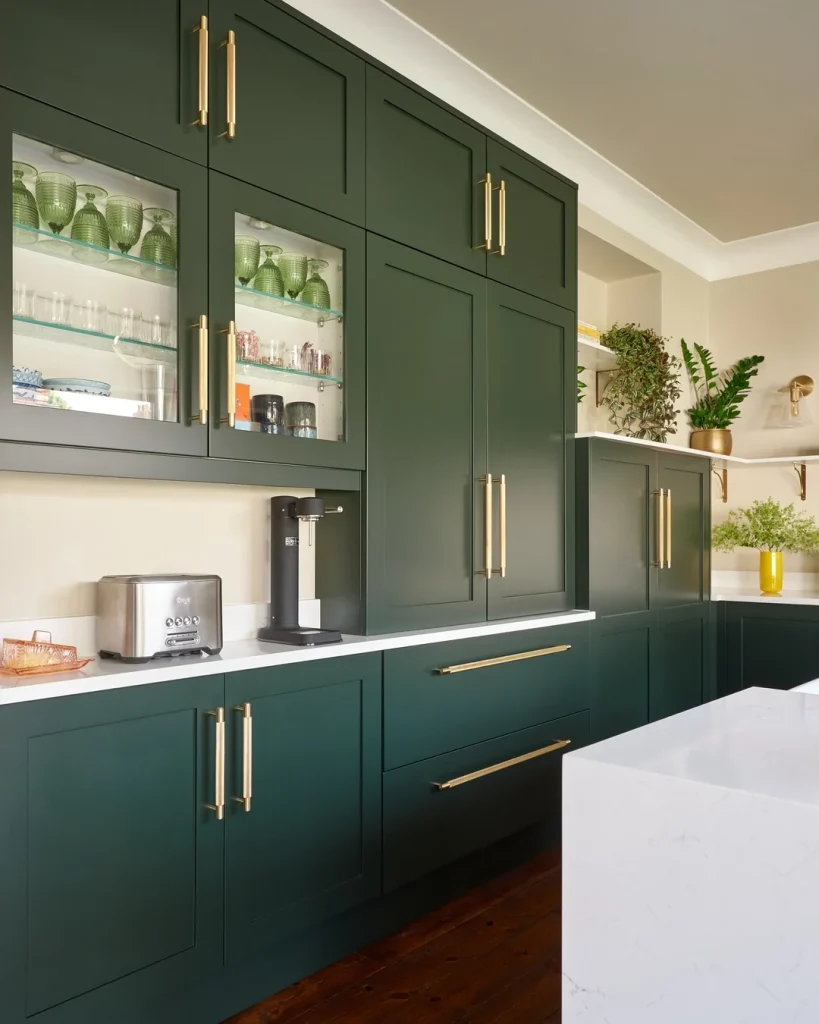
This kitchen goes all in, covering every cabinet from floor to ceiling in a rich, dark green with shaker-style fronts.
Long brass bar handles run the full height of the upper cabinets and add a warm metallic contrast that keeps the look from feeling heavy.
credits: @johnlewisofhungerford
Glass-fronted upper cabinets on one wall display green-tinted glassware that echoes the cabinet color, a clever styling detail that makes the kitchen storage itself part of the decoration.
A white marble island and cream-painted walls provide the breathing room the dark cabinetry needs, and open shelving with trailing plants on the side wall softens the overall formality of the space.
This is one of those green kitchen ideas that reads equally well in a period home and a contemporary one.
What makes deep green cabinets work
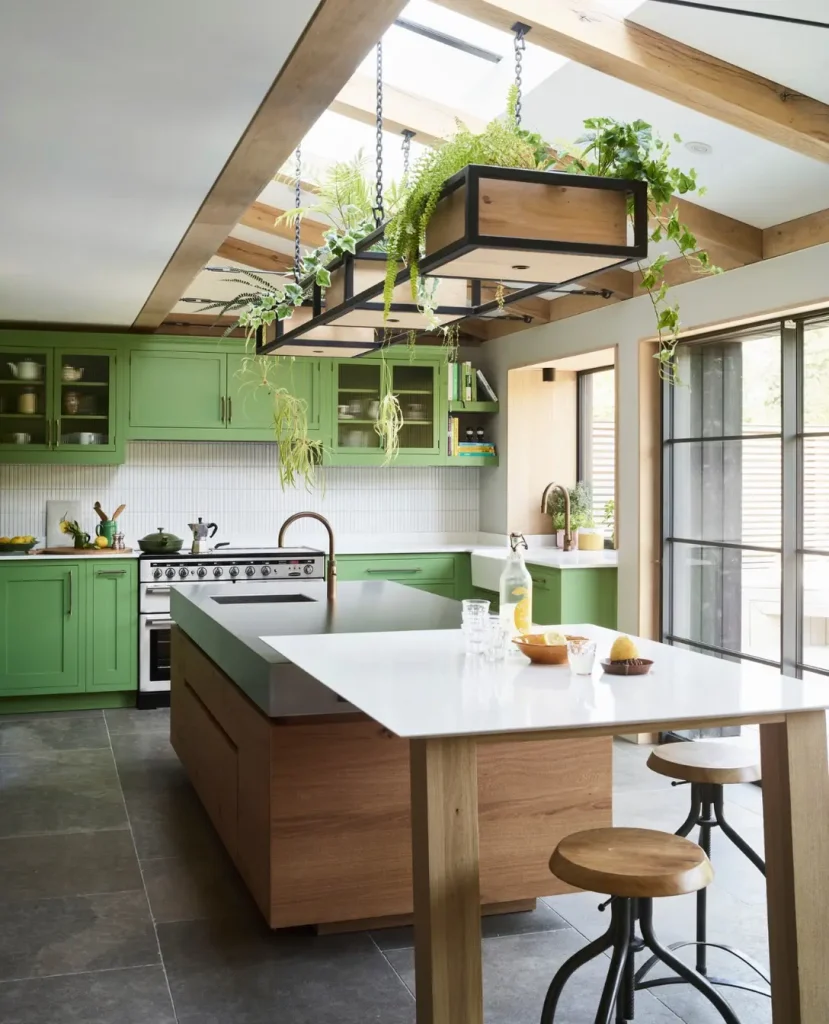
4. Hang a Ceiling-Mounted Plant Rack Above the Island
Bringing plants into a green kitchen is an obvious move. Hanging them from the ceiling above the island is the less obvious version, and it works remarkably well.
credits: @roundhouse_design
This kitchen suspends a black metal rectangular rack from chains attached to the exposed timber ceiling beams, then fills it with trailing ferns, ivy, and other cascading plants that spill down toward the island below.
The green shaker cabinets running the perimeter, a white subway tile backsplash, and a large skylighted ceiling make the whole room feel like a greenhouse crossed with a working kitchen. The wood-grain island base and adjustable industrial bar stools keep it grounded and practical.
Plants on the rack need good light to thrive, so this setup works best directly beneath a skylight or large roof window.
Position the rack directly below a skylight or roof window so the plants get enough natural light to stay healthy.
Choose trailing varieties like pothos, ivy, or string of pearls that cascade naturally without growing outward.
Avoid hanging the rack directly above a gas cooktop where steam and grease will damage the plants and the rack.
Don’t overload the rack. Three to five plants look intentional. More than that and it starts to feel unmanageable.
5. Paint a U-Shaped Kitchen in Duck Egg Green and Let a Rooflight Do the Rest

credits: @redonionkitchen
Duck egg sits right at the boundary between green and blue, which gives it a quality that pure sage green doesn’t have: it shifts depending on the light.
On a cloudy morning it reads almost teal. On a sunny afternoon it’s clearly green. That changeability makes it one of the most interesting cabinet colors to live with.
This U-shaped kitchen uses duck egg shaker cabinets on every wall with warm wood butcher-block countertops running all the way around.
A large rooflight floods the centre of the room with natural light that hits the cabinet color differently at every hour.
A geometric white tile backsplash adds subtle pattern without competing with the green.
The rooflight is what makes this room. The color does the rest.
💡 Quick Tip
Duck egg cabinets can read quite cool under artificial light. Warm-toned bulbs in ceiling recessed lights and under-cabinet strips keep the color balanced after dark.
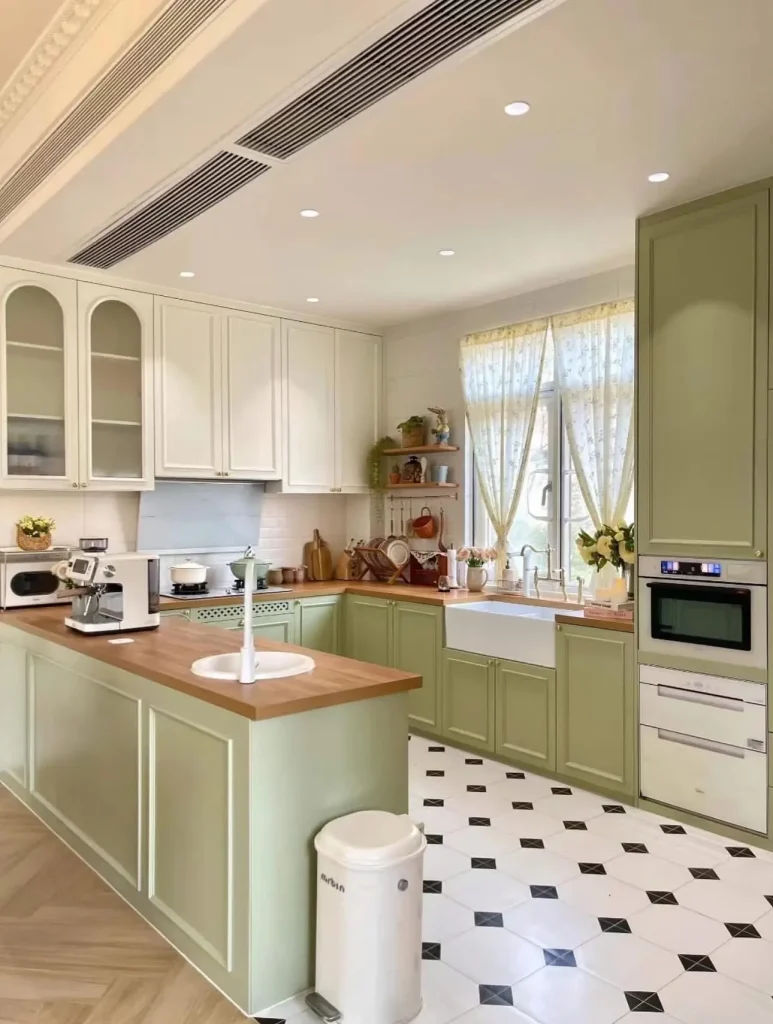
6. Mix Soft Sage Lower Cabinets With White Uppers for a Light French-Style Green Kitchen
credits: @blueheavenconstructions
Not everyone wants to commit to a fully green kitchen, and this approach is one of the most practical ways to bring the color in without it dominating.
Sage green on the lower cabinets and island only, with cream-painted uppers above, keeps the room feeling light and open while still giving it strong character.
The wood countertop running across both the perimeter and the island ties the two cabinet tones together naturally.
Arched glass-front uppers on the left wall add a French country detail that suits the soft sage perfectly. A black-and-white geometric floor tile grounds the room and prevents the soft palette from feeling too washed out.
The warm floral curtains framing the window complete the picture without any fuss.
Two-tone green and white kitchens feel softer and more timeless than an all-green kitchen, and are easier to update when tastes change.
7. Try Green Painted Brick as a Kitchen Backsplash

Painted brick brings something smooth tile simply cannot: texture.
A section of exposed brick behind the cooktop or along one wall, painted in a muted green that matches or coordinates with the cabinetry, adds depth and a slightly raw quality that keeps a kitchen from feeling too polished. It works especially well in older homes where the brick is already there under plaster.
The key is choosing a green that sits in the same tonal family as the cabinets rather than a completely different shade, so the backsplash reads as part of the room rather than a separate feature.
8. Add Green Zellige or Handmade Tiles
Zellige tiles have an uneven, slightly reflective surface that catches light in a way flat tiles never do. In green, they bring a jewel-like quality to a kitchen backsplash that reads as both earthy and luxurious.
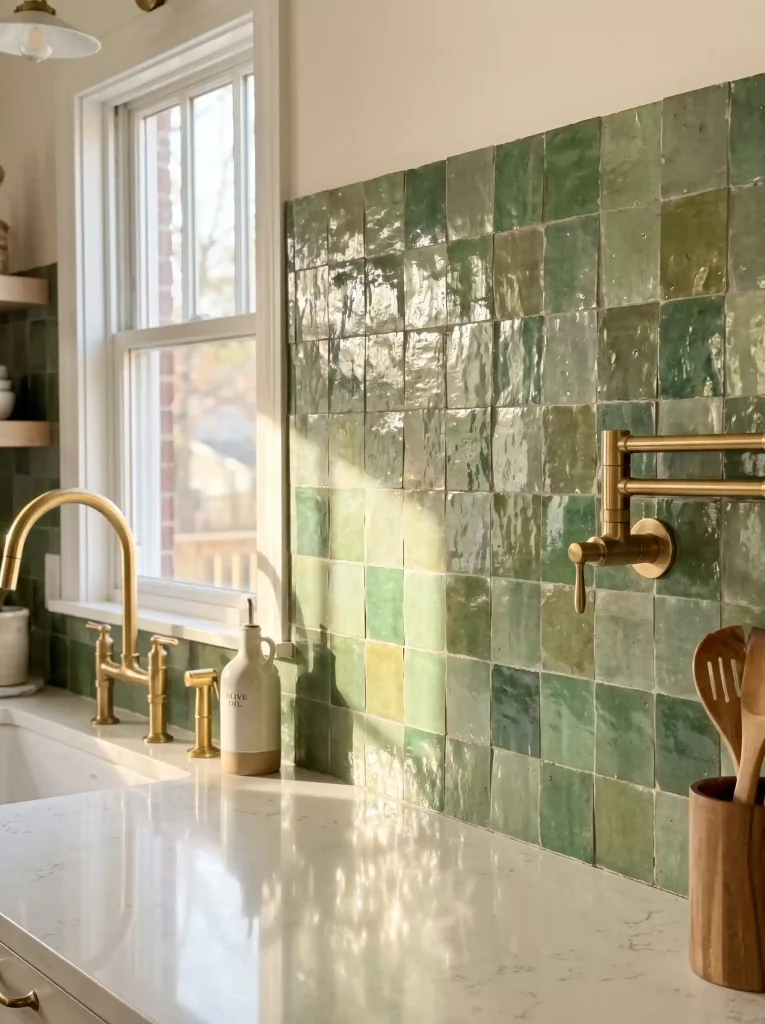
Each tile varies slightly in tone and glaze, so the overall effect has depth and movement rather than the flatness of standard ceramic.
They pair beautifully with white cabinets, cream cabinets, or natural wood, and need very little else in the room to make an impact.
Flat, uniform surface with consistent color. Clean and easy to maintain but adds little visual texture.
Slightly irregular handmade surface with tonal variation and a reflective glaze that shifts with natural and artificial light.
9. Paint Just the Kitchen Island Green
Painting the island a different color to the perimeter cabinets is one of the most accessible green kitchen ideas because it requires no full renovation.
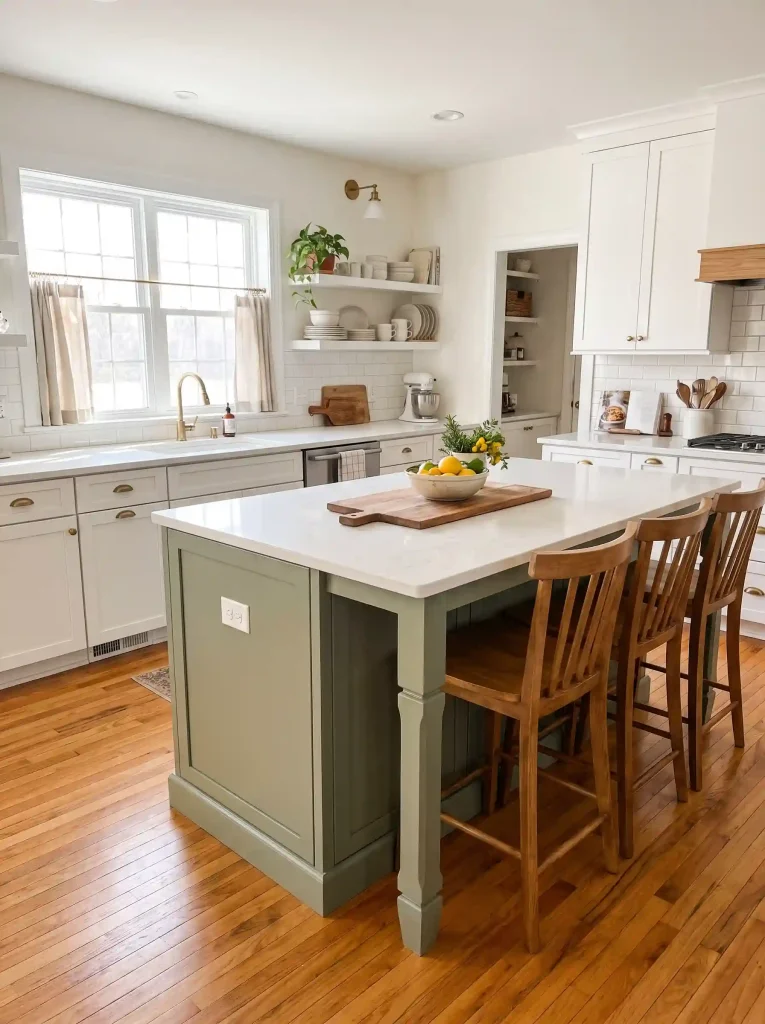
A white or cream kitchen gets an immediate focal point when the island is painted in a rich sage, forest green, or soft olive.
The rest of the room stays neutral, which means the green never overwhelms the space.
It also makes the island feel like a piece of furniture rather than built-in cabinetry, which suits open-plan kitchens especially well.
See different layouts for your kitchen to make it more beautiful.
💡 Quick Tip
Use a furniture-grade paint or a cabinet-specific finish rather than standard wall paint. Kitchen islands take a lot of daily contact and need a harder, more washable surface.
10. Use Green Grout With White Tiles to Bring Subtle Color to a Kitchen Backsplash
White subway tiles are one of the most common kitchen backsplash choices precisely because they go with everything.

Swapping the standard grey or white grout for a sage or forest green grout changes the whole character of the same tile.
The green lines become a grid pattern that reads as a deliberate design choice rather than a background detail.
It costs almost nothing extra and is one of the easiest ways to bring green into a kitchen without touching the cabinets or countertops.
Colored grout is the lowest-commitment way to introduce green into a kitchen that already has white tiles.
11. Combine Green Cabinets With Unlacquered Brass Fixtures
Unlacquered brass ages over time, developing a natural patina that makes it feel more like a material found in the kitchen than one installed in it.

Against green cabinetry, it sits warmer and softer than polished chrome or brushed nickel, and it coordinates with timber, stone, and ceramic surfaces equally well.
The combination appears in kitchens across a wide range of styles from traditional to contemporary.
The tap, cabinet handles, light fittings, and shelf brackets can all carry the same brass tone without the kitchen feeling overdone.
Where to use brass in a green kitchen
12. Bring Green Into a Rental Kitchen With Peel-and-Stick Cabinet Wraps

Not every green kitchen requires a full renovation or even a paintbrush.
Peel-and-stick vinyl wraps designed for cabinet fronts come in a wide range of green tones, from sage to forest, and apply directly over existing cabinet doors without any damage to the surface underneath. Remove them cleanly when you move out or when you want a change.
The finish has improved significantly in recent years. Many wraps now mimic a matte painted look well enough that the result is hard to distinguish from real painted cabinets in photos and in person.
13. Style Open Shelves in a Green Kitchen With Earthy Ceramics and Trailing Plants
Open shelves in a green kitchen are a chance to build a small still life.

The background color of the wall or the cabinet fronts already sets the tone, so what sits on the shelf just needs to coordinate rather than match.
Earthy terracotta pots, cream and white ceramics, wooden bowls, and a trailing plant or two create a layered, collected feeling that keeps the shelves from looking like pure storage.
Group items in odd numbers. Leave some breathing room between objects. Resist the urge to fill every inch.
14. Add a Green Kitchen Island With Seating
An island does two jobs at once when one side is open for seating.
During meal prep the cook faces the kitchen. Guests or family members sit on the opposite side at bar height, which puts them at conversation level without getting in the way.
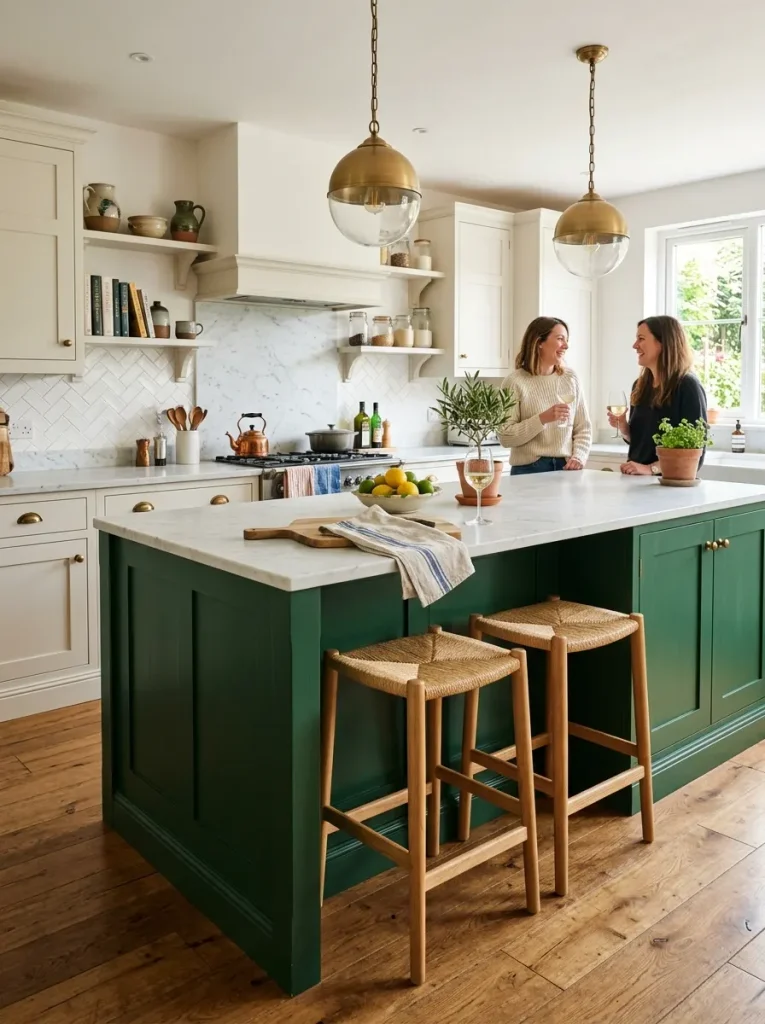
A green island in a mostly neutral kitchen becomes the gathering point of the whole room, the place everyone ends up regardless of whether food is being made.
Choose a green that reads as a furniture color rather than a paint color.
Deeper, more saturated tones tend to work better for islands than pale ones because they hold their own against the surrounding cabinetry.
15. Use Green on the Ceiling or Cornice to Frame
Most people think about color on the walls or cabinets and completely overlook the ceiling.
Painting the ceiling or the cornice line in a soft green pulls the eye upward and gives the room a sense of enclosure that makes it feel more deliberate and finished.
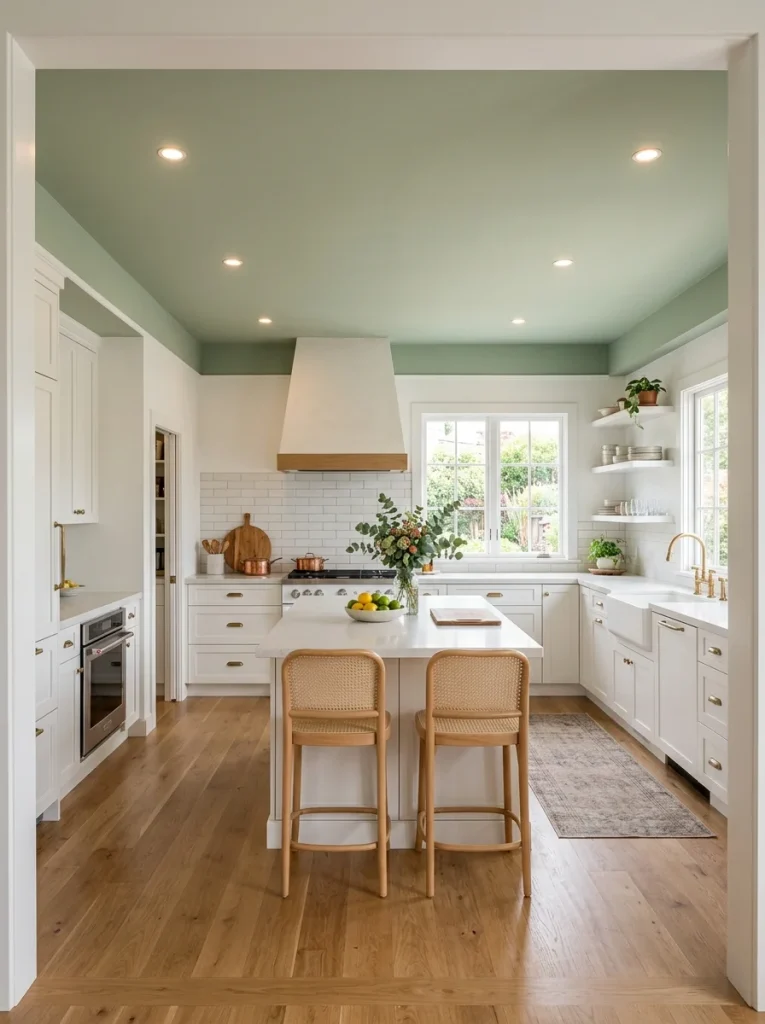
In a white kitchen it reads as a frame rather than a full color commitment, which keeps the room light while still adding character.
Sage and soft olive work best for this since they’re gentle enough not to make the ceiling feel oppressive.
Deep green on a ceiling is a bolder move that suits a larger kitchen with good natural light.
16. Pair Dark Green Cabinets With Black Countertops

Dark green and black sit close enough in tone to create a near-monochromatic effect, which gives a kitchen a sense of depth and drama that lighter combinations simply cannot match.
The countertop reads as an extension of the cabinetry rather than a contrasting surface, and the whole room feels unified and intentional.
Breaking it up is simple: a brass or gold tap, a light wood floor, or a cream-painted wall is enough to stop the dark palette from closing in. One light element goes a long way in a room this deep in color.
17. Combine Green Cabinets With a Butcher Block Countertop
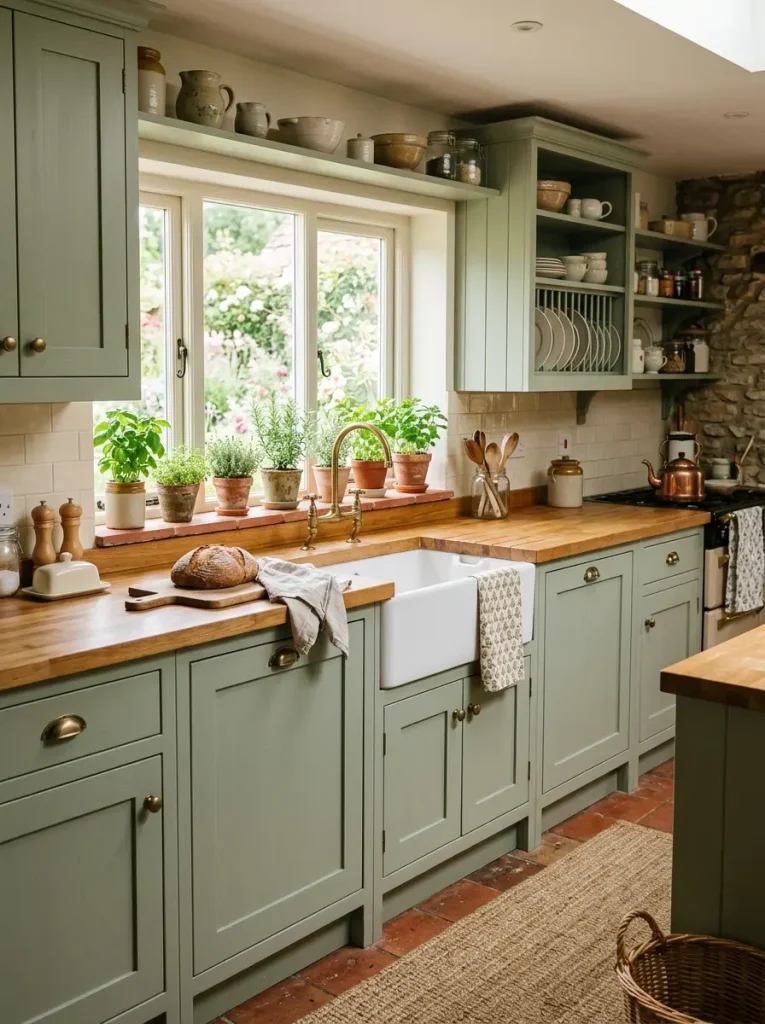
Butcher block and green cabinets is one of those combinations that looks like it took careful planning but actually comes together very naturally.
The warm honey tones of the wood pull the green toward the earthy end of the spectrum, which suits cottage, farmhouse, and country-style kitchens especially well. The countertop also brings a tactile quality that stone and quartz lack.
Oil the wood regularly to keep it from drying out and cracking along the grain. A well-maintained butcher block countertop deepens in color over years of use and looks better for it.
💡 Quick Tip
Oil your butcher block countertop every few months with food-safe mineral oil. It takes about 10 minutes, keeps the wood from drying out, and deepens the color beautifully over time.
18. Go for Green and Pink in the Kitchen for a Retro

Green and pink sit opposite each other on the color wheel, which is exactly why they work.
In a kitchen the combination reads as retro without being kitschy, especially when the tones are muted rather than saturated.
Dusty rose or blush pink accessories against sage or olive green cabinetry bring warmth and personality that neutral kitchens rarely achieve.
Start small with pink before committing. A set of blush ceramic mugs, a pink kettle, or a dusty rose pendant shade alongside green cabinets is enough to test whether the combination suits the room.
19. Install Green Kitchen Cabinets

Cabinets that stop short of the ceiling leave a gap that collects dust and visually breaks the room.
Carrying them all the way to the ceiling does two things at once: it adds storage height and makes the room feel taller.
In green, a full-height cabinet run is especially striking because the color has more surface area to work with and the room reads as a complete, considered space rather than a kitchen that ran out of budget at the top.
This works in rooms of almost any ceiling height. Low ceilings benefit because the unbroken vertical line draws the eye upward.
20. Pair Green Cabinets With Terrazzo Flooring for a Playful Yet Sophisticated Kitchen
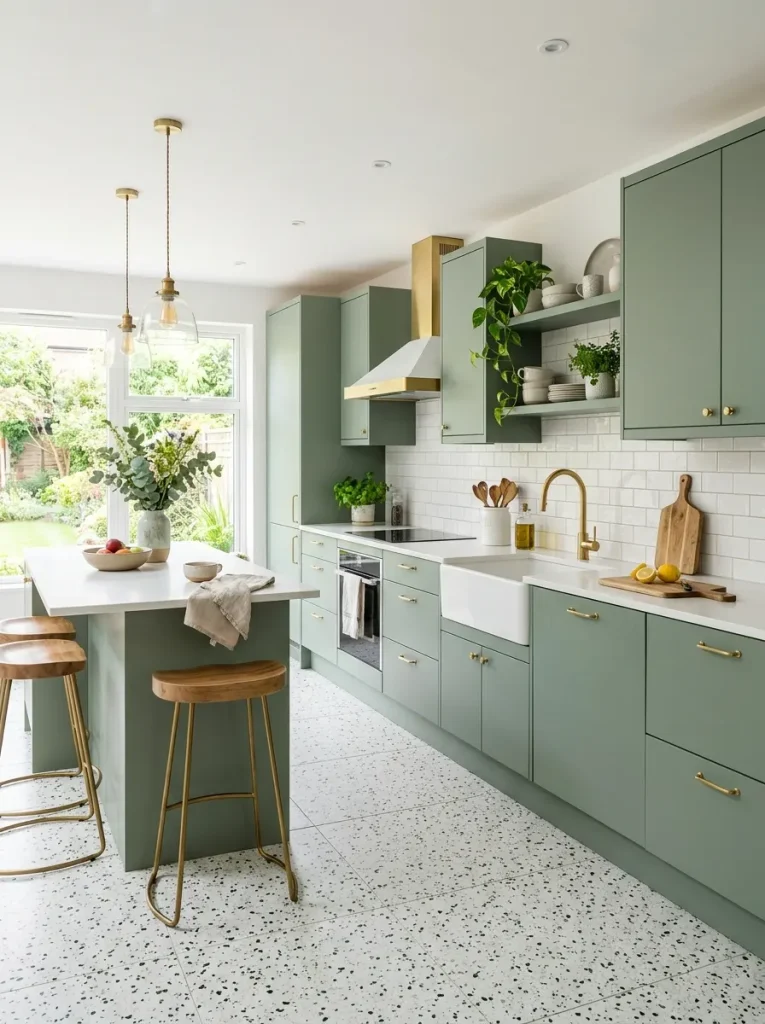
Terrazzo floors have enough going on visually that they need a strong cabinet color to hold their own against them.
Green is one of the best choices because most terrazzo patterns include at least some green chips, which ties the floor and the cabinets together without any additional effort.
The combination feels playful and considered at the same time, which is a hard balance to strike in a kitchen.
Choose a terrazzo with a light base and small to medium chips rather than a busy pattern with large pieces, which can compete too aggressively with the cabinetry.
21. Use Green on a Single Accent Wall Behind Open Shelving to Anchor the Kitchen

Painting one wall green rather than the cabinets is the softest commitment on this list and also one of the most effective for renters or anyone not ready for a full cabinet repaint.
A deep sage or olive wall behind a run of open shelving makes the shelf contents pop and gives the kitchen a clear focal point without touching a single cabinet door.
The shelves themselves stay natural wood or white. The wall does the heavy lifting.
22. Bring in Green Through Appliances Like a Colored Range or Retro Fridge
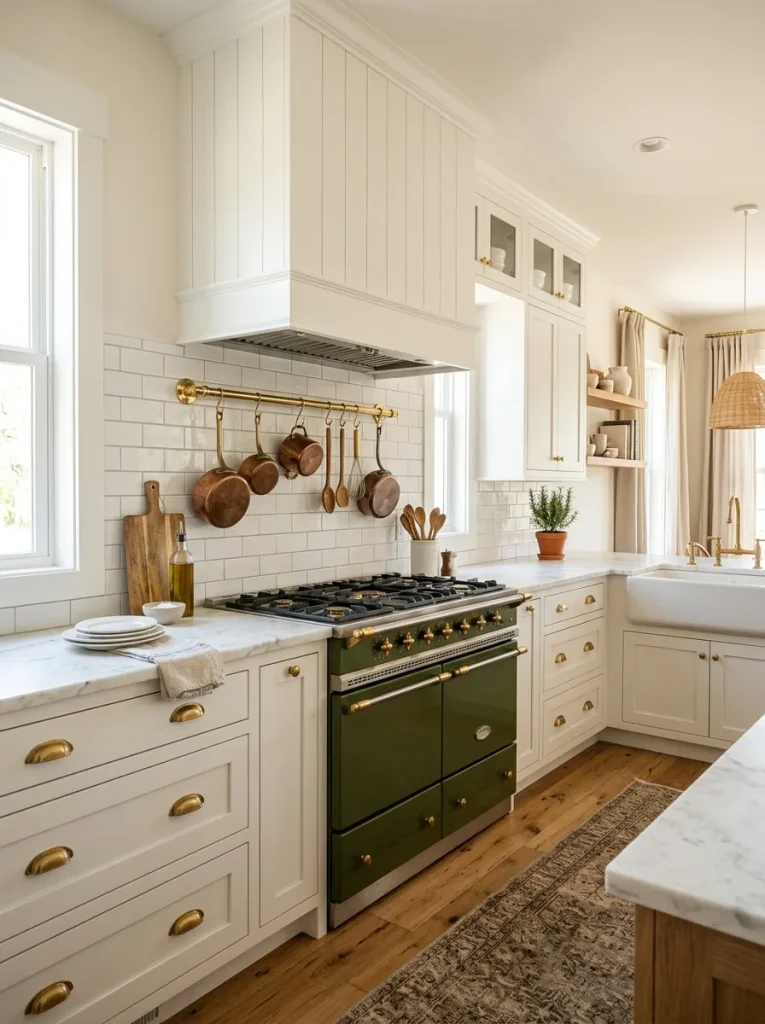
Cabinet paint is not the only route to a green kitchen.
A colored range cooker in olive, sage, or British racing green becomes the centerpiece of a neutral kitchen without any structural changes.
Similarly, a retro-style fridge in a green tone adds personality and color to a white or grey kitchen in a way that is completely reversible.
Colored appliances work best when the rest of the kitchen is deliberately neutral. If the cabinets, countertops, and walls compete for attention, the appliance loses its impact.
23. Layer Multiple Shades of Green in One Kitchen for a Tonal, Garden-Inspired Look

Most green kitchens use a single shade throughout.
Using two or three tones of green together, darker on the lower cabinets, a mid-tone on the island, and a lighter wash on the walls or upper cabinets, creates a layered effect that feels more like a garden than a showroom.
The tones stay within the same green family so nothing clashes, but the variation keeps the eye moving around the room.
This approach suits larger kitchens best since smaller spaces can feel busy when multiple tones compete in a tight footprint.
Frequently Asked Questions
What shade of green works best for kitchen cabinets?
It depends almost entirely on the light in your kitchen and the other materials around it. Sage and olive greens are the most forgiving because they sit in the warm neutral zone and work with timber, brass, stone, and white equally well.
Does green work in a small kitchen?
Yes, with the right approach. Lighter greens like sage, mint, and soft olive keep a small kitchen feeling open. If you want a darker green in a compact space, use it only on the lower cabinets and keep the uppers white or cream to draw the eye upward. A single green accent wall or a painted island also bring the color in without closing the room down.
What hardware finish works best with green kitchen cabinets?
Brass and unlacquered bronze are the most popular choices because they bring warmth that balances the cool or earthy quality of most green tones.
Can I add green to a kitchen without repainting the cabinets?
Absolutely. Green grout with existing white tiles, a colored range cooker, a retro-style green fridge, peel-and-stick cabinet wraps, open shelving styled with green ceramics and plants, or a single painted accent wall all bring green into a kitchen without touching the cabinet color.
What colors pair well with green in a kitchen?
White and cream are the most reliable partners since they provide contrast without competing. Warm wood tones in floors, countertops, or shelving complement almost every shade of green.
Conclusion
Green is one of the few kitchen colors that genuinely suits every style, every budget, and almost every size of space.
The shade you choose and how much of it you use are the two decisions that shape everything else.
Start with the idea on this list that feels most achievable right now, whether that’s a painted island, a colored appliance, or a full cabinet repaint in the green you’ve been thinking about for months.
Save this post so you can come back to it when you’re ready for the next step.