You want a living room that makes guests stop in the doorway and genuinely catch their breath?
A Victorian living room is the most atmospherically rich, visually dramatic, and deeply personal interior design style ever created. It layers color, pattern, texture, and collected objects into a space that feels simultaneously grand and genuinely livable.

These 32 practical steps will guide you through creating a breathtaking Victorian living room that stops being a room you merely inhabit and becomes one you genuinely love.
1. How to Understand the Victorian Living Room Philosophy
The Victorian living room — called a parlour or drawing room in the period itself — was the most important public room in the entire Victorian home. It was the space where social life happened, where cultural accomplishments were displayed, and where the family presented its best face to visiting guests.
Understanding this social function helps every subsequent design decision feel purposeful and authentic rather than merely decorative.
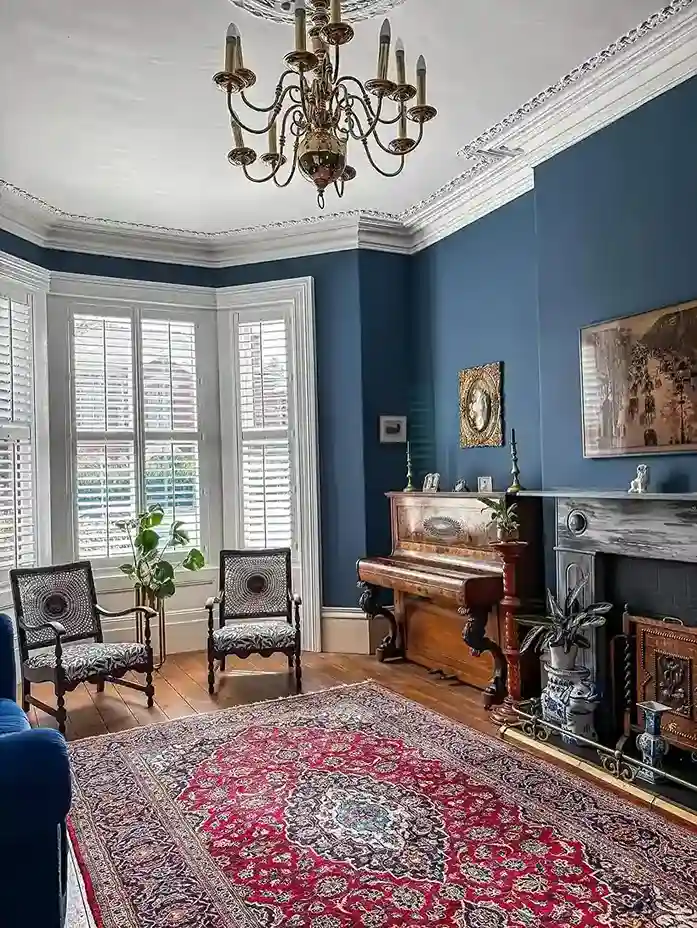
The Victorian living room celebrated abundance, personal collection, and the layering of beautiful objects as an expression of cultural refinement and social success.
Nothing was minimal, nothing was understated, and every surface participated in the overall decorative scheme of the room. The guiding principle was that more beauty created more comfort and that a richly furnished room demonstrated both taste and prosperity to all who entered.
| Victorian Living Room Principle | Design Application |
|---|---|
| Abundance over minimalism | Layer multiple patterns and objects |
| Personal collection displayed | Art, curiosities, family objects |
| Every surface participates | Walls, floor, ceiling all decorated |
| Social impression matters | Best furniture faces the entrance |
2. How to Choose an Authentic Victorian Color Palette
Color is the single most transformative element in creating an authentic Victorian living room atmosphere. The Victorians approached color with bold confidence and sophisticated understanding of how rich, saturated tones create warmth, intimacy, and visual drama. Getting the color palette right from the very beginning makes every subsequent design decision easier and more cohesive.

Deep jewel tones — forest green, burgundy, sapphire blue, plum, and terracotta — dominate the Victorian living room palette for walls and large upholstered pieces. These rich saturated colors are paired with warm cream or ivory for painted woodwork, cornices, and ceiling which creates essential visual relief against the deeper wall tones. Gold, aged brass, and antique copper run through all metallic accents as the warm connective thread.
| Victorian Living Room Color | Application |
|---|---|
| Forest green walls | Richest, most classic Victorian |
| Deep burgundy walls | Warm, intimate, traditional |
| Sapphire blue walls | Dramatic, sophisticated |
| Warm cream woodwork | Universal, essential contrast |
| Gold metallic accents | Hardware, frames, accessories |
3. How to Select Victorian Wallpaper for the Living Room
Victorian wallpaper transforms a plain modern room into an authentically period space faster than virtually any other single intervention. The Victorians considered patterned wallpaper essential to any properly furnished room and their wallpaper designs remain some of the most beautiful ever created. A genuine William Morris design or a quality period reproduction immediately announces Victorian intent with unmistakable authority.
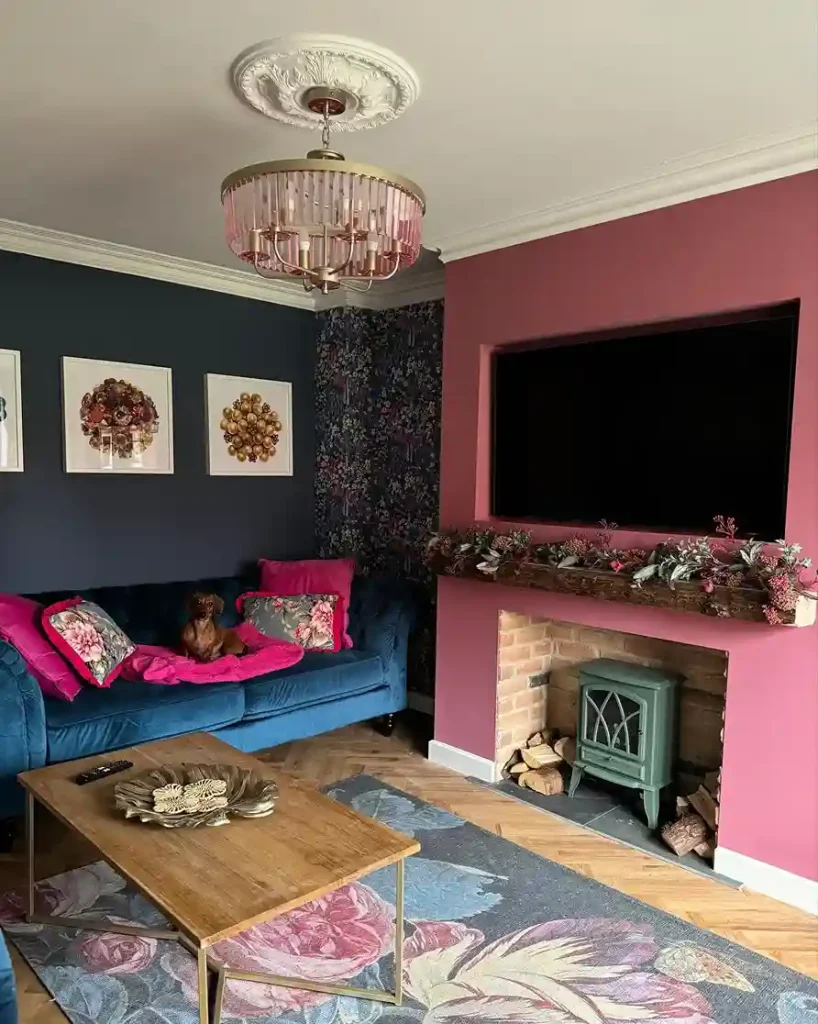
Choose botanical prints, pomegranate patterns, damask repeats, or Arts and Crafts-inspired designs for the most period-accurate living room wallpaper. William Morris designs remain available as licensed reproductions and represent the very pinnacle of Victorian decorative design philosophy. Use wallpaper on all four walls for a fully immersive Victorian atmosphere or limit it to a single chimney breast feature wall for a more accessible contemporary interpretation of the style. Explore vintage cottage decor for complementary decorative approaches that pair beautifully with Victorian living room wallpaper.
| Victorian Wallpaper Pattern | Period Reference |
|---|---|
| William Morris botanical | Arts and Crafts movement |
| Pomegranate or acanthus | Classic mid-Victorian |
| Damask repeat | Formal Victorian parlour |
| Chinoiserie design | Victorian orientalism |
| Geometric tile pattern | Early Victorian formality |
4. How to Install Victorian Architectural Molding Details
Decorative architectural molding is one of the most impactful and most permanent ways to establish Victorian authenticity in any living room. The Victorians applied molding with great enthusiasm to ceilings, walls, and floors as an expression of architectural craftsmanship. Even modest molding additions create an immediate and significant increase in the period character and perceived quality of the room.
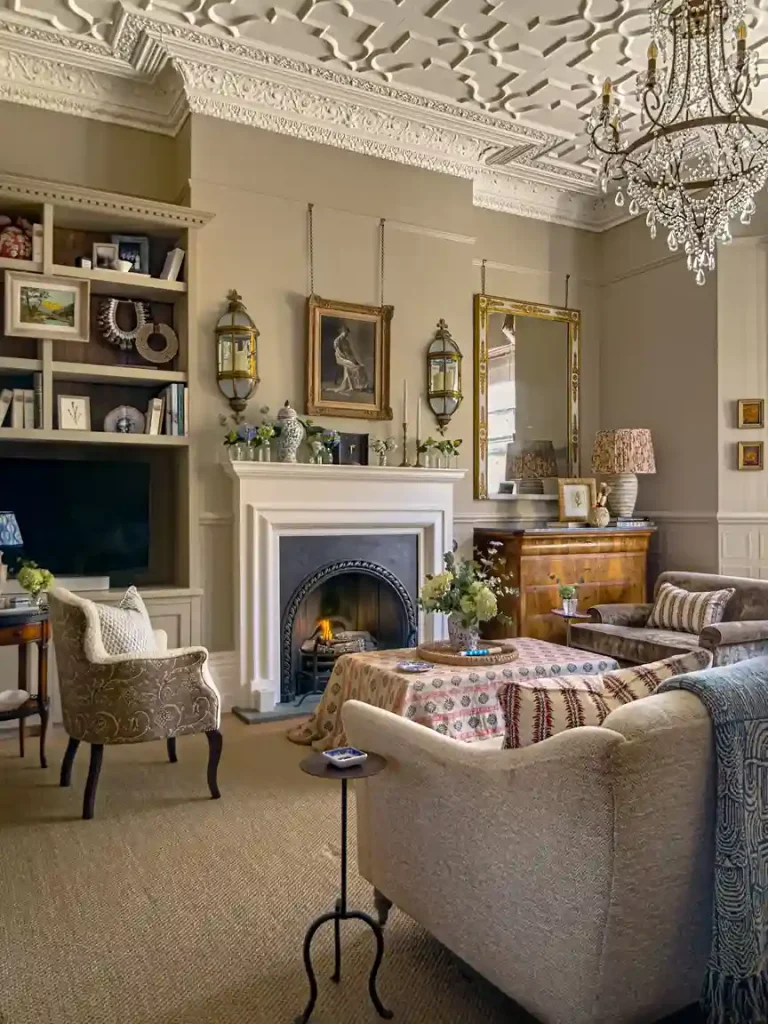
Install a decorative plaster ceiling rose around the central light fitting as the single most impactful molding addition available. Add crown or coving molding at the ceiling and wall junction around the entire room perimeter. Install a picture rail approximately 12 to 18 inches below the crown molding for flexible artwork hanging without wall damage. Add a dado rail at approximately one-third wall height to create the two-zone wall treatment that is central to the Victorian decorative vocabulary.
| Victorian Molding Detail | Installation Location |
|---|---|
| Ceiling rose | Around central light fitting |
| Crown or coving molding | Ceiling and wall junction |
| Picture rail | 12–18 inches below crown |
| Dado rail | One-third of wall height |
| Deep skirting board | Floor and wall junction |
5. How to Choose a Victorian Sofa and Seating Arrangement
The seating arrangement in a Victorian living room was a carefully considered social statement as much as a practical furniture placement decision. Victorian parlours typically featured a formal arrangement of multiple seating pieces arranged to facilitate conversation while allowing movement around the room. The sofa and armchairs faced each other or angled toward the fireplace as the primary focal point of the entire room.

Choose a Chesterfield sofa, a camelback sofa, or a tufted settee in a rich fabric for the most authentically Victorian living room seating. Deep button tufting in velvet, wool, or high-quality brocade creates the most period-appropriate upholstered seating surface. Add a pair of matching upholstered armchairs flanking the fireplace and one or two smaller occasional chairs for additional seating that completes the formal Victorian conversation group.
| Victorian Living Room Sofa | Upholstery Choice |
|---|---|
| Chesterfield deep button | Velvet, leather, or wool |
| Camelback curved sofa | Damask or brocade |
| Tufted settee | Jewel-toned velvet |
| Parlour chair pair | Matching upholstered frame |
| Occasional chair | Contrasting but complementary |
6. How to Design a Victorian Fireplace as the Room’s Focal Point
The fireplace was the absolute heart of the Victorian living room around which every other furniture and decorative decision revolved. The Victorians invested significantly in elaborate fireplace surrounds, decorative tile inserts, and ornate overmantel displays because they understood the fireplace’s unrivalled power as a room focal point. Getting the fireplace right is the single most important design priority in any Victorian living room project.

Choose a marble or painted wood fireplace surround with ornate carved detailing and decorative tile inserts in the sides and hearth. Cast iron fireplace inserts with botanical or geometric cast detailing are the most authentically Victorian option for the firebox itself. The overmantel — the decorative structure rising above the mantel shelf — provides display space for mirrors, artwork, and collected objects that makes the fireplace wall the most richly decorated surface in the entire room.
| Victorian Fireplace Element | Design Detail |
|---|---|
| Marble surround | White, black, or coloured marble |
| Painted wood surround | Carved, cream or white painted |
| Cast iron insert | Botanical or geometric casting |
| Decorative tile sides | Blue and white, terracotta |
| Overmantel structure | Mirror, shelves, carved detail |
7. How to Style a Victorian Living Room Mantel
The Victorian living room mantel was the most decorated and most carefully arranged surface in the entire room. It functioned as a personal showcase for the family’s most beautiful and most meaningful objects. Styling the mantel correctly creates the room’s most powerful focal point and communicates more about the character and taste of the household than any other single decorative arrangement.

Place a large ornate mirror or an elaborate overmantel painting above the mantel as the primary visual backdrop. Arrange candlesticks in varying heights symmetrically toward the outer edges. Add a decorative clock at the center as the primary functional and focal object. Include small vases with flowers or botanical stems, framed photographs or miniatures, and one or two carefully chosen curiosity objects to complete the richly layered Victorian mantel tableau.
| Victorian Mantel Layer | Positioning Strategy |
|---|---|
| Overmantel mirror or painting | Directly above mantel shelf |
| Decorative clock | Center of mantel surface |
| Candlestick pairs | Symmetrically on either side |
| Vases with flowers or stems | Outer edges, organic element |
| Small framed objects | Leaning against mirror base |
8. How to Choose Victorian Living Room Lighting
Victorian living room lighting created an atmosphere of warm, intimate, slightly theatrical glow that is entirely at odds with the bright, even illumination that modern lighting systems typically produce. Replicating this specific quality of light is enormously important to the overall atmosphere of a Victorian living room. The right lighting transforms a room that looks Victorian in the daytime into one that feels genuinely Victorian in the evening.
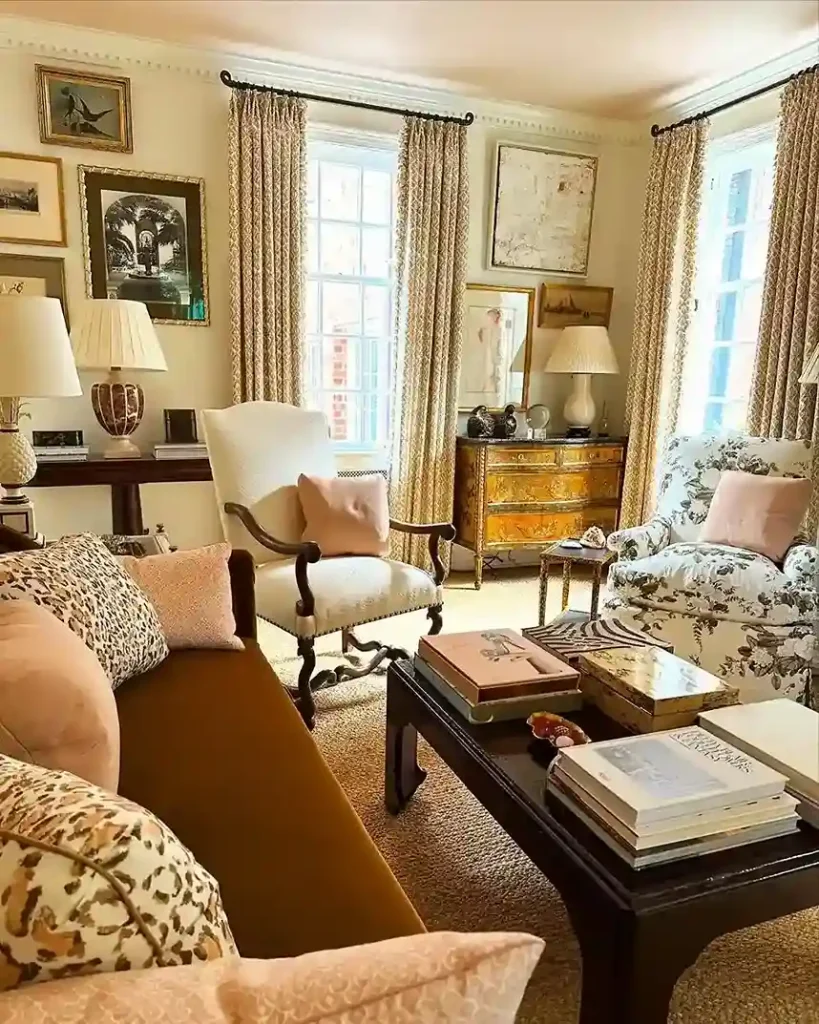
Choose a large decorative ceiling chandelier or pendant with multiple light sources for the primary living room illumination. Add wall-mounted bracket lights in aged brass or antique bronze at regular intervals around the room. Use table lamps with fabric shades in warm amber or cream tones on side tables and occasional tables throughout. Fit all fixtures with warm Edison-style LED bulbs between 2200K and 2700K for the most period-appropriate amber glow.
| Victorian Living Room Light | Fixture Style |
|---|---|
| Central chandelier | Ornate, multiple arms |
| Wall bracket lights | Brass, candle-style |
| Table lamp with fabric shade | Amber or cream shade |
| Picture light over artwork | Brass, directed beam |
| Candlesticks on mantel | Real or battery candles |
9. How to Choose Victorian Living Room Flooring
Victorian living room flooring combines the warmth and beauty of natural materials with the richly patterned overlay of decorative carpeting. The combination of dark-stained hardwood boards with large patterned area rugs or fitted carpet creates the layered floor treatment that is most authentic to the period. This approach adds depth and richness to the room from the floor upward that significantly contributes to the overall Victorian atmosphere.

Dark-stained oak or pine boards in the original house provide the most authentic floor base. Where original floorboards are not present, dark-stained engineered hardwood or luxury vinyl plank in a dark wood tone provides an excellent alternative. Layer with a large Turkish, Persian, or Axminster-style carpet in deep jewel tones covering the central floor area with dark boards visible around the perimeter for the most classically Victorian floor treatment.
| Victorian Living Room Floor | Carpet Overlay |
|---|---|
| Dark stained oak | Turkish medallion carpet |
| Ebony stained pine | Persian floral carpet |
| Dark engineered hardwood | Axminster geometric |
| Original Victorian tiles | No carpet, tiles exposed |
10. How to Create a Victorian Gallery Wall
A Victorian gallery wall in the living room celebrates the period passion for collected art, family portraits, and decorative objects displayed with enthusiastic abundance on every available wall surface. The Victorians hung pictures in tightly clustered groups at multiple heights, overlapping frames, and in every available wall space including above picture rails and beside chimney breasts. A properly executed Victorian gallery wall is one of the most visually powerful statements in any period living room.

Mix oil paintings or quality prints in ornate gilded frames with botanical illustrations, portrait miniatures, decorative mirrors, and three-dimensional wall-mounted objects in an asymmetric arrangement. The picture rail makes rearranging and adding to the gallery wall flexible without wall damage. The Victorian principle of aesthetic abundance applies directly — the gallery wall should feel rich and layered rather than minimal and curated. Find complete gallery wall inspiration from French country decor ideas for layering artwork and decorative objects that complement the Victorian aesthetic beautifully.
| Victorian Gallery Wall Element | Frame Choice |
|---|---|
| Landscape oil painting | Large ornate gilded frame |
| Botanical illustration | Dark mahogany or gilt |
| Portrait print or painting | Period-appropriate ornate |
| Decorative mirror | Carved gilded frame |
| Needlework sampler | Simple dark wood frame |
11. How to Choose Victorian Living Room Curtains
Victorian living room window treatments were among the most elaborate textile constructions in the entire home. Multiple layers of curtaining served both practical purposes — light control, warmth, privacy — and the purely decorative purpose of communicating the household’s commitment to beautiful domestic furnishing. Replicating this multi-layered approach creates one of the most immediately impressive Victorian living room features.
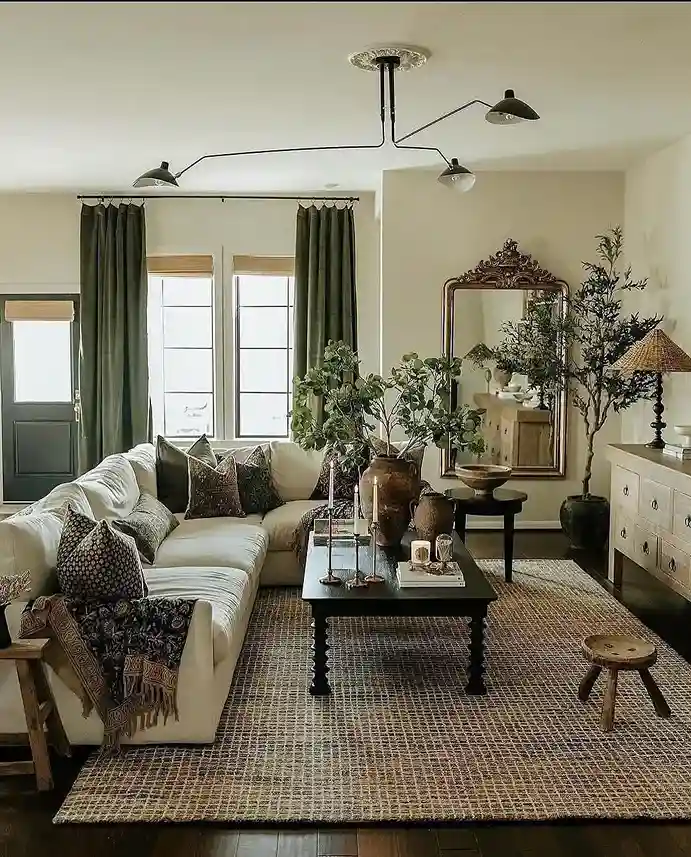
Use sheer white lace or muslin under-curtains across the full width of the window for daytime privacy while maintaining natural light. Over-curtains in heavy velvet, damask, or brocade in a rich jewel tone hang from an ornate brass curtain pole with decorative finials. A fabric pelmet or lambrequin above the curtains adds a formal architectural quality to the window treatment. Tassel tiebacks in gold or brass hold the over-curtains elegantly to either side during daylight hours.
| Victorian Curtain Layer | Fabric and Finish |
|---|---|
| Sheer under-curtain | White lace or muslin |
| Heavy over-curtain | Velvet, damask, or brocade |
| Pelmet or valance | Matching or contrasting fabric |
| Tassel tiebacks | Gold or brass coloured |
| Curtain pole | Brass with ornate finials |
12. How to Add Victorian Occasional Tables and Furniture
Beyond the primary sofa and armchair group, the Victorian living room contained a rich collection of occasional tables, cabinets, display cases, and freestanding furniture pieces that served both practical and decorative purposes. This secondary layer of furniture creates the layered, fully inhabited quality that distinguishes an authentic Victorian room from a merely period-inspired one. Each piece tells part of the room’s story.
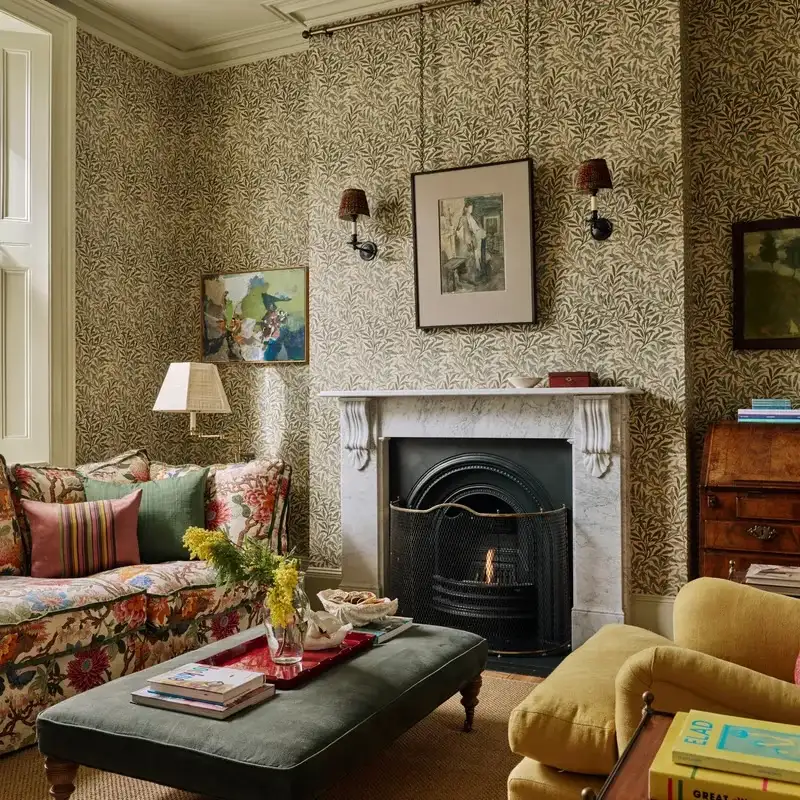
Add a pair of ornate side tables beside the sofa and armchairs for lamp and teacup placement. Include a small writing desk in one corner for letter-writing and practical daily tasks. A whatnot shelf or étagère for displaying collected curiosities in a corner adds vertical decorative interest. A low central occasional table or a Victorian parlour table gives the seating group a functional center without the heavy footprint of a modern coffee table.
| Victorian Occasional Furniture | Function |
|---|---|
| Ornate side tables | Lamp and teacup placement |
| Corner whatnot étagère | Curiosity and object display |
| Small writing desk | Letter writing, daily tasks |
| Parlour center table | Central seating group anchor |
| Canterburys music stand | Magazine and sheet music |
13. How to Create a Victorian Display Cabinet or Whatnot
The display cabinet or whatnot shelf was one of the most characteristically Victorian furniture pieces in the parlour. It provided dedicated space for the display of collected curiosities, decorative ceramics, travel souvenirs, and beautiful objects that the Victorians accumulated with enormous enthusiasm. A properly stocked and styled display cabinet is one of the most authentically Victorian additions to any living room.
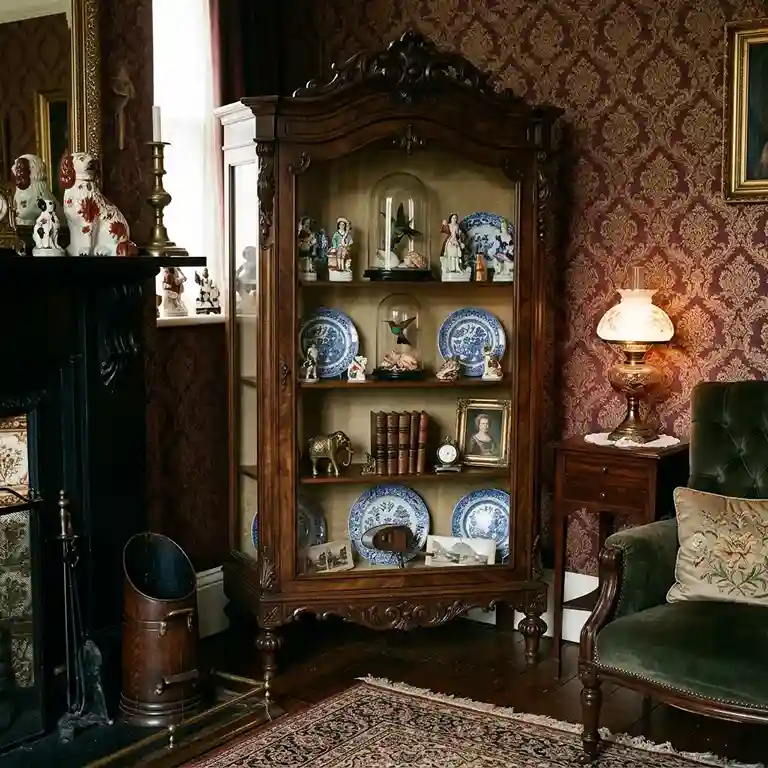
Choose a glazed cabinet with ornate carved wooden detailing or a corner whatnot shelf with multiple display tiers for the most Victorian display furniture. Style the interior with collections of decorative ceramics, miniatures, shells, geological specimens, small bronzes, and glass objects. Arrange by size and visual weight rather than by strict category for the most naturally Victorian, collected appearance. Vary heights using small stands and risers within the cabinet for visual interest.
| Victorian Display Cabinet Contents | Display Strategy |
|---|---|
| Decorative ceramics | Grouped by size and colour |
| Geological specimens | Mixed with miniatures |
| Travel souvenirs | Personal and collected |
| Small bronze or metal objects | Weight and grounding detail |
| Glass and crystal objects | Light-catching placement |
14. How to Add Victorian Botanical and Nature Elements
The Victorian passion for the natural world expressed itself throughout the home in botanical displays, natural specimen collections, and the enthusiastic cultivation of indoor plants. In the Victorian living room, plants, cut flowers, botanical prints, and natural curiosities created a connection to the natural world that was both fashionable and deeply culturally significant. These natural elements soften the richness of the Victorian interior and bring it life.

A large potted palm or aspidistra in a decorative jardinière in the corner of the living room is one of the most quintessentially Victorian living room plant placements possible. Add ferns on plant stands, trailing ivy from high shelves, and cut flower arrangements in decorative vases throughout the room. Display natural specimen collections — shells, minerals, pressed flowers — in glass cases or under glass domes for the most authentically Victorian presentation. Find the best low-maintenance living room plants from bathroom plants for varieties that thrive in the lower light conditions typical of richly decorated Victorian living rooms.
| Victorian Living Room Plant | Display Method |
|---|---|
| Large potted palm | Decorative jardinière, corner |
| Aspidistra | Cast iron pot, shade tolerant |
| Boston fern | Hanging basket or plant stand |
| Cut flower arrangement | Ornate vase, mantel or table |
| Pressed flower display | Framed or under glass dome |
15. How to Choose Victorian Upholstery Fabrics
Upholstery fabric selection is one of the most impactful material decisions in creating an authentic Victorian living room. The Victorians used a rich variety of luxury upholstery fabrics in their parlours and each fabric communicates a specific quality of period character. Getting the upholstery fabrics right throughout the room creates the rich, layered textile environment that defines the Victorian interior at its most authentic.

Velvet is the most quintessentially Victorian upholstery choice — deep, rich, and available in the jewel tones that define the period palette. Wool or cut velvet in burgundy, forest green, sapphire, or teal suits all primary seating pieces. Brocade and damask in gold and cream tones suit the more formal occasional chairs and window seat cushions. Leather — particularly in dark brown, oxblood, or black — provides an excellent alternative for Chesterfield sofas and reading chairs that adds masculine weight to the room.
| Victorian Upholstery Fabric | Best Application |
|---|---|
| Deep velvet | Main sofa and armchairs |
| Brocade or damask | Occasional chairs, cushions |
| Wool or tapestry | Robust seating, window seats |
| Leather in dark tones | Chesterfield, reading chair |
| Silk or silk blend | Decorative cushions, panels |
16. How to Style Victorian Throw Pillows and Cushions
Decorative cushions in a Victorian living room are not the casual, understated accessories they are in modern interiors. Victorian cushions and throw pillows were richly worked, heavily decorated, and provided in generous quantity across all seating surfaces. They communicated craft, luxury, and domestic feminine accomplishment through their needlework, tassels, fringing, and rich fabric choices.
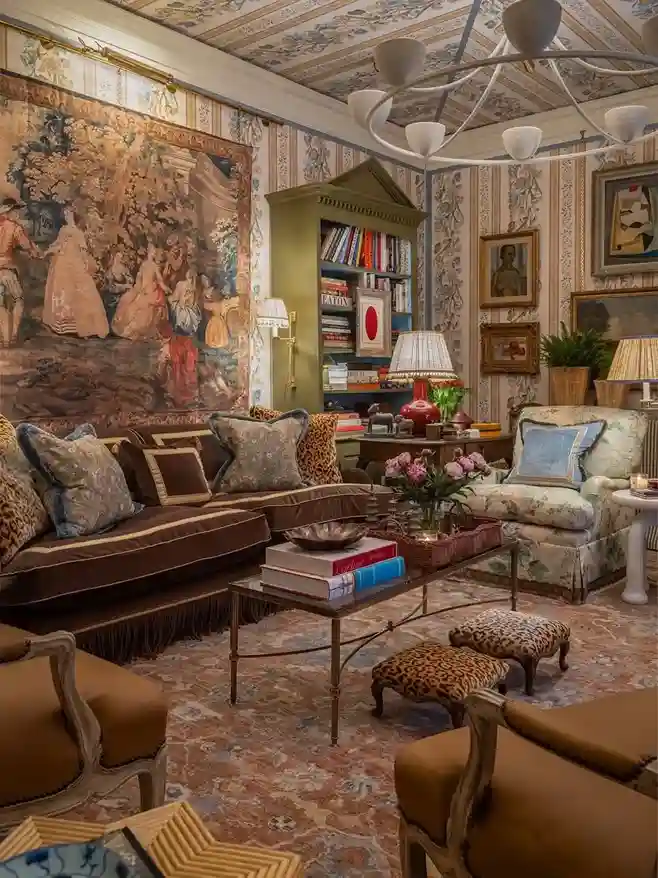
Use a mix of velvet, tapestry, brocade, and needlepoint cushions in the jewel tones and warm neutrals of the room’s overall palette. Add fringe and tassel trim to cushion edges for the most authentically Victorian decorative detail. A pair of large bolster cushions at either end of the sofa references the formal Victorian parlour convention. Needlepoint cushion covers — worked by hand or sourced as antiques — add the most genuine period authenticity.
| Victorian Cushion Style | Trim Detail |
|---|---|
| Velvet jewel-tone | Tassel or fringe edge |
| Needlepoint worked | No additional trim needed |
| Tapestry woven | Braid or cord edge |
| Brocade or damask | Gold cord edge |
| Large bolster | Tassel end caps |
17. How to Add a Victorian Chaise Longue or Fainting Couch
A chaise longue or fainting couch is one of the most distinctively Victorian pieces of furniture available and its inclusion in a living room immediately establishes period credibility with unmistakable clarity. The chaise longue served multiple social and practical functions in the Victorian parlour — as a resting place, a reading spot, and as a demonstration of leisured domestic comfort that the period valued highly.

Choose a chaise longue with a carved wooden frame and deep button upholstery in a velvet or brocade fabric that complements the primary sofa upholstery. A méridienne with one raised end is especially Victorian in character. Position the chaise longue near the window or beside the fireplace where it can serve as a genuine reading and resting spot rather than existing purely for display. A side table within reach and a reading lamp above complete this intimate Victorian seating vignette.
| Victorian Chaise Longue Style | Fabric Pairing |
|---|---|
| Classic scroll end | Burgundy velvet |
| Méridienne asymmetric | Jewel-tone brocade |
| Récamier double curved | Tapestry or damask |
| Deep button all-over | Rich emerald velvet |
18. How to Choose Victorian Living Room Rugs
Victorian living room rugs are richly patterned, deeply colored, and genuinely central to the atmospheric quality of the entire room. The right rug adds a layer of visual richness to the floor that significantly contributes to the immersive, layered quality of the Victorian interior. A plain or neutral rug is entirely at odds with the Victorian aesthetic and should be avoided completely in favor of pattern.
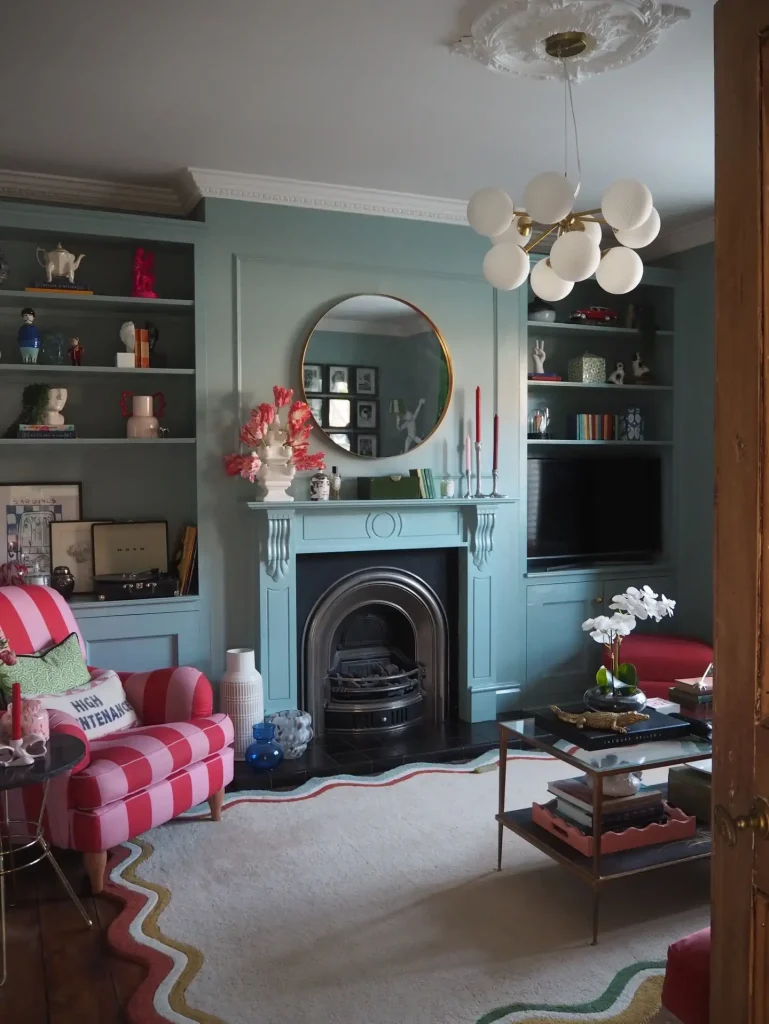
Choose a large Turkish, Persian, or Axminster carpet with complex floral, medallion, or geometric patterns in deep jewel tones for the living room floor. The carpet should cover the central floor area generously with dark stained boards visible around the perimeter. Colors in the carpet should connect to both the wall color and the upholstery colors throughout the room for maximum visual cohesion. A secondary smaller rug can be layered over the primary carpet in front of the fireplace for additional warmth and pattern.
| Victorian Living Room Rug | Color Palette |
|---|---|
| Turkish medallion carpet | Red, gold, navy, ivory |
| Persian floral carpet | Blue, green, burgundy, cream |
| Axminster geometric | Classic period repeat pattern |
| Needlepoint hearth rug | Floral, positioned at fireplace |
19. How to Incorporate Victorian Artwork Throughout the Room
Victorian living room artwork goes far beyond occasional pictures on walls into a comprehensive decorative program that covers every available surface. The Victorians used art on walls, on decorative screens, on porcelain and ceramic pieces, on textiles, and as three-dimensional objects throughout the parlour. Art in a Victorian living room is abundant, varied, and deeply reflective of the household’s cultural interests and aspirations.
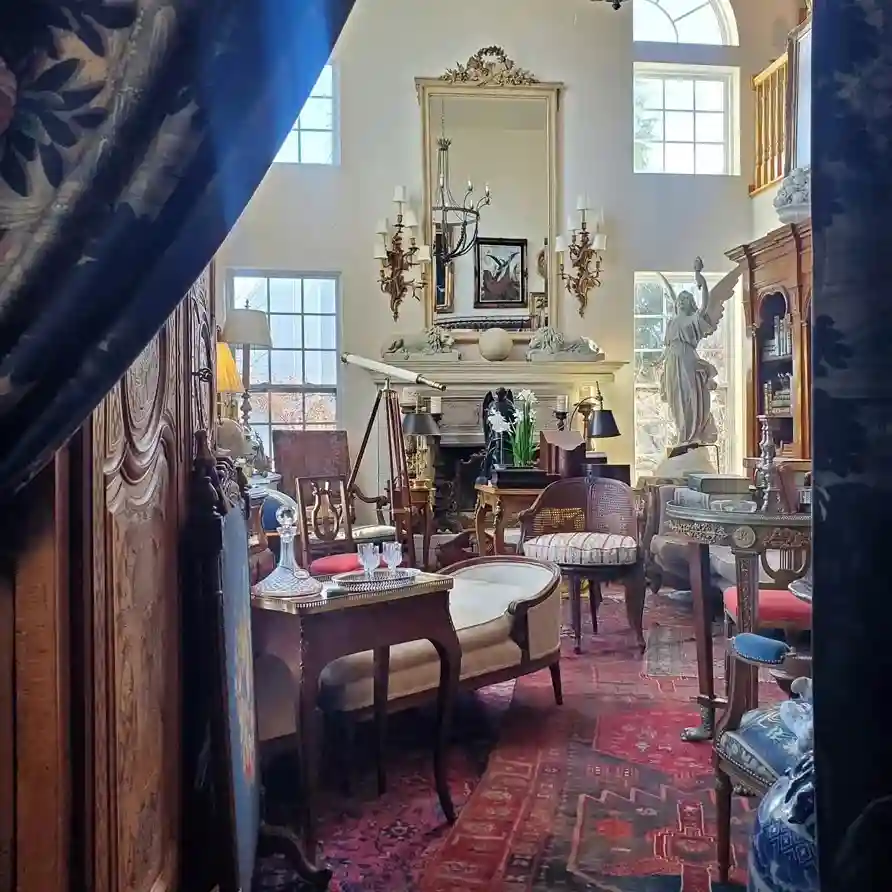
Mix oil paintings or quality prints of romantic landscapes, marine subjects, historical scenes, and botanical studies in ornate gilded or dark carved frames throughout the room. Add framed needlework and tapestry panels as textile artwork alternatives to painted and printed works. Three-dimensional sculptural objects — bronzes, ceramic figures, decorative busts — function as art objects on mantel and cabinet surfaces. Never leave a significant wall area entirely bare in an authentic Victorian living room.
| Victorian Living Room Artwork | Scale and Placement |
|---|---|
| Large oil painting | Above sofa or fireplace |
| Botanical watercolor studies | Grouped in secondary wall area |
| Portrait prints | Gallery wall with other works |
| Framed needlework | Mixed into gallery arrangement |
| Small bronze sculpture | Mantel or cabinet surface |
20. How to Create a Victorian Living Room Reading Corner
A reading corner in the Victorian living room provides an intimate retreat within the social room for the reading and personal study that the Victorians considered central to cultivated domestic life. The Victorians were voracious readers who took considerable pride in their personal libraries and domestic reading arrangements. A proper reading corner makes a Victorian living room feel genuinely inhabited and intellectually active rather than purely decorative.

Position a deeply upholstered button-back armchair or a small chaise beside the best natural light source in the room — typically the window that receives the most afternoon sun. Add a floor-standing brass reading lamp for evening use and a small side table at arm height for a book, a cup of tea, and reading glasses. A small bookcase within reach stocked with leather-bound volumes and current reading material completes this intimate Victorian reading vignette. Find brilliant hidden storage solutions from hidden storage ideas for keeping additional books and reading materials organized and accessible within the Victorian living room.
| Victorian Reading Corner Element | Period Character |
|---|---|
| Button-back velvet armchair | Deeply comfortable, period-perfect |
| Brass floor reading lamp | Authentic lighting for reading |
| Small marble-top side table | Period-appropriate surface |
| Leather-bound book collection | Intellectual, personal display |
| Small footstool | Victorian comfort convention |
21. How to Choose Victorian Living Room Accessories
Victorian living room accessories are where the most personal and most culturally expressive dimension of the period aesthetic manifests. The Victorians filled their parlours with a carefully curated but abundantly displayed collection of accessories that told the story of their travels, interests, family, and aspirations. The right accessories make a Victorian living room feel genuinely inhabited and deeply personal rather than generically period-inspired.
source
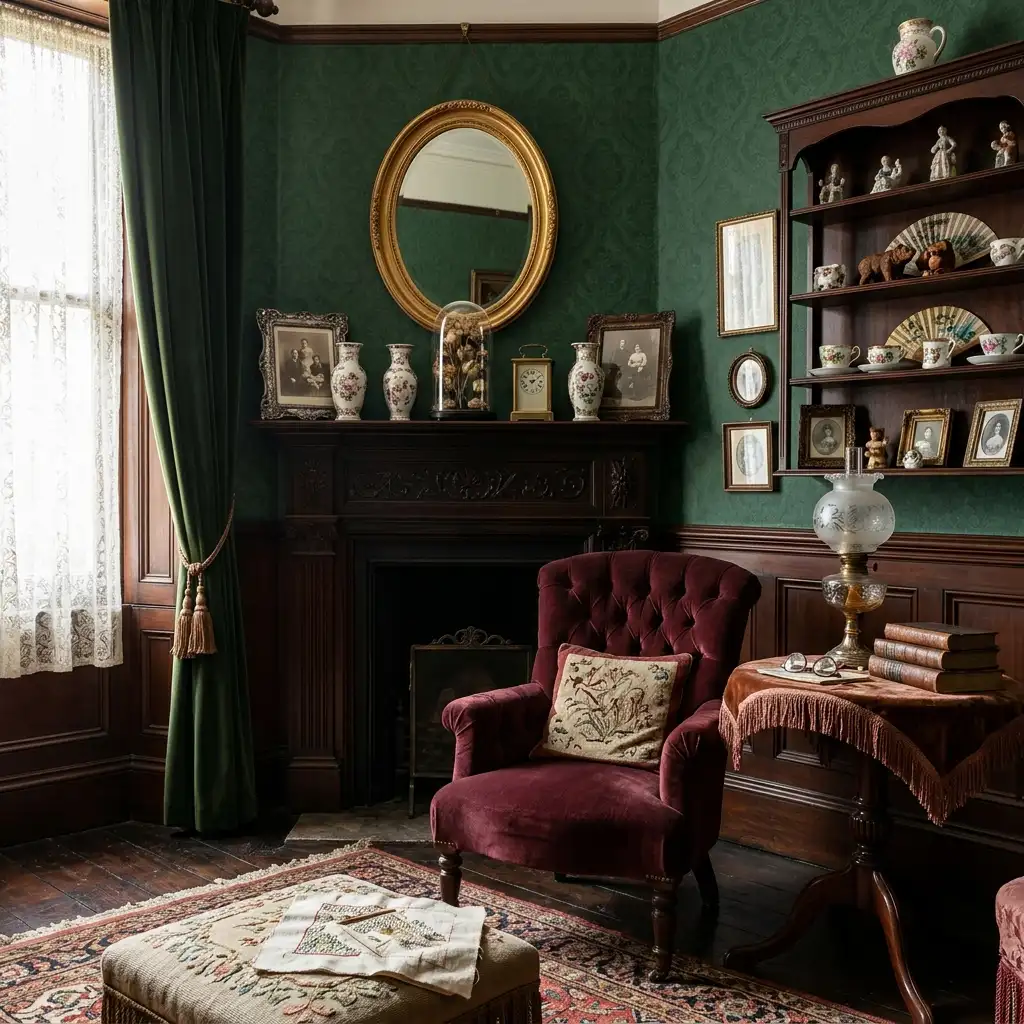
Include a decorative clock on the mantel as the room’s functional and aesthetic timepiece. Add crystal, silver, or brass decorative objects on tables and cabinets throughout. Display collections of decorative ceramics, glass, and miniatures in the display cabinet. Place a small writing set on the writing desk. Include a few carefully chosen natural curiosities — a mounted butterfly, a geological specimen, a pressed fern — displayed under glass for the most authentic Victorian collecting spirit.
| Victorian Living Room Accessory | Display Location |
|---|---|
| Ornate mantel clock | Center of mantel surface |
| Crystal decanters and glasses | Cabinet or side table |
| Decorative ceramic vases | Mantel, cabinet, table surfaces |
| Natural specimen under dome | Display cabinet or side table |
| Silver or brass tray | Occasional table surface |
22. How to Add Victorian Textiles Throughout the Room
Textiles in a Victorian living room are not limited to upholstery and curtains but extend to table coverings, piano scarves, mantel drapery, and decorative textile panels that cover every surface with fabric warmth. The Victorian approach to domestic textiles was one of genuine enthusiasm for softening every hard surface with fabric in some form. This comprehensive textile treatment creates the warmth and acoustic softness that characterizes the Victorian interior experience.

source
Add a heavy velvet or tapestry table covering to the central parlour table. Drape a decorative textile panel or antique embroidery across the piano top if present. Place a velvet or brocade mantel drape along the front edge of the mantel shelf. Use antimacassars — small decorative cloth pieces — on the backs and arms of chairs and sofas for the most period-specific textile detail. These fabric layers collectively create the muffled, warm, enclosed quality of sound and feeling that defines the Victorian interior.
| Victorian Living Room Textile | Application |
|---|---|
| Velvet table covering | Central parlour table |
| Mantel drape | Front edge of mantel shelf |
| Piano scarf or panel | Top of upright piano |
| Antimacassar cloths | Chair and sofa backs |
| Embroidered table runner | Occasional and side tables |
23. How to Design a Victorian Living Room Ceiling
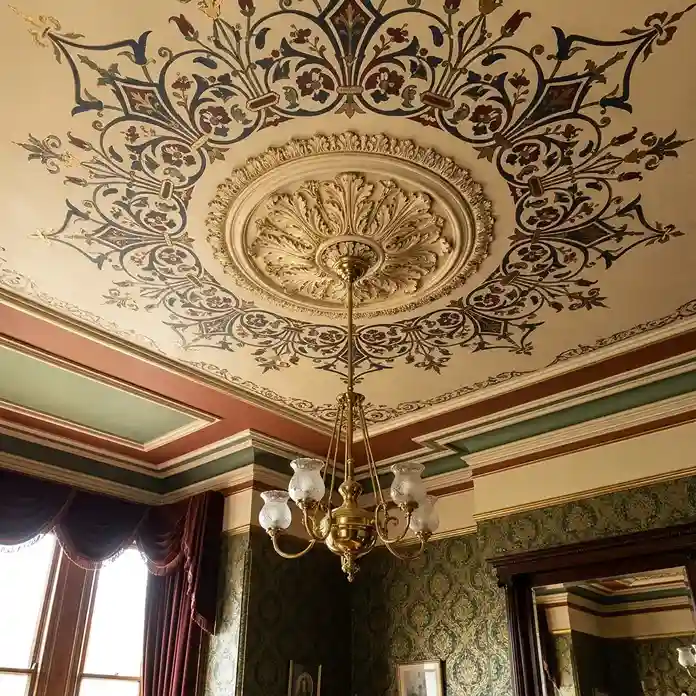
The Victorian ceiling was never simply painted white and left as an afterthought. The Victorians considered the ceiling a fifth decorative surface that deserved as much attention as the walls and floor. Ceiling color, decorative plasterwork, stencilled patterns, and the central ceiling rose all contributed to a ceiling treatment that completed the richly decorated room below.
source
Paint the ceiling in a warm cream or ivory that provides relief against deeply colored walls while maintaining warmth and period character. Add a decorative plaster ceiling rose around the central chandelier as the most impactful single ceiling detail. Consider stencilling a simple repeating border around the ceiling perimeter in a tone that complements the wall color. Deep, elaborate plasterwork coving at the ceiling and wall junction adds the most formal, grand Victorian character to any room.
| Victorian Ceiling Treatment | Design Effect |
|---|---|
| Warm cream or ivory paint | Lightens, maintains warmth |
| Decorative plaster ceiling rose | Most impactful single detail |
| Stencilled border pattern | Decorative without cost of plaster |
| Elaborate coving and cornice | Grand, formal Victorian character |
| Tented fabric ceiling | Unusual, tent room Victorian effect |
24. How to Add a Victorian Writing Desk or Davenport
A writing desk was considered an essential piece of furniture in the Victorian parlour because letter writing was the primary form of personal communication throughout the period. A beautifully positioned writing desk adds a layer of everyday functionality to the living room that also serves as a significant decorative element. The small davenport desk — with its hinged writing surface and drawers — is one of the most elegantly Victorian desk forms available.
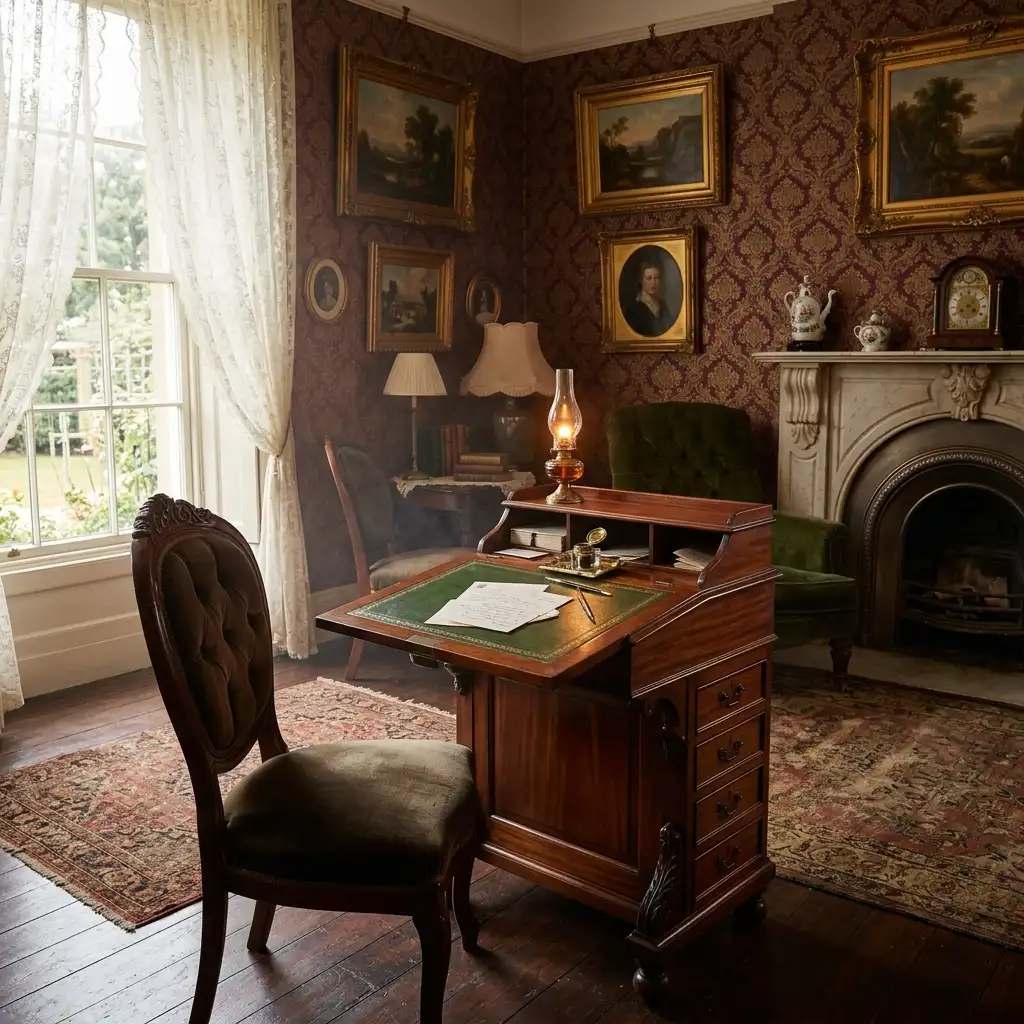
source
Position the writing desk near a window for natural light during daytime letter-writing and add a small brass lamp for evening use. Style the desk surface with period-appropriate writing accessories — a glass inkwell, a pen stand, a blotter, a seal, and a small correspondence box. A decorative chair with a padded seat pulled up to the writing desk completes the functional Victorian correspondence corner that was standard in every well-furnished Victorian parlour.
| Victorian Writing Desk Style | Period Character |
|---|---|
| Davenport desk | Most characteristically Victorian |
| Lady’s writing bureau | Enclosed, formal, elegant |
| Small secretary desk | Folding front, storage drawers |
| Cylinder-top desk | Formal, large, grand scale |
25. How to Choose Victorian Living Room Hardware and Metalwork
Hardware and metalwork throughout the Victorian living room — on furniture, doors, windows, and lighting fixtures — should be consistently period-appropriate and consistently finished throughout the room. The metalwork choices tie together all the furniture pieces and decorative elements with a consistent material vocabulary. Inconsistent or modern hardware immediately undermines the period character of even the most carefully assembled Victorian room.
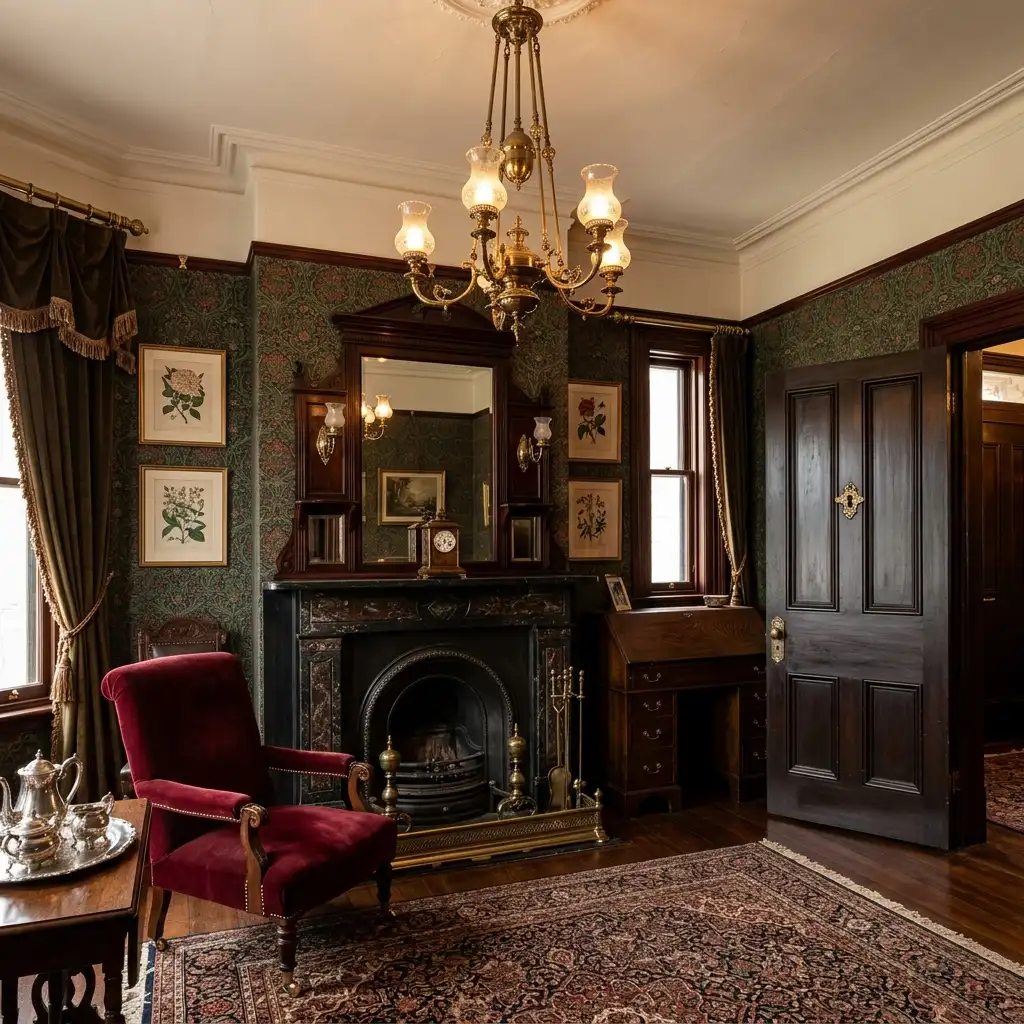
source
Choose aged brass, antique gold, or oil-rubbed bronze for all hardware throughout the living room. Door handles, window fasteners, curtain poles, picture hooks, and furniture pulls should all share this consistent warm metallic finish. Ornate cast brass door furniture with decorative backplates rather than plain contemporary rosettes establishes the Victorian standard from the moment anyone enters the room. Replace any chrome or brushed nickel hardware throughout as an early priority step.
| Victorian Metalwork Finish | Application |
|---|---|
| Aged brass | Most authentic, warm tone |
| Antique gold | Richer, more formal |
| Oil-rubbed bronze | Classic, slightly darker |
| Cast iron | Hearth accessories, plant stands |
| Polished brass | Brightest, most formal Victorian |
26. How to Create a Victorian Scent and Atmosphere
The atmosphere of a Victorian living room extends beyond the visual into the sensory experience of sound, scent, and the warmth of a properly used space. The Victorians were deeply attentive to the full sensory experience of their domestic interiors and a great Victorian living room engages all the senses simultaneously. Creating this full sensory atmosphere elevates a decorated room into a genuinely immersive Victorian experience.
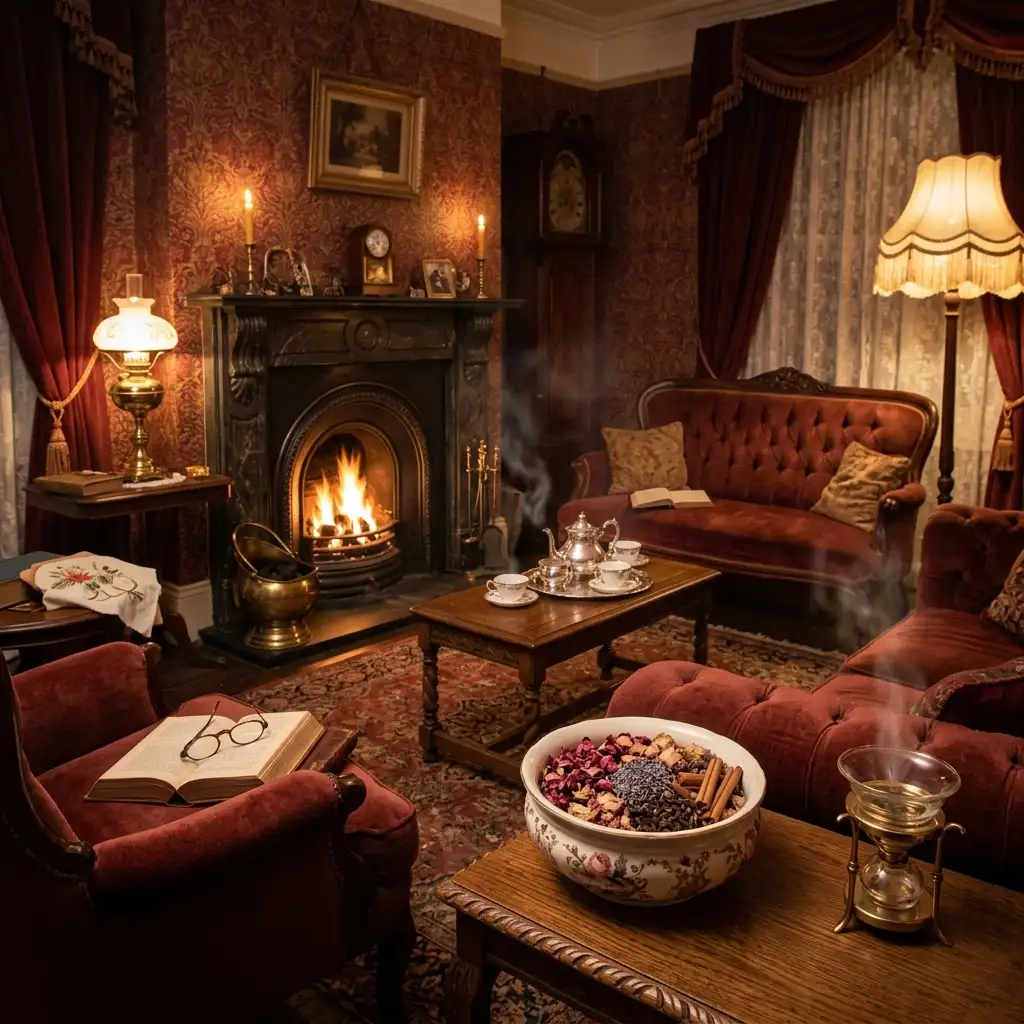
Use beeswax or soy candles in brass and crystal holders throughout the room for both warm candlelight and the specific scent of beeswax that is deeply associated with Victorian domestic life. Place dried lavender sachets in cushion covers and behind curtain valances. Add a reed diffuser in a rose, sandalwood, or cedarwood fragrance on a side table. Fresh flowers in decorative vases add living fragrance and color that changes with the seasons.
| Victorian Living Room Scent | Application Method |
|---|---|
| Beeswax candles | Brass candlesticks, mantel |
| Rose or lavender | Reed diffuser, dried sachets |
| Sandalwood | Diffuser on side table |
| Fresh flowers | Vases throughout room |
| Cedar | Behind curtains, in cushions |
27. How to Source Victorian Scent and Atmosphere
The atmosphere of a Victorian living room extends beyond the visual into the sensory experience of sound, scent, and the warmth of a properly used space. The Victorians were deeply attentive to the full sensory experience of their domestic interiors and a great Victorian living room engages all the senses simultaneously. Creating this full sensory atmosphere elevates a decorated room into a genuinely immersive Victorian experience.
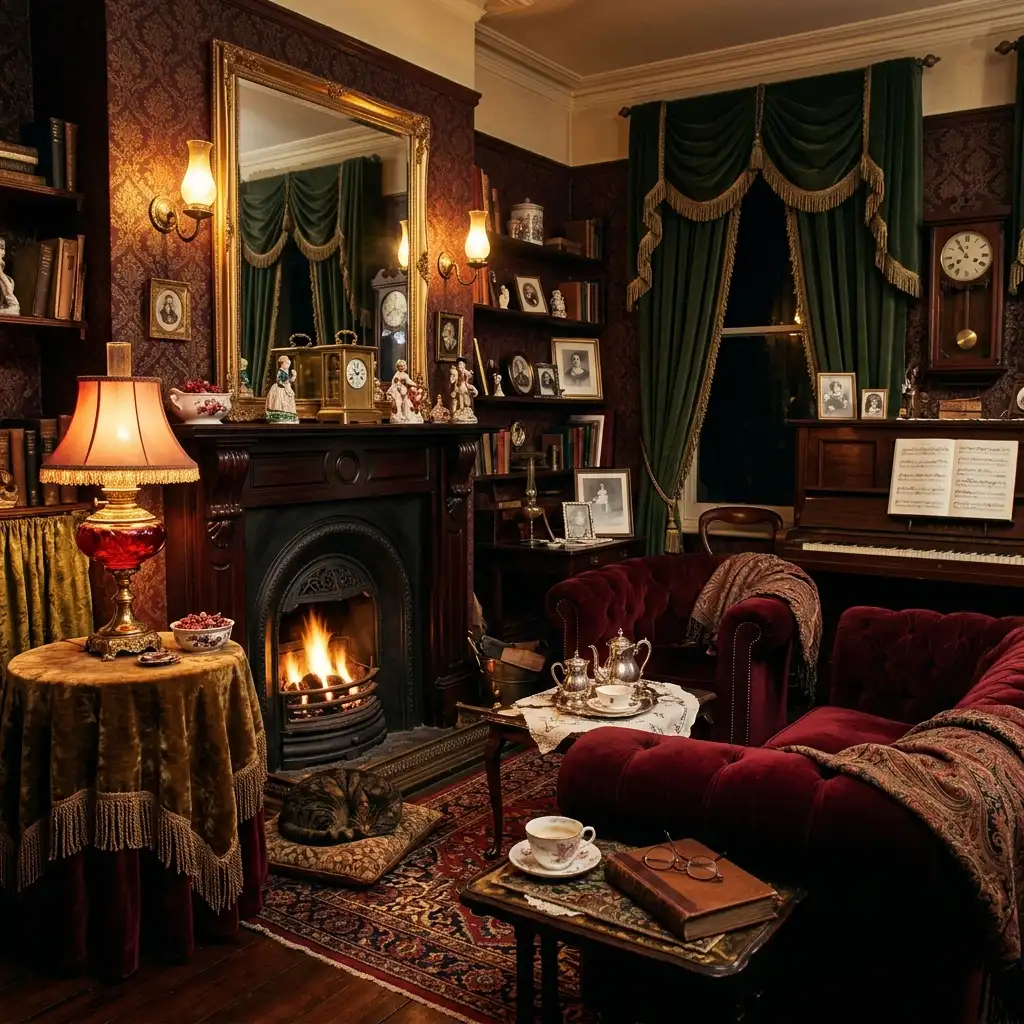
Shop regularly at estate sales, antique markets, thrift stores, and online auction platforms for Victorian-style furniture pieces. Victorian-era sofas, chairs, occasional tables, and cabinets appear frequently at these sources at prices dramatically below reproduction furniture retailers. Learn basic upholstery skills or commission a local upholsterer to recover finds in period-appropriate fabrics for genuinely impressive results at a fraction of new reproduction cost.
| Victorian Furniture Source | Expected Saving |
|---|---|
| Estate sales | 70–90% below reproduction cost |
| Antique markets | 50–80% below retail |
| Online auction platforms | 60–85% below retail |
| Thrift stores | 80–95% below retail |
28. How to Incorporate a Victorian Piano or Musical Corner
A piano in the Victorian living room was one of the most significant social and cultural statements a household could make. Musical accomplishment was central to the Victorian ideal of domestic feminine achievement and almost every respectable Victorian parlour contained an upright piano around which much of the room’s social life revolved. Including a piano or a musical corner in a Victorian living room adds an irreplaceable period authenticity.

An upright piano in dark mahogany or walnut positioned against one wall with a decorative scarf across the top and a candle holder on either side creates an immediately Victorian musical corner. If a piano is not possible, a music stand displaying a piece of period sheet music, a violin case propped against the wall, or a small harp creates the musical reference without requiring the full instrument. A Canterbury music stand beside the piano holds additional sheet music in the most period-appropriate manner.
29. How to Add a Victorian Decorative Screen
A decorative screen or room divider is an authentically Victorian living room accessory that serves both practical and aesthetic purposes. The Victorian parlour screen provided partial division between different areas of the room, protected from drafts, and displayed beautiful lacquerwork, painted panels, or richly upholstered fabric. A beautiful screen adds an extraordinary layer of visual richness to any Victorian living room corner.
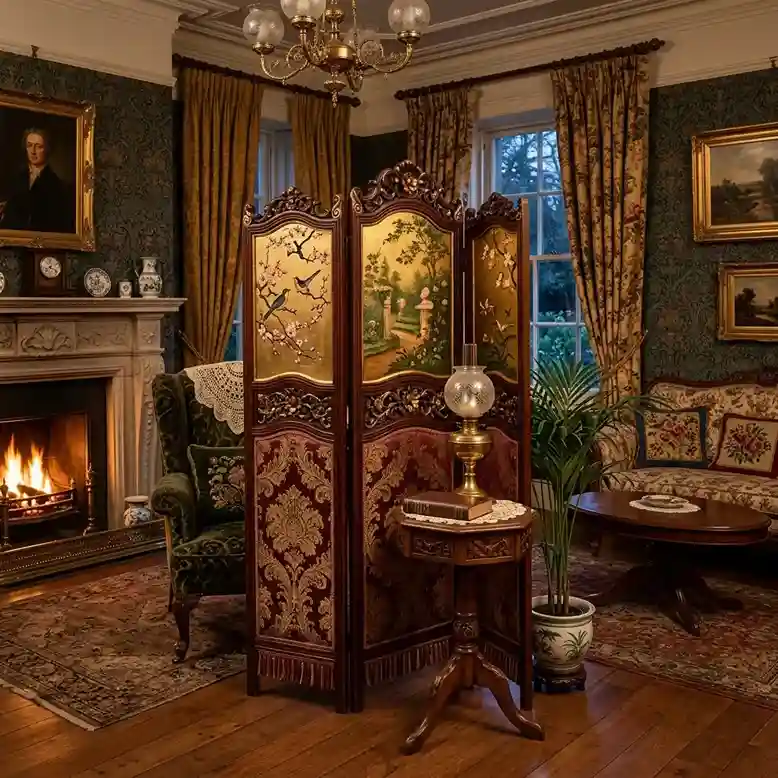
Choose a three or four-fold screen with lacquered Japanese-inspired panels, hand-painted botanical scenes, or velvet-upholstered panels for the most period-appropriate Victorian appearance. Position it in a corner of the room or partially dividing the space between the seating area and the writing corner. A decoupage screen covered with Victorian scraps, prints, and botanical images is an extremely satisfying Victorian DIY project that creates an entirely unique and personally meaningful decorative piece.
| Victorian Screen Style | Decorative Character |
|---|---|
| Lacquered Oriental panels | Chinoiserie, exotic |
| Hand-painted botanical | Arts and Crafts character |
| Velvet-upholstered panels | Rich, formal, intimate |
| Decoupage Victorian scraps | Personal, DIY, charming |
30. How to Choose Victorian Living Room Storage Furniture
Storage furniture in the Victorian living room was expected to be as decorative as it was functional. Plain utilitarian storage had no place in the parlour — every cabinet, bookcase, and chest needed to contribute positively to the decorative scheme of the room. This principle of beautiful functionality produces some of the most characterful and most useful Victorian furniture pieces available to the modern decorator.
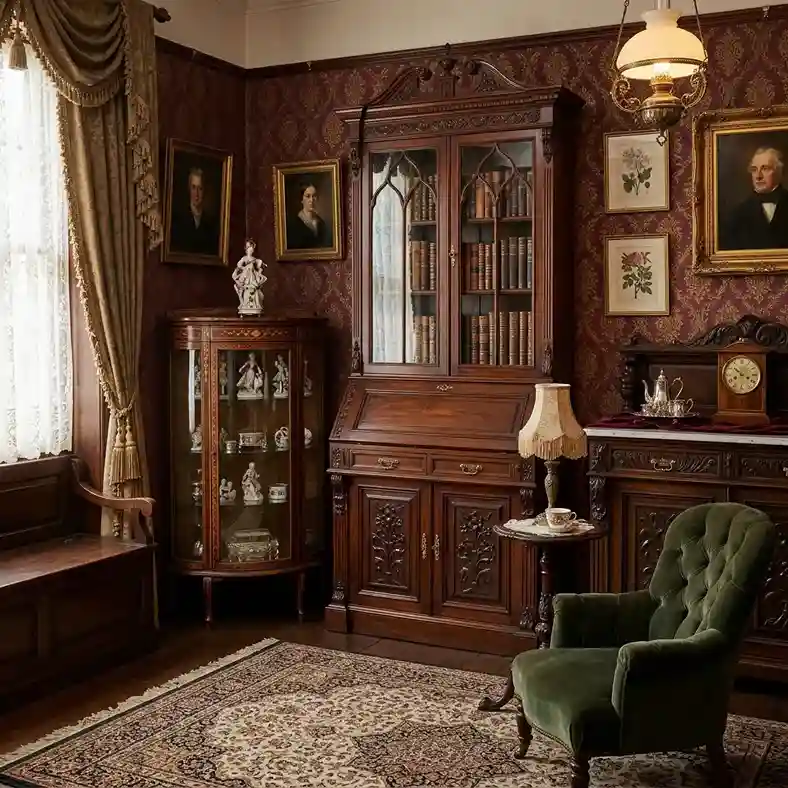
Include a glazed bookcase with ornate carved detailing for displaying books alongside decorative objects. Add a chiffonier or side cabinet with a mirrored back for storing and displaying china, glass, and decorative pieces.
A work table with interior storage served for sewing and domestic craft supplies in the Victorian parlour. Every storage piece should be finished in dark mahogany or walnut with brass hardware consistent with the room’s overall material palette.
Find brilliant organization approaches from closet shelving ideas for organizing the interiors of Victorian living room storage furniture beautifully and functionally.
| Victorian Storage Furniture | Decorative Feature |
|---|---|
| Glazed bookcase | Carved wood, glass doors |
| Chiffonier side cabinet | Mirrored back, carved detail |
| Music Canterbury | Open sections, turned legs |
| Sewing work table | Fabric bag below surface |
31. How to Create a Victorian Living Room on a Budget
An authentic Victorian living room atmosphere is entirely achievable without a large budget when the most impactful elements are prioritized correctly. Understanding which design elements deliver the most period atmosphere per pound or dollar spent allows a strategic approach that creates genuinely impressive results with limited financial resources. The most impactful Victorian effects come from relatively affordable decorating decisions.
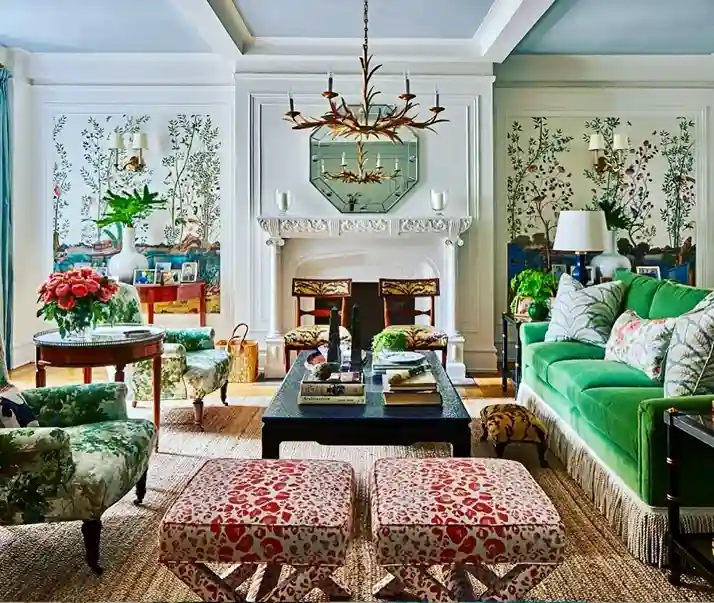
Prioritize Victorian reproduction wallpaper as the highest-impact single budget investment — one or two walls of quality period wallpaper transform the atmosphere of an entire room immediately. Add crown molding and picture rails as affordable DIY architectural additions that dramatically increase period character. Source furniture from thrift stores and estate sales and recover or paint them in period-appropriate finishes. Velvet curtains and richly layered cushions complete the Victorian atmosphere at modest cost.
| Budget Victorian Living Room | Approximate Investment |
|---|---|
| Feature wall wallpaper | $200–$600 for one wall |
| Crown molding and picture rail | $100–$300 DIY installed |
| Thrifted and painted furniture | $200–$600 for key pieces |
| Velvet curtains | $150–$400 per window |
32. How to Maintain and Evolve Your Victorian Living Room
A Victorian living room is not a static, completed project but a living, evolving space that grows more characterful and more personally resonant over time. The most authentic Victorian interiors always feel assembled and collected over many years rather than designed and installed in a single project. Understanding how to maintain and develop your Victorian living room over time is the final and most enjoyable aspect of the entire decorating journey.
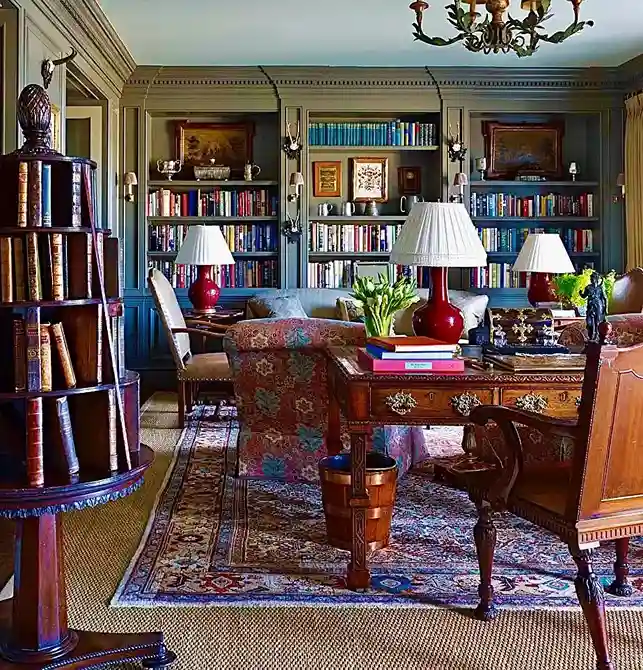
Add new pieces gradually and deliberately rather than attempting to source everything at once. Let the room develop its own personality through genuine use, seasonal decoration changes, and the steady accumulation of personally meaningful objects. Polish furniture, clean textiles carefully, and maintain architectural details with appropriate materials to preserve the beauty of every period element. The Victorian living room that improves with age — growing richer, more layered, and more personal with every passing season — is the truest achievement of the style.
| Victorian Living Room Maintenance | Frequency |
|---|---|
| Dark wood furniture polish | Every 3–6 months |
| Velvet and upholstery brush | Monthly |
| Curtain and textile care | Seasonally or as needed |
| Gallery wall rearrangement | Seasonally, as collection grows |
Frequently Asked Questions
What are the essential elements of a Victorian living room?
The essential elements of an authentic Victorian living room include a central ornate fireplace as the room’s focal point, richly patterned Victorian wallpaper, deep jewel-toned wall colors, a tufted velvet or leather Chesterfield sofa, heavy layered curtains with lace under-curtains, an elaborate gallery wall, decorative ceiling rose and crown molding, patterned Turkish or Persian carpet, and an abundance of collected accessories, artwork, and botanical elements throughout.
What colors are most authentic for a Victorian living room?
The most authentically Victorian living room wall colors are deep jewel tones including forest green, burgundy, sapphire blue, plum, and terracotta. These rich saturated colors are always paired with warm cream or ivory for painted woodwork, cornices, and ceiling. Aged brass, antique gold, and warm copper serve as the consistent metallic accent tones throughout hardware, lighting, and decorative accessories in the Victorian living room.
How do I start designing a Victorian living room?
Begin with the two highest-impact elements simultaneously — the wallpaper and the fireplace. Victorian reproduction wallpaper immediately establishes the period atmosphere of the entire room while the fireplace provides the focal point around which all furniture and accessory decisions organize naturally. Once these foundations are in place, build the room layer by layer starting with floor covering, then primary seating, then curtains, then accessories and artwork.
Can I create a Victorian living room in a modern apartment or house?
Absolutely. Victorian living room design is entirely achievable in any modern home through the application of wallpaper, molding details, appropriate furniture, and richly layered textiles. The architectural character of the room matters far less than the decorative choices applied within it. Adding crown molding, a ceiling rose, picture rails, and a dado rail creates the architectural framework needed even in a completely plain modern room at relatively modest cost.
What is the most important piece of furniture in a Victorian living room?
The fireplace and its surround is the single most important element of any Victorian living room because every other furniture and decorative decision in the room traditionally organized itself around this central focal point. Among moveable furniture, the primary sofa — typically a Chesterfield, camelback, or tufted settee in a rich velvet or brocade — is the most important piece because it anchors the seating arrangement and establishes the upholstery palette for the entire room.
Conclusion
A Victorian living room is one of the most rewarding, most atmospherically rich, and most personally expressive interior design projects available to any homeowner.
Every element from the William Morris wallpaper to the layered velvet curtains to the gallery wall of ornate frames contributes to a space that feels genuinely extraordinary and deeply unlike any other living room you have ever entered. This is interior design at its most committed, most layered, and most beautiful.
Work through these 32 steps at your own pace and allow the room to develop its character organically over time. The best Victorian living rooms are never rushed or purchased complete — they accumulate personality, warmth, and individuality through genuine use, seasonal changes, and the gradual addition of personally meaningful pieces.
Give your Victorian living room the time, care, and creative attention it deserves and it will reward you with the most beautiful, most atmospheric, and most genuinely individual living space you have ever created.