
There is a moment most people know well. You walk into your bedroom after a long day, hoping to feel relaxed, and instead you feel more tired just looking at it.
Clothes on the chair. Things piled on the nightstand. Stuff pushed under the bed. You lie down, but your brain keeps running.
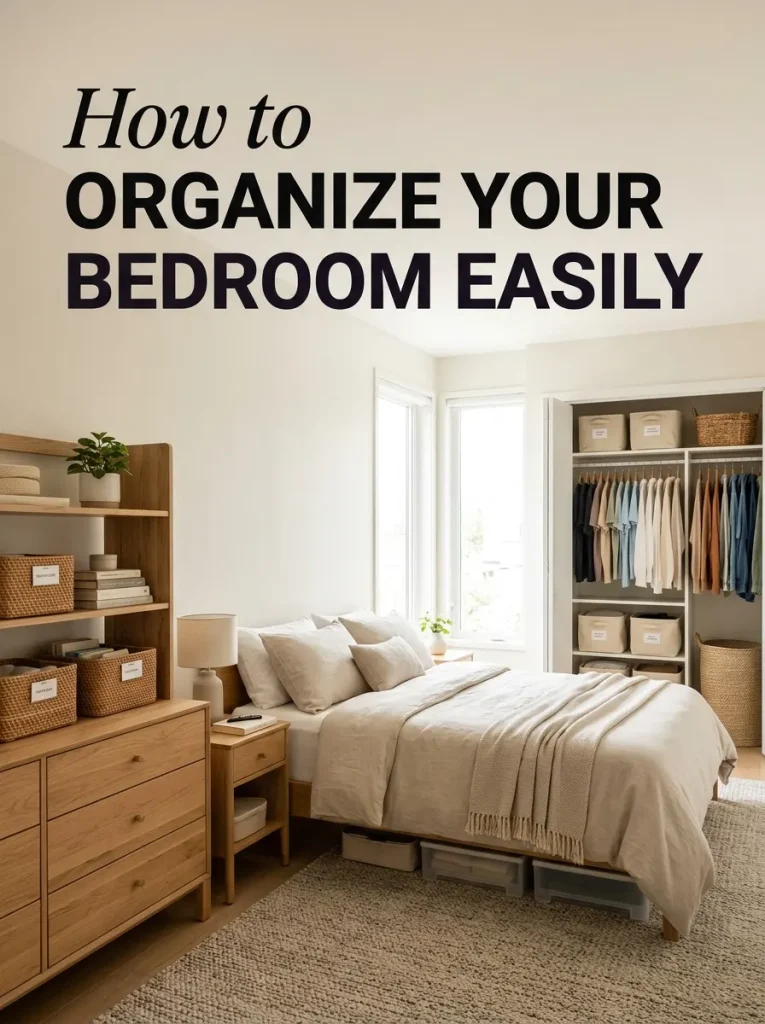
That feeling is not just in your head. Research from the University of California, Berkeley found that people with cluttered bedrooms had poorer sleep quality and reported higher levels of daytime fatigue. A separate UCLA study found that women who described their homes as cluttered had measurably higher levels of cortisol, the body’s main stress hormone, throughout the day.
According to Discover Magazine, the connection between a messy bedroom and poor mental health is real and backed by data. Organizing your bedroom is not just about making it look nice. It is about giving your brain a place to switch off.
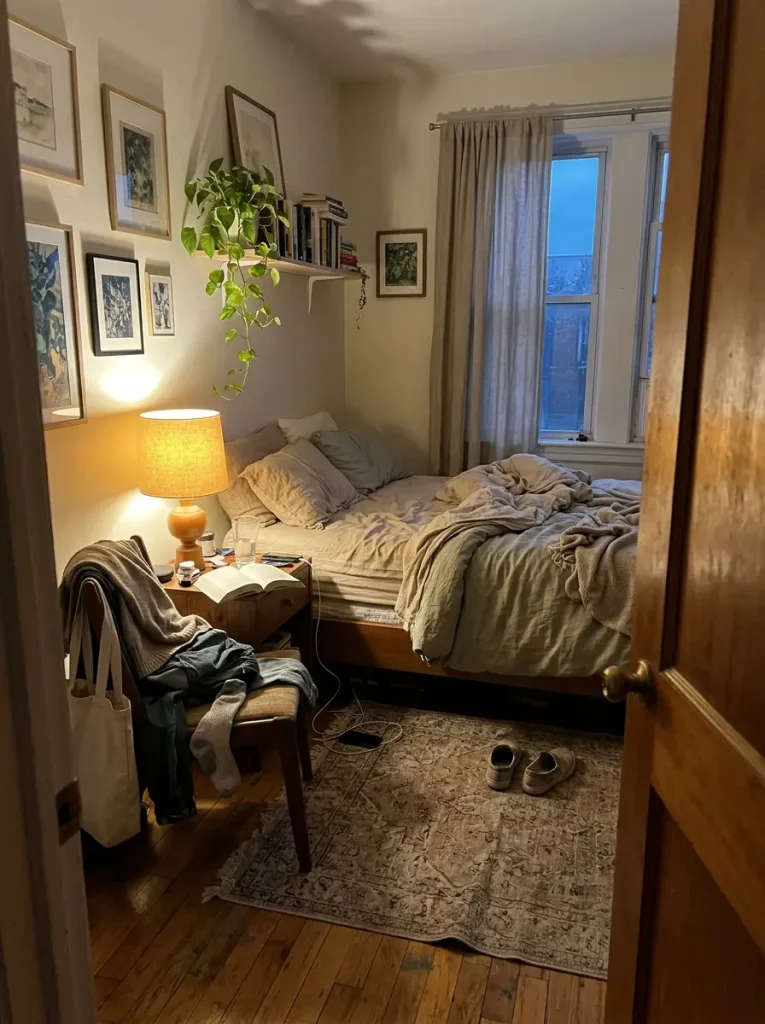
In fact, a survey by Bensons for Beds found that 56% of people say they sleep better when their bedroom is neat and tidy, and that figure rose to 67% among people aged 25 to 34.
This guide walks you through how to organize your bedroom and do it properly, one step at a time, without turning it into a weekend project you never finish.
Step 1: Take Everything Out of Its Place
This sounds like the wrong way to begin. Most people think organizing means neatening up what is already there.
That approach almost never works, because you are just rearranging the same clutter into slightly tidier piles.
Clear the Bed First
The right starting point is to pull everything out and look at it all at once.
Clear your bed and use it as a sorting surface. Go through every drawer, every shelf, every corner of your floor, and every item stuffed under the bed. Put it all on the bed. Yes, all of it.
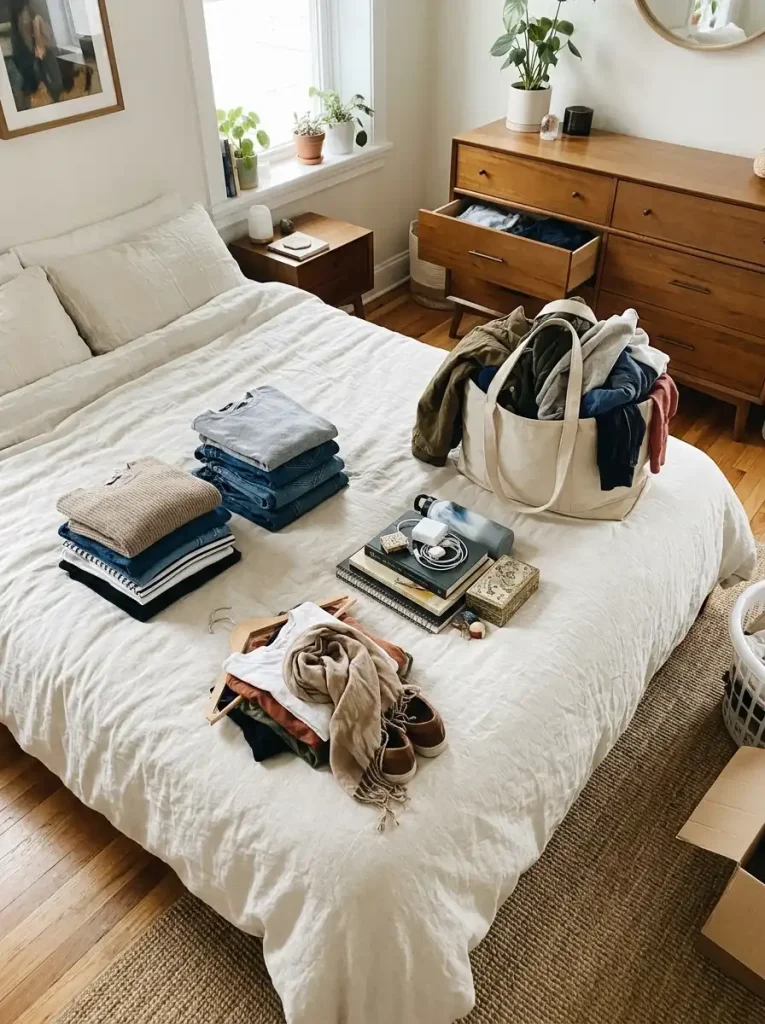
Now you can see exactly what you are working with. Most people are surprised by this step. They find things they forgot they owned, multiples of items they thought they had only one of, and a surprising amount of things that have no real reason to be in a bedroom at all.
Sort Into Four Groups
Once everything is out, sort it into four groups.
- Keep in the bedroom. Things you genuinely use in your bedroom on a regular basis. Clothes, books you are currently reading, your phone charger, items on your nightstand you actually reach for.
- Move to another room. Random items that drifted in over time. Tools, old mail, gym equipment, food wrappers, children’s toys. These go back where they belong.
- Donate or throw away. Clothes you have not worn in a year. Broken items. Things you kept just in case but never use.
- Decide later. A small pile of things you genuinely cannot decide on. Come back to these last, not first.
This initial sort is the most important step. Everything that comes after it depends on how honestly you do this part. You’ll also love to know which color is beneficial for your bedroom.
Step 2: Deal With Clothes First
In most bedrooms, clothes are the main source of clutter. They pile on chairs, spill out of drawers, cover the floor, and fill a closet so tightly that nothing can be found.
The reason is almost always the same. There are too many clothes for the storage space, and there is no clear system for where things go.
Here is how to fix both problems.
Reduce the Volume
Before you organize a single item, go through your clothes and remove anything you have not worn in the past year. Not the past decade. One year.
If you did not reach for it in twelve months, you do not need it in your bedroom. Donate it, give it to someone, or throw it away if it is worn out.
Group by Type, Not by Color
A common mistake is organizing clothes by color because it looks visually satisfying. But you do not get dressed by color. You get dressed by type: tops, bottoms, dresses, jackets, workout clothes.

Group things the way you actually use them.
Use the Right Hangers
According to Jonathan Warren, a bed and storage specialist at Time4Sleep, velvet or flocked hangers are one of the easiest upgrades you can make to a closet.
They stop clothes from sliding, they take up less horizontal space than plastic hangers, and they make the whole closet look more uniform. A closet full of matching velvet hangers looks dramatically more organized than the same closet with a mix of wire, plastic, and wooden hangers.
Deal With the Chair
Almost every bedroom has a chair or a corner where almost clean clothes pile up. Clothes that have been worn once but are not dirty enough for the wash.
The honest solution is to create an actual place for these. A small hook on the back of the door, or a single dedicated shelf, works much better than the chair method because it gives these items a home instead of just a surface.
Step 3: Think in Zones, Not Just Storage
One of the most useful ideas in bedroom organization comes from productivity coach Rashelle Isip, founder of The Order Expert.
In her work with clients on room organization, she points out that a bedroom is rarely used for just one thing. Most people sleep there, get dressed there, sometimes read or work there, and often charge devices there. When these different activities are jumbled together with no separation, the room feels chaotic even when individual areas are tidy.
The solution is to think in zones. A zone is just an area of the room that is set up for one specific activity. You do not need a large bedroom to do this.
Zoning does not mean buying new furniture or rearranging everything dramatically. It mostly means deciding what each area is for and keeping only the right things in each area.
Step 4: Use the Space You Already Have
Most bedrooms have more storage potential than people realize. The problem is usually not a lack of space. It is unused or poorly used space.
Under the Bed
The space under most beds is either completely empty or filled with random things in no particular order. Both are wasted potential.
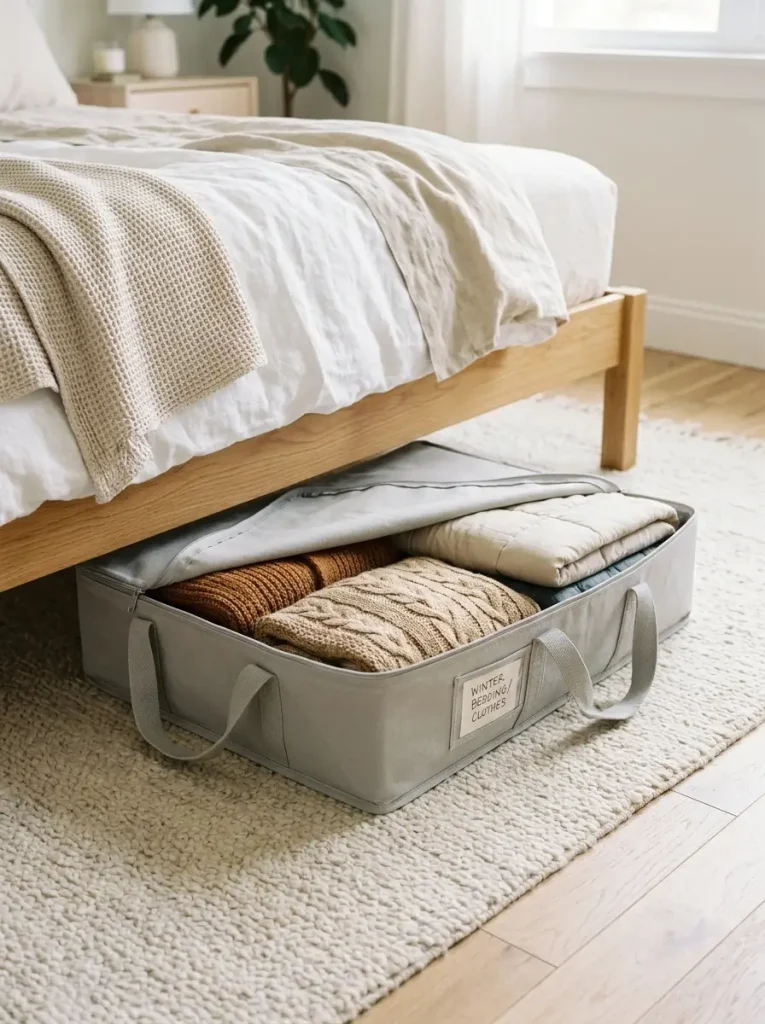
Flat storage containers or vacuum storage bags for seasonal items, spare bedding, or off-season clothes can turn this area into genuinely useful storage. The key is to store things in labeled containers, not just slide things under there loosely.
The Back of the Door
An over-the-door organizer on the back of your bedroom door or your closet door can hold shoes, accessories, small items, or even books. This is completely hidden when the door is open and uses space that is otherwise doing nothing.
Vertical Wall Space
Most bedrooms use furniture that sits on the floor, which means everything is fighting for the same horizontal space.
A shelf or two on the wall, positioned above eye level, can hold books, boxes, and items you do not need daily without taking up any floor space at all. According to Homes and Gardens, effective use of vertical storage is one of the most consistent pieces of advice from professional organizers working with small bedrooms.
Inside Drawers
A drawer that is just loosely filled with items is harder to use than a drawer with simple dividers.
Dividers do not have to be expensive. Small boxes, cut pieces of cardboard, or inexpensive drawer organizer trays from any home store work perfectly. When a drawer is divided, you can find what you need without pulling everything out every time.
Step 5: Give the Nightstand Special Attention
The nightstand is the last thing you see before you fall asleep and the first thing you reach for when you wake up. Despite this, most nightstands become dumping grounds for everything that does not have a place anywhere else.
A well-organized nightstand has only what you genuinely use at night or in the morning. A good rule to follow is this: if you have not touched it in a week, it does not belong on your nightstand.
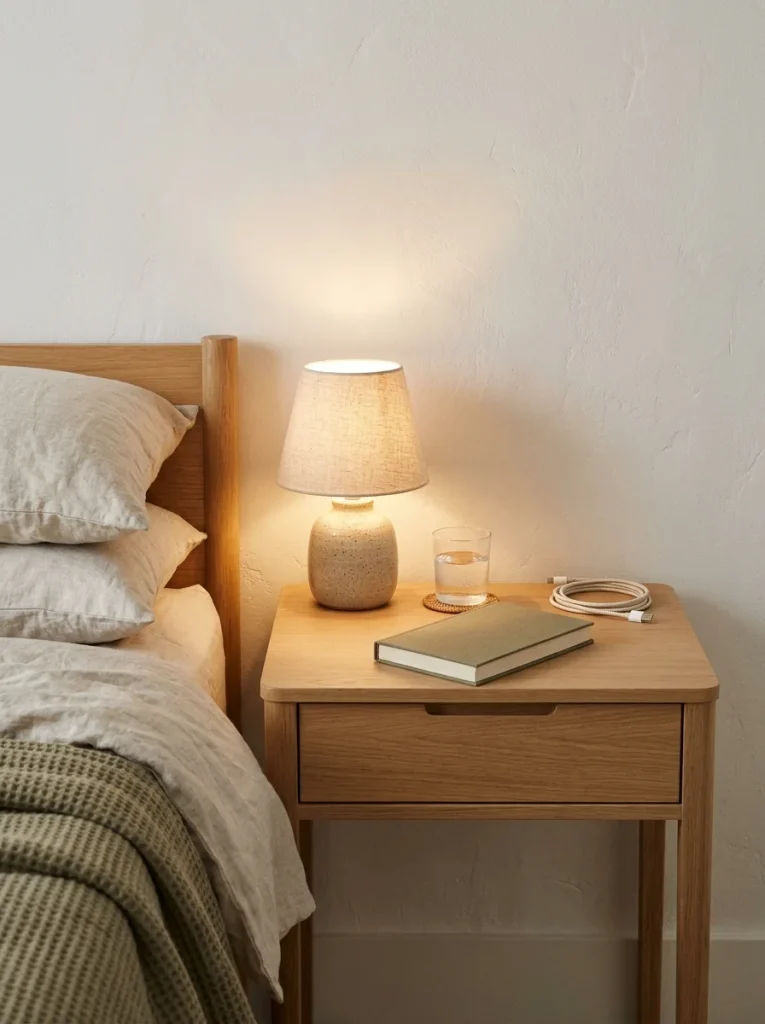
The things that typically do belong there:
- A lamp
- Your current book or e-reader
- Your phone charger
- A glass of water
- A small notebook, if you write things down at night
That is genuinely enough. Everything else is creating visual noise that your brain has to process every time it looks in that direction.
If your nightstand has a drawer, that is a better home for items like hand cream, earplugs, lip balm, or a spare pair of reading glasses. On the surface, keep it minimal.
Step 6: Build a Daily Reset Habit
Here is the honest truth about bedroom organization. It does not stay organized on its own. No system, no matter how well designed, maintains itself without any effort.
But the effort required to maintain an organized bedroom is much smaller than the effort required to organize a messy one. The difference is a daily habit.
Start Small
Decluttering expert Vicky Silverthorn, quoted in Homes and Gardens, gives a simple piece of advice: do not pull everything out at once if you feel overwhelmed. Tackle one category at a time.
The Five Minute Morning Reset
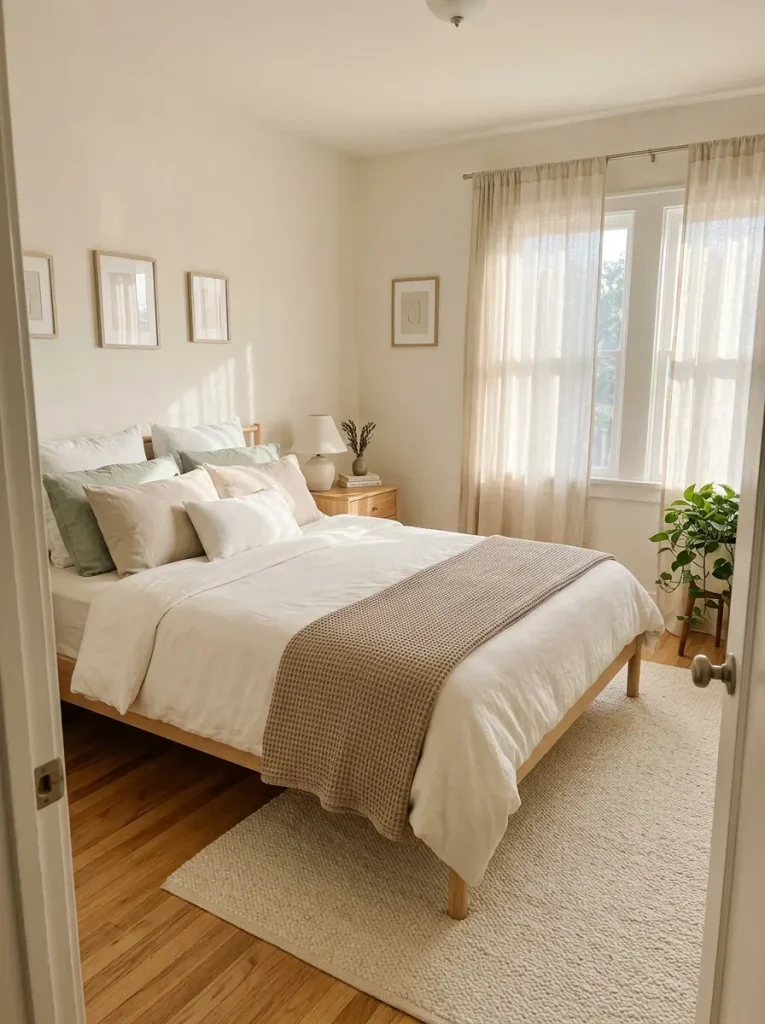
Once the room is organized, protect that work with a five-minute reset each morning.
- Make the bed as soon as you get up.
- Put away any clothes that were left out.
- Return anything that drifted in from another room.
- Clear the nightstand of anything that does not belong there.
That is it. Five minutes at most.
The bed being made matters more than it might seem. A made bed is the visual anchor of the whole room. When the bed looks tidy, the rest of the room looks more tidy too, even if everything else is the same. It sets a tone that carries through the whole day.
Why This Habit Matters
A study published in the journal Current Psychology in 2017 found that people who delayed dealing with clutter because of indecision ended up with a growing problem that weighed on their mental state over time.
The research was clear that the longer clutter accumulates, the harder it becomes to address, and the more it affects daily wellbeing. The daily reset habit exists precisely to prevent that accumulation from starting.
The One Rule That Covers Everything
If there is one organizing principle that covers everything in this guide, it is this: every item in your bedroom needs a home.
Not a surface it ends up on. Not a chair it gets thrown over. A designated, specific home where it lives when it is not being used.
When something has a home, putting it away takes two seconds. When it does not have a home, it ends up somewhere random, and that randomness is the source of almost all bedroom clutter.
Go through your bedroom once and ask yourself, for each category of item: does this have a real place? If the answer is no, either create a place for it or remove it from the bedroom entirely. Those are the only two options that work.
A well-organized bedroom is not about having the most storage or the most minimalist aesthetic. It is about having a room where everything that is there has a reason to be there, and where you know exactly where to find it.
That kind of room is genuinely easier to live in, easier to maintain, and, as the research consistently shows, easier to sleep in too.
When you are done with your bedroom move to organize guest bedroom and fix it better with our recommended ideas.
Frequently Asked Questions
How long does it take to organize a bedroom?
A full reset usually takes one weekend if you follow the four-step sort. The daily maintenance takes about five minutes. The reason most people fail is that they try to do it all in one hour and give up when it gets messy.
Should I organize by color or by type?
By type. You get dressed by category, not by color. Color sorting looks good in photos but slows you down in real life.
What if I have no closet?
Use the vertical space you already have. An over-the-door organizer, a tall narrow cabinet, and labeled bins under the bed will cover most of your storage needs without a closet.