I’ve redone my bedroom three times in the last four years. The first time I painted everything white and bought matching furniture sets and it looked like a hotel — fine, but completely soulless. The second time I went full maximalist and couldn’t find my floor. The third time I finally got it right, and it looked like something I’d actually want to sleep in: warm, layered, personal, and unmistakably boho.
This list is everything I actually used, tried, or wish I’d known. Not a roundup of things I’ve never touched. Real boho bedroom decor that works in apartments, rentals, small rooms, and regular budgets.
Bohemian style is not about buying a bunch of rattan and calling it a day. It’s about layering things that feel meaningful — textures, patterns, and pieces that tell a story. When it’s done right, a boho bedroom looks like it took years to collect, even if you pulled it together over a single weekend.

Here’s how.
1. Start With a Warm Neutral Base, Not White
Every boho bedroom I’ve ever loved starts with a wall color that feels warm rather than cool. Pure white is too stark — it fights the earthy tones that boho depends on. The rooms that look best use warm whites, creamy off-whites, warm taupes, or even terracotta as the base.
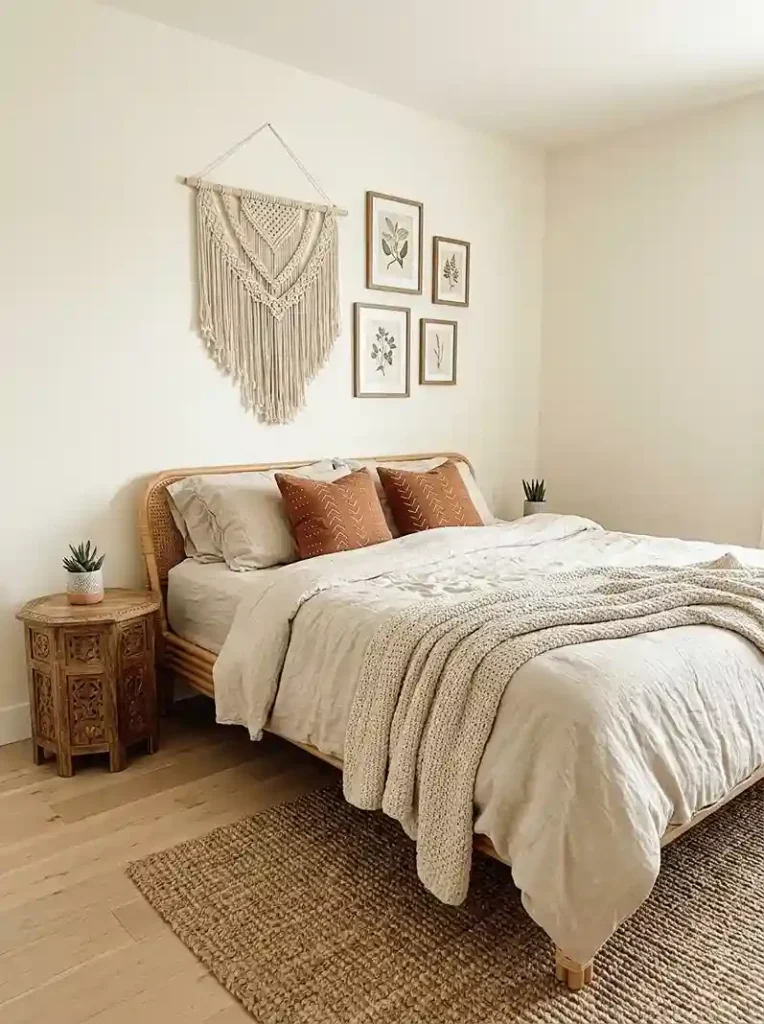
My bedroom walls are Benjamin Moore White Dove, which reads ivory rather than white in warm light. The difference is subtle in a paint chip but enormous on a full wall. Other warm bases worth considering: Sherwin-Williams Accessible Beige, Behr Antique White, or any terra-cotta-leaning clay color if you want something with more character.
If you’re in a rental and can’t paint, a large warm-toned area rug and warm curtains do most of the same work. The wall color matters, but it’s not the whole story.
The rule I follow: whatever’s on your walls, it should make your natural wood and rattan tones look richer, not cooler.
2. Layer Two or Three Rugs Instead of One
This is probably the single most impactful boho bedroom trick I’ve actually used. One standard area rug under the bed is fine. Two or three rugs layered together — a jute base layer, a Moroccan patterned rug on top, a small kilim at the foot of the bed — transforms the floor into something interesting. See ideas on sage green bedroom for amazing touch with boho.
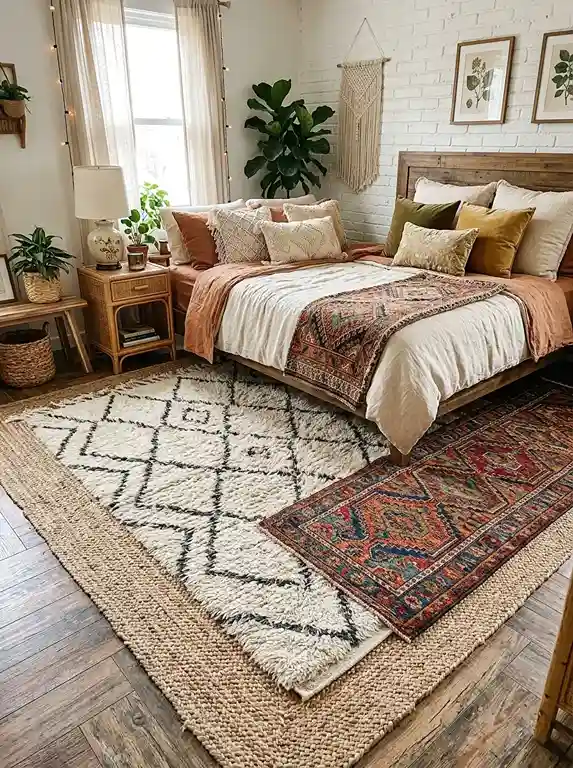
The layered rug look works because it adds the kind of visual texture that takes years to accumulate naturally. It also lets you use smaller, cheaper rugs rather than one large expensive one. I bought a 5×7 jute rug from Amazon ($68), a 4×6 Moroccan-style patterned rug from a thrift store ($12), and a small vintage kilim runner from Facebook Marketplace ($25). Together they look like a room someone’s been decorating thoughtfully for years.
What to layer: Start with a flat-weave natural fiber base (jute, seagrass, sisal) in a size slightly larger than the top rug. Add a patterned rug on top, centered under the bed. Add a small runner or third rug if the room is large enough.
3. Hang a Macramé Wall Piece as the Focal Point

Macramé is the most-photographed element in boho bedroom decor for a reason — it fills vertical space, adds texture, and looks genuinely handmade in a way no print or canvas can replicate. A large macramé wall hanging above the headboard anchors the whole room.
I bought mine from an Etsy seller — a 3×5 foot piece in natural cotton for $85. You can find similar pieces at HomeGoods and TJ Maxx for $30–$60 when they’re in stock. You can also make a simple one yourself with two hours and $15 in macramé cord if you’re willing to learn a couple basic knots.
What to look for: Natural cotton or jute cord in cream, ivory, or natural tan. Avoid macramé pieces with metallic thread or bright dye — they look cheaper and fight the earthy palette. The larger the better; a piece that’s too small for the wall always looks like an afterthought.
4. Add a Rattan or Bamboo Headboard
If you’re buying any single new furniture piece for a boho bedroom, make it a rattan or bamboo headboard. Nothing signals boho more clearly, and nothing does more to set the tone of the whole room from a single purchase.
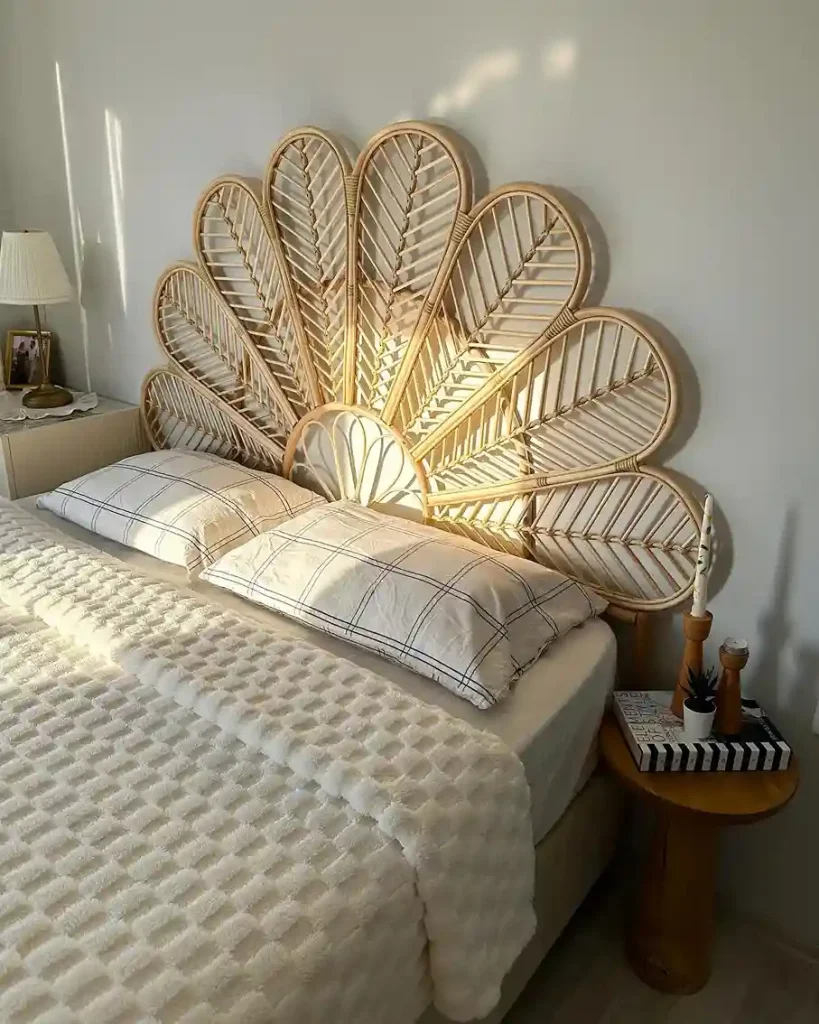
Credits: @kakishomeblog
Rattan headboards range from $80 for simple woven styles at IKEA or Walmart to $400+ for artisan-made pieces. The middle range — $150–$250 — consistently delivers the best quality for everyday use. Look for a frame that’s reinforced at the corners and uses real rattan weave rather than a printed rattan-look veneer on particle board. You can tell the difference: real rattan has slight variations in the weave; printed veneer looks too perfect and peels at the edges.
Budget alternative: A tall bamboo room divider placed behind the bed works as a headboard-adjacent backdrop. Two panels placed symmetrically behind a low platform bed look intentional and cost $40–$80.
5. Use Linen or Cotton Gauze Bedding, Never Polyester
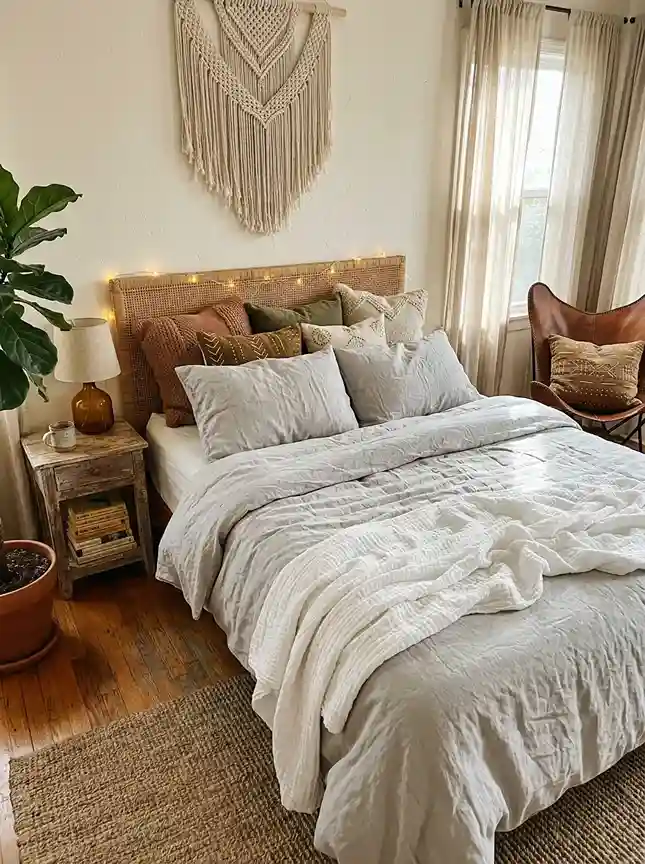
Boho bedrooms look wrong with crisp, shiny, perfectly pressed bedding. The aesthetic depends on bedding that looks naturally rumpled, slept-in, and touchable. Linen and cotton gauze (also called muslin or cheesecloth-weight cotton) do exactly this. They wrinkle beautifully, get softer with every wash, and look expensive in a completely unpretentious way.
I switched from a polyester duvet cover to a linen one from Quince — $89 for a queen set — and the bedroom immediately looked like a boutique hotel in Portugal. The warm sand color, the natural wrinkle, the way it catches light differently across the surface. Polyester can’t do any of that.
Colors that work: Warm white, ivory, sand, dusty terracotta, sage green, faded rust. Avoid crisp blue-white or bright white — they look too clean for the aesthetic.
6. Hang Sheer or Linen Curtains Floor to Ceiling

Floor-to-ceiling curtains hung as high as possible on the wall make any room feel taller, more dramatic, and more finished. In a boho bedroom, sheer white or natural linen curtains do double work: they soften the light during the day (creating that dreamy, golden-hour glow that boho photography always shows) and they add vertical texture when they’re drawn.
Mount the curtain rod as close to the ceiling as possible — ideally within 4 inches. The curtains should puddle slightly on the floor or at minimum touch it. A curtain rod installed at the standard height (just above the window frame) makes the room look shorter and the windows look smaller. The same curtains, hung ceiling-height, make the same room feel like a different space.
What to buy: IKEA LILL sheers ($8 per pair) are the open secret of boho interiors everywhere. Layer them with a heavier linen panel in a natural color for light control. Total cost: under $40 per window.
7. Bring in a Vintage or Antique Dresser

New furniture in a boho bedroom always looks slightly off — too perfect, too uniform. A vintage or antique dresser from a thrift store, estate sale, or Facebook Marketplace adds the age and patina that makes a boho room feel curated rather than purchased.
I found my dresser at an estate sale — a solid walnut mid-century piece for $60. I cleaned it, tightened the drawer slides, and replaced the hardware with antique brass pulls from Amazon ($18 for a set of 8). The total investment was $78 and the piece looks like it cost $600 in a vintage furniture shop.
What to look for at thrift stores: Solid wood construction (check underneath — particle board sounds hollow when tapped). Drawers that slide smoothly. Hardware that’s removable and replaceable. Avoid anything with strong particleboard smell, visible water damage on the top, or drawers that stick badly — these are harder to fix than they look.
8. Pile the Pillows and Mix the Patterns
Boho bedding is not about matching sets. It’s about mixing patterns that share a color family. The look that works: a solid or lightly textured duvet in a neutral tone, with 6–8 decorative pillows in a mix of prints — a geometric, a floral, a stripe, a solid with fringe, a lumbar in a different pattern.
The rules for mixing patterns without it looking chaotic: keep the color palette consistent (warm terracottas, muted mustards, dusty blues, and naturals), vary the scale of patterns (one large-scale print, one medium, one small), and use solid-colored pillows as visual breaks between busier prints.
I buy most of my decorative pillow covers on Amazon or at HomeGoods. Covers (without inserts) run $10–$20 each. Pillow inserts can be reused across covers as you redecorate, so buy good inserts once and cheap covers often.
9. Add a Wicker or Rattan Pendant Light
The overhead fixture matters more than most people think. A standard builder-grade flush mount light with a flat white globe immediately signals “generic apartment.” A wicker or rattan pendant light — even in a rental where you can swap it back before moving — changes the entire character of the room.
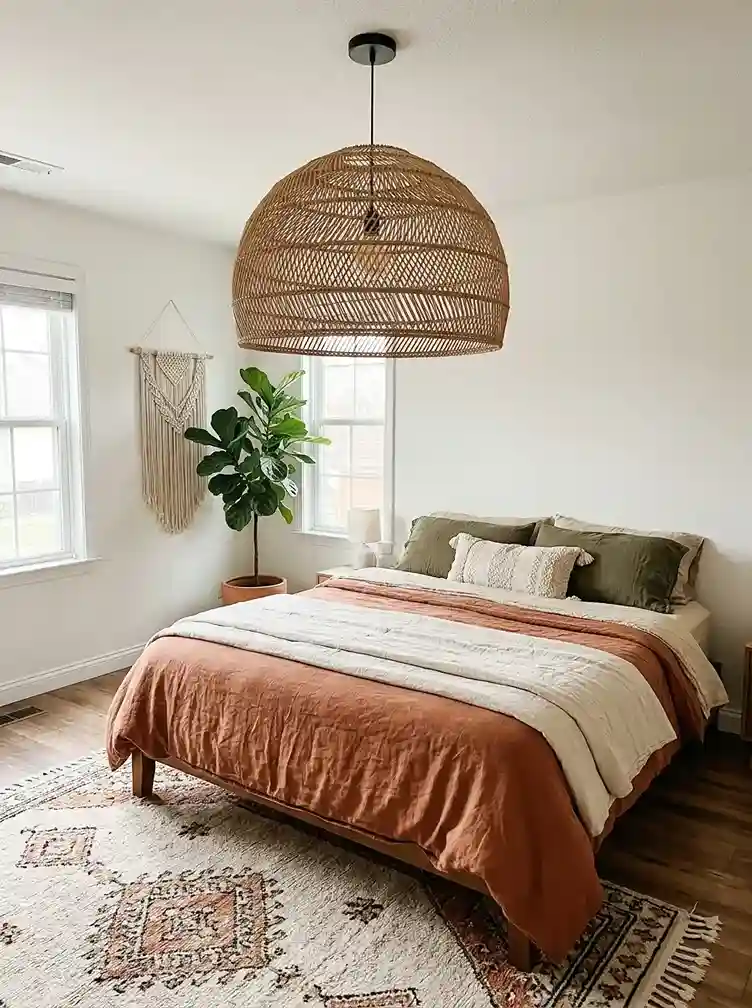
Swapping a ceiling light fixture is a one-hour job that requires turning off the breaker and matching three wires. If you’ve never done it, a YouTube tutorial and a basic voltage tester get you through it in an afternoon. If you’re not comfortable with electrical, a floor-to-ceiling lamp with a rattan shade accomplishes the same visual effect without any wiring.
Where to find them: Amazon has rattan pendant lights from $35–$80. Pottery Barn and Anthropologie have beautiful ones for $150–$400. For rentals, a plug-in pendant light (a pendant with a standard plug rather than hardwired) hangs from a ceiling hook and requires no electrical work at all — perfect for apartments.
10. Create a Plant Corner That Actually Grows
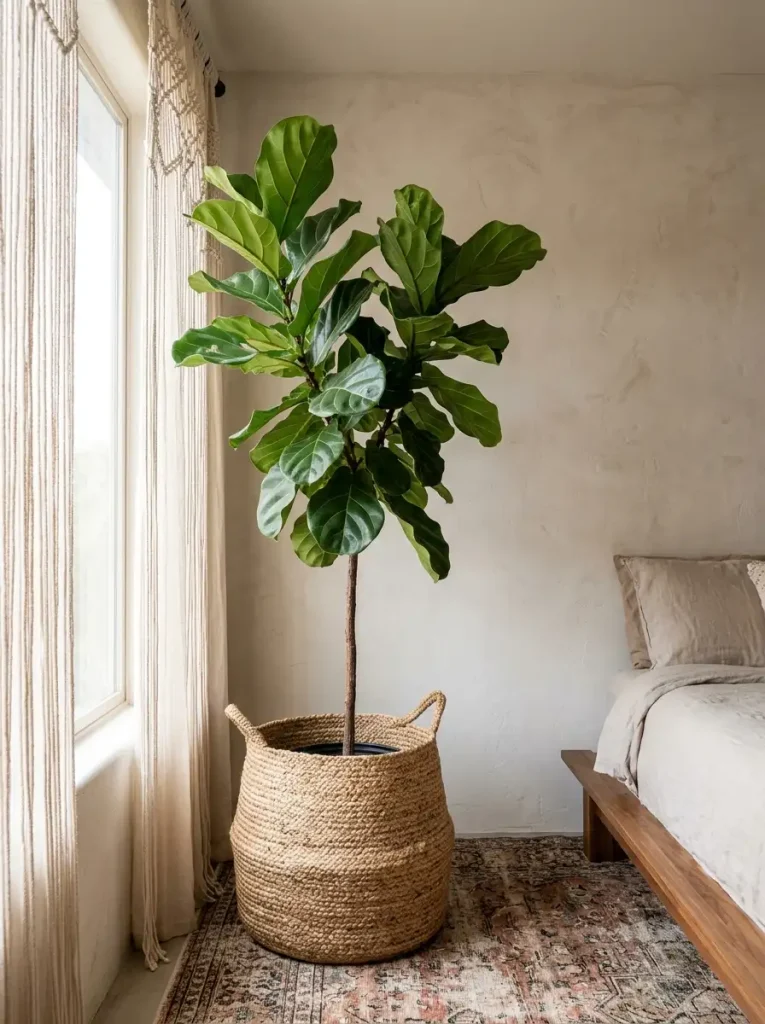
No boho bedroom looks complete without plants — but the cliché version (a few small succulents on a shelf) doesn’t deliver the impact the aesthetic needs. What works is scale: one or two large statement plants that command space, plus a collection of trailing or cascading plants that soften shelves and nightstands.
The plants that thrive in bedrooms (low to medium light, tolerate some neglect): pothos, philodendron, snake plant, ZZ plant, and spider plant. For statement size: a bird of paradise or a large fiddle-leaf fig by the window. A 6-foot fiddle-leaf in a woven basket planter transforms a corner.
I keep a pothos on my highest shelf, letting the vines trail 4 feet down the wall. A snake plant sits in the corner by the window. A small monstera is on the nightstand. The whole collection cost about $60 over a year of thrift store and grocery store plant finds.
The boho planter rule: Never use plastic pots directly. A terracotta pot, a woven seagrass basket, or a hand-thrown ceramic pot is always the right move. Hide plastic nursery pots inside nicer planters rather than repotting every time.
11. Hang Tapestries as Art — Not Just Wall Filler
A tapestry hung intentionally as the room’s primary artwork hits differently than a tapestry thumbtacked to the wall without thought. Choose one large tapestry in a warm colorway — Persian-inspired, Moroccan geometric, mandala, or botanical — and hang it properly with a dowel rod or curtain rod through a sewn loop at the top.
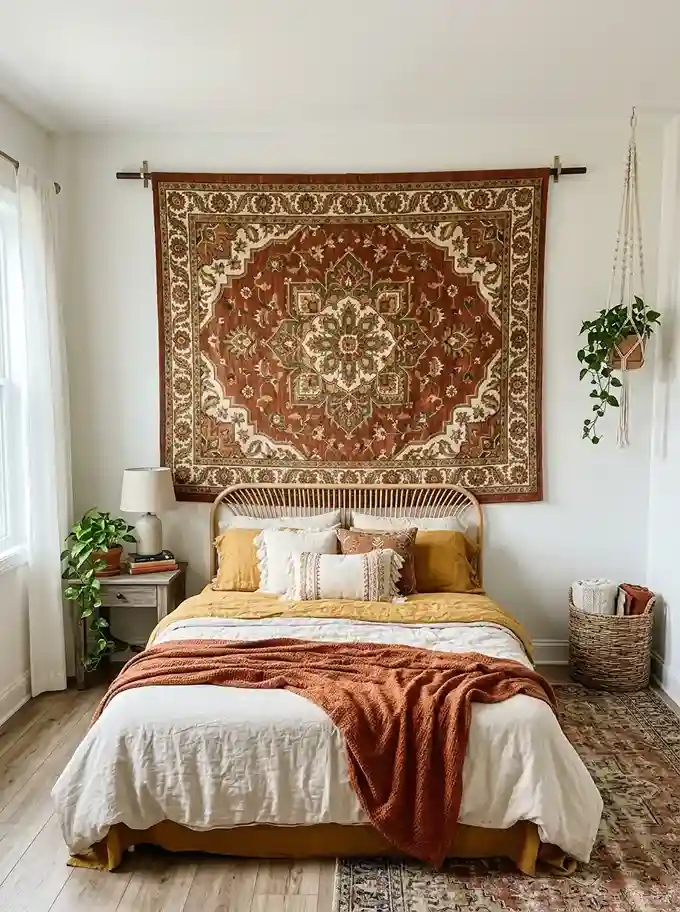
The hanging method matters. A tapestry clipped to a dowel and hung centered on a large wall reads as art. The same tapestry thumbtacked at all four corners reads as a college dorm room. The presentation is everything.
Size guidance: The tapestry should be at least as wide as the headboard — ideally wider. A 60-inch wide tapestry above a queen bed looks purposeful. A 30-inch wide tapestry above the same bed looks like it couldn’t find a better spot.
12. Use Warm-Toned Edison Bulbs Everywhere
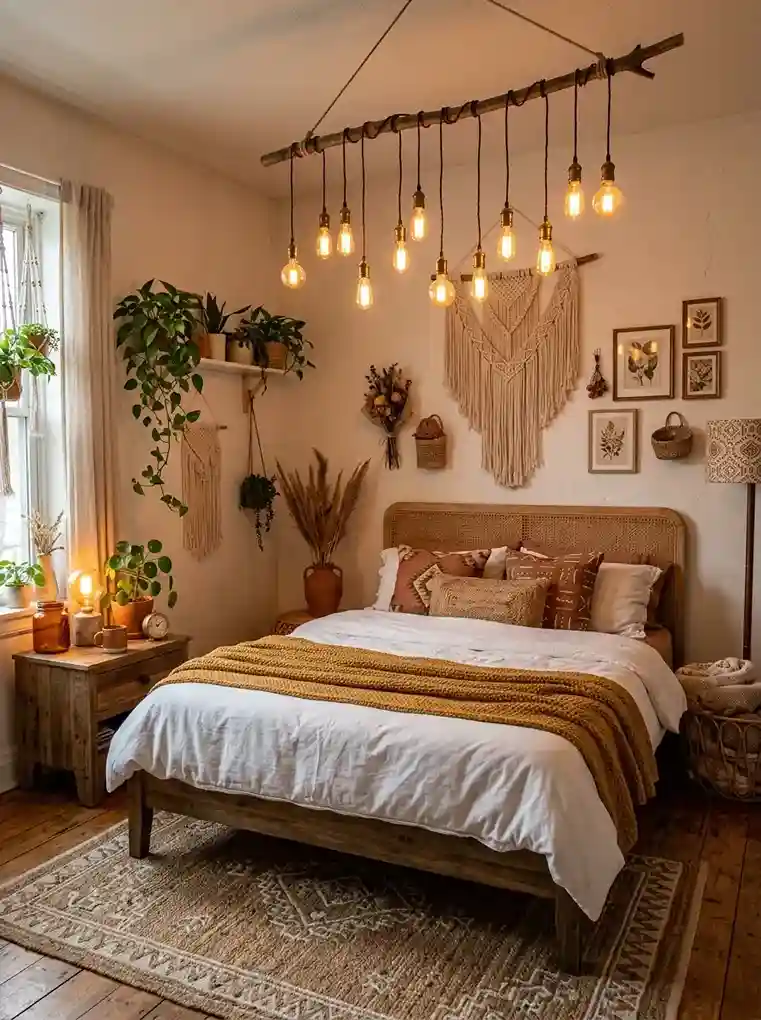
The boho aesthetic is fundamentally about warmth — warm colors, warm textures, warm wood tones. Cool LED lighting (anything above 3000K color temperature) fights every single design choice in a boho room. Edison-style warm LED bulbs (2200K–2700K) make the whole room glow in a way that pulls every element together.
Replace every bulb in every fixture with a warm LED. It costs $15–$30 total and is the easiest, most immediate upgrade you can make. The difference between 2700K and 4000K in a bedroom is the difference between “this feels like a cozy retreat” and “this feels like a clinic.”
The trick that actually works: Add a dimmer switch to the overhead light ($20, one-hour install). Being able to dim the main light from full brightness down to 20% in the evening changes how the room feels every single night.
13. Build a Canopy Above the Bed With Sheer Fabric
A bed canopy gives any bedroom an instant sanctuary feeling. In a boho room it’s one of the most dramatic transformations possible — two panels of sheer fabric hung from a ceiling hook above the headboard, draping down on either side of the bed, costs under $30 and takes 20 minutes.
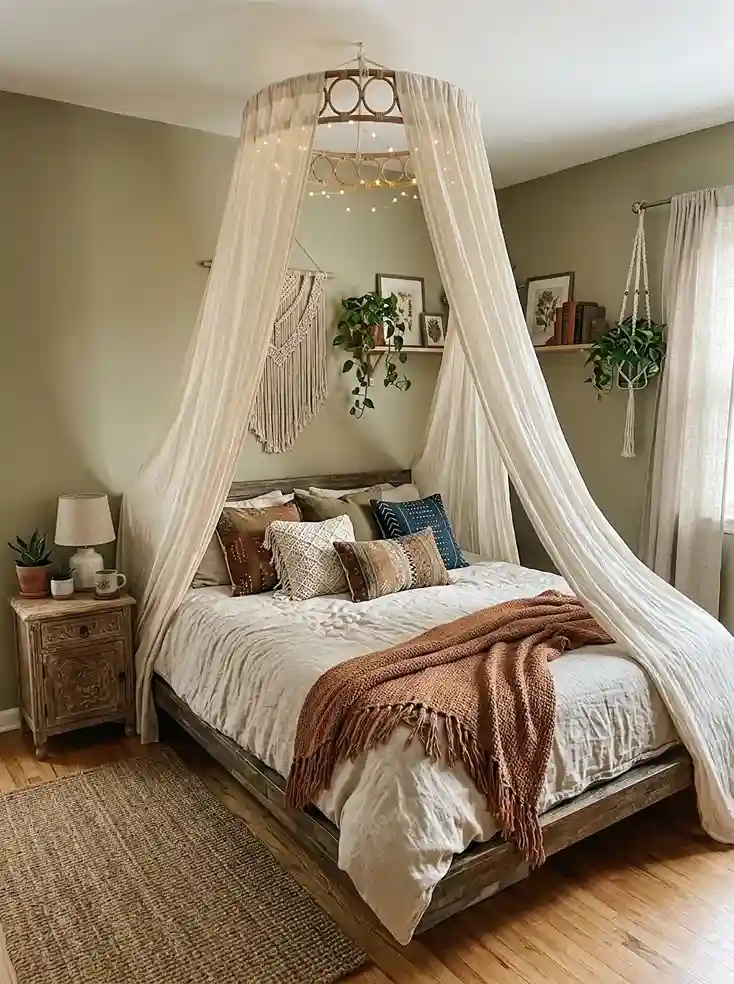
The simplest method: buy 4–6 yards of sheer fabric from a fabric store (the lightest weight available, sometimes called voile or chiffon — $3–$6 per yard). Fold it over a decorative brass ring hung from a ceiling hook directly above the headboard. Let the fabric fall on both sides. That’s the whole project.
A more structured alternative: a bed canopy frame ($40–$120 on Amazon) that mounts over or around the bed and holds the fabric in a defined shape.
14. Layer the Lighting With Multiple Sources
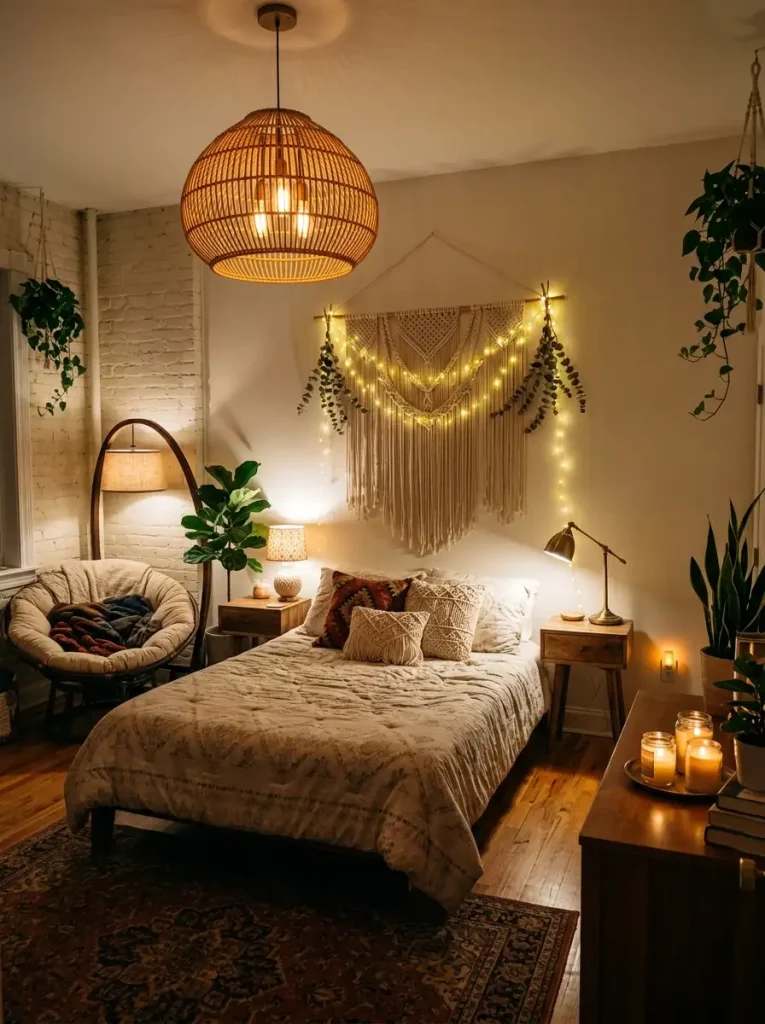
A boho bedroom with only one overhead light source is never quite right. The aesthetic depends on pools of warm light from multiple sources at different heights — a pendant overhead, table lamps on the nightstands, a floor lamp in the corner, string lights somewhere, candles on the dresser.
Each light source creates its own atmosphere and you layer them or use them individually depending on the time of day. Reading: nightstand lamp. Getting ready: overhead light. Evening wind-down: floor lamp at low dimmer setting plus string lights. Middle-of-the-night water: none of the above, which is why a small LED nightlight in the outlet behind the nightstand is always worth having.
String lights draped over a mirror, looped around a headboard, or pinned along the top of a wall add enormous warmth for almost no money. A set of outdoor-rated warm LED string lights from Amazon: $18–$30. That’s one of the best dollar-per-impact purchases in boho decor.
15. Style a Vintage Vanity or Dressing Area
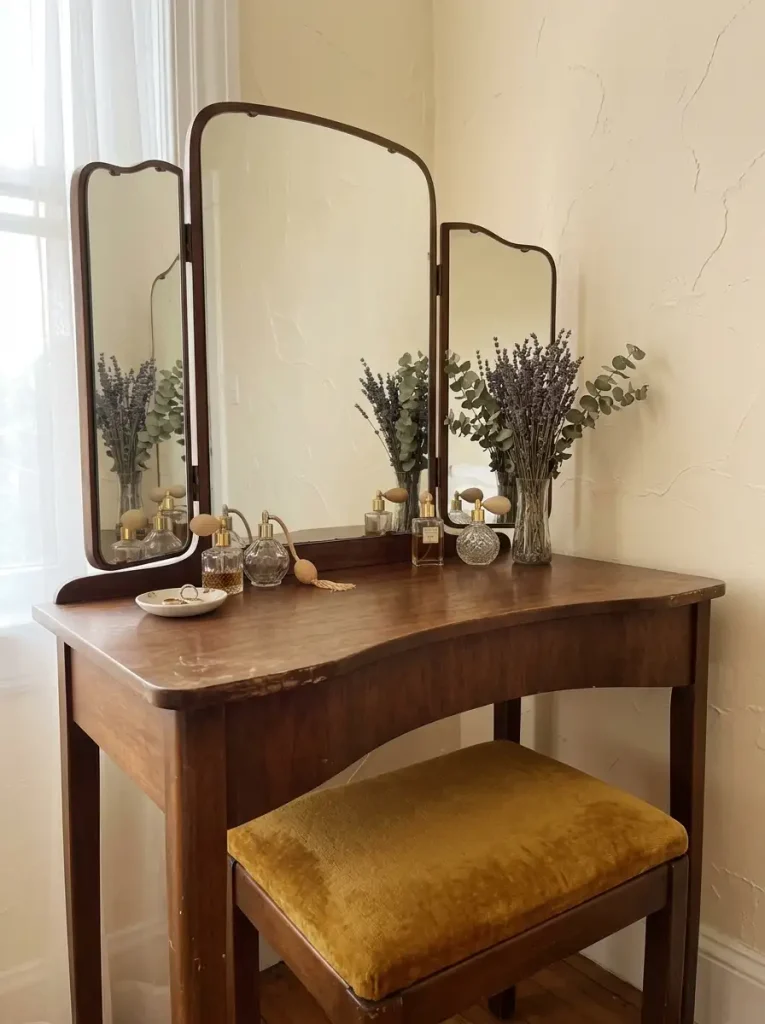
A vanity or dressing table is one of the most character-filled elements in a boho bedroom. It doesn’t need to be new or matched to anything else in the room. In fact, it’s better if it isn’t — a scuffed vintage vanity table, a thrifted stool reupholstered in a boucle or velvet fabric, a collection of perfume bottles, vintage hand mirrors, dried flowers in small vases, and a ring dish or two on the surface creates a lived-in dressing area that looks deeply personal.
My own vanity is a $35 thrift store find — a 1960s kidney-shaped dressing table with the original tri-fold mirror. I replaced the stool cushion with a $12 piece of foam and some ivory boucle fabric I stapled on. The whole setup cost $65 and it photographs better than anything else in the room.
Where to find vintage vanity tables: Facebook Marketplace, thrift stores, estate sales, and antique malls. Search “vintage vanity,” “dressing table,” “mid-century vanity.” Condition doesn’t need to be perfect — a scratched surface that you can clean and wax is a feature, not a problem.
16. Fill Empty Wall Space With Gallery-Style Arrangements

Boho bedrooms rarely have large, empty walls. The walls are usually covered with an arrangement of objects: framed prints, small mirrors, macramé pieces, dried botanical stems in frames, small weavings, a few photos. This isn’t clutter — it’s curation.
The gallery wall that works in a boho bedroom isn’t the perfectly symmetrical grid layout. It’s the salon-style hang: different sizes, mixed frame colors (natural wood, brass, matte black), pieces at slightly different heights within the overall arrangement. The arrangement should feel discovered rather than calculated.
Before nailing anything: Lay the whole arrangement on the floor and photograph it from above. That photo tells you whether the mix is working before you make any holes in the wall. Adjust on the floor until you’re happy, then transfer the arrangement to the wall.
17. Add a Floor Mirror — the Bigger the Better

A large floor mirror leaning against the wall is one of the most useful pieces in a small bedroom. It reflects light, makes the room feel bigger, and adds a visual anchor that grounds the whole design. In a boho bedroom, an arched floor mirror in a rattan or natural wood frame does all of that plus fits the aesthetic perfectly.
Arch-shaped floor mirrors with rattan or woven frames: $80–$250 depending on size and retailer. World Market consistently has them in the $120–$180 range. IKEA’s HOVET mirror ($200, large rectangular) works beautifully with a DIY rattan frame glued around the edges.
Lean the mirror at a slight angle rather than perfectly vertical. A mirror tilting slightly forward reflects more of the room and less of the ceiling, which is almost always more flattering and more useful.
18. Bring in Natural Wood With Mismatched Nightstands
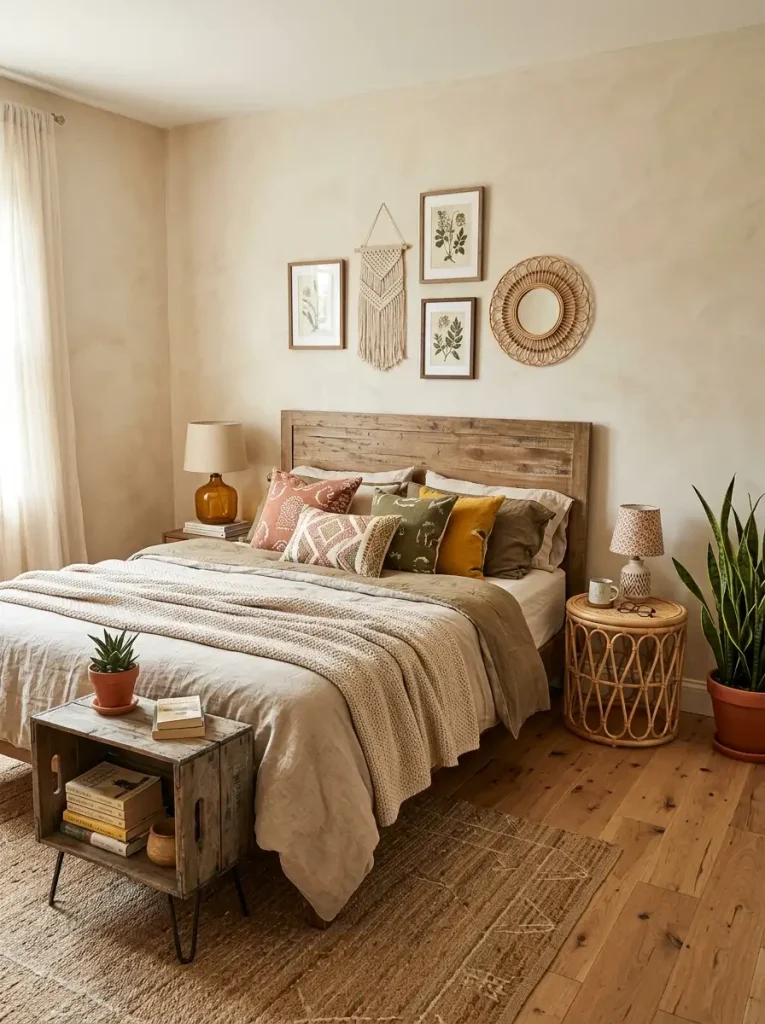
Matching nightstands on either side of the bed is a conventional choice that works against boho design. Mismatched nightstands that share a common material (both wood, both rattan) or a common tone (both warm, both natural) add far more personality.
The best boho nightstand combinations I’ve seen: a small vintage wooden crate on legs beside a woven rattan side table. A weathered wood bedside table beside a small vintage stool with a marble top. A simple floating shelf on one side beside a tall slender wooden nightstand on the other. The asymmetry is the point — it signals that the room developed organically rather than being bought as a set.
The key rule: Different shapes, different heights are fine. Just keep the tones in the same warm wood family so the pieces feel related without being matchy.
19. Hang Dried Botanicals for Permanent, Zero-Maintenance Decor
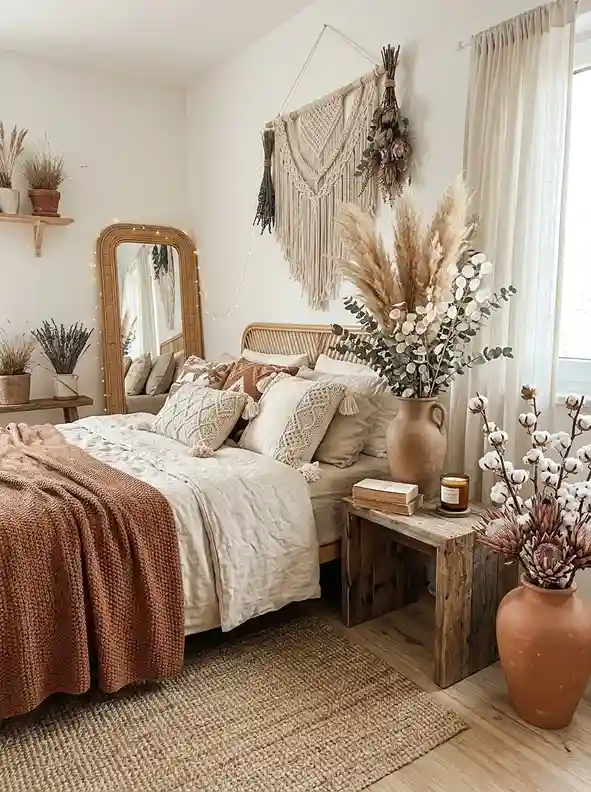
Dried botanicals — pampas grass, dried lavender, preserved eucalyptus, dried cotton stems, lunaria seed pods, dried protea — are the defining botanical accent of boho interior design right now. Unlike fresh flowers, they never need water, never die (beyond fading slightly over years), and actually look more interesting as they age.
A large bunch of pampas grass in a tall vase in a corner: $20–$40 and it lasts indefinitely. A bundle of dried lavender tied with twine and hung above the headboard: $8 and the scent lasts 6–12 months. A few dried cotton stems in a small terracotta vase on the nightstand: $12 and they look beautiful for years.
Buy dried botanicals from Etsy sellers, floral supply shops, or dry your own. In late summer, fresh pampas grass and eucalyptus dry beautifully if you hang them upside down in a dry, dark spot for 2–3 weeks.
20. Use a Bed Crown for a Dramatic Romantic Look

A bed crown is a simple fabric gathering point mounted on the ceiling above the headboard, from which curtains or sheer fabric drape on either side of the bed. It’s been used in European bedrooms for centuries. In a boho bedroom it creates a genuinely dramatic, romantic canopy effect without needing a full four-poster frame.
The simplest version: a wooden curtain holdback or decorative brass ring mounted on the ceiling above the center of the headboard, 12–18 inches from the wall. Loop 4–6 yards of sheer fabric through it and let it pool on either side. The look takes 30 minutes and costs $20–$30 in materials.
For a more layered effect: use two fabric layers. A sheer inner layer (voile or chiffon) gathered in the center, with a heavier semi-sheer panel in a warm cream or terra cotta layered behind it. The two layers add depth and a more finished, considered look.
21. Create a Reading Nook With a Hanging Chair or Floor Cushion
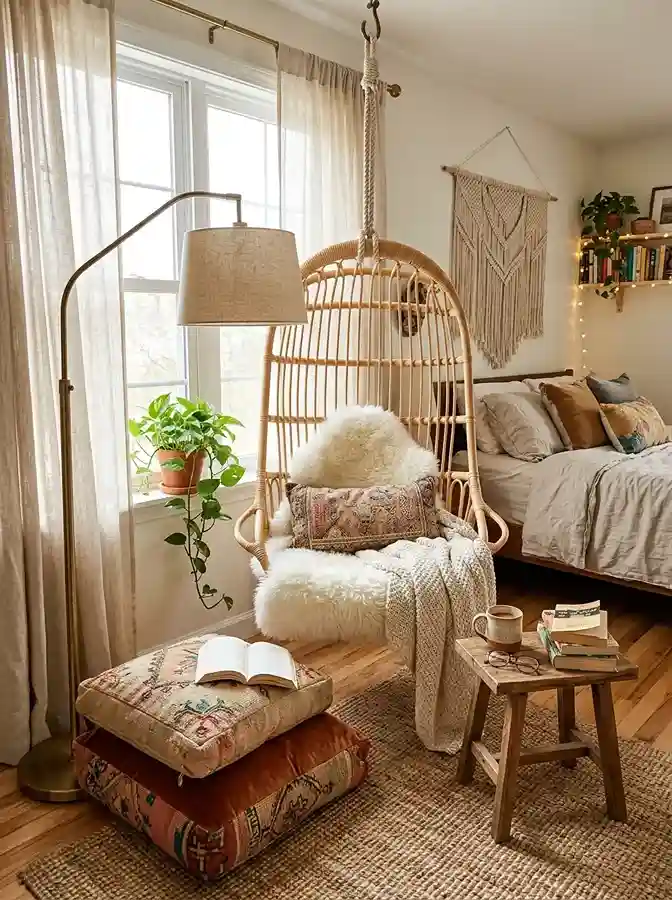
A dedicated reading area in the bedroom transforms how you use the space. It gives the room a second purpose beyond sleep, which changes the energy of the whole space. A hanging rattan chair by the window with a sheepskin throw and a floor lamp beside it is the most coveted corner in any boho bedroom.
Hanging rattan egg chairs: $80–$300 depending on size and quality. They require a ceiling joist mount rated for at least 250 lbs — make sure to mount into actual structural support, not just drywall. If the ceiling won’t work, a floor-standing rattan swing chair achieves the same visual impact with no ceiling mounting required ($120–$200).
The simpler version: a large floor cushion (floor pouf or Moroccan leather pouf, $40–$80) with a sheepskin thrown over it and a leaning floor lamp behind it. The visual is nearly as compelling and the cost is half.
22. Add a Woven Storage Basket Collection for Organized Chaos
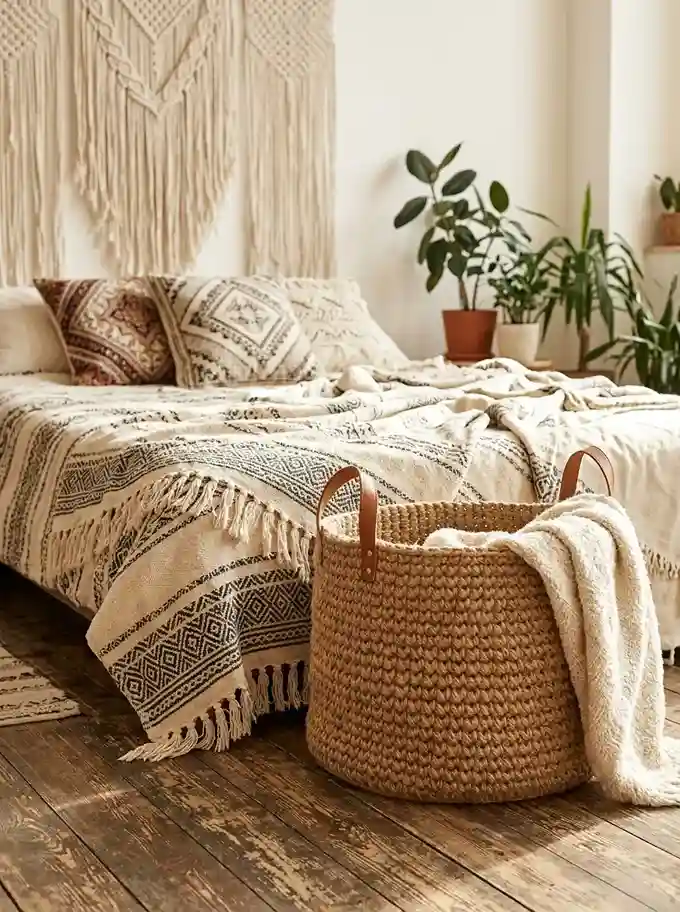
Boho bedrooms aren’t minimalist — they hold a lot of objects and a lot of textiles. The challenge is keeping everything accessible without looking messy. Large woven baskets on the floor solve this perfectly: they look like intentional decor while hiding extra blankets, pillows, laundry, or whatever else needs to disappear.
A grouping of three baskets in different heights, woven in natural seagrass or water hyacinth, against a corner or beside the wardrobe: deeply practical and completely on-aesthetic. Lidded baskets hide more; open-top baskets are better for things you access regularly (like extra blankets you pull out every evening).
Seagrass and water hyacinth baskets: $15–$50 at Target, TJ Maxx, HomeGoods, IKEA (the ORENÄS baskets), and on Amazon. Buy in sets of three for a cohesive look.
23. Incorporate a Vintage Kilim or Turkish Rug

If you can only buy one antique or vintage textile for the whole room, make it a Turkish kilim or Moroccan rug. The colors — muted reds, dusty blues, burnt orange, cream, and black — are perfect for the boho palette and they add a genuinely exotic, well-traveled quality that no new rug can replicate.
Real vintage Turkish kilims and Moroccan Beni Ourain rugs are widely available on eBay, Etsy, Facebook Marketplace, and estate sales. A 4×6 vintage kilim in good condition typically runs $80–$200 — significantly less than a new rug of similar quality, and with far more character. Machine-made kilim-style rugs from brands like Loloi or Safavieh are a reasonable alternative at $100–$200 for larger sizes.
24. Hang a Dreamcatcher or Woven Fiber Art
Dreamcatchers are the most recognizable symbol in boho bedroom decor and they earn their place — a handmade piece with feathers, beads, and intricate webbing hung above the headboard adds both visual interest and a handmade quality that manufactured decor never achieves.
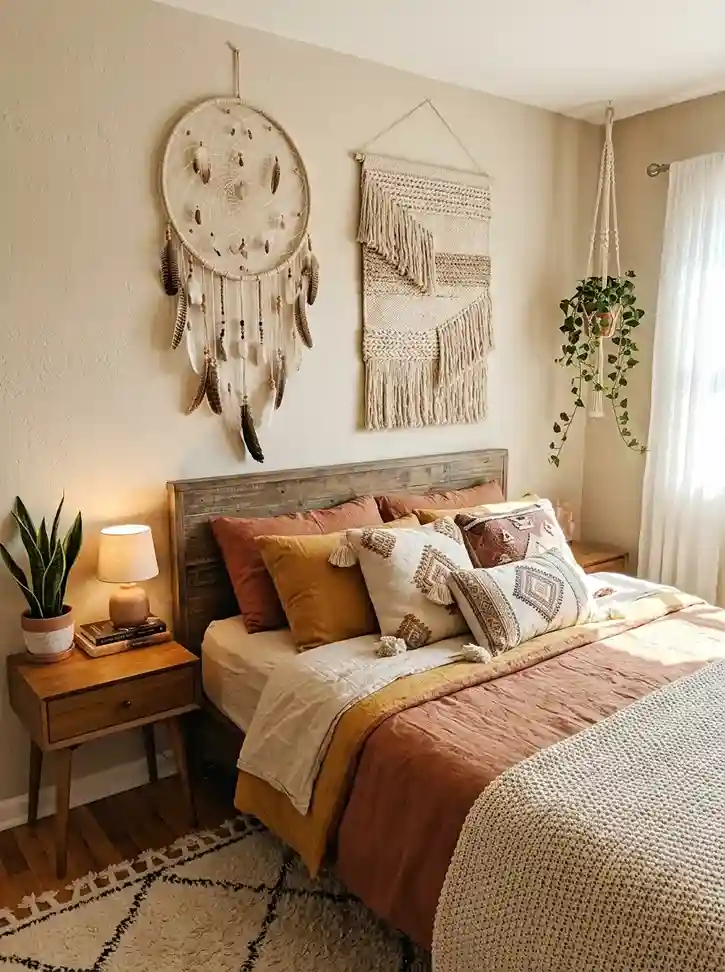
The best dreamcatchers come from independent Etsy sellers, many of whom are Indigenous artists. If you’re buying something labeled as a dreamcatcher, support the cultural origins it comes from by buying from Native-owned shops. Alternatively, look for fiber art pieces inspired by natural forms — woven circles, branching twig frames with yarn wrapping — that are clearly made by independent artists from their own craft traditions.
25. Paint One Wall in Terracotta or Warm Clay
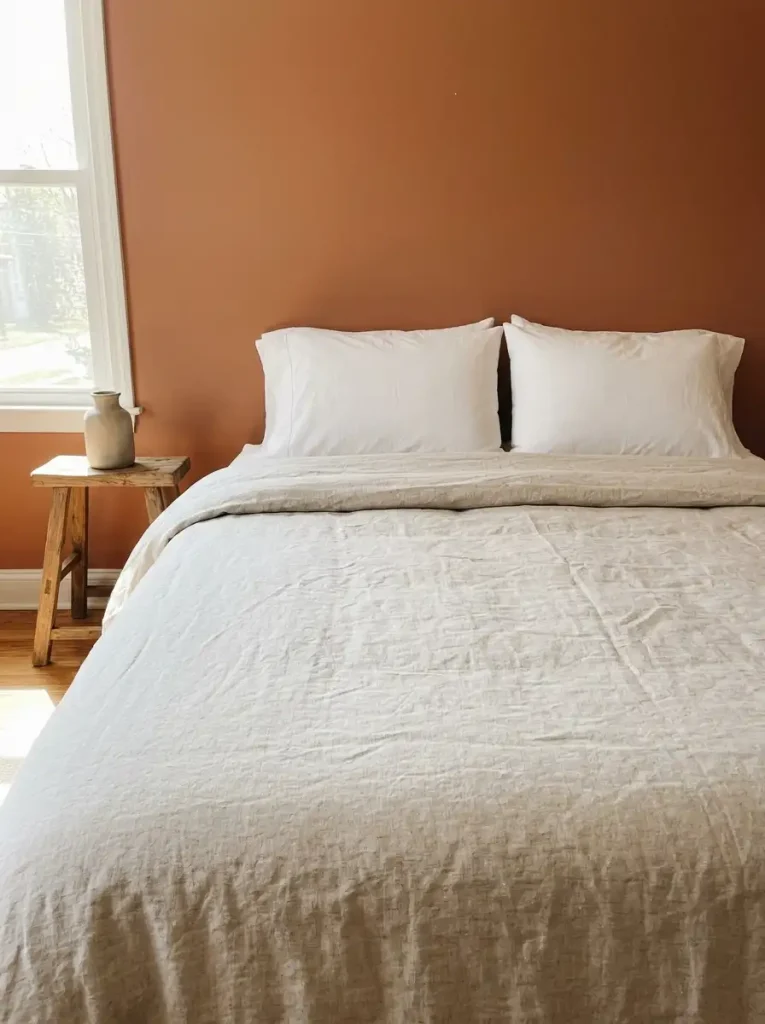
If you want a statement color in the boho bedroom, terracotta is the one. It’s warm, earthy, and deeply flattering in artificial light — it makes a room glow orange-gold in the evening in the best possible way. And unlike many trendy colors, terracotta has a long history in global interior design. It doesn’t date quickly.

Paint one wall — ideally the headboard wall — in a mid-depth terracotta. Keep the other three walls in a warm white or cream. The contrast is striking without being overwhelming.
Paint colors worth considering: Sherwin-Williams Cavern Clay (SW 7701), Benjamin Moore Terra Mauve, Farrow & Ball Dead Salmon (if you want a more muted, almost pink-terracotta), or Behr Terra Cotta tile. Buy a sample pot first — terracotta colors shift significantly depending on natural light and exposure direction.
26. Style Your Dresser Top Like a Curated Vignette
A dresser top in a boho bedroom isn’t just storage — it’s a display surface. Styling it thoughtfully makes it one of the most visually interesting elements in the room. The elements that work together: a large decorative mirror or framed art piece leaning against the wall, a small tray corralling jewelry and small objects, 2–3 different-height candles, a small potted plant or dried botanical arrangement, and one or two meaningful objects (a travel souvenir, a geode, a vintage perfume bottle).
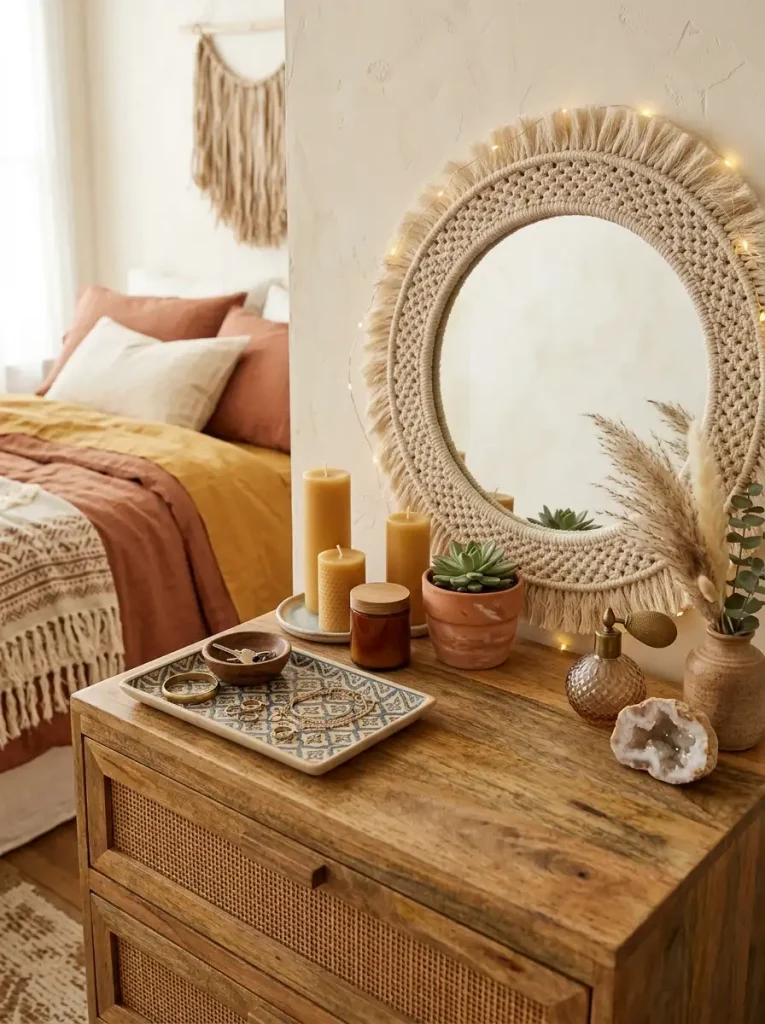
The rule for dresser styling: odd numbers of objects, varying heights, one organic element (plant, stone, dried botanical), and one personal element that means something to you. Everything else is filler.
27. Layer Throws and Blankets for Texture and Warmth
A bed that looks genuinely inviting in a boho bedroom has multiple layers of textile visible: a duvet, at least one throw folded across the foot of the bed, possibly a second lighter throw across a corner. The throws should look casually placed, not folded with military precision.
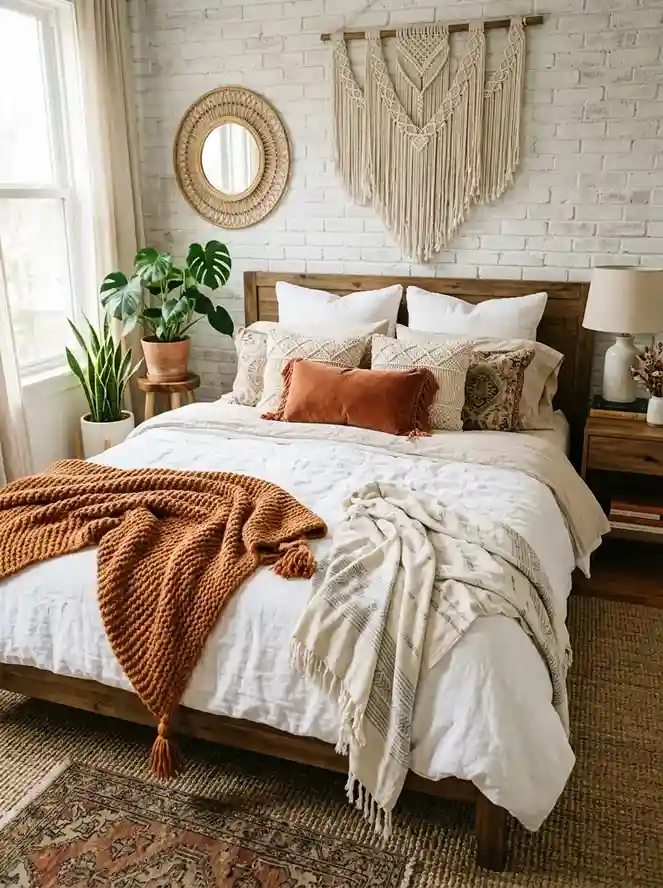
The textures that work best layered together: chunky knit wool (adds dimension and warmth), cotton gauze (lightweight and drapey), a faux fur or sheepskin piece for contrast and luxury, and a woven blanket or quilt with geometric pattern. Not all of these at once — pick two or three and mix them.
A chunky knit throw in a cream or warm oatmeal color is the single piece I recommend most. It photographs beautifully, feels luxurious, and anchors the layered textile look that boho bedrooms depend on. Amazon, Anthropologie (on sale), and TJ Maxx all carry them in the $25–$60 range.
28. Incorporate Crystals and Natural Minerals as Decor
Crystals and raw minerals — amethyst clusters, rose quartz points, selenite towers, pyrite cubes, geode slices — fit perfectly in boho bedroom styling as natural objects that add color, texture, and an earthy, grounded quality. You don’t need to attach any spiritual significance to them to appreciate that a large amethyst cluster on a nightstand looks genuinely beautiful.
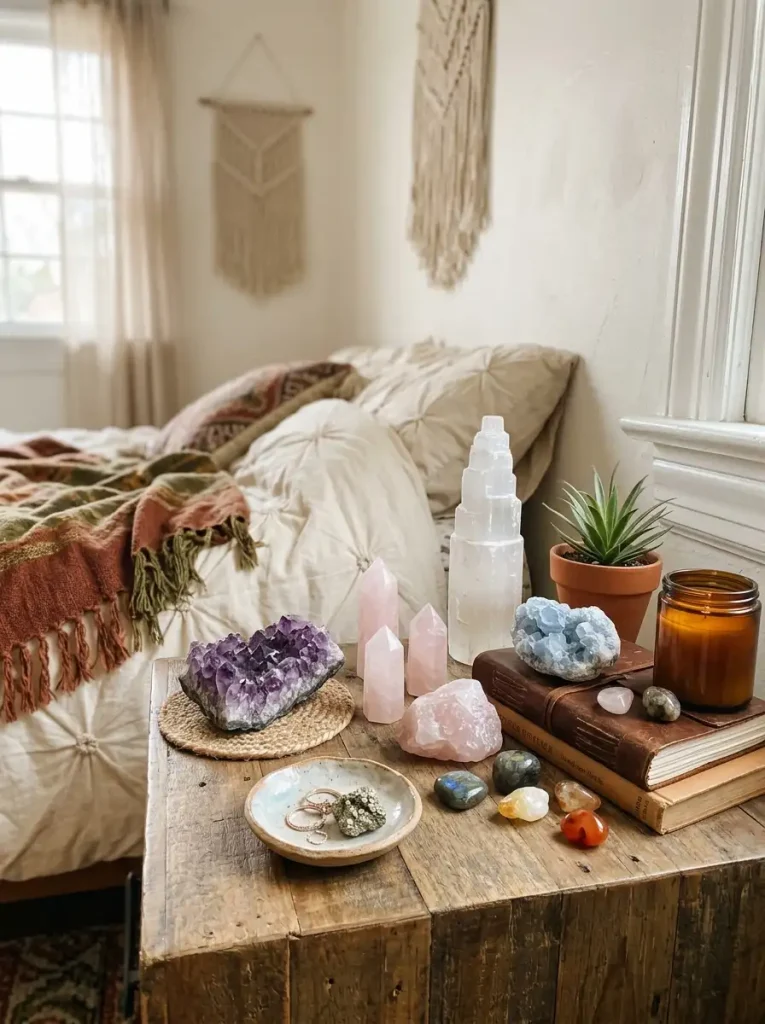
Mineral markets, crystal shops, and Etsy sellers all stock them at a wide range of prices. A small amethyst cluster: $8–$20. A large rose quartz point for the dresser: $20–$40. A selenite tower on the windowsill to catch and scatter light: $10–$15. A geode slice as a ring dish: $12–$25.
The key to using crystals in decor without it feeling like a witch supply store: limit the number (3–5 pieces, spread around the room rather than grouped together) and combine them with other natural materials (wood, stone, dried botanicals) so they read as part of a collected natural palette.
29. Add an Arched or Carved Wood Mirror Above the Dresser
An arched wood mirror above the dresser is one of the most consistent elements in well-executed boho bedroom design. The arch shape adds softness to what would otherwise be a hard rectangular arrangement of furniture. Natural wood or rattan frames tie it to the warm material palette.

Arched wood mirrors with carved or carved-look frames: available at World Market ($60–$120), At Home, HomeGoods (check regularly — inventory changes weekly), and online at Wayfair and Amazon ($45–$150). Look for solid wood frames rather than resin or MDF — they’re heavier but last much longer and have real grain texture.
The ideal size: as wide as the dresser or slightly narrower. An undersized mirror floating above a wide dresser looks lost. A mirror that’s proportional to the furniture beneath it looks intentional and designed.
30. Keep One Area Intentionally Minimal to Let the Room Breathe
This is the thing most boho bedrooms get wrong: everything is layered and textured and decorated, and nothing has anywhere to rest your eye. The rooms that work — the ones that feel thoughtfully curated rather than chaotically overfilled — always have at least one area of intentional calm.
That might be: a section of wall that’s completely empty beside a busy gallery arrangement. A clean dresser top on one side of the room while the other side is fully styled. A nightstand with only two objects on it while the dresser has a full vignette. A window left unframed with simple sheers while the rest of the room is heavily textured.
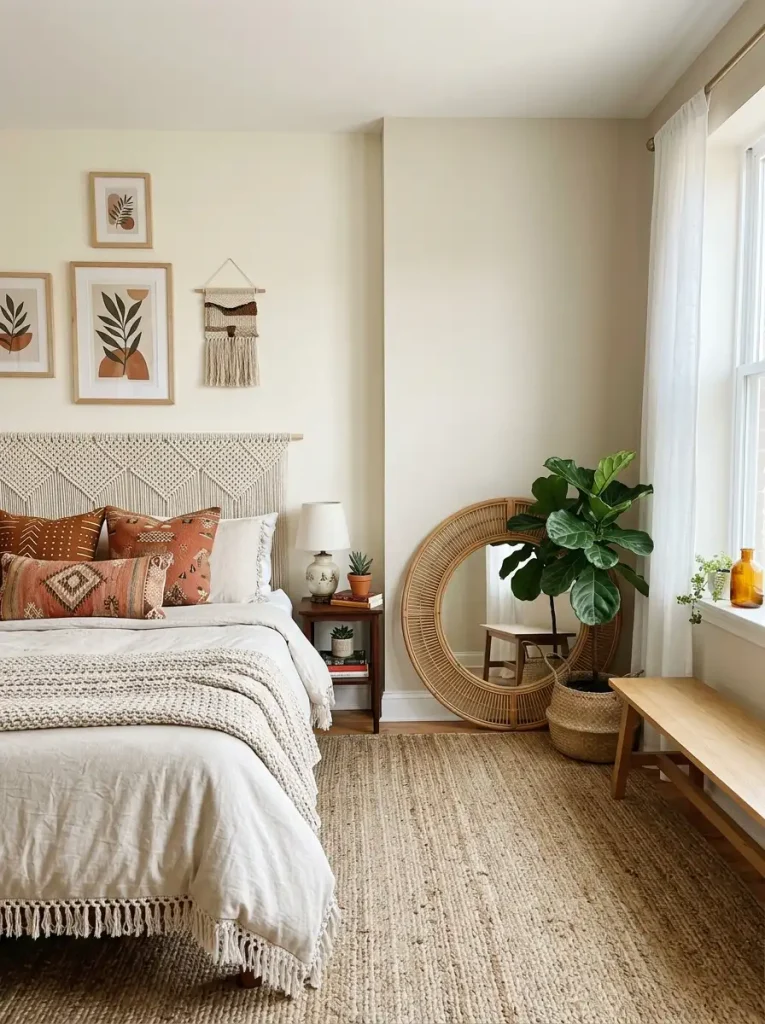
The empty space isn’t a failure to decorate. It’s what makes the decorated areas look intentional. Interior designers talk about this as “visual rest” — the pause between notes that makes the music work.
31. Make It Personal — Add One Thing That Has No Design Logic
The last and most important element in any boho bedroom is something that makes no sense as a design decision but is deeply personal to you. A collection of vintage cameras on a shelf. A piece of art your kid made, properly framed. A photograph from your favorite trip, printed large and hung prominently. Your grandmother’s quilt folded at the foot of the bed. A vintage instrument hanging on the wall that you actually play.

Boho design philosophy is rooted in the idea that spaces should reflect the people living in them — not a trend, not a retailer’s curation, not a Pinterest board. The rooms that feel genuinely alive always have something in them that can only be explained by: this person lives here, and they love this.
What’s yours?
What I’d Do Differently If I Started From Scratch
I’d buy the rattan headboard first, not last. I spent months swapping out smaller things and wondering why the room didn’t look right. The headboard set the whole tone once I finally added it — everything else fell into place around it. Start with the statement piece.
I’d skip the matching throw pillow sets. I bought a coordinated 5-piece pillow set thinking it would be easier than mixing individual pieces. It looked stiff and department-store. The best boho pillow arrangements come from buying pieces individually over time, or from mixing and matching singles that you chose independently. The slight imperfection of pieces that don’t perfectly coordinate is actually the point.
I’d invest in lighting earlier. For the first year I lived with overhead lighting only and wondered why the room never felt cozy. Adding a floor lamp, two table lamps, and a string of warm Edison bulbs changed how I felt about being in the room more than any furniture change I made.
I’d hang the curtains higher from day one. I mounted my first curtains at normal height — just above the window frame — and later moved them to ceiling height. It’s a 20-minute re-install but it felt like I was moving into a different room. Do it right the first time.
I would not overthink it. Boho design is forgiving. The “rules” are loose, the materials are warm and easy to combine, and things that look different from each other usually work together if they share a general warmth. Buy things you actually love. Put them where they feel right. That’s the whole method.
Frequently Asked Questions
What is boho bedroom style?
Bohemian bedroom style — often called boho — is an interior design aesthetic centered on warmth, layered textures, natural materials, and collected, personal objects. It draws from global textiles (Turkish kilims, Moroccan rugs, Indian block print fabric), natural materials (rattan, bamboo, jute, terracotta, raw wood), and handmade or artisan crafts (macramé, woven tapestries, hand-thrown ceramics). The look is warm rather than cool, layered rather than minimal, and personal rather than showroom-perfect. At its best, a boho bedroom looks like it developed naturally over years rather than being decorated all at once.
How do I start a boho bedroom on a tight budget?
Start with the things that have the highest impact for the lowest cost: layer two rugs (thrift stores and Facebook Marketplace are excellent for this), add warm Edison bulbs to every fixture ($15–$30 total), hang sheer curtains ceiling-height ($8–$40), bring in a few plants in terracotta or woven basket pots ($20–$40), and add a throw blanket with texture. These five changes can be done for under $100 and will shift the feel of the room significantly. Build from there over time — boho rooms that look the best are usually assembled slowly, not bought all at once.
What colors work in a boho bedroom?
The boho color palette is built on warm, earthy, slightly muted tones rather than bright or cool ones. The core palette: terracotta, warm sand, dusty rose, muted mustard yellow, sage green, warm cream, rust orange, and warm whites. Accent colors drawn from global textiles — deep indigo, brick red, warm turquoise — work well in small doses in throw pillows, rugs, and textiles. Avoid anything with a cool or grey undertone — cool blues, cool greys, and pure white fight the warmth that the whole aesthetic depends on.
Does boho style work in a small bedroom?
Yes — and it often works especially well in small bedrooms. The warm colors make the space feel cozy rather than cramped. The layered textiles add richness without requiring floor space. Plants grow vertically and add life without taking much room. The key adjustments for small spaces: hang curtains ceiling-height to maximize the feeling of height, use a floor mirror to reflect light and add perceived depth, and limit the furniture to what you actually need — a boho bed, a small nightstand, and a dresser is enough. Don’t try to fit everything from this list into a small room. Choose the elements that resonate most with you and let them breathe.
What’s the difference between boho and maximalist design?
Boho design is warm, earthy, and curated — it uses a lot of objects and layers, but they all share a visual language of natural materials, warm colors, and global textiles. Maximalist design uses a lot of everything, often across many styles and color families simultaneously. The easiest distinction: a boho room has a coherent palette and material story that ties everything together, even though it’s layered and full. A maximalist room intentionally breaks those rules for a more chaotic, eclectic effect. Boho rooms feel curated. Maximalist rooms feel deliberately overwhelming. Both are valid — they’re just different degrees of the same love of layering.
Can I do boho in a rental without painting?
Completely. Some of the best boho bedrooms I’ve seen were in rentals with white walls and standard fixtures. A large warm-toned rug, ceiling-height curtains in natural linen, a rattan headboard, macramé above the bed, plants, warm lighting, and layered textiles do the vast majority of the aesthetic work. Paint helps, but it’s not the foundation of the style. The foundation is warmth, texture, and personal objects — none of which require a landlord’s permission.
Conclusion
My bedroom took four years to get right. Not because the design was complicated, but because I kept looking for shortcuts — buying complete sets, following trends too literally, prioritizing what looked good in photos over what felt good to live in.
The moment I stopped trying to replicate what I saw on Instagram and started adding things I actually loved, the room started to look like mine. A vintage dresser I found for $60 and immediately felt attached to. Pampas grass from a market I went to on a rainy Saturday. A kilim runner I bought at an estate sale because the colors made me happy even though I had no idea where I’d use it.
That’s what boho design actually is — a way of decorating that gives you permission to love the things you love and put them in your space without apology. Warm, layered, personal, and completely yours.
Start with one element. The headboard, the rug, the curtains. Build from there. The room that feels right is the one you put real things in.