
Commercial gym memberships cost hundreds of dollars every year. The commute adds thirty minutes to every workout. The equipment is always occupied when you need it. And the hours never fit your schedule.
A garage gym ideas solves all of that. Your equipment. Your hours. Your rules.
Whether you have a full two-car garage or half of a single car space, this guide covers everything. Planning, layout, flooring, racks, bars, plates, storage, lighting, climate control, and every piece of equipment that actually earns its place in a home gym.

Some setups in here cost under $500. Some run into the thousands with saunas, cable machines, and Olympic lifting platforms. All of them solve real problems that commercial gyms cannot.
By the end, you will know what to buy first, what to skip, and how to build a gym you actually use every day.
1. Plan Your Garage Gym Before Buying Any Equipment
Planning prevents the most common garage gym mistake: buying equipment that does not fit the space or the training style. A garage filled with the wrong equipment wastes money and creates a gym nobody uses.

Texas gym builders shows what planning looks like when it works. A folding rack on the wall. Barbells on a wall-mounted rack.
Plywood walls, which are the cheapest and most durable gym wall finish. Rubber flooring in the training zone. Every item has a place because the layout was decided first.

Measure the garage before purchasing anything. Note ceiling height. Eight feet is the minimum for overhead pressing and pull-ups. Ten feet is better if you plan any Olympic lifting.
Identify which walls are load-bearing. Wall-mounted racks and pull-up bars have to attach to structural studs, not drywall.
Decide which workouts matter most. Strength training, cardio, functional fitness, or a mix. Every equipment decision should follow from those priorities.
2. Design a Half Garage Gym Layout
A half garage gym is the most popular setup for homeowners sharing the space with a vehicle or storage. One half is the gym. The other half stays functional. The two coexist with smart planning.
Position the gym zone along the back wall, away from the vehicle entry. That keeps equipment clear of car doors and weather.

Bryan created compact version built around a heavy bag, kettlebells, and wall storage. The bag hangs from a ceiling-mounted rack that swings out of the way when not in use.
For a half garage, the wall-mounted folding rack is the single best equipment choice. It folds flat against the wall when not in use and extends into the space only during training. You get a full rack without permanently losing floor space to one.

| Half Garage Gym Zone | Dimensions | Equipment That Fits |
|---|---|---|
| One car half (10×10 ft) | 100 sq ft | Rack, barbell, plates, bench |
| One car half (10×12 ft) | 120 sq ft | Rack, bench, dumbbells, storage |
| Two car half (10×20 ft) | 200 sq ft | Full strength + cardio machine |
| Two car half (12×20 ft) | 240 sq ft | Full gym with cable machine |
3. Build a Full Garage Gym in a Single Car Garage
A single car garage converted entirely to a gym gives you 200 to 280 square feet of dedicated training space. That is more than enough for strength, cardio, and functional work.

See the garage, what a well-planned single car conversion looks like. Power rack centered against the back wall. Weight plates stored vertically on a wall-mounted rack. Barbells in a dedicated holder. Rower along the right wall. Whiteboard for programming. Mirror panels on the walls.
The result rivals many commercial gyms for functional training capability.
A few rules worth following. Install rubber flooring before any equipment. Position the rack where ceiling height allows a full overhead press. Dedicate one wall to organized storage. Mount a mirror on at least one wall for form checking.
Add a ceiling fan. Garage gyms become extremely hot in summer without ventilation.
4. Design a Two-Car Garage Gym for Maximum Space
A two car garage converted to a full gym gives you 400 to 600 square feet. That is enough for a genuinely comprehensive setup: dedicated strength, cardio, functional, and recovery zones.

Check there is rogue power rack on the left. Full dumbbell set in a two-tier rack on the right. Barbell storage on the wall behind. Adjustable bench in the center. Even a mini fridge.
The extra space lets you plan distinct zones.
A strength zone with the rack, bench, and free weights. A cardio zone with a treadmill, rower, or assault bike. A functional zone with open floor space for kettlebells and bodyweight work. A mobility and recovery zone with a mat, foam roller, and stretching tools.
Keep the center clear. Open floor space is what makes a gym feel usable rather than cramped.
5. Install Rubber Flooring as the Foundation

Rubber flooring is the single most important infrastructure investment in any garage gym. It protects the concrete from dropped weights. It reduces noise and vibration that transmit to the house. It provides a non-slip surface. And it makes the garage feel like a proper gym rather than a converted storage space.
Try this installation process. Stall mats laid out on the concrete. A level checking for flatness. Plywood and rubber platform sections ready for assembly.
Rubber stall mats from agricultural supply stores, typically 4 by 6 feet and 3/4 inch thick, cost $40 to $60 each. They cover the floor efficiently with minimal cutting.
Interlocking rubber tiles cost more but are easier to install and easier to replace individually. A dedicated lifting platform built from plywood and rubber costs $100 to $200 and adds the most protection where it matters.
Lay flooring before any equipment goes in.
6. Choose the Right Power Rack for Your Space
The power rack is the centerpiece of most garage gyms. It determines which barbell exercises are possible, how safe solo training is, and how much vertical space you need.
Before mounting anything, locate and mark every stud. Racks attach to structural framing, not drywall.

A full cage rack gives you maximum safety with four uprights and safety bars on all sides. It needs about 4 by 4 feet of floor space and at least 8 feet of ceiling.
A half rack or squat stand uses less floor space and suits lower ceilings. It offers less safety for solo heavy lifting.
A wall-mounted folding rack is the best choice for half garage setups. It folds flat when not in use and extends into the space only during training.
The rack here is a full cage setup with a bench, poster wall showing exercise references, and concrete block walls behind. Simple, effective, and built for serious training.
7. Build a Budget Garage Gym Under $500
A genuinely effective garage gym is achievable for under $500 with smart purchases. Budget does not mean ineffective. It means prioritizing equipment that delivers the most training value per dollar.

The setup here shows what a well-chosen budget gym looks like. Power rack. Barbell and plates on a deadlift platform. Chalk bowl. Lifting belts hanging on the wall. Whiteboard for tracking.
A 300 pound barbell and plate set costs $200 to $350 and covers squats, deadlifts, bench press, overhead press, and rows. A used power rack found online runs $100 to $200. Rubber stall mats add $50 to $100. A wall-mounted pull-up bar is $30 to $50.
The entire setup lands between $380 and $700 and handles progressive strength training for years.
Search Facebook Marketplace, Craigslist, and OfferUp for used equipment at 50 to 70 percent off retail. Barbells and plates are the top priority.
8. Design a Garage Gym for Powerlifting

A powerlifting garage gym is optimized for the squat, bench press, and deadlift. The equipment selection is focused and intentional.
The gym here is a full-featured version with a power rack, dumbbell set, kettlebells, assault bike, treadmill, whiteboard for programming, mirrors on the wall, and rubber flooring throughout.
The essentials for a dedicated powerlifting setup are a competition-spec power rack with adjustable safeties, a competition barbell rated to 1500 pounds, bumper or iron plates to at least 500 pounds, and a proper adjustable bench.
A deadlift platform built from three layers of plywood topped with rubber protects the floor and the barbell during heavy work. A chalk bowl, a belt, and wrist wraps complete the setup.
9. Create a Garage Gym for Olympic Weightlifting
Olympic weightlifting, the snatch and the clean and jerk, needs specific equipment that differs from powerlifting.

A proper lifting platform with a wood center and rubber sides. Bumper plates loaded on the barbell. Jerk blocks on the left. Wooden ceiling beams that provide the headroom overhead lifting requires.
The essentials. A rotating-sleeve Olympic bar. Bumper plates that absorb impact when dropped from overhead. A lifting platform at least 8 by 8 feet, built from three sheets of 3/4 inch plywood with a rubber-topped center section.
Ceiling height is the most critical factor. Ten feet minimum is strongly recommended for overhead work. The beams in the photo give this garage the clearance.
Install eye bolts in the ceiling above the platform for attaching jerk blocks and safety straps.
10. Build a Functional Fitness Garage Gym
A functional fitness garage gym supports varied, high-intensity training. Barbell work, gymnastics movements, conditioning, and loaded carries all happen in the same space.

Green painter’s tape on the floor marks out each zone before any equipment is bought. Rack in one zone. Bikes in another. Open floor space for barbell and bodyweight work clearly defined.
11. Add a Pull-Up Station to Any Garage Gym
A pull-up bar is one of the highest-value additions to any garage gym. It adds an entire dimension of upper body training for almost no cost. Pull-ups, chin-ups, hanging leg raises, and ring work all start from a solid overhead bar.

Reconstructed human created a practical entry-level gym. Adjustable bench on the left, squat stand in the center with a barbell loaded, plate storage on the wall, and a Roman chair on the right. The overhead bar in this setup is built into the squat stand.
13. Design a Cardio-Focused Garage Gym Layout

A cardio-focused garage gym maximizes equipment for aerobic training and conditioning. This setup suits runners, cyclists, and general fitness enthusiasts who want structured indoor cardio regardless of weather.
The commercial cardio floor above shows the layout approach worth copying. Treadmills along one wall, bikes along another, open floor between. Nothing blocks sightlines. Nothing interferes with the machine next to it.
Position the treadmill along a wall where the user faces into the room rather than facing a blank wall. Facing into the room during long cardio sessions feels less claustrophobic.
Install a small wall-mounted TV or tablet holder at eye level for entertainment during steady-state work.
Space requirements matter. A treadmill needs about 3 by 6 feet. A rowing machine needs 4 by 8 feet during use. A stationary bike needs only 2 by 4 feet. An assault bike needs 3 by 4 feet and delivers the most conditioning per square foot of any cardio machine.
14. Create a Garage Gym With a Cable Machine
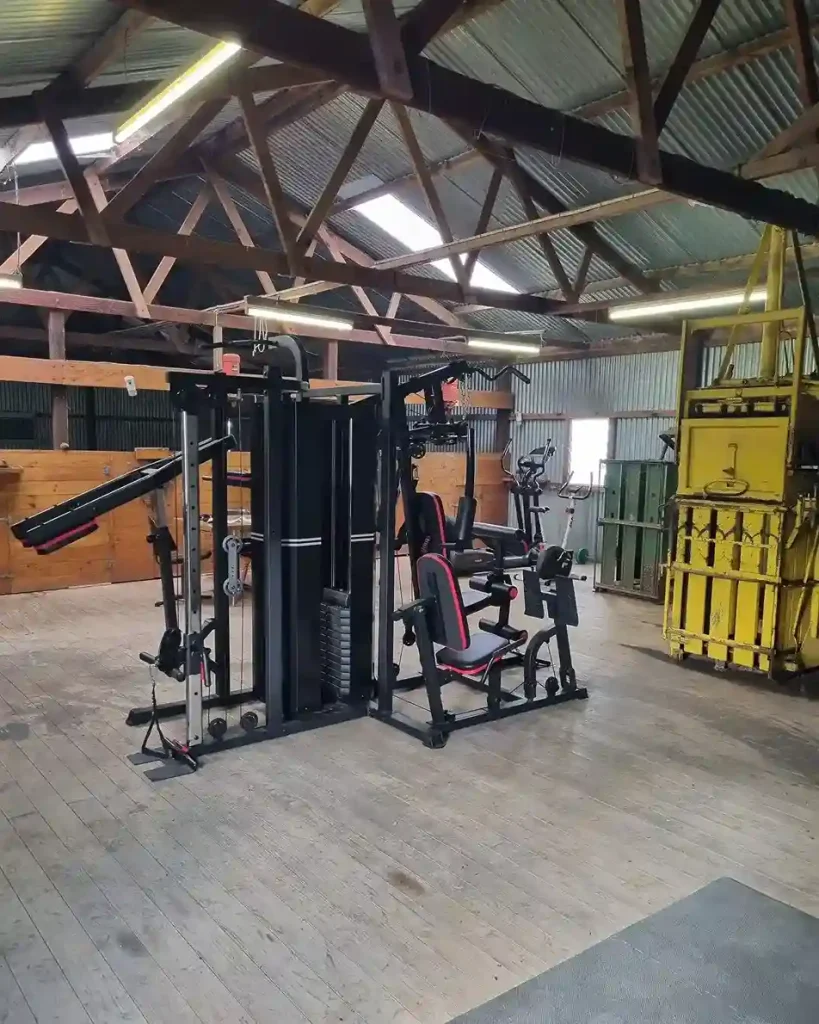
A cable machine adds a range of isolation and functional exercises that free weights cannot replicate efficiently. Cable flyes, tricep pushdowns, lat pulldowns, cable rows, and face pulls all become possible. The constant tension of a cable system provides a training stimulus fundamentally different from barbells and dumbbells.
The setup above is a multi-station cable machine in a large open barn space. It combines a functional trainer on one side with a lat pulldown and seated row on the other.
A functional trainer, which is a dual cable machine with independently adjustable pulleys, is the most versatile option. It takes up about 4 by 4 feet.
A single cable stack attached to an existing power rack adds cable training without any additional floor footprint. Budget cable attachment kits for power racks run $80 to $200 and instantly expand the training options of a rack you already own.
If floor space is tight, the rack-mounted cable attachment is the smarter purchase.
15. Set Up a Dumbbell Wall for Organized Storage

A wall-mounted or floor-standing dumbbell storage system turns a pile of dumbbells into a clean, organized training station. The rack above holds a full set from 5 to 50 pounds in five-pound increments across two tiers. Kettlebells sit on the floor underneath.
A complete dumbbell set from 5 to 50 pounds covers the most useful range for most home lifters. Buying the full set at once is cheaper than buying pairs individually, and the rack keeps everything accessible.
Adjustable dumbbells, which are a single pair that adjusts from 5 to 50 or 90 pounds, save enormous space and cost compared to a fixed set. They store on a small stand that takes up less than one square foot of floor space.
The setup above uses a fixed rack, which is the right choice if you plan to train with a partner or run circuits where switching weights quickly matters. For solo training, adjustable dumbbells deliver 90 percent of the utility at a fraction of the cost and space.
16. Build a Dedicated Lifting Platform
A lifting platform is the most important floor upgrade in any barbell garage gym. It protects the concrete from dropped weights. It protects the barbell from impact damage.
It defines the primary lifting zone within the larger gym space. And it provides a better surface for deadlifts and Olympic lifts than rubber mats alone.
Build a basic 8×8 foot platform from three sheets of 3/4-inch plywood. Glue and screw the first two sheets together for the base.

Cut the third sheet into two 2×8 foot side strips and leave the center 4×8 foot section bare plywood for the foot stance area. Cover the two side strips with horse stall rubber or bumper plate rubber.
The result is a platform that absorbs impact where the barbell lands while providing a stable surface where the lifter stands.
17. Maximize Vertical Storage on Garage Walls

Vertical wall storage is the single most effective strategy for keeping a garage gym organized. Every item stored on the wall is an item not consuming the floor space needed for training.
See eight plates stored vertically on wall-mounted pegs. Kettlebells on the floor against the wall. Rowing machine in the center. Storage bins on shelving on the right. The orange squat rack in the back corner.
Nothing is on the floor that does not need to be.
Install 2-inch steel pipes horizontally on the wall for barbell storage. Mount plate storage pegs between the barbell pipes for organized weight storage by denomination. Add a pegboard section near the main training area for chalk, bands, belts, and accessories.
A fully organized wall storage system transforms even a small garage gym from a cluttered obstacle course into a clean, efficient training environment.
18. Add Mirrors for Form Checking and Space Perception
Mirrors in a garage gym serve two purposes. They let you check form in real time on pressing, squatting, and hinging movements, which is a real safety benefit when training alone. And they make the garage feel larger than the actual square footage suggests.

Install mirrors on the wall facing the primary lifting position. Full-length mirror panels can be purchased affordably at home improvement stores and attached to the wall with mirror adhesive and clips.
A horizontal run of mirrors at shoulder-to-ceiling height along one full wall gives you the maximum form-checking benefit.
Secure mirror panels with safety clips even when using adhesive. Dropped barbells create vibration that can dislodge adhesive-only mirrors over time. This is not optional.
19. Control Temperature and Ventilation for Year-Round Training

A garage gym without proper temperature management is unusable in summer heat and winter cold. This is the most overlooked and most impactful comfort factor. A gym that is too hot or too cold in extreme seasons gets abandoned during those months.
Have a look on a large industrial drum fan on wheels. These move enormous volumes of air and can be repositioned around the gym as needed.
Install a ceiling fan as the minimum summer cooling. Add a portable air conditioner for hot climates or extreme summer periods. Ventilate by opening the garage door partially during training. Even a few inches of opening creates significant airflow.
A garage-rated electric heater or a mini-split heat pump handles year-round temperature control at moderate cost. Insulating the garage door and any exterior walls reduces the heating and cooling load significantly.
The total cost of a proper climate setup runs $200 to $500 for the fan plus heater approach, or $800 to $2,500 for a mini-split system.
20. Install Proper Lighting for a Safe Training Environment

Poor lighting is both unsafe and demotivating. A single dim overhead bulb creates shadows where rack heights, barbell position, and form details disappear. Proper lighting eliminates shadows, energizes the training atmosphere, and makes the gym feel professional.
Hexagon LED panels on a black ceiling create even, bright light across the entire floor. No shadows. No dark corners.
LED shop lights in 4-foot and 8-foot lengths are the practical choice for most garages. Mount them on the ceiling grid or hang them from joists on chains. Space them for even coverage across the full training area.
21. Create a Garage Gym for the Whole Family
A family garage gym accommodates multiple fitness levels, ages, and training styles at once. The equipment selection has to serve a teenager doing bodyweight training, a parent doing strength work, and a partner doing cardio without any one person’s needs dominating the space.

Artificial turf strip on the right for sled pushes, agility work, and stretching. Rack and barbell on the left for strength training. Dumbbells and benches for everything in between. “Prove Them Wrong” banner on the wall setting the tone.
A power rack with an integrated pull-up bar serves strength trainers at every level. Adjustable dumbbells serve everyone from beginners to advanced lifters.
A rowing machine or assault bike delivers high-intensity conditioning for every fitness level. A yoga mat and stretching corner handles mobility and recovery.
Wall-mounted storage keeps everything organized and accessible to all family members equally.
22. Design a Motivating Garage Gym Aesthetic
A garage gym that looks good feels better to train in. Motivation is finite. A gym that is visually inspiring, organized, and personal reduces the energy required to start every workout.

Here is a motivating aesthetic looks like in practice. Dark grey walls. Framed posters reading “Focus. Effort. Results.” and “Hustle for the Muscle.” A large chalkboard on the right listing weekly programming and personal records. Folding rack centered. Dumbbells to the left. Barbells stored vertically.
The chalkboard is doing serious work. Seeing your own PRs written on the wall next to today’s workout is a small thing that makes training feel like a practice rather than a chore.
Paint the walls a bold color. Mount quotes or athlete imagery on the wall facing the primary lifting position. Add a Bluetooth speaker for music. Track lifts on a whiteboard or chalkboard.
Display personal records prominently. The numbers you have already hit motivate you to beat the
23. Add a Sauna or Recovery Station to the Garage Gym
A recovery station recognizes that recovery is as important as training for long-term progress. A dedicated recovery area with the right tools turns the garage gym into a complete fitness facility.

Two-person infrared sauna on the left. Chest freezer converted to a cold plunge next to it. Stretching mat in the foreground with foam rollers, massage guns, and mobility tools. Treadmill and bike on the right for active recovery.
A two-person infrared sauna fits in a 4 by 4 foot footprint and costs $800 to $2,000. It provides cardiovascular benefits, muscle recovery acceleration, and stress reduction.
A cold plunge tub, often a chest freezer modified with a chiller, fits in a 2 by 4 foot space for contrast therapy alongside the sauna.
A foam rolling station, a massage gun charging dock, and a stretching mat complete the recovery zone at minimal additional cost. The sign on the wall says it best: “Recovery is as important as training.”
24. Build a Garage Gym With a Home Office Corner
A home office corner within the garage gym creates a productive dual-purpose space. The garage handles both fitness and professional work from the same footprint.
This combination suits remote workers, freelancers, and entrepreneurs who want their professional workspace to sit adjacent to their training space for efficient daily transitions.

Partition the office corner from the training area with a simple shelving unit or a curtain on a ceiling track. The office zone needs a desk, a comfortable chair, reliable internet connection, and proper task lighting.
Keep the office corner at the opposite end of the garage from the weightlifting area to prevent dust, chalk, and rubber particles from contaminating the workspace.
For a complete home office design that works within a garage gym space, explore this comprehensive guide on home office ideas.
25. Install a TV or Screen for Guided Workouts
A wall-mounted TV or monitor in the garage gym enables online training programs, guided workout videos, virtual coaching, and progress tracking software. The addition of a screen eliminates the need for a separate device during training and keeps the workout flow uninterrupted.
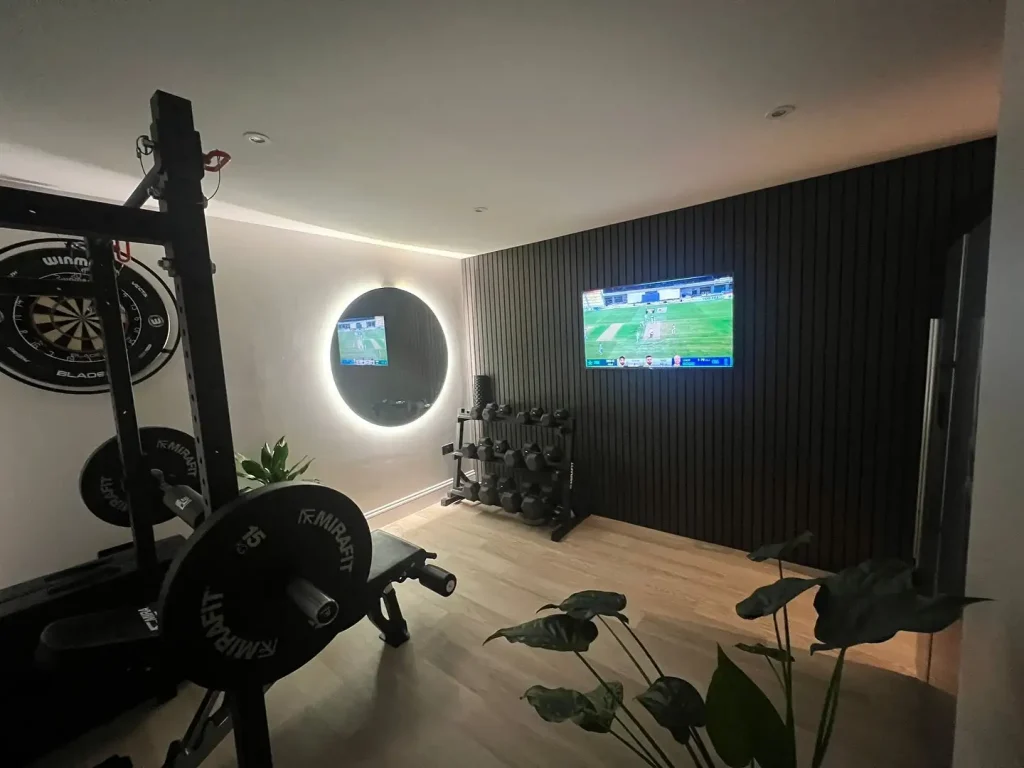
Mount the TV at eye level when standing — approximately 60 to 66 inches from the floor to the center of the screen. Choose a display size appropriate for the garage dimensions — a 43-inch TV suits most garage sizes comfortably.
Use a VESA wall mount with a tilting arm for angle adjustment from different positions in the gym. Run an HDMI cable from a mounted streaming device for a clean, wireless-free connection. The TV becomes the programming hub, the coaching resource, and the entertainment system all in one installation.
For inspiration on styling and organizing the wall space around a mounted screen beautifully, explore these décor ideas above the TV for approaches that work equally well in a garage gym as in a living room.
26. Create a Garage Gym With a Dedicated Stretching Zone
A dedicated stretching and mobility zone in the garage gym acknowledges that flexibility and mobility work is as training-critical as strength and conditioning. Without a designated space, stretching always gets pushed aside in favor of more equipment-intensive work. A dedicated zone makes the practice habitual and consistent.

Define the stretching zone with a large, high-quality yoga mat or a dedicated rubber flooring section separate from the main lifting area. Mount a wall-mounted mirror in this zone for checking alignment during mobility work.
Add a foam roller, lacrosse balls, resistance bands, and a yoga block to a small wall-mounted shelf beside the stretching zone. Position the zone away from the main traffic flow of the gym so it remains accessible and appealing during and after training.
27. Design a Minimalist Garage Gym With Essential Equipment Only
A minimalist garage gym contains only the equipment that delivers the most training value per square foot and per dollar. Everything non-essential is eliminated.
The result is a clean, focused training environment that uses the garage space most efficiently and costs significantly less than a fully equipped gym.

The minimalist garage gym essentials are a barbell, a set of plates to 300 pounds, a pull-up bar, and rubber flooring. These four elements support an enormous range of effective training — squats, deadlifts, overhead presses, rows, pull-ups, and all barbell variations.
Add a set of three to five kettlebells and a jump rope for conditioning. The entire minimalist setup costs $400–$800 and fits comfortably in a 10×10 foot space. Less equipment means more space, more focus, and a gym that never feels cluttered.
| Minimalist Setup | Items | Total Cost | Space Needed |
|---|---|---|---|
| Barbell only | Bar + plates + floor | $250–$500 | 8×10 ft |
| Barbell + pull-up | Above + bar | $300–$600 | 8×10 ft |
| Full minimalist | Above + kettlebells + rope | $400–$800 | 10×10 ft |
28. Add Specialty Equipment for Advanced Training
Once the fundamental equipment is in place and training is consistent, specialty equipment adds specific capabilities that standard garage gyms lack.
Specialty bars, cable machines, kettlebells of unusual weights, and conditioning equipment all add training dimensions that keep workouts challenging and progressive over years.

A safety squat bar allows heavy lower body training with reduced shoulder stress — invaluable for lifters with shoulder injuries or mobility limitations. A trap bar enables a mechanically advantageous deadlift variation that suits most body types.
A belt squat machine provides heavy leg training without axial spinal loading. A GHD — glute ham developer — develops posterior chain strength that transfers directly to squats and deadlifts. Each specialty item solves a specific training problem and extends the productive life of the garage gym significantly.
29. Build a Garage Gym That Doubles as an Entertaining Space
A well-designed garage gym can transform into an entertaining space for gatherings when not in active training use. Foldable and movable equipment creates flexibility between gym and party configurations.
Built-in seating along the walls serves as spectator seating during events. A quality sound system already installed for training sets the atmosphere for entertaining equally well.

Folding gym equipment — a folding squat rack, folding benches, and plate trees on wheels — all move quickly to create an open floor plan for gatherings. A compact bar setup with a mini-fridge mounted under a wall shelf completes the entertainment transition. The garage gym that entertains well pays for itself through reduced venue costs and increased hosting frequency.
For entertaining space inspiration that translates from indoors to a garage setting, explore these dark brown couch living room ideas for rich, warm design approaches that create the right atmosphere in any gathering space.
30. Plan for Growth and Evolution of Your Garage Gym
The best garage gyms evolve over time. Starting minimally and adding equipment as training needs, budget, and space understanding develop produces a better outcome than trying to build the perfect gym immediately.
Every experienced garage gym owner has equipment they wish they had bought sooner and equipment they wish they had never purchased. Starting with the fundamentals and building deliberately avoids both regrets.

Leave intentional empty floor space in the initial setup. The empty space is not wasted — it is reserved for the equipment that experience will reveal as genuinely needed.
Keep equipment decisions tied to specific training goals rather than general impressions of what a good gym looks like. Review the gym setup annually and make one or two targeted additions or changes.
A garage gym that grows with the lifter is always more effective and more enjoyable than one that was built all at once and never reconsidered.
| Growth Stage | Training Level | Equipment to Add | Budget |
|---|---|---|---|
| Stage 1 (foundation) | Beginner | Barbell, plates, pull-up bar | $300–$600 |
| Stage 2 (expand) | Intermediate | Rack, bench, dumbbells | $500–$1,000 |
| Stage 3 (optimize) | Advanced | Cardio, cables, specialty bars | $500–$1,500 |
| Stage 4 (complete) | Expert | Recovery, specialty, aesthetics | $500–$2,000 |
Frequently Asked Questions (FAQs)
Q1: How much does a basic garage gym cost to set up?
A functional basic garage gym, with a barbell, plates, pull-up bar, and rubber flooring, costs $400 to $800 in new equipment. Adding a used power rack from an online marketplace brings the total to $600 to $1,200. A complete garage gym with rack, barbell, plates, dumbbells, and a cardio machine runs $1,500 to $4,000 depending on whether equipment is purchased new or used. Used equipment from Facebook Marketplace and Craigslist typically costs 40 to 60 percent less than new.
Q2: What is the minimum ceiling height for a garage gym?
Eight feet is the minimum for most garage gym exercises. This allows overhead pressing, pull-ups, and most barbell work. Ten feet is strongly preferred for Olympic lifting, where the snatch requires full overhead arm extension plus barbell height. If your ceiling is below eight feet, focus on deadlifts, rows, squats in a squat stand, and machine exercises that do not require overhead clearance.
Q3: Can I build a garage gym in half the garage and still park a car?
Yes. A half garage gym is one of the most popular configurations. Position the gym along the back wall and one side wall. A 10 by 10 to 10 by 12 foot gym zone fits comfortably in half of a standard two-car garage while leaving full access for one vehicle. A wall-mounted folding rack is the best equipment choice for a half garage gym because it occupies no floor space when folded.
Conclusion
A garage gym is one of the most valuable investments in long-term health and fitness you can make. The elimination of commute time, membership costs, and schedule constraints removes every barrier between you and your training.
Start with the fundamentals. Barbell, plates, pull-up bar, and rubber flooring. Build from there as your training evolves and your budget allows. Every addition should solve a specific training problem or open a new training capability.
The garage gym you build over time, carefully considered, deliberately equipped, and personally designed, will always outperform any commercial gym for the simple reason that it is completely yours.