By Ambar Mitchell · Updated July 2026 · 22 min read
The farmhouse bathroom of 2026 is not the shiplap-and-mason-jar aesthetic that peaked around 2018 and became associated with a certain kind of overly decorated, slightly generic home. That version felt assembled. The 2026 version feels found.

credits: @thegreen_barn
The distinction is subtle but important. Assembled means every piece obviously came from the same place at the same time — matching hardware sets, coordinated towel sets, identical storage baskets in a row. Found means the room looks like it came together over time, with pieces that have different histories and different textures but somehow speak the same design language.
Part 1: The Walls
Walls are where farmhouse bathrooms do most of their heavy lifting. The right wall treatment transforms a plain bathroom without touching a single fixture.
1. Shiplap — The Classic That Still Works
Shiplap is so associated with farmhouse style that it risks feeling clichéd, but used correctly it remains one of the most effective wall treatments available for creating warmth and character in a bathroom.
The 2026 version of shiplap has evolved in two directions: vertical installation and stained rather than painted finishes. Vertical shiplap makes a room feel taller — genuinely useful in most bathrooms, which tend to have low ceilings. Stained shiplap in a warm honey or walnut tone adds warmth that painted white shiplap can’t achieve.

If you’re working with budget constraints, MDF shiplap boards are significantly cheaper than solid wood and paint up identically once primed. The difference in cost between MDF and solid wood shiplap on a single accent wall is often $100 or more.
One rule I follow: shiplap one wall, not all four. Full-room shiplap reads as overwhelming in a small space. One shiplap accent wall — typically behind the vanity or the bathtub — reads as intentional and creates a clear focal point without competing with everything else.
2. Board and Batten Wainscoting
Board and batten is shiplap’s more architectural sibling. Where shiplap is horizontal planks, board and batten is vertical boards with flat strips (battens) covering the seams, typically installed on the lower half of the wall with paint above.
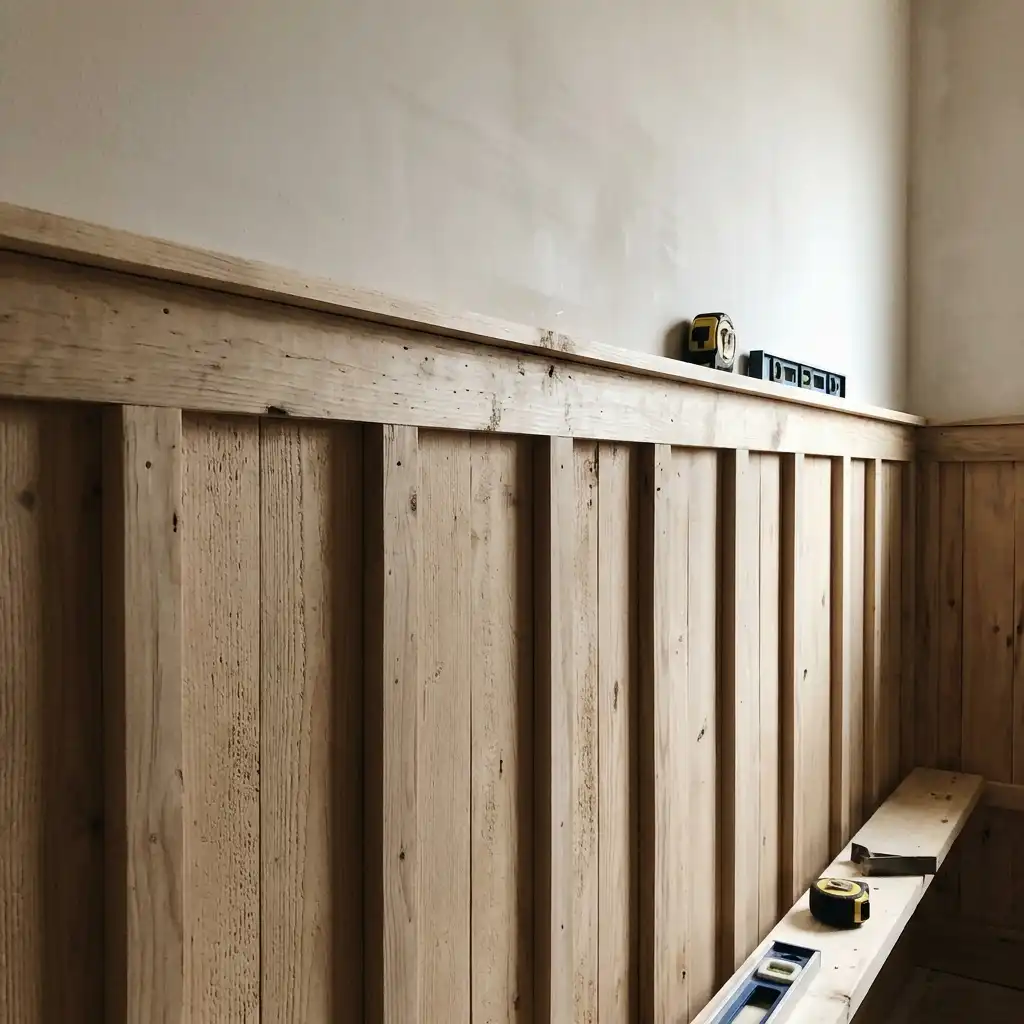
The result looks designed in a way that shiplap alone doesn’t quite achieve — it has a more formal, structured quality that works particularly well in master bathrooms and powder rooms where you want the space to feel elevated. It’s also extremely DIY-friendly: the materials are inexpensive, the installation doesn’t require special tools, and the results look custom.
Paint the wainscoting and wall in the same color for a seamless, sophisticated look. Paint them different colors — a deeper tone below, warm white above — for more graphic contrast.
3. Subway Tile With Dark Grout
Subway tile has been a bathroom staple for over a century, and in farmhouse bathrooms it remains the most reliable choice for shower walls, backsplashes, and feature walls. The 2026 update is dark grout — charcoal, slate, or warm brown rather than white.

Dark grout changes the personality of subway tile entirely. White grout with white tile reads as clean and slightly clinical. Dark grout with white tile reads as vintage and handcrafted — it emphasizes the individual tile rather than the overall surface, which is exactly the character a farmhouse bathroom needs.
For an updated take, oversized subway tile — 4×12 or 4×16 instead of the standard 3×6 — has a more contemporary quality that bridges farmhouse and modern styles effectively.
4. Whitewashed Brick
If your bathroom has exposed brick — original or installed — whitewashing it rather than painting it solid white preserves the texture while brightening the space. The variation in how the wash takes to different bricks creates exactly the kind of imperfect, organic character that farmhouse design celebrates.
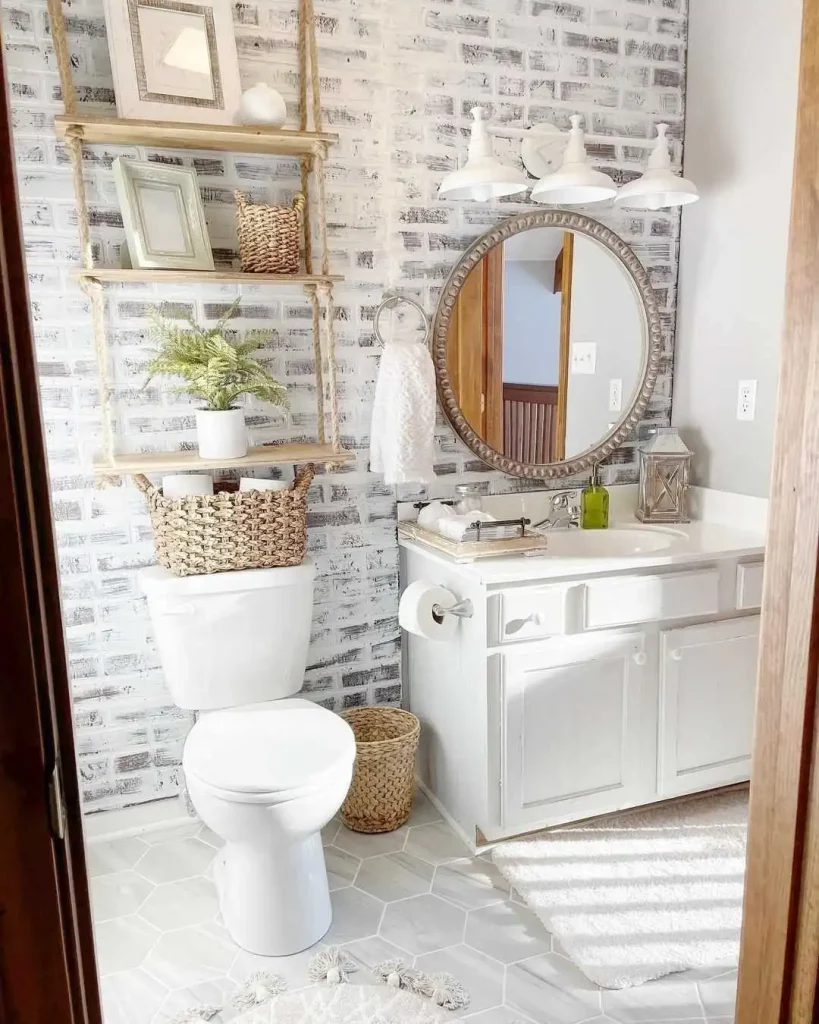
No existing brick? Brick veneer panels have become increasingly convincing and are available at most home improvement stores. Installed on one accent wall with a whitewash finish, they read as original in most rooms.
5. Beadboard Paneling
Beadboard — narrow vertical planks with a rounded bead at each seam — is the softest, most cottage-like of the farmhouse wall treatments. Where shiplap is rustic and board and batten is architectural, beadboard reads as charming and slightly vintage.
It works particularly well in smaller bathrooms and powder rooms, where its delicate scale suits the proportions. Paint it in soft white, warm cream, or a muted sage green for a look that feels genuinely cottagelike without veering into precious territory.
Part 2: The Vanity
The vanity is the piece that most defines a farmhouse bathroom. It’s also the most common thing people replace unnecessarily — when in most cases, painting the existing vanity and replacing the hardware produces a result that’s visually indistinguishable from a new piece.
6. Paint Your Existing Vanity Before You Replace It
I want to say this clearly before we get into vanity ideas: if your current vanity is structurally sound — the drawers work, the cabinet doors close, the frame isn’t damaged — painting it costs $30 to $80 and takes a weekend. The result looks like a new vanity to everyone who sees it.
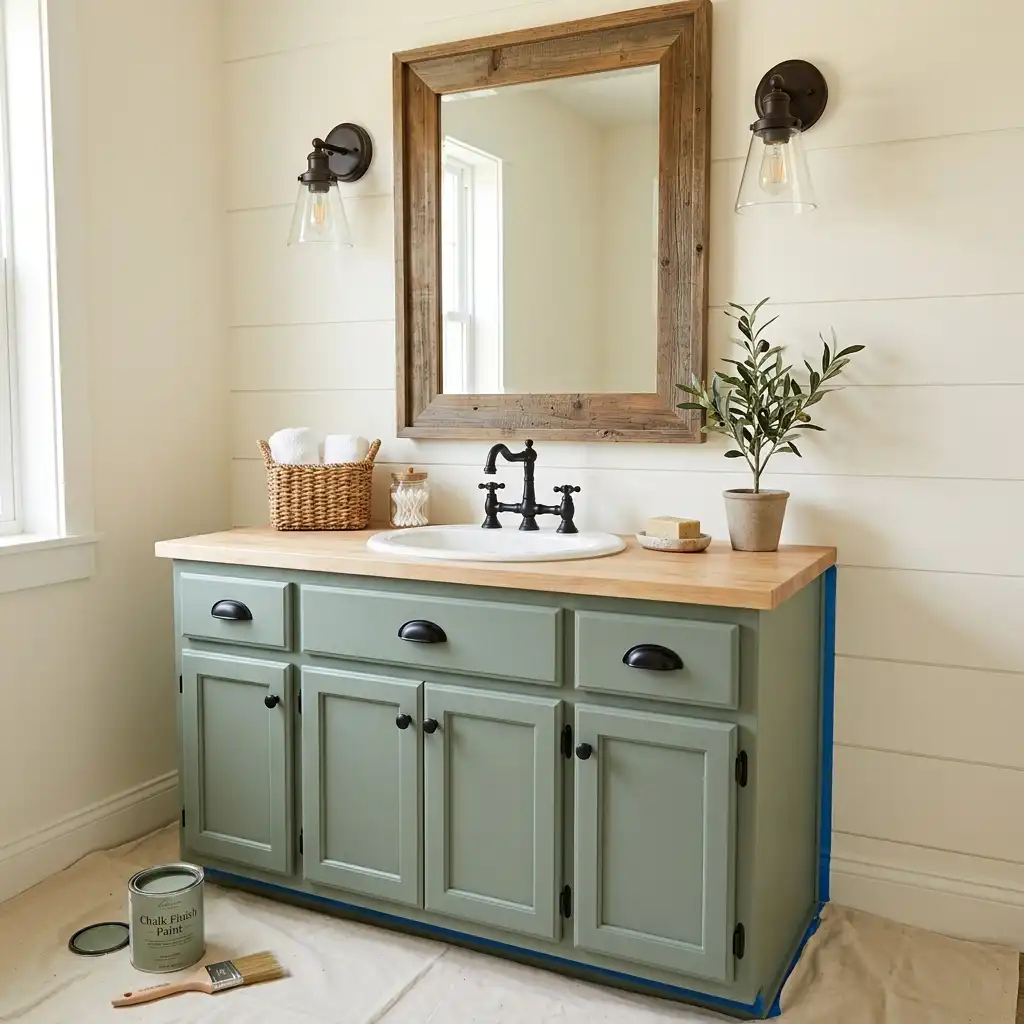
The colors that work best in a farmhouse bathroom: warm white, soft cream, dusty sage green, and warm navy. Matte or eggshell finish for the body, semi-gloss for the interior. Sand lightly between coats and replace the hardware with matte black or brass pulls afterward. The combination of fresh paint and new hardware is genuinely transformative.
7. Reclaimed Wood Vanity
A reclaimed wood vanity — either one you build from salvaged timber or a ready-made piece with a reclaimed wood finish — is the piece most associated with the farmhouse bathroom aesthetic, and for good reason. The grain, the variation in color, and the small imperfections in the wood create a warmth that no painted MDF cabinet can replicate.
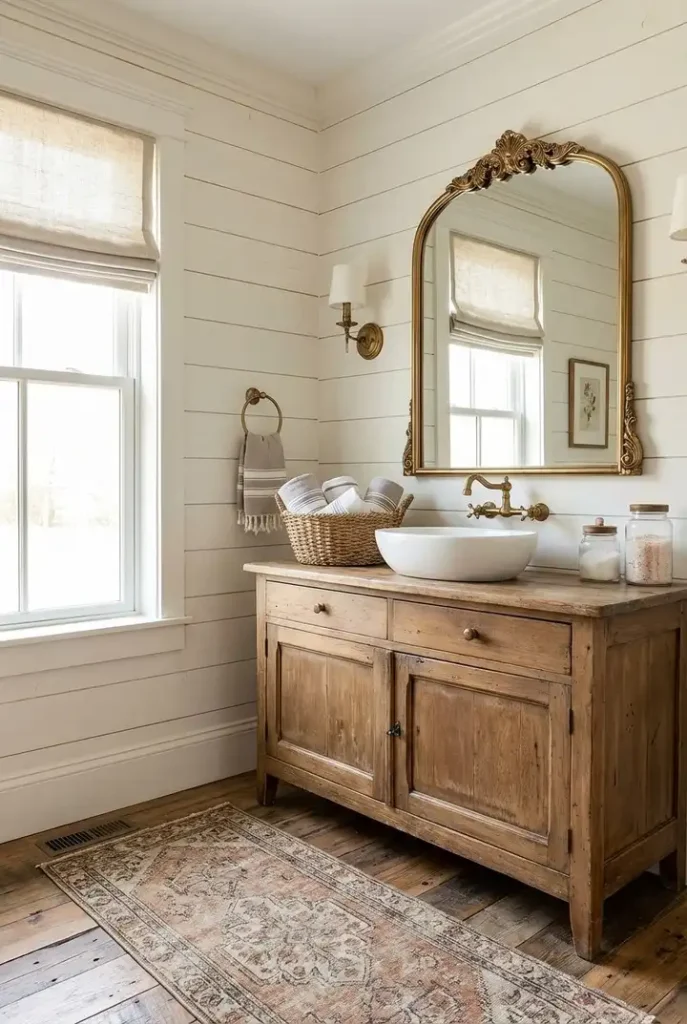
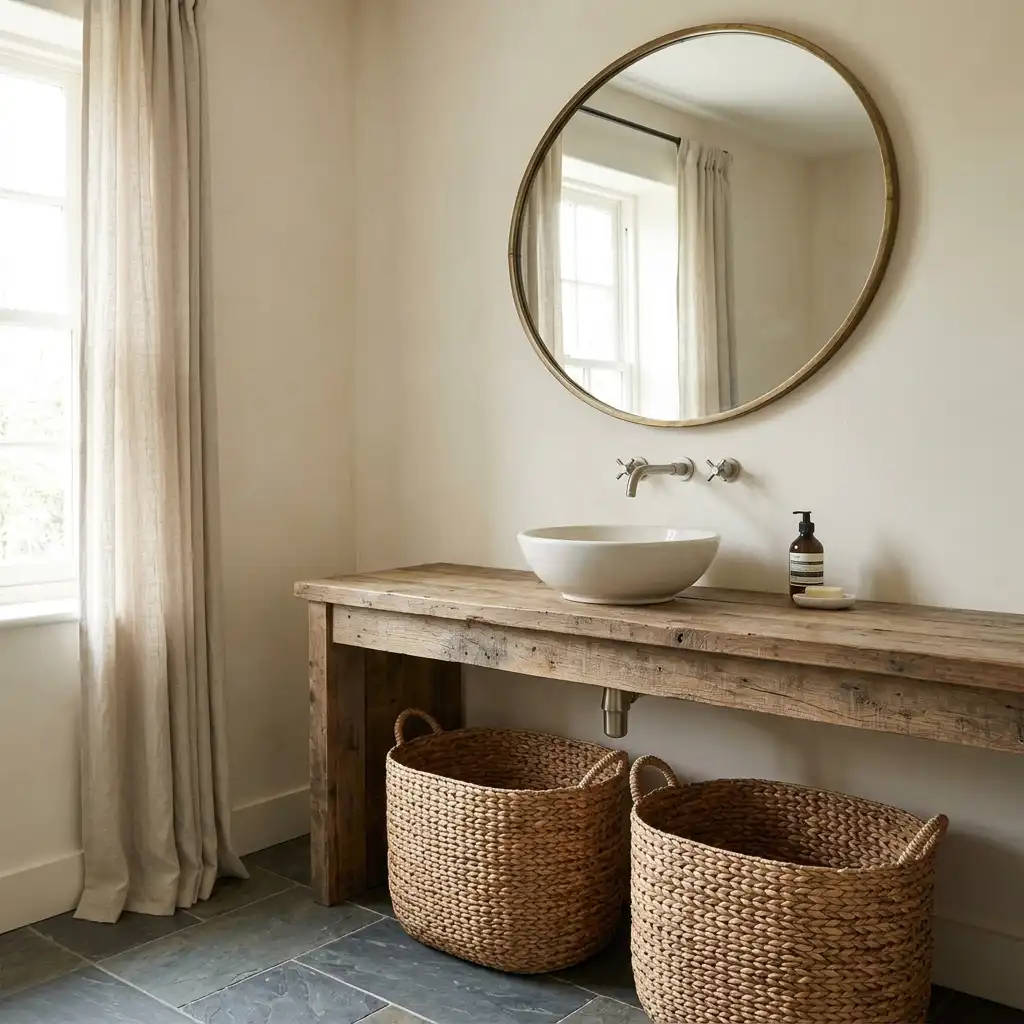
If you’re building one, the most common approach is a simple open base (two vertical sides, a horizontal top shelf, and a bottom shelf for towel storage) with a vessel sink on top and a wall-mounted faucet above. The open design avoids the need for cabinet doors, which keeps the build simple and creates additional storage visibility.
If you’re buying, look for pieces described as “live edge,” “barn wood finish,” or “reclaimed oak” — the terms vary by retailer but they indicate the warm, irregular grain character you’re looking for.
8. Converted Antique Dresser or Console
Converting a vintage dresser, sideboard, or console table into a bathroom vanity is one of the more genuinely inventive moves in farmhouse design, and the results are consistently more interesting than anything you’d find in a bathroom fixture showroom.

The process involves: cutting a hole in the top surface for the sink basin, reinforcing the cabinet for the weight and moisture exposure, sealing all wood surfaces with waterproof finish, and plumbing the sink. It’s not a beginner DIY project, but it’s achievable for anyone comfortable with basic plumbing and woodworking.
The best finds for this conversion: vintage dressers with interesting legs (ball-and-claw or tapered), old console tables with lower shelves, and antique sideboards with interesting hardware already in place. Estate sales and Facebook Marketplace consistently yield better options at lower prices than antique stores.
9. Floating Wood Vanity
A floating vanity — mounted to the wall with no legs touching the floor — looks modern and farmhouse simultaneously when it’s made from or finished to look like warm wood. The floor-to-ceiling visibility it creates makes small bathrooms feel significantly larger, and the warm wood tone brings in the natural material quality that defines farmhouse style.
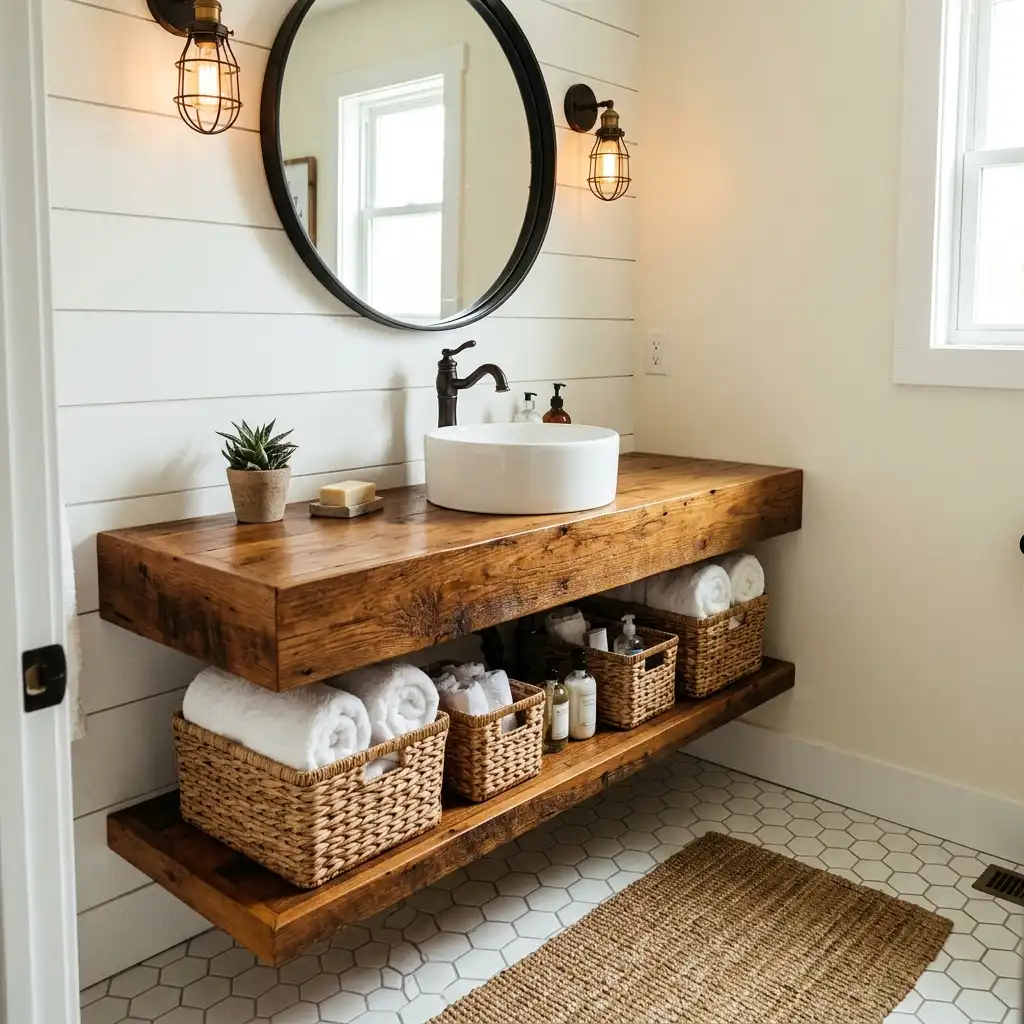
Open shelves beneath a floating vanity are more farmhouse-appropriate than a closed cabinet base. Store woven baskets there for towels and toiletries rather than letting the space stay empty, which reads as unfinished.
10. Double Vanity for Shared Bathrooms
In master bathrooms shared by two people, a double vanity transforms the morning experience in a way that no other single update matches. The farmhouse version of a double vanity uses a single long piece of reclaimed or warm-toned wood as the countertop, with two undermount or vessel sinks, and two sets of matte black or brass fixtures.
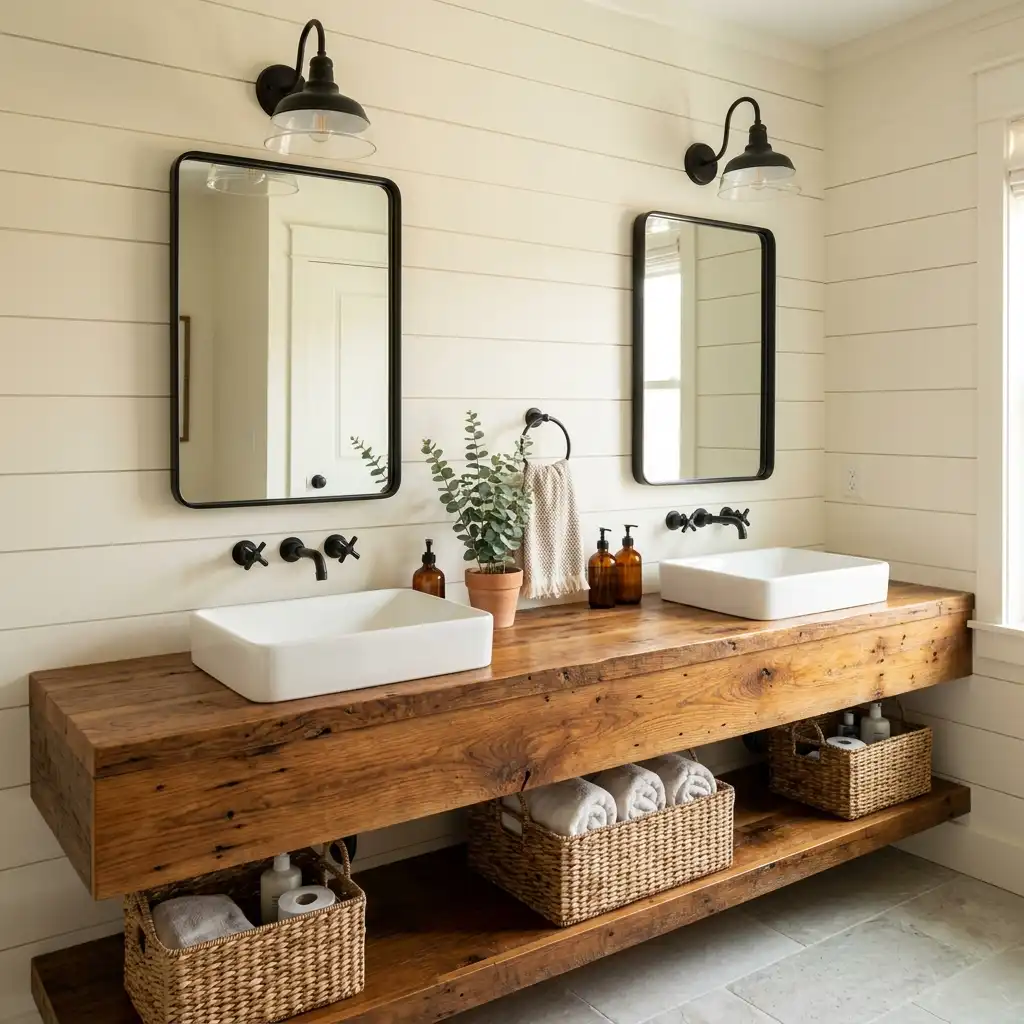
The long horizontal counter paired with two mirrors rather than one large mirror creates a look that’s both symmetrical and warm — symmetry from the matched fixtures, warmth from the wood.
Part 3: Tubs and Showers
11. The Clawfoot Tub — Still the Farmhouse Icon
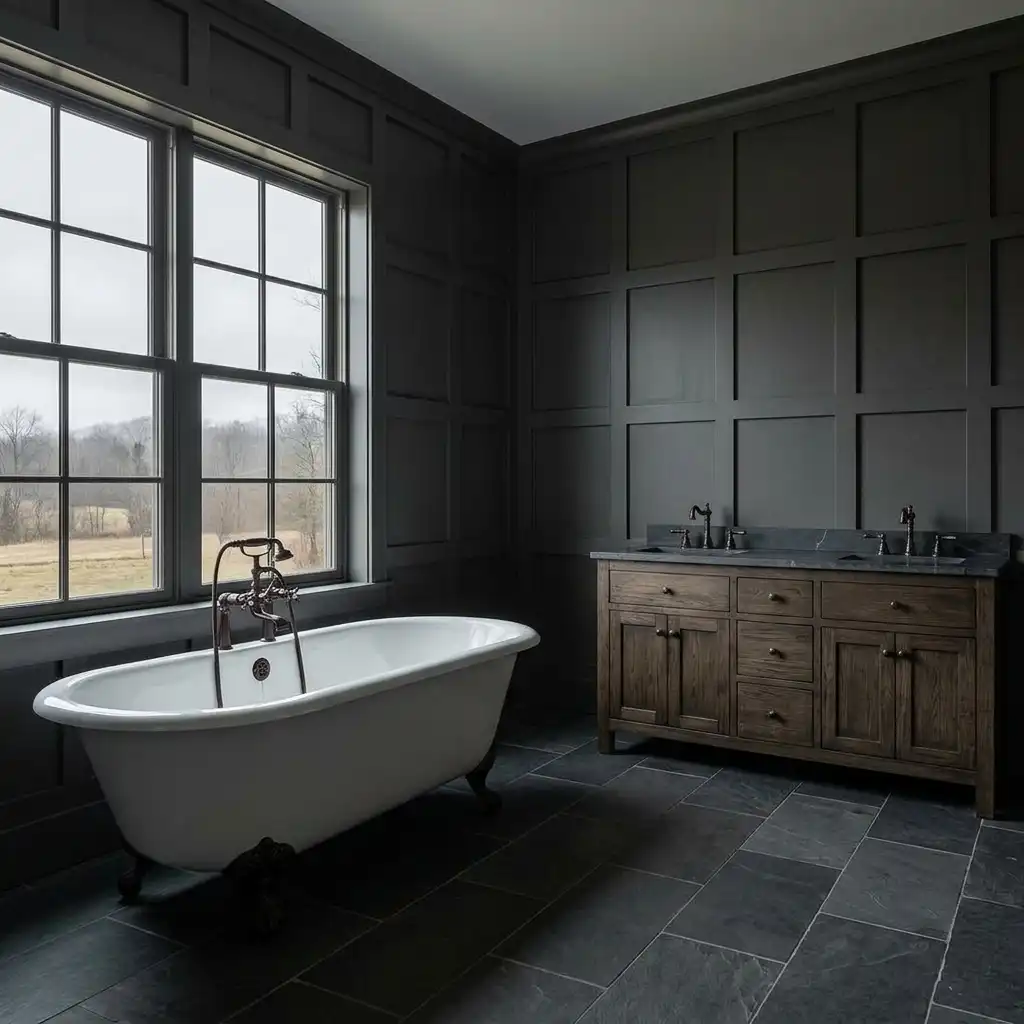
The clawfoot tub remains the definitive farmhouse bathroom statement piece, and in 2026 it’s available in a wider range of finishes than at any previous point: matte white interior with matte black exterior, navy blue exterior, sage green exterior, and the classic all-white. The feet — traditionally finished in chrome or brass — now come in matte black, unlacquered brass, and oil-rubbed bronze to match current fixture preferences.
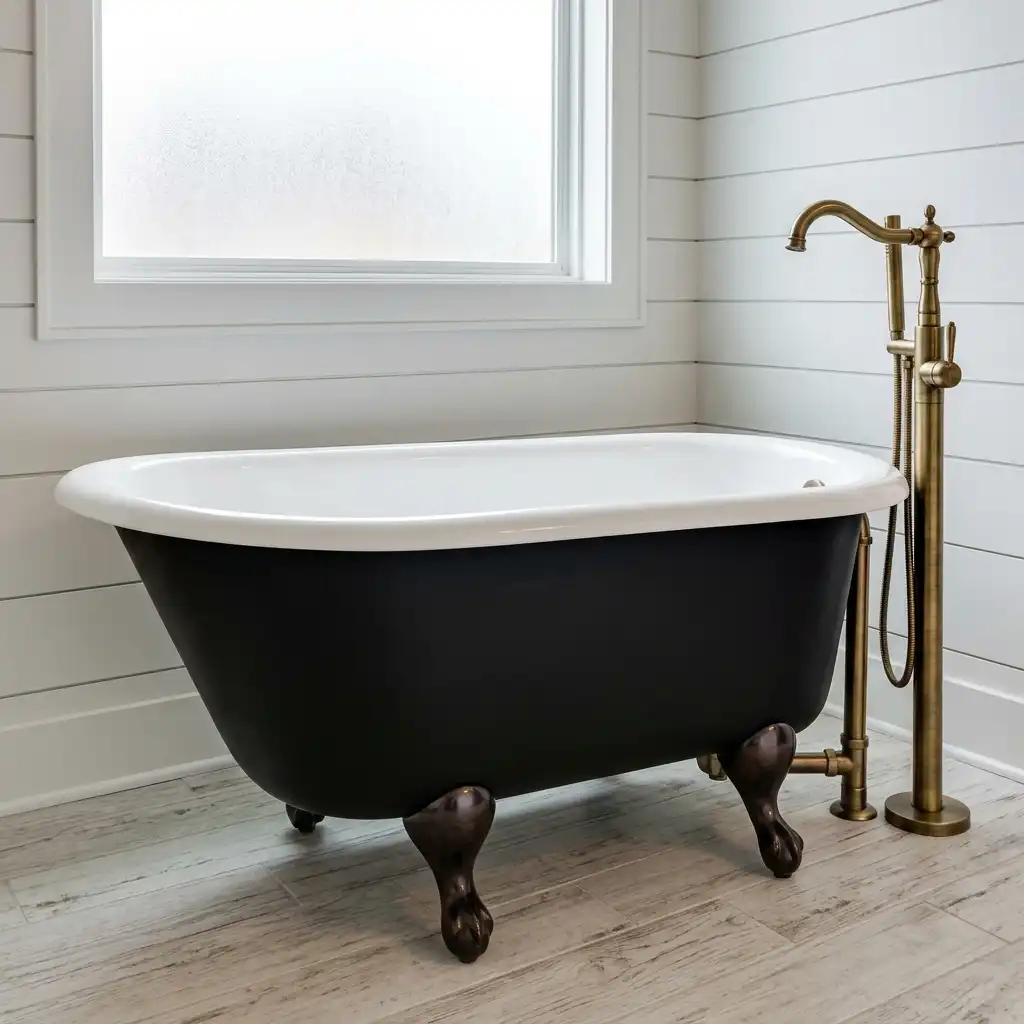
If a new clawfoot tub is outside your budget, original cast-iron clawfoot tubs appear regularly on Craigslist, Facebook Marketplace, and at architectural salvage stores for $100 to $500. They require refinishing — a process that costs $300 to $600 professionally, or $50 to $100 in DIY refinishing supplies — but the result is a piece with genuine history that no new tub can replicate.
Pair a clawfoot tub with a floor-mounted tub filler rather than a wall-mounted faucet — the floor-mounted version suits the freestanding nature of the tub and adds to the vintage quality. Aged brass or oil-rubbed bronze finishes are the most farmhouse-appropriate options.
12. The Slipper Tub
A slipper tub is a clawfoot tub variant with one raised end — the “slipper” — that provides a backrest for soaking. It has a slightly more romantic, Victorian quality than the standard clawfoot, and it’s become increasingly common in farmhouse master bathrooms where the tub is intended as a genuine destination rather than just a functional piece.

The raised end makes a slipper tub slightly more visible than a standard clawfoot, which means it works best positioned where it can be seen from multiple angles — under a window, in a corner, or centered on a feature wall.
13. Walk-In Farmhouse Shower
Not every farmhouse bathroom has room for a freestanding tub. The farmhouse-style walk-in shower is the alternative that delivers the same aesthetic character in the floor plan of a standard shower stall.
The defining elements of a farmhouse walk-in shower: hand-laid subway tile on the walls (in a brick pattern, stacked pattern, or herringbone), a pebble floor or hex tile floor rather than large format tile, a frameless glass enclosure rather than a framed one, a rainfall showerhead in matte black or brushed brass, and a reclaimed wood bench inside the shower if dimensions allow.

credits: @cattzevada
The pebble floor is a detail worth investing in specifically. It reads as handcrafted and natural in a way that large format tile doesn’t, and it provides texture that prevents the floor from looking like a generic home improvement store installation.
14. Shower Curtain as Statement
If your bathroom has a tub-shower combination rather than a separate walk-in shower, the shower curtain is your biggest single opportunity for farmhouse character — and it costs $30 to $80 rather than thousands.

The most farmhouse-appropriate shower curtain options: linen in natural or cream, a simple stripe in navy and white or black and white, a lightweight cotton with subtle texture, or a bold botanical print for a more eclectic farmhouse look.
The curtain rod matters too. Replace a standard chrome tension rod with a matte black or unlacquered brass curtain rod on proper brackets mounted into the wall. The rod-and-bracket combination looks more intentional and reads as substantially more expensive than a tension rod.
Part 4: Floors
15. Black and White Hex Tile
Small hexagonal black and white tiles — the classic Victorian bathroom floor pattern — are one of the most reliably farmhouse-appropriate floor choices available. They photograph well, they work with almost any wall color or vanity style, and they create visual interest in a small space without overwhelming it.

credits: @waynesvillewhitehouse
The pattern is available in several variations: classic alternating black and white, all-white with black grout, a more complex geometric arrangement using different size hexagons. For a bathroom with strong rustic elements elsewhere, simple alternating black and white is the most cohesive choice. For a more modern farmhouse look, all-white tile with charcoal grout is quieter and more contemporary.
16. Wide-Plank Wood-Look Tile
Porcelain tile made to look like wide-plank hardwood floors brings the warmth of wood to a bathroom without the moisture problems that make real wood floors a risk in wet environments. The technology has improved significantly — the better options are genuinely difficult to distinguish from real wood at normal viewing distance.
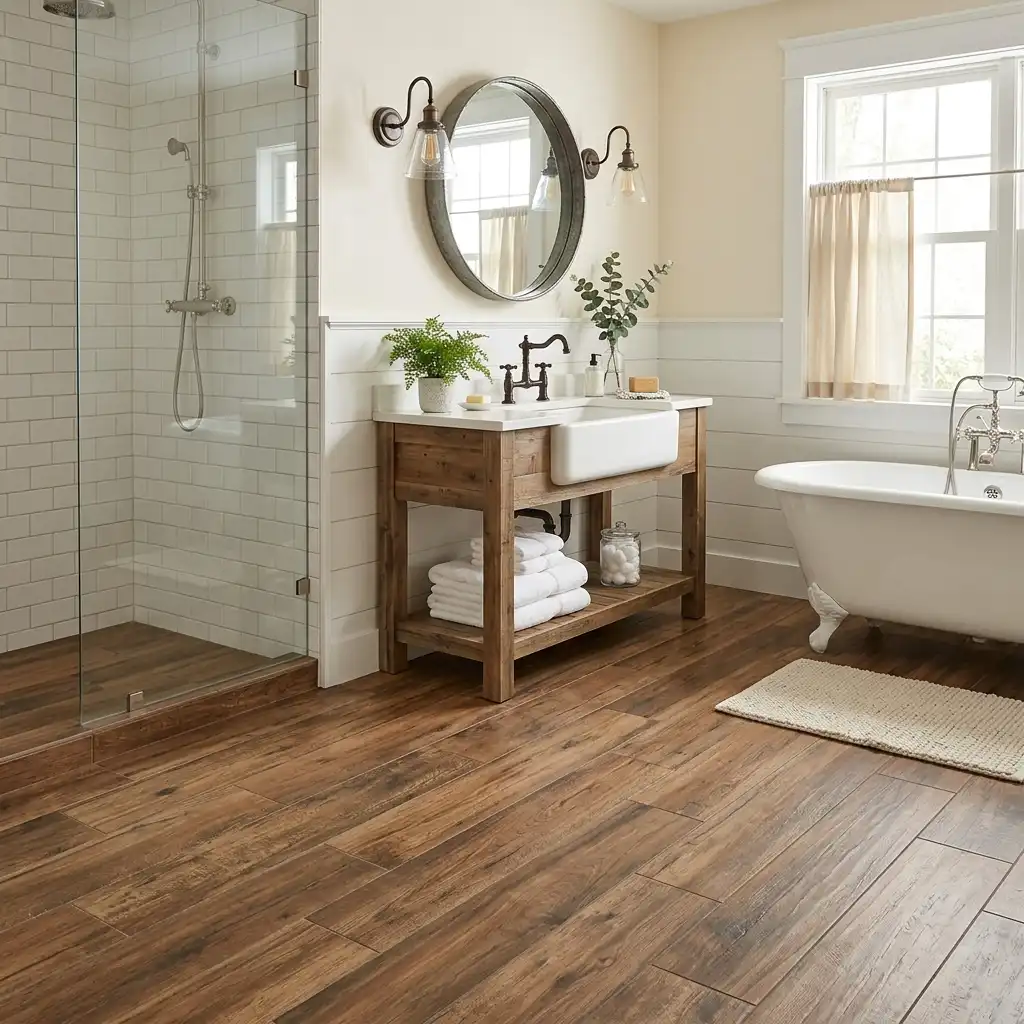
For farmhouse bathrooms, choose warm honey or walnut tones rather than gray-washed wood looks, which read as more contemporary than farmhouse. A plank width of at least 6 inches looks more authentic than narrow planks.
17. Cement Tile with Pattern
Encaustic cement tiles — handmade tiles with patterns pressed into the surface using different colored cement — bring pattern and color to a farmhouse bathroom floor in a way that reads as artisan and collected. They appear in historic farmhouses and in boutique hotels that pay significant sums for the authentic versions.
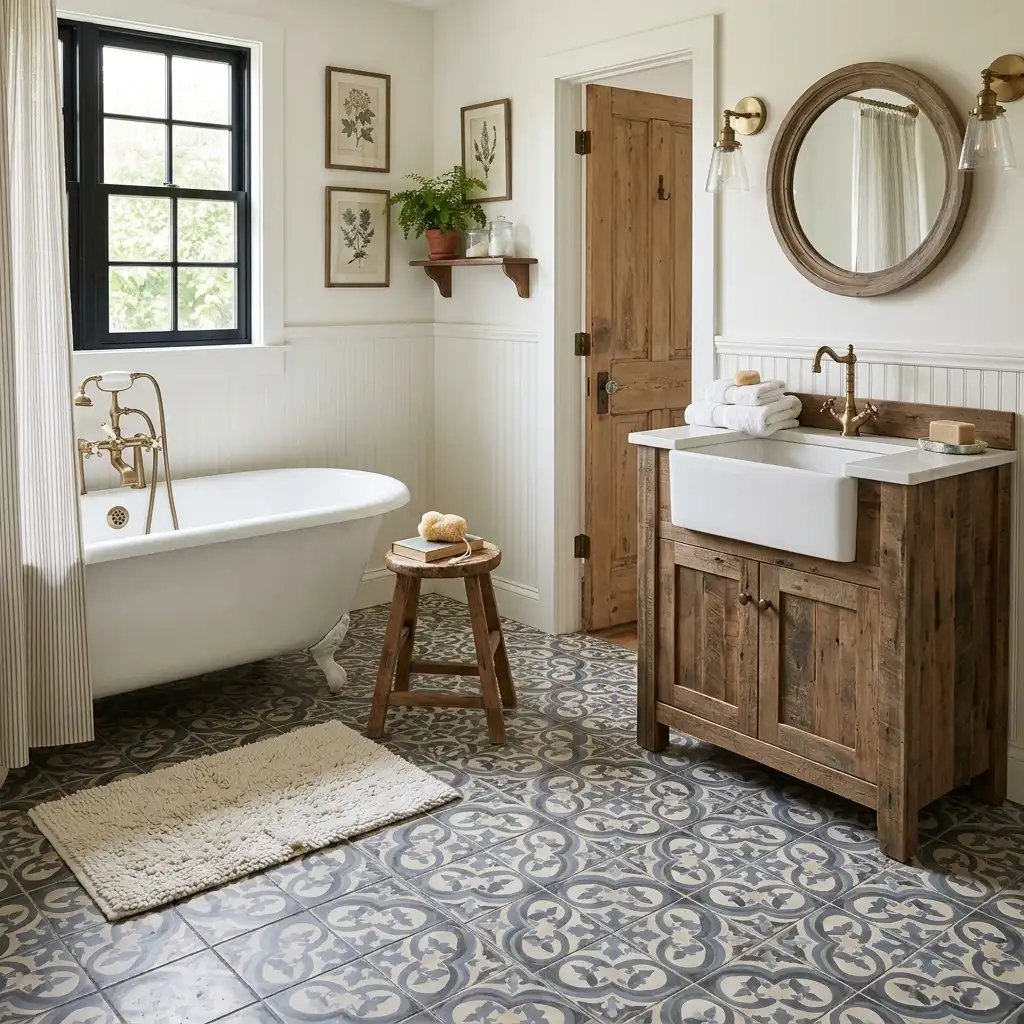
The authentic imported versions are expensive. Domestic production options and high-quality ceramic tiles that replicate the cement tile look have brought the aesthetic within budget range for most bathrooms. On a standard bathroom floor — typically 40 to 60 square feet — even premium patterned tile is achievable.
18. Pebble Floor Tile
A floor covered in small river pebbles set in mortar — or in preassembled pebble tile sheets — creates the most organic, natural surface possible in a bathroom. It reads as outdoor-inspired and feels genuinely unusual in a way that flat tile never does.
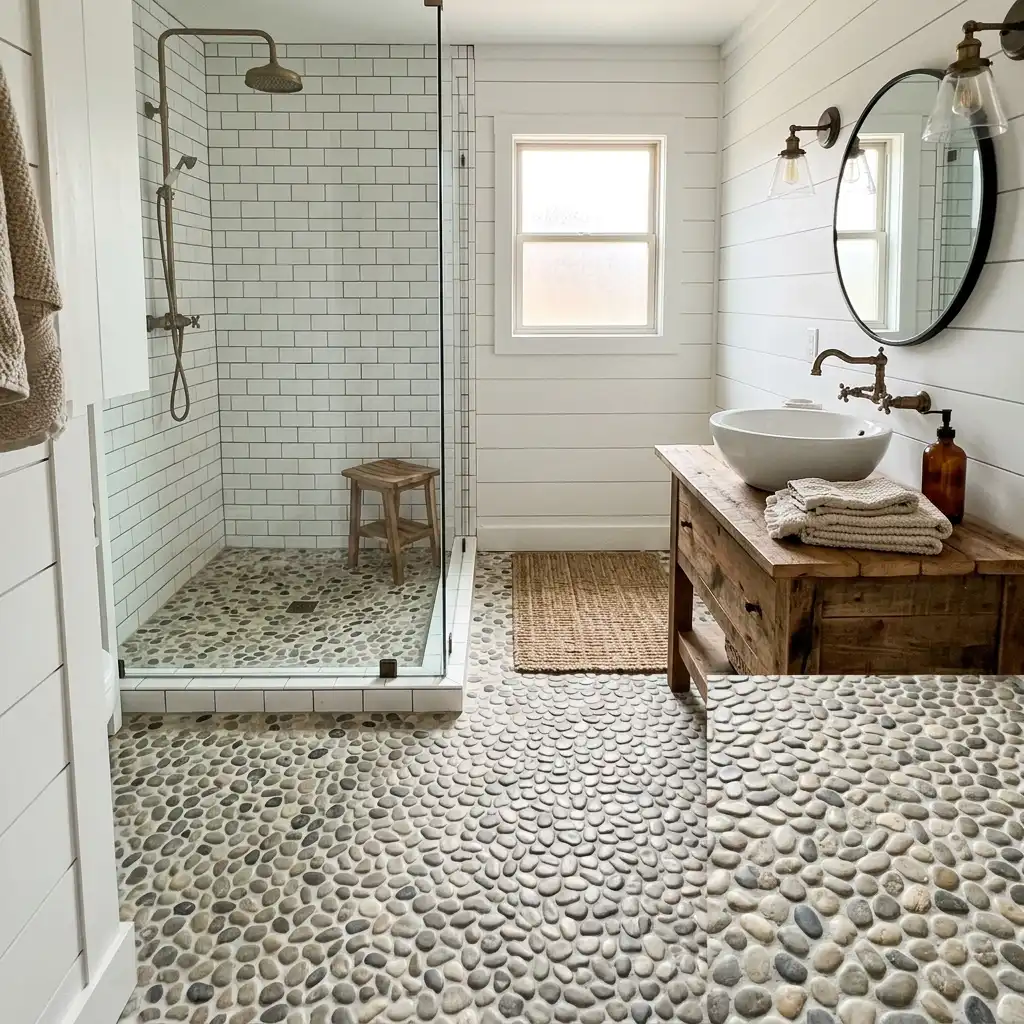
It works best in shower floors, where the texture is appreciated underfoot and the scale suits the space, or in smaller bathrooms where the unusual texture reads as a deliberate feature rather than an awkward choice.
Part 5: Fixtures and Hardware
This is the section I’d tell anyone to start with before spending money on anything else. Fixtures and hardware are the smallest changes with the largest visual impact in a bathroom — and they’re the changes most easily done without professional help.
19. Swap Every Chrome Fixture for Matte Black or Brass
If your bathroom has chrome faucets, chrome towel bars, chrome toilet paper holder, and chrome light fixture — and most bathrooms built in the last 20 years do — swapping all of them for matte black or unlacquered brass changes the entire personality of the room.
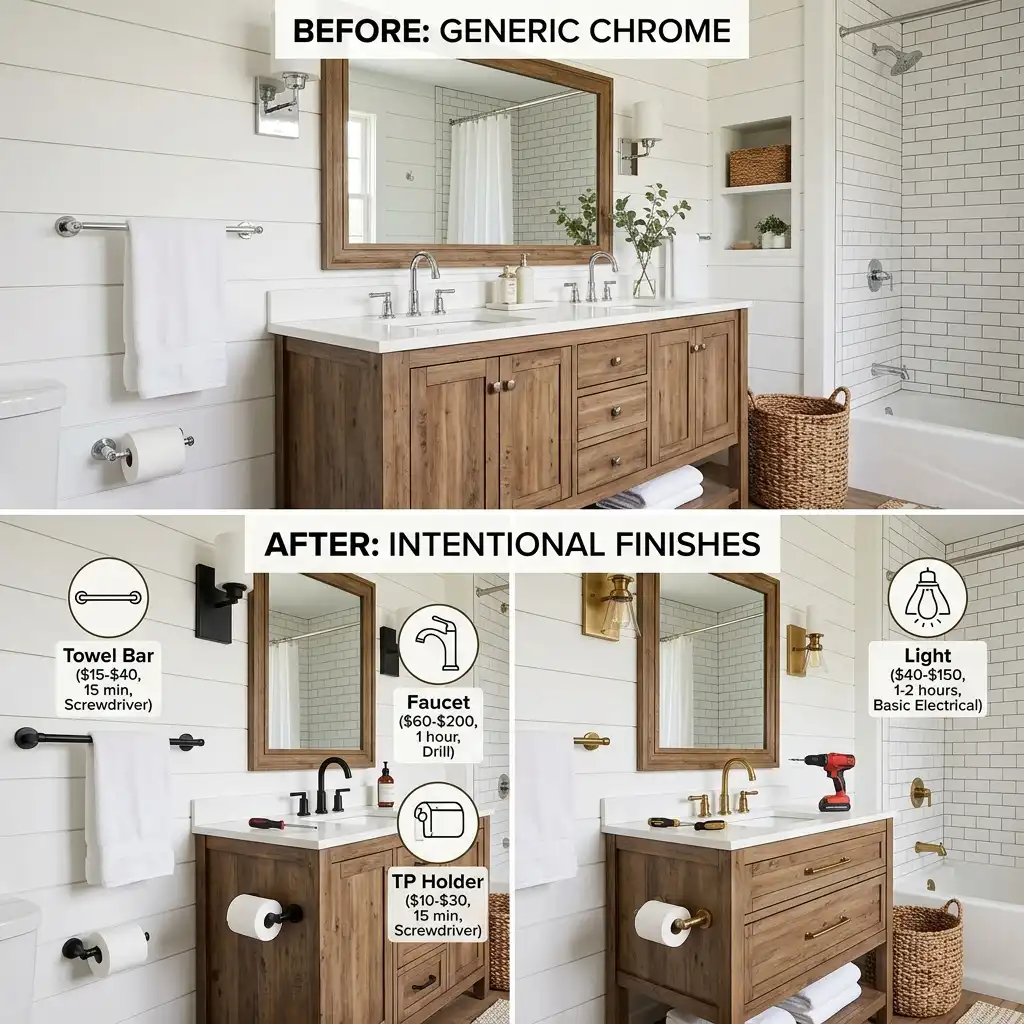
Chrome reads as generic. It doesn’t have a style — it’s just the default. Matte black reads as intentional and contemporary. Unlacquered brass reads as warm and vintage. Either one is more farmhouse-appropriate than chrome, and either one makes the room look more considered with no other changes required.
Swapping a towel bar costs $15 to $40 and requires a screwdriver and 15 minutes. A faucet costs $60 to $200 and a drill and about an hour. A light fixture costs $40 to $150 and a basic understanding of electrical connections. None of these require a plumber or electrician for standard swaps.
20. Telephone-Style Faucets
Wall-mounted telephone faucets — named for their resemblance to an old-fashioned telephone handset, with an arching spout and two separate handles — are the most distinctive farmhouse fixture choice and the one most likely to make people stop and ask about it.
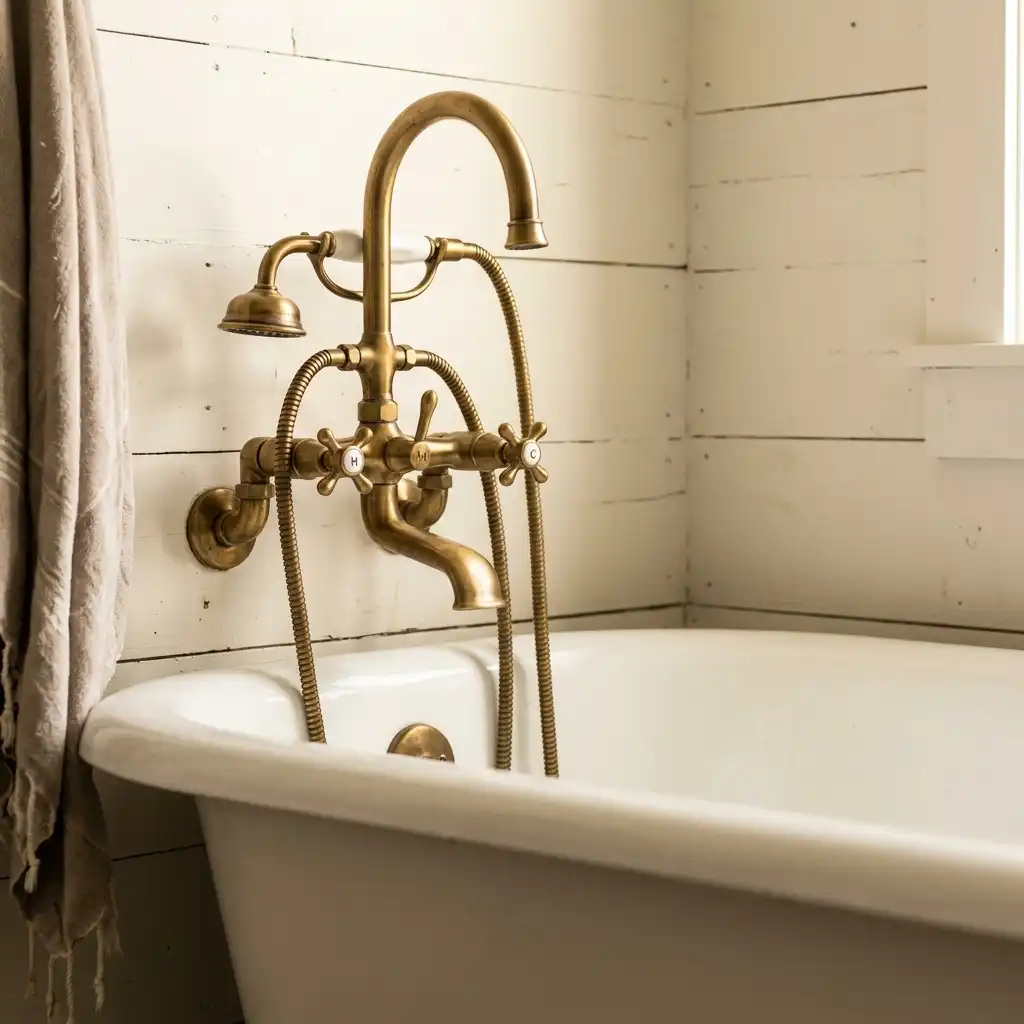
They work best on freestanding tubs (wall-mounted above a clawfoot tub is the most common configuration) and on vessel sinks where the wall mount keeps the fixture proportionally appropriate.
In aged brass or oil-rubbed bronze, a telephone faucet is one of the few fixture choices that genuinely reads as antique rather than just vintage-inspired.
21. Rainfall Showerhead
A rainfall showerhead — a large, flat head that mounts to the ceiling or on an extended arm, producing water that falls straight down rather than at an angle — adds a spa quality to a farmhouse shower that standard showerheads can’t produce.
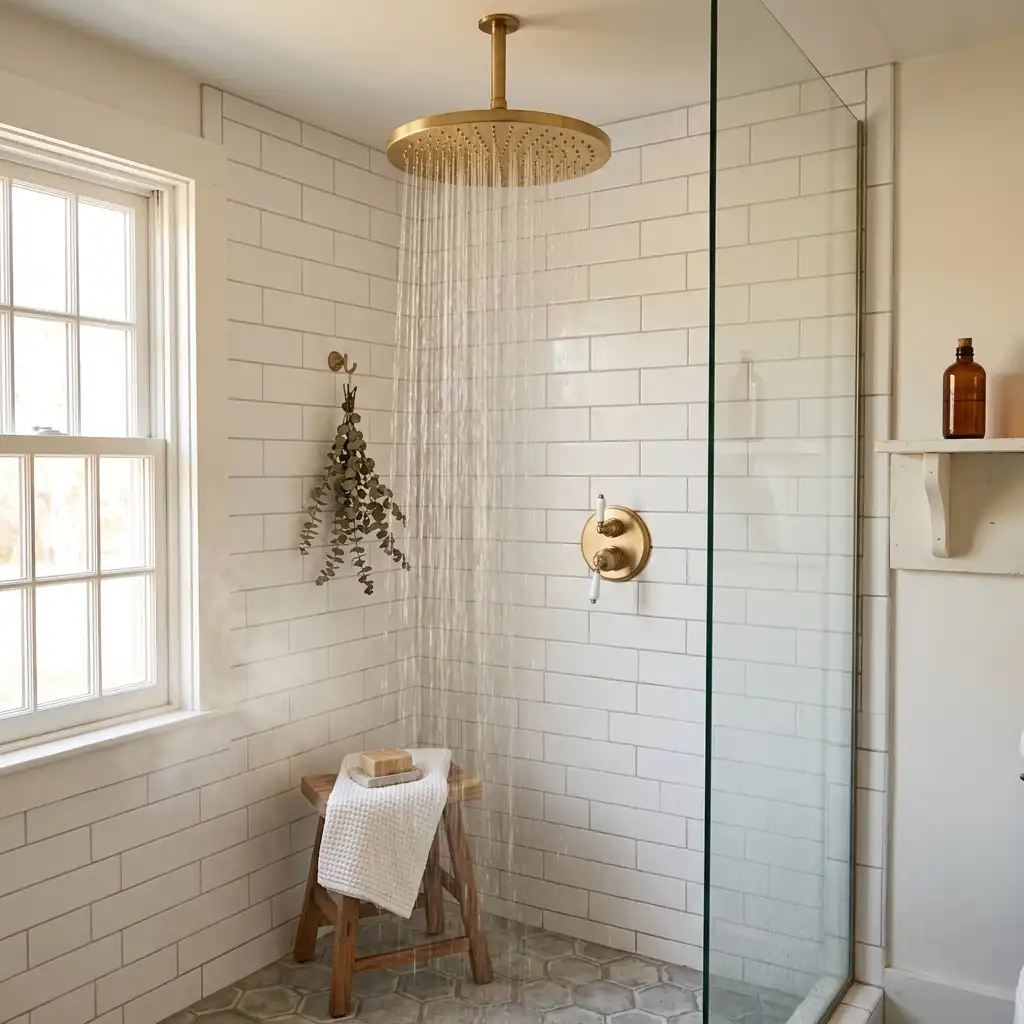
In matte black or brushed brass, a rainfall showerhead is both a functional upgrade and a visual one. The oversized head reads as intentional and premium even in otherwise modest showers.
Part 6: Storage and Decor
22. Open Shelving with Woven Baskets
Closed cabinet storage hides things but adds visual weight. Open shelving with woven baskets hides things and adds texture simultaneously — which is why it’s one of the most consistently recommended farmhouse storage solutions.

The key to open shelving that looks organized rather than cluttered: use baskets or bins for anything that doesn’t look good on display, and only display things that actually look good. White folded towels, a small plant, a candle, a soap dispenser. Everything else goes in a basket.
Water hyacinth, seagrass, and jute baskets perform better in bathroom humidity than most natural materials and look significantly better than plastic bins. They’re also inexpensive — a set of three or four good-quality woven baskets typically costs $20 to $50.
23. Ladder Towel Rack
A leaning ladder rack — a simple wooden or metal ladder leaned against the bathroom wall — is the most functional and most visually interesting towel storage option in a farmhouse bathroom. It takes up minimal floor space, it displays towels attractively, and it adds vertical visual interest that flat towel bars can’t provide.
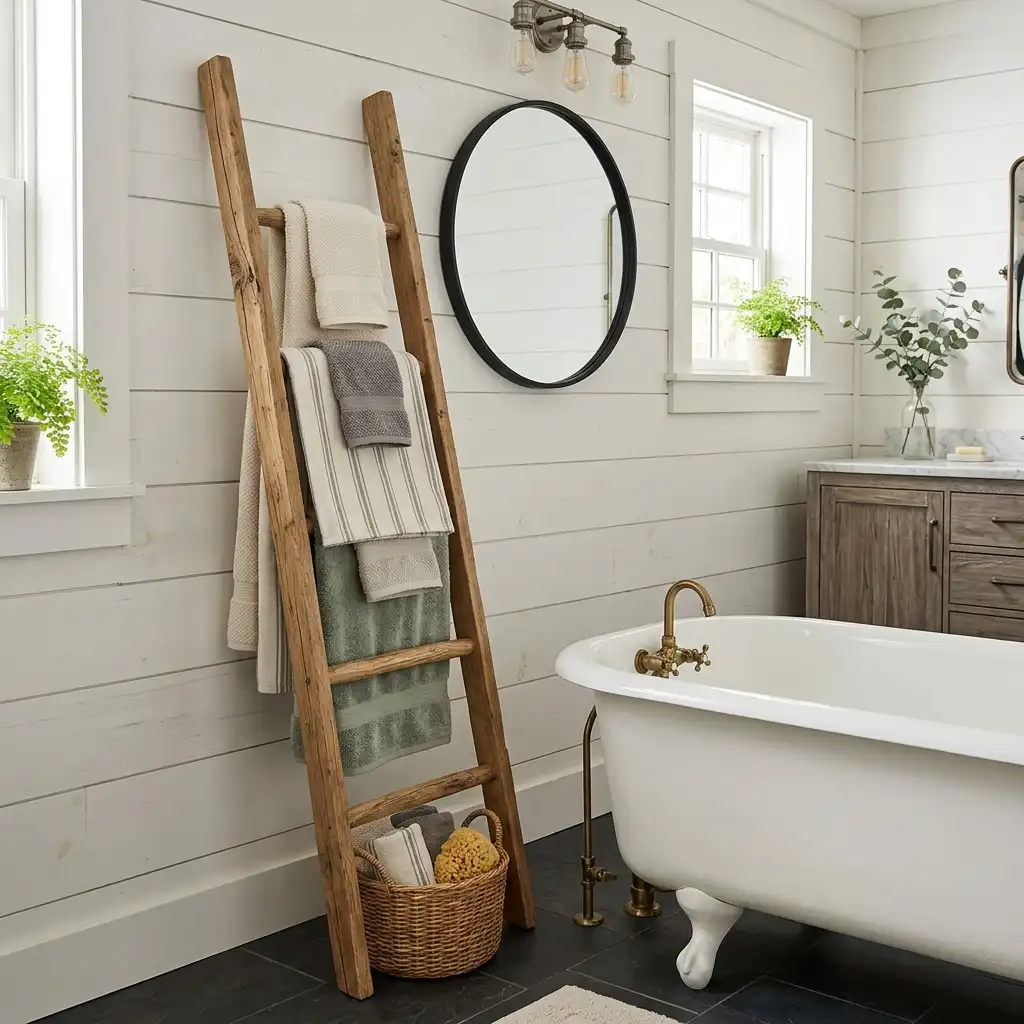
Wooden ladder racks in a natural, dark walnut, or matte black finish all work in farmhouse bathrooms. The wood version is DIY-buildable from two lengths of lumber and a few dowels in about two hours.
24. Reclaimed Wood Floating Shelves
Above the toilet is the most underused storage and display space in most bathrooms. A pair of reclaimed wood floating shelves — rough-sawn edges, visible wood grain, wall-mounted on simple black brackets — transforms that space into a display and storage zone.

Keep what you put on them curated: folded hand towels, a small plant, a candle or two, a small basket for cotton balls or soap. The visual weight of reclaimed wood shelves with a few considered items reads as designed rather than decorated.
25. Vintage Mirror with Character
Builder-grade rectangular mirrors — the kind that come with the bathroom when you move in — are functionally fine and aesthetically anonymous. A vintage mirror with an interesting frame — arched, beveled, oval, ornate, or with a warm-toned wood frame — changes the look of the entire vanity area for very little money.
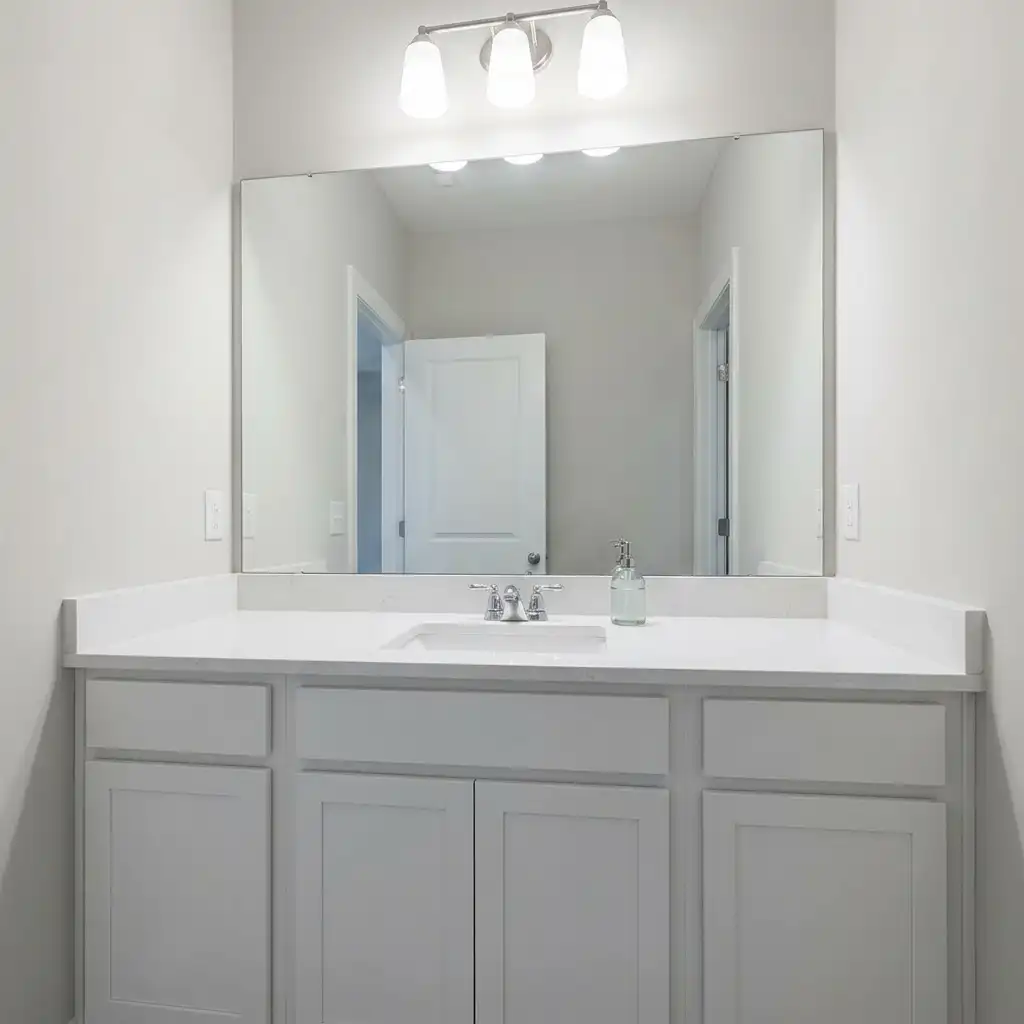
Thrift stores, estate sales, and Facebook Marketplace consistently have interesting mirrors for $15 to $60. What to look for: warm wood frames, brass or gold frames, arched tops, or any frame with visible age or craft in it. What to avoid: anything with a beveled plastic frame, anything that looks like it was bought at a chain home goods store in the 2000s.
26. Plants That Actually Work in Bathrooms
Plants are one of the few decor additions that make a farmhouse bathroom look more expensive rather than more decorated. But not all plants survive bathroom conditions — low light, humidity fluctuation, and intermittent watering make bathrooms a difficult environment for most species.

The ones that genuinely work: pothos (tolerates low light and humidity exceptionally well), snake plant (almost impossible to kill, tolerates any light condition), peace lily (thrives in low light and high humidity), and ferns (love humidity — a Boston fern in a bathroom is usually the healthiest Boston fern you’ll own).
Place plants where they’ll get the most light available — on a windowsill if there’s a window, on a shelf near the mirror where artificial light supplements natural, or in a hanging planter near any light source.
27. Linen Towels and Textured Accessories
The finishing layer of a farmhouse bathroom — the towels, the bath mat, the soap dish — doesn’t get enough credit for how much it changes the room’s feel.
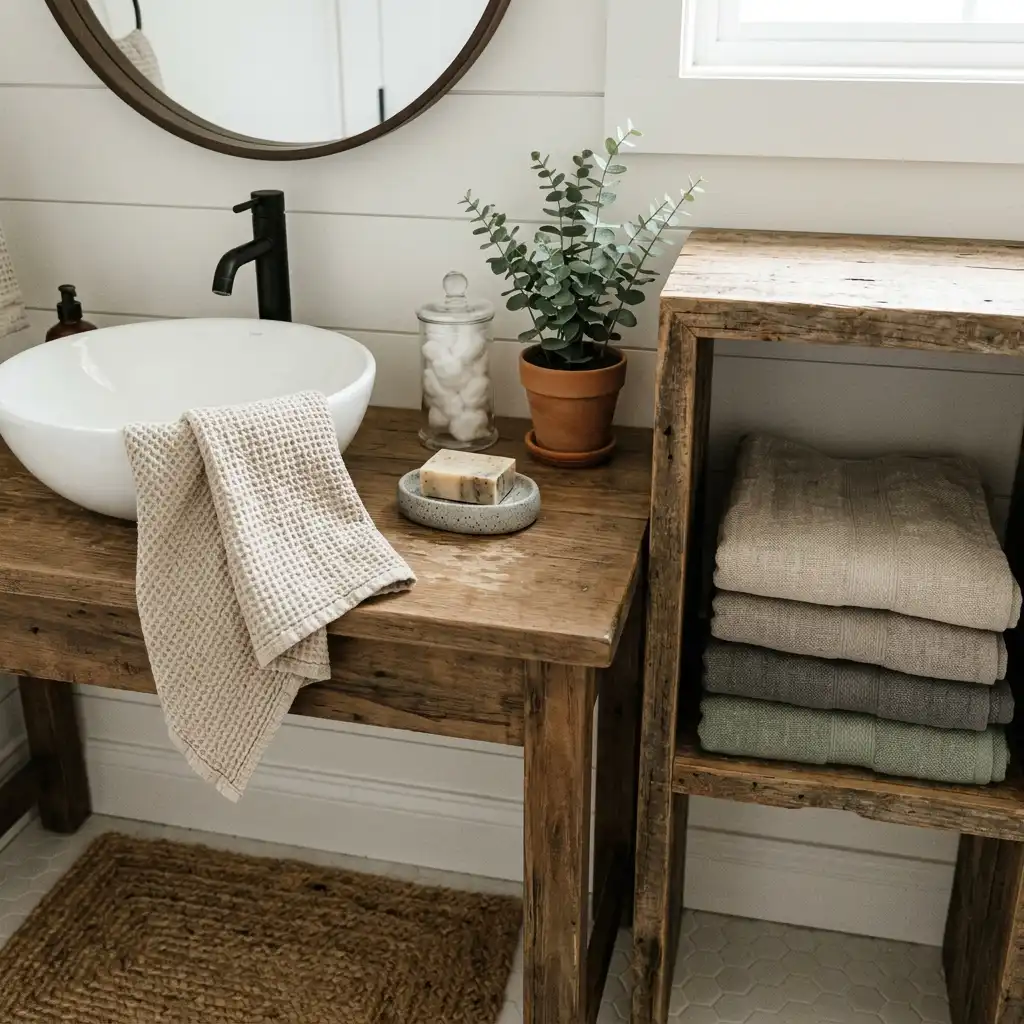
Linen towels — heavier and more textured than standard cotton towels, with a slightly rough texture when dry and a soft quality when damp — look more expensive and more intentional than standard towels even in the same color. They also photograph better, which matters if any of your motivation for this renovation is creating content.
A jute or cotton woven bath mat, a ceramic or wooden soap dish rather than a plastic one, and a simple ceramic or glass apothecary jar for cotton balls replace the kind of plastic accessories that make bathrooms feel like the inside of a hotel minibar.
28. A Single Standout Piece
Every farmhouse bathroom I’ve seen that genuinely works has one standout piece — one element that the rest of the room is organized around. Everything else is supporting cast; this is the lead.

In some bathrooms it’s a clawfoot tub. In others it’s a spectacular piece of reclaimed wood as the vanity countertop. In my first renovated bathroom it was that $18 flea market mirror above a $30 painted vanity. The mirror was the thing. Everything else just needed to not compete with it.
Decide what your standout piece is before you buy anything else. Then let every other decision serve it.
In practical terms, 2026 farmhouse bathroom design means:
Fewer rustic elements, more restraint. The style has evolved toward cleaner lines and a more edited palette. You don’t need barn doors, exposed pipe shelving, and a chalkboard sign all in the same bathroom. One or two strong farmhouse elements — a clawfoot tub, a shiplap wall, a reclaimed wood vanity — are more effective than layering every characteristic of the style into one small room.
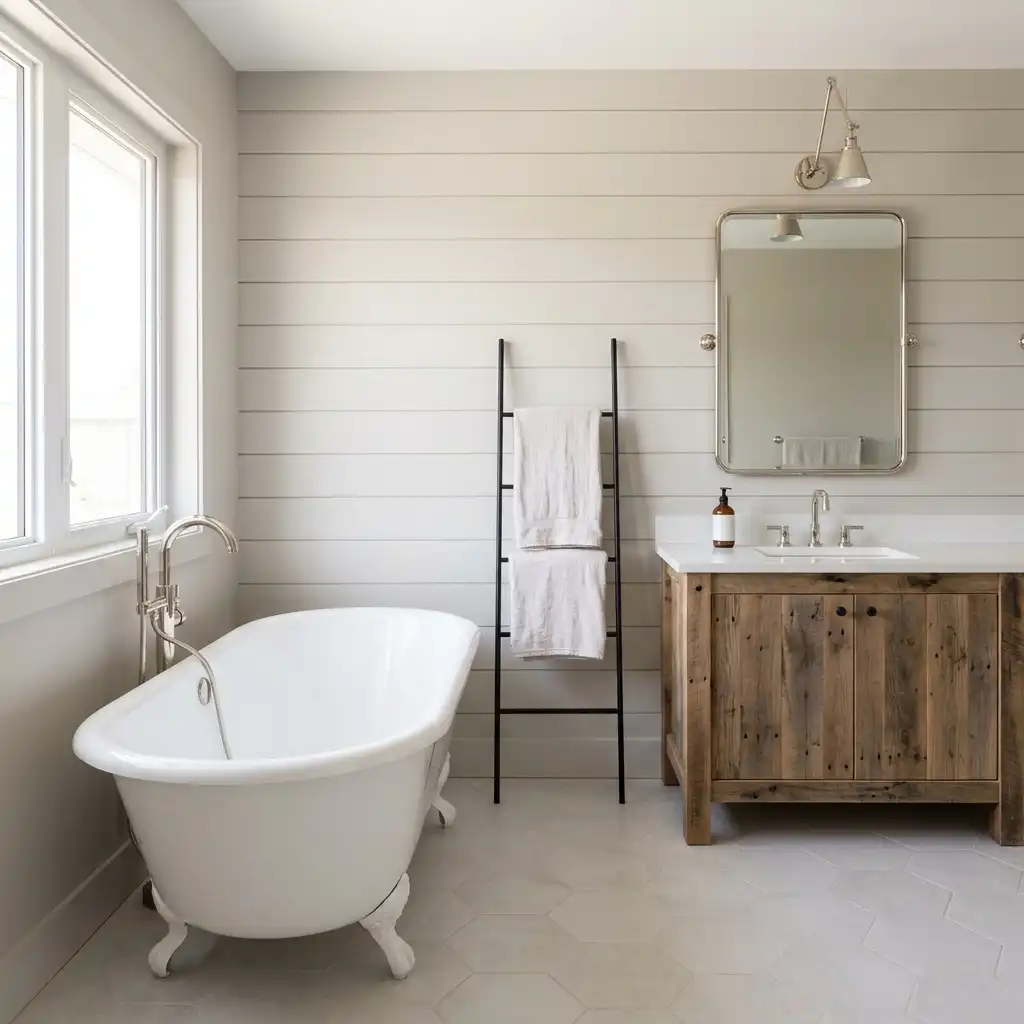
Warm wood over distressed white paint. Distressed white everything felt right for a while. Now the warmth in a farmhouse bathroom more often comes from actual wood tones — walnut, oak, cedar — rather than from aged or whitewashed finishes.

Matte black or brass hardware, not chrome. Chrome reads as generic regardless of the style. In a farmhouse bathroom, matte black or unlacquered brass fixtures make everything else look more intentional. This is a $40 change (replacing a faucet or towel bar) that visually upgrades the entire room.

Natural textures over synthetic ones. Woven baskets, jute rugs, linen towels, rattan shelving — these materials absorb light rather than reflecting it, which creates the warmth that makes farmhouse spaces feel genuinely inviting rather than photographed.
The Budget Breakdown: What to Spend and Where to Save
This is the section that gets skipped in most farmhouse bathroom guides, and it’s the most useful one.
Where to spend: The tub or shower (if you’re replacing them — quality matters for longevity and daily experience), the vanity (if you’re replacing rather than painting), and the plumbing fixtures (a cheap faucet leaks, feels cheap to use, and looks cheap for the life of the bathroom).
Where to save: Mirrors (vintage finds are better than new ones), towel bars and hardware (generic matte black hardware is $15 and looks identical to $80 hardware), decor accessories (thrift stores consistently beat retail for farmhouse-style pieces), storage baskets (nearly indistinguishable in quality across price points at the farmhouse look level).
The highest-ROI changes under $100:
- Paint the vanity ($30–$50 in paint and supplies)
- Replace all hardware with matte black or brass ($40–$80 total)
- Add shiplap to one accent wall using MDF boards ($50–$100 in materials)
- Swap the shower curtain and rod ($40–$80)
- Replace the builder mirror with a vintage one ($15–$60 at thrift stores)
These five changes, totaling $175 to $370 done strategically, produce a farmhouse bathroom transformation that most people assume cost $1,000 or more. The reason my first bathroom renovation worked wasn’t that I had a budget for real renovation — I didn’t. It was that I spent what I had on the changes that made the biggest visual difference, and ignored the things that looked fine even if they weren’t exactly what I wanted.
Mistakes I’ve Made and Watched Other People Make
Overdoing it. Shiplap and a barn door and rope mirrors and mason jar light fixtures and distressed wood everything — this is how a farmhouse bathroom becomes a parody of itself. Pick two or three characteristic elements and let them do the work.
Ignoring the grout. Grout color changes the entire personality of a tile installation. Dark grout on white subway tile reads as vintage. White grout on the same tile reads as contemporary. Make this decision deliberately, not as an afterthought.
Buying a clawfoot tub without measuring the door. This sounds obvious. It is obvious. People still do it. A cast-iron clawfoot tub can weigh 300 to 400 pounds and won’t fit through a standard bathroom door. Measure the tub, the door, the hallway, and the bathroom before committing to any freestanding tub.
Installing shiplap on damp walls without proper moisture barrier. Shiplap in a bathroom needs a moisture barrier behind it, especially in shower-adjacent walls. Without it, moisture gets behind the wood and creates mold. This is not optional.
Choosing hardware in too many different finishes. Mixing matte black and brass and chrome in the same bathroom reads as uncoordinated rather than eclectic. Pick one metal finish for all hardware — faucet, towel bars, light fixture, toilet paper holder, cabinet pulls — and stay consistent throughout the room.
Frequently Asked Questions
What makes a bathroom “farmhouse style”?
Farmhouse bathrooms are defined by natural materials (wood, stone, woven fibers), warm neutral palettes, vintage-inspired fixtures, and a lived-in quality that feels collected over time rather than assembled all at once. In 2026, the style has evolved toward cleaner lines and more restraint — fewer rustic elements used more deliberately.
What is the most important element in a farmhouse bathroom?
The vanity and the fixtures together have the most impact for the least investment. Painting an existing vanity and replacing chrome fixtures with matte black or brass changes the entire character of a bathroom for under $150 in most cases.
How do I make a small bathroom look farmhouse without making it feel smaller?
Use vertical shiplap rather than horizontal — it adds perceived height. Keep the wall color light (warm white or soft cream). Use open shelving rather than closed cabinets where possible. Install a large mirror — preferably arched — to add depth. And limit the number of farmhouse elements to two or three maximum — too many details in a small space read as cluttered.
Are clawfoot tubs practical for everyday use?
Yes, but with some adjustments. Getting in and out requires stepping over the rim, which takes some getting used to. Cleaning around the feet and beneath the tub takes more effort than cleaning around a built-in tub. A handheld showerhead attachment makes showering in a clawfoot tub significantly more functional. For most people, the aesthetic payoff outweighs the practical adjustments.
What colors work best in a farmhouse bathroom?
Warm whites, soft creams, warm grays, muted sage green, and dusty blue are the most common farmhouse bathroom palette choices. In 2026, deeper tones — warm navy, dark olive, muted forest green — are increasingly being used on vanities and accent walls while maintaining lighter tones on the remaining walls and ceiling.
Can I do a farmhouse bathroom in a rental without permanent changes?
Yes, more than most styles. Removable shiplap panels (mounted with construction adhesive that peels off cleanly, or even command strips for lighter panels), peel-and-stick floor tiles over existing tile, a new shower curtain and rod, swapped hardware (saved and swapped back at move-out), plants, and a vintage mirror leaned against the wall rather than hung — these changes produce a genuinely convincing farmhouse look without permanent modification.
A Final Thought
The farmhouse bathroom looks most convincing when it looks like it wasn’t trying very hard.
That sounds counterintuitive for a guide that just covered 28 specific design decisions. But what I mean is: the rooms that read as genuinely warm and personal aren’t the ones where every detail was sourced from the same Pinterest board. They’re the ones where the $18 flea market mirror hangs above the repainted vanity above the floor tile that was already there when you moved in — and somehow it all just works.
The style has always been about making something from what you have, improving what you can, and finding the character in imperfection. That’s as achievable today as it ever was.
You don’t need a renovation budget. You need a good mirror and a can of paint.
Ambar Mitchell is the founder of HomefixTrends. She has been researching and writing about home design since 2022, with a focus on practical, budget-friendly ideas for real homes. She studied interior design research at the University of Texas at Austin.
Related articles you might like: