
My nephew turned 18 last spring. His bedroom still had glow-in-the-dark stars on the ceiling from when he was nine, a twin bed he’d outgrown three years earlier, and a desk buried under so much stuff he did his homework at the kitchen table. His mom asked me to help. His dad wanted something “practical.” My nephew wanted something that didn’t look like a little kid’s room.
We had a $600 budget, a weekend, and three very different opinions.
What we ended up with was something all three of them liked — which is honestly the hardest design problem there is. A room that feels grown-up and personal without being so stylized that it stops feeling like a bedroom. A space that works for sleeping, studying, gaming, and hanging out with friends, without needing to be four different rooms.

This guide covers everything we did, everything I’ve learned since, and 27 specific ideas you can use whether you’re the 18-year-old himself, a parent helping out, or somewhere in between. Real costs, real sources, and what actually works versus what looks good only on Pinterest.
1. Ditch the Twin Bed If You Haven’t Already
This is the single most impactful change in an 18-year-old’s bedroom. A twin bed reads as a child’s bed — no matter how everything else is decorated, the furniture size sets the visual age of the room. A full or queen bed immediately makes the space feel like an adult’s bedroom.
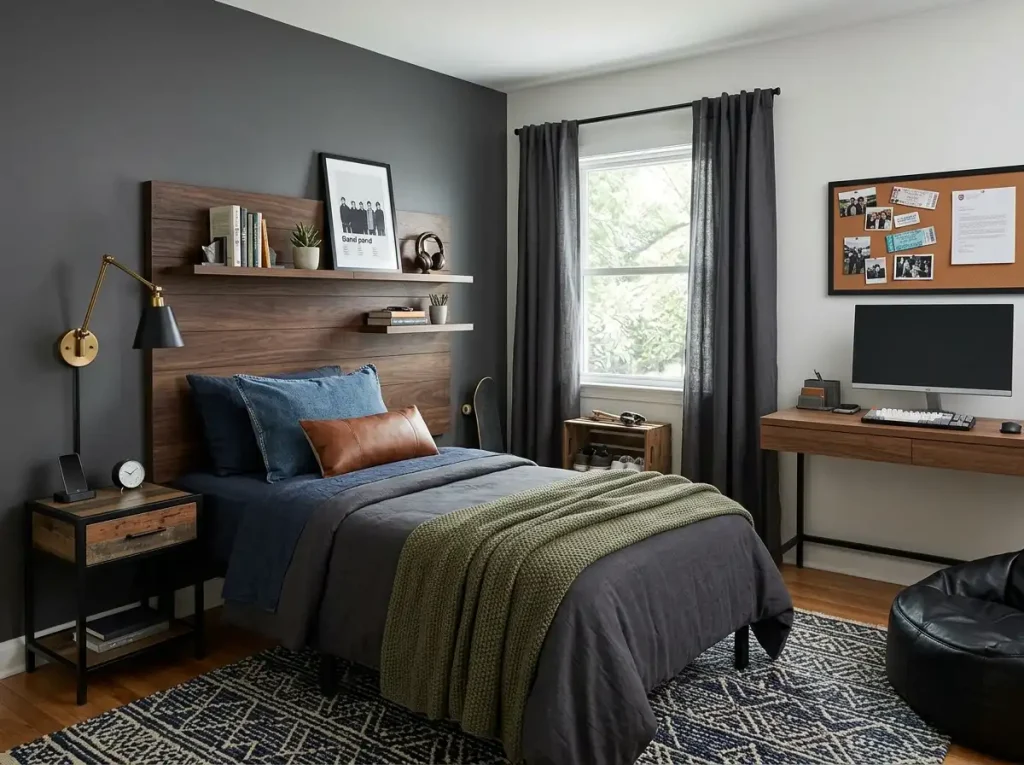
I know the objection: the room is small. But a full bed (54 inches wide) is only 15 inches wider than a twin (39 inches). In most bedrooms, that 15-inch difference is manageable — and the visual difference in how the room reads is enormous. A full-sized bed with a proper headboard, adult bedding, and two nightstands looks like a man’s room. The same room with a twin bed looks like a teenager’s room regardless of what else you change.
Bed frames without headboards at full and queen size: IKEA’s FJELLSE (full, $99) and NEIDEN (full, $79) are workhorses. Zinus platform beds on Amazon run $120–$180 for a queen. If budget allows, a bed with a low-profile upholstered headboard in charcoal or navy adds maturity instantly.
2. Choose a Dark or Deeply Saturated Wall Color
Nothing says “adult bedroom” more immediately than bold wall color. The beige and pale blue paint that gets applied to kids’ rooms doesn’t belong in an 18-year-old’s space. Deep navy, forest green, charcoal grey, warm black, slate blue, or even a moody burgundy — these colors make a bedroom feel deliberate, confident, and grown-up. You’ll also like to see ideas on french country bedrooms because it will change your thinking perspective.
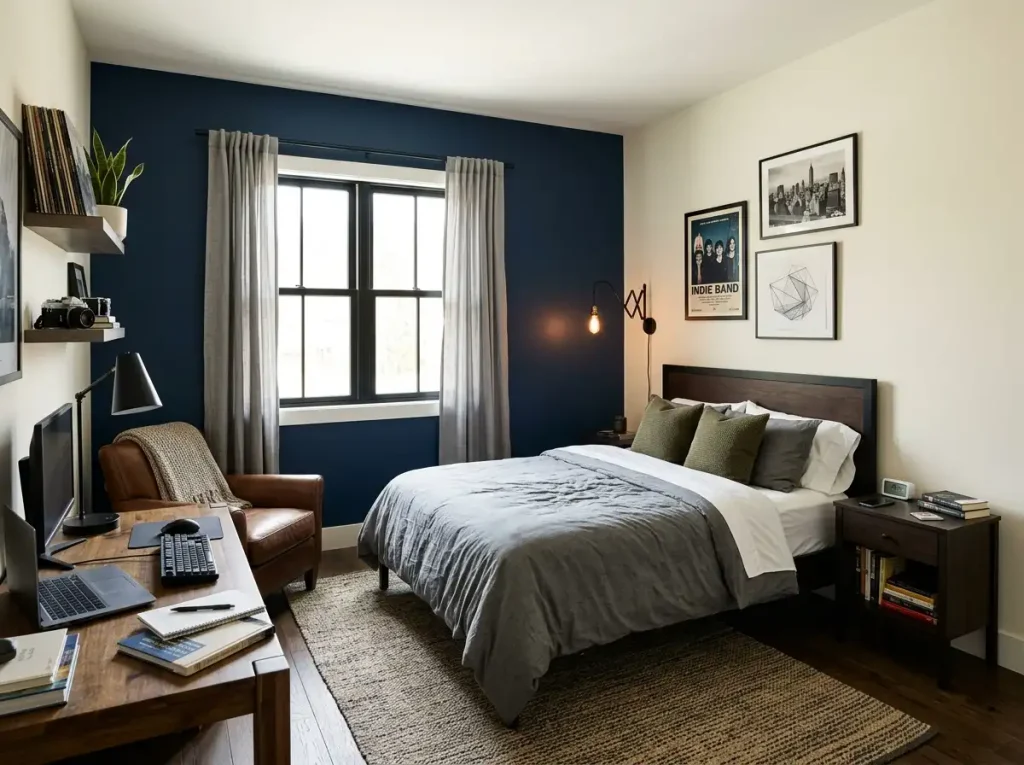
For my nephew’s room we chose Sherwin-Williams Naval (SW 6244) — a deep, slightly warm navy that reads almost black in low light and opens into a rich blue in daylight. We painted one wall (the headboard wall) and left the other three in the existing warm white. The contrast was everything.
Other colors worth considering for this age and aesthetic:
- Sherwin-Williams Cascades — a muted, complex teal-green
- Benjamin Moore Black Forest Green — deep, confident, pairs beautifully with wood
- Behr Cracked Pepper — a warm charcoal that reads as almost-black
- Sherwin-Williams Urbane Bronze — a warm brown-black that feels masculine without being heavy
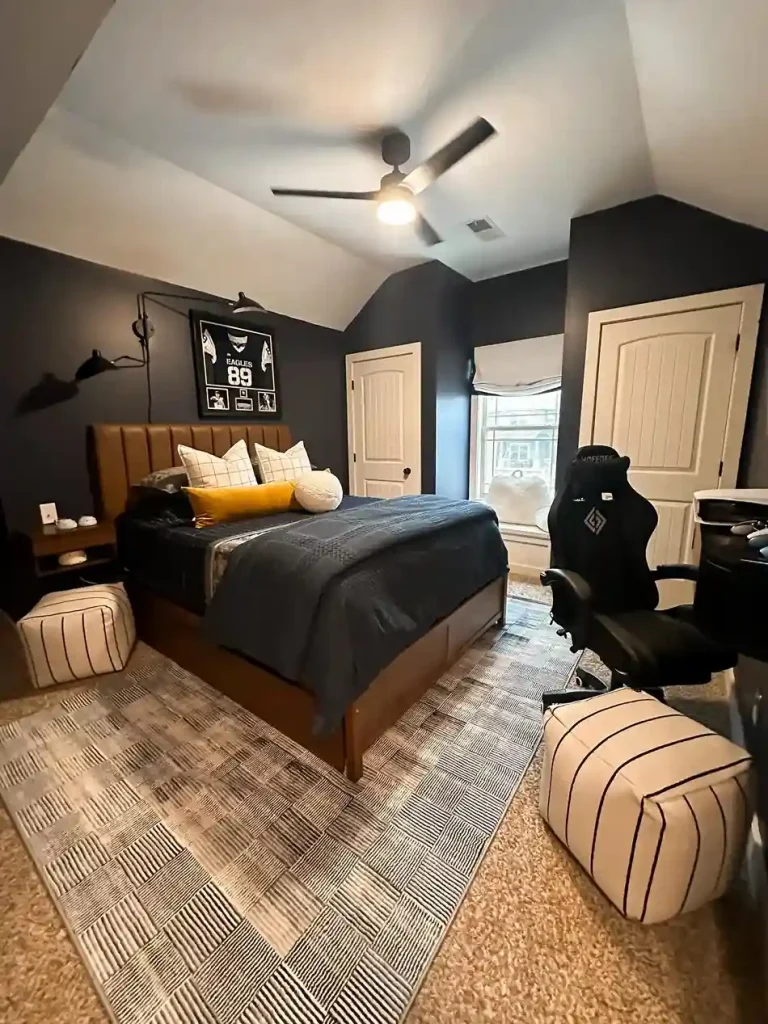
Paint one wall or all four depending on the room size, accent walls and how bold you want to go. In a small room, one dark accent wall plus three warm white walls is the safer move and still delivers the impact.
3. Build a Functional, Dedicated Study Setup
At 18, whether heading to college, trade school, or straight into work, a proper study or workspace in the bedroom is non-negotiable. A desk shoved in a corner with no thought given to lighting, ergonomics, or organization breeds procrastination and back pain. A well-set-up workspace actually gets used.
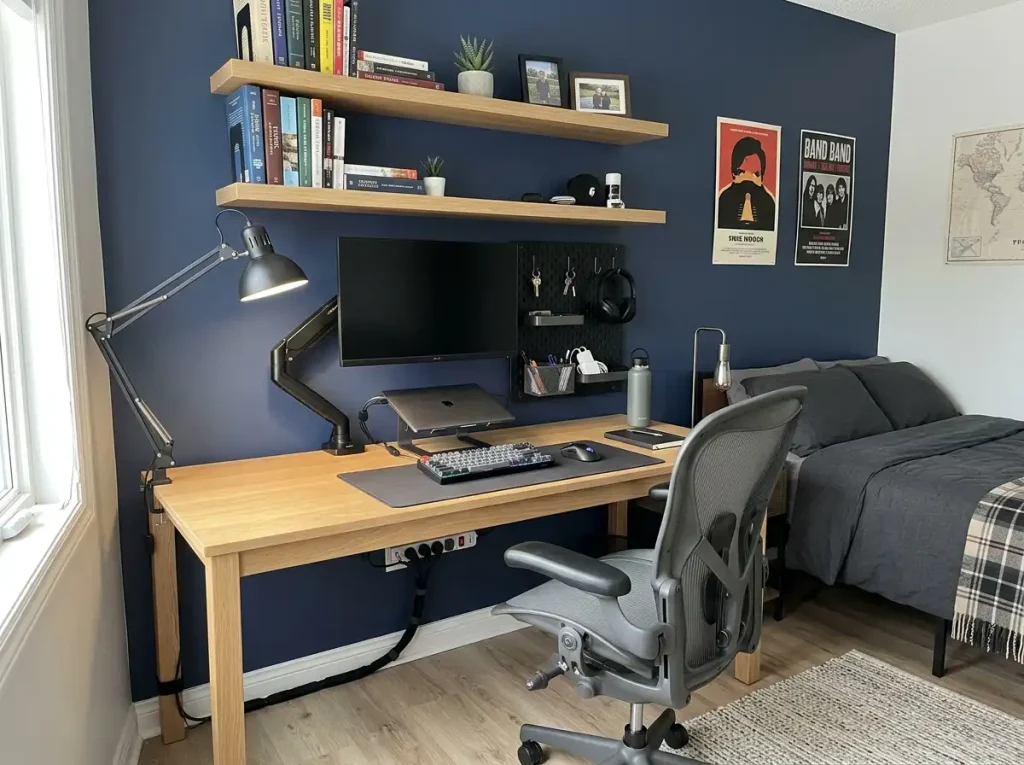
The minimum viable study setup: a desk at least 48 inches wide (width matters more than depth for most people — you need space to spread out), an ergonomic chair, a monitor arm or stand that raises the screen to eye level, a task lamp that illuminates the work surface without glare on a screen, and some form of cable management so the whole thing doesn’t look like a nest of wires.
For my nephew’s setup we used the IKEA ALEX desk ($229, comes with built-in drawers — a genuine value), a used Herman Miller Aeron chair he found on Facebook Marketplace for $180 (worth every cent — a good chair is a long-term investment), and a simple monitor arm from Amazon ($35). Total: $444. He’s used it every single day since we set it up, which is more than can be said for the buried desk that came before it.
4. Create a Dedicated Gaming Setup If That’s His World
If gaming is a significant part of his life — and for most 18-year-olds it is — a dedicated gaming setup that’s actually designed for it rather than improvised on a too-small desk with a chair that destroys your back will be used far more and enjoyed far more.
The elements that matter: a desk wide enough for a monitor (or two), a monitor at the right eye height (center of the screen should be at eye level), a chair with proper lumbar support, cable management so the area doesn’t look chaotic, and lighting that doesn’t create glare on the screen.
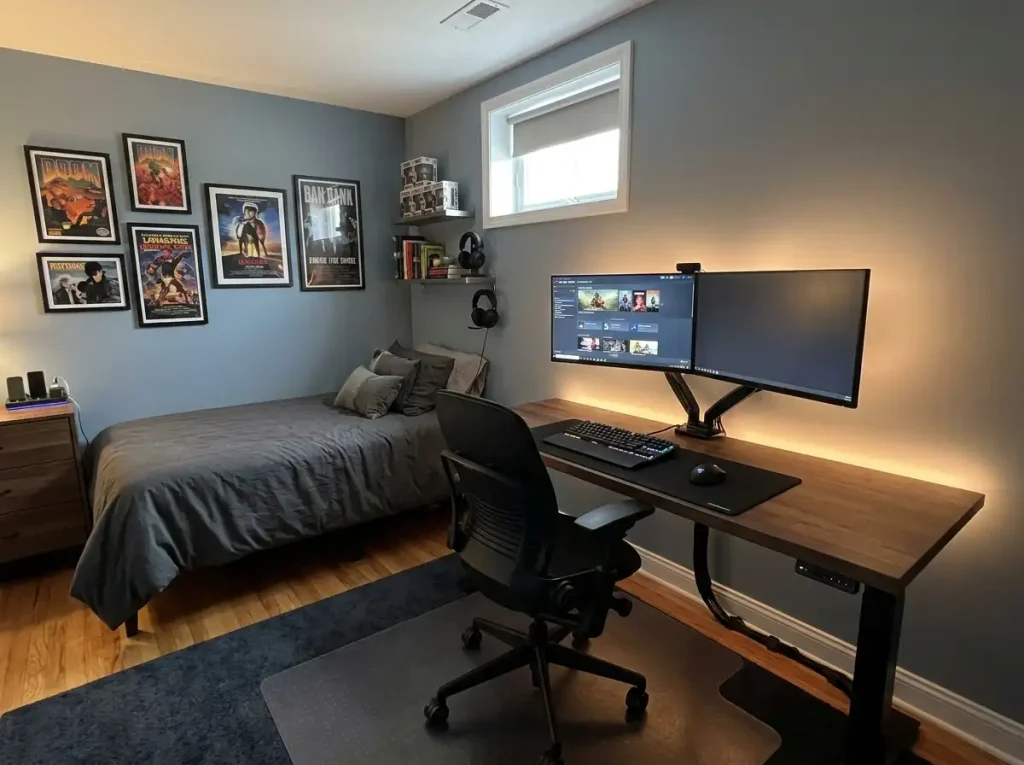
On gaming chairs: Most gaming chairs sold at mainstream price points ($100–$250) are ergonomically worse than a decent office chair in the same price range. The bucket seat design forces a posterior pelvic tilt that strains the lower back during long sessions. If budget allows, a used office chair from Herman Miller, Steelcase, or Humanscale — available on Facebook Marketplace and Craigslist for $100–$300 — will serve him better for both gaming and studying than any “gaming chair” at that price.
RGB lighting beneath the desk and behind the monitor (bias lighting) is a legitimate comfort feature, not just aesthetic — it reduces eye strain by preventing the harsh contrast between a bright monitor and a dark wall behind it. An Govee or Philips Hue LED strip behind the monitor: $15–$40.
5. Choose Bedding That Looks Intentional, Not Accidental
The bedding in most teenage boys’ bedrooms is either a leftover from childhood (superheroes, sports teams) or a basic solid that was grabbed without much thought. At 18, the bedding is one of the most visible things in the room and sets the tone for everything else.
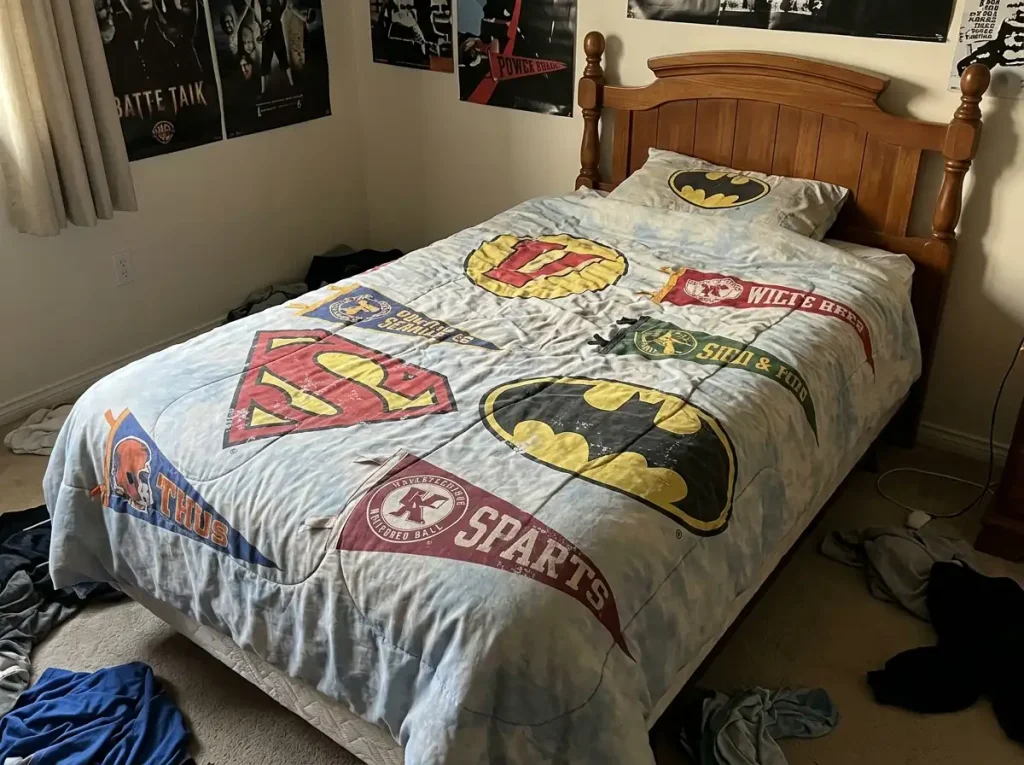
What works for this age and demographic: a high-quality duvet cover in a dark solid (charcoal, navy, forest green, deep burgundy) or a subtle pattern (a muted plaid, a geometric, a fine stripe). Avoid anything that reads as juvenile — large graphics, cartoonish prints, or anything from a “kids’ bedding” section.
Parachute, Brooklinen, and Quince all make excellent duvet covers at accessible prices ($60–$130 for a full/queen). For a tighter budget, H&M Home and IKEA both carry quality cotton duvet covers in adult colorways for $30–$60. Add two Euro shams and one or two accent pillows and the bed looks finished and intentional without requiring elaborate styling.
The one rule: Whatever color the duvet is, it should either match or contrast intentionally with the accent wall. Navy bedding on a white wall looks fine. Navy bedding in front of a navy accent wall needs a lighter contrast element — lighter pillows, a lighter throw — to separate them visually.
6. Add Shelving That Does Double Duty
Shelves in an 18-year-old’s bedroom aren’t just storage — they’re display space for the things that make the room his. Books, records, sneakers, collectibles, sports gear, camera equipment, gaming accessories, awards, travel souvenirs. The shelving system is where the room gains its personality.
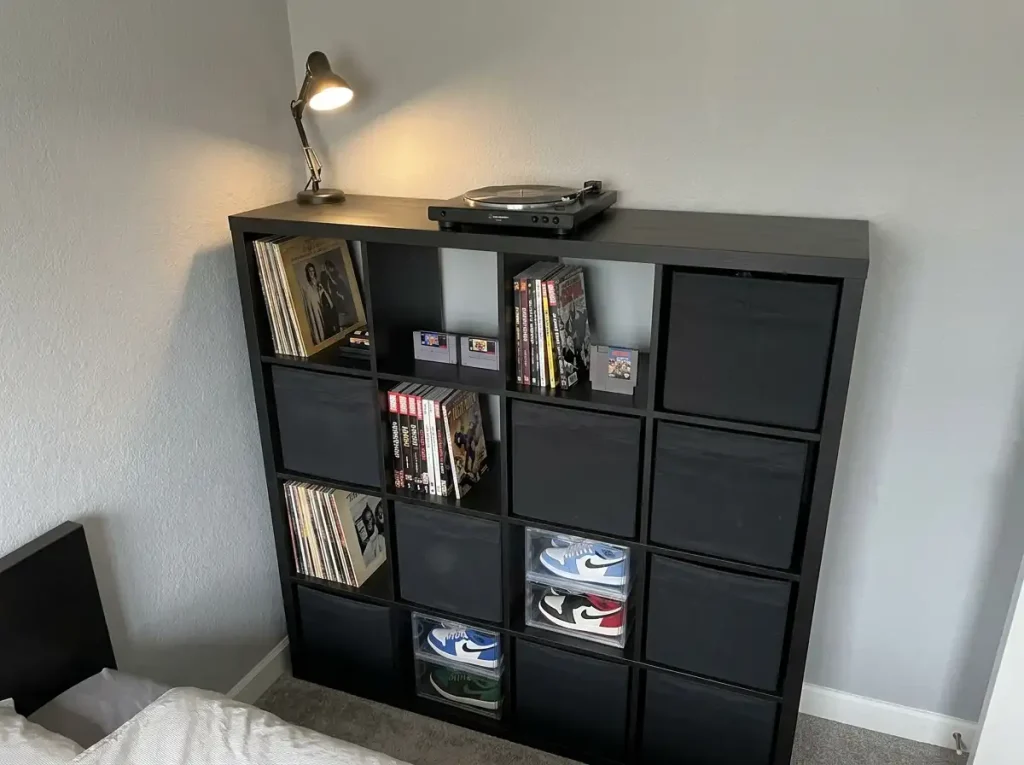
The best systems for this age: IKEA KALLAX (the square modular unit, $60–$130 depending on size) is one of the most useful pieces of furniture ever designed. It stores records, games, books, and clothes in the cubes, and the top surface works as a display shelf, a record player stand, or a secondary desk surface. Floating shelves in a dark wood or matte black finish add character without taking floor space.
Style the shelves the way a shop window is styled: group objects by height, mix books (stacked both vertically and horizontally), add one or two plants, and leave some open space. A shelf that’s packed solid to every edge looks cluttered. A shelf that has breathing room looks curated.
7. Hang Meaningful Art — Actual Framed Pieces, Not Posters Taped to the Wall
This is the detail that separates a grown-up bedroom from a teenage one more than almost anything else. Posters blu-tacked or tape-pinned to the wall look like a dorm room. The same image, properly framed, looks like a considered design choice.
Framing doesn’t have to be expensive. IKEA’s RIBBA frames ($5–$15 depending on size) come in black, white, and natural wood and work for virtually any print. Print shops like Parabo and Mpix print poster-sized photos and art prints for $10–$30. Society6, Redbubble, and Etsy sell prints from independent artists in formats sized for standard frames starting at $10–$20.
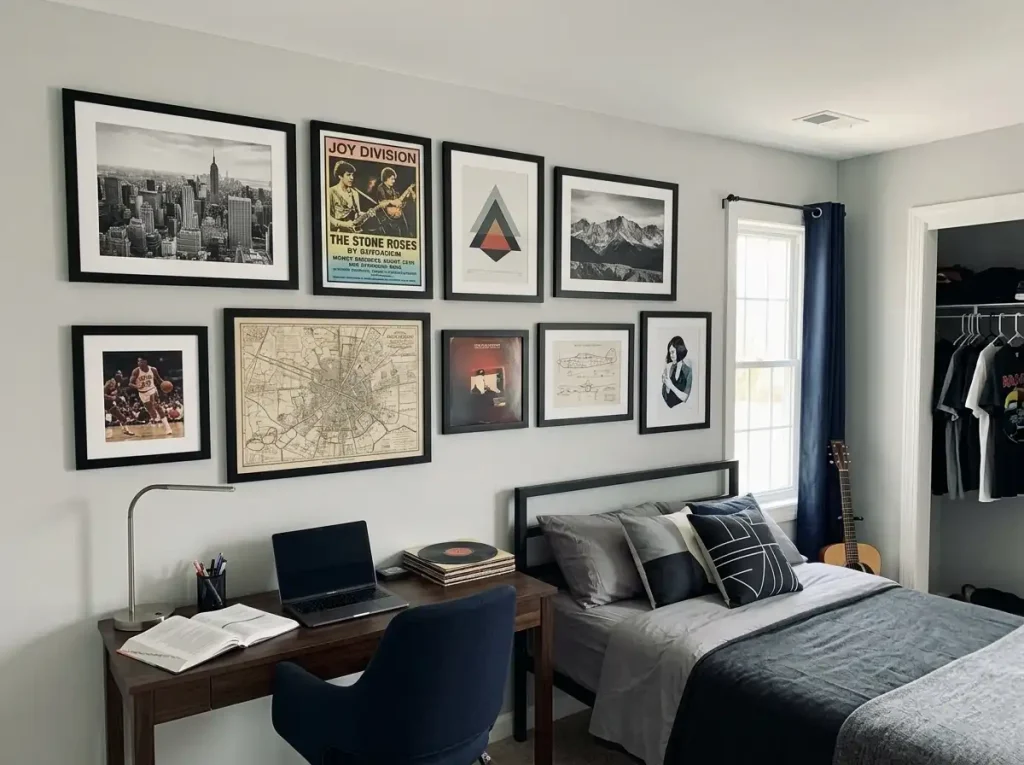
For an 18-year-old, art that works well: large-format photography (landscape, urban, architectural), vintage sports photography, band or artist posters in proper frames, film or concert poster reprints, architectural drawings, maps of meaningful places. The subject should be his — the room is his, and the art should say something about who he is.
A gallery wall of 5–9 frames in a mix of sizes, all in matching black frames, above the desk or beside the bed: achievable for $60–$120 total and looks genuinely considered.
8. Invest in a Good Floor Lamp
Most bedrooms rely entirely on overhead lighting, which is almost always the wrong choice for a teenage or young adult bedroom. Overhead lighting makes spaces feel like waiting rooms — bright, flat, and featureless. A floor lamp in the corner behind the desk chair or beside the bed creates a pool of warm light that makes the room feel like a place someone actually lives in.

A good floor lamp for this age and aesthetic: a simple arc floor lamp in matte black ($60–$120, widely available at Target, Amazon, and Home Depot) gives reading light over the bed or desk chair and fills vertical space in a way that feels intentional. An arc lamp that reaches over the bed eliminates the need for table lamps on nightstands (useful in a small room where nightstand space is limited).
Match the bulb to the vibe: a warm Edison-style LED (2200K–2700K) for relaxed, evening use. If the lamp is primarily for studying or reading, a slightly cooler 3000K bulb in the desk lamp is acceptable for task use, but the floor lamp and any ambient sources should stay warm.
9. Build a Sneaker Display If He’s Into Them
For many 18-year-olds, sneakers are the most important collection in the room — and they deserve better than being piled on the floor of a closet. A proper sneaker display is both functional storage and a genuine style statement.
A floating shelf system with individual shelves spaced 6–8 inches apart, displaying sneakers with the toe facing forward: looks exactly like a boutique sneaker store and costs $30–$80 in floating shelf hardware from IKEA or Amazon. For serious collections, clear acrylic sneaker display boxes ($5–$15 per box) stacked or displayed on shelves show off the shoes while protecting them from dust.
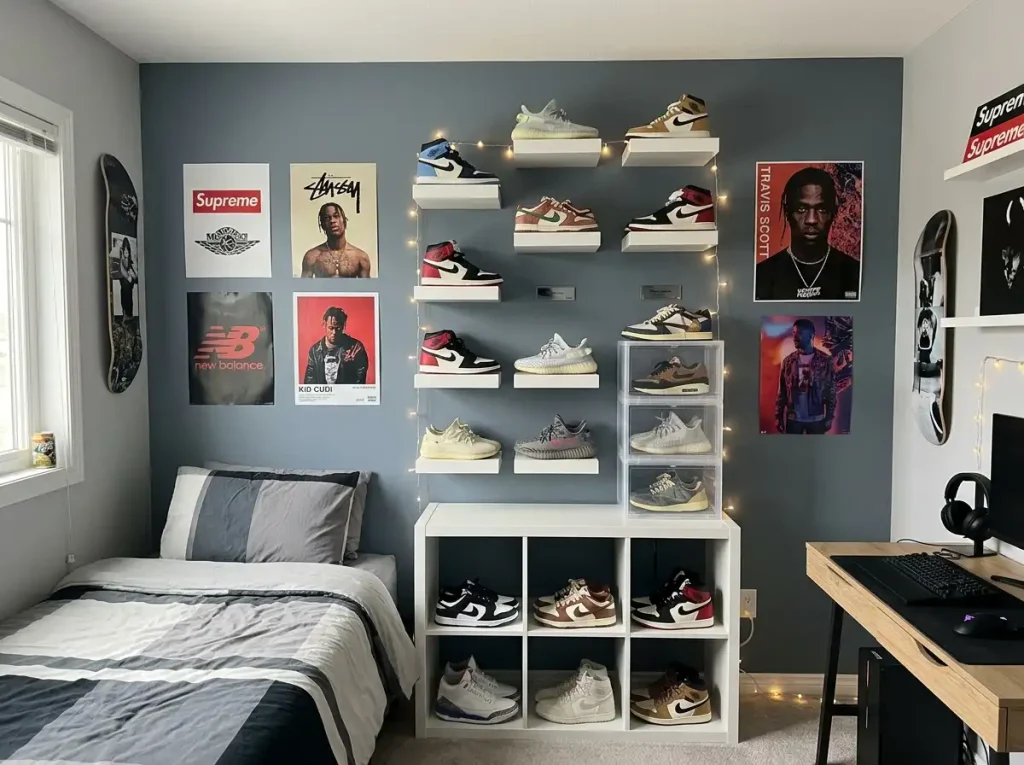
The IKEA KALLAX unit, turned on its side with each cube holding one or two pairs, is one of the most popular sneaker display solutions for exactly this reason: it’s modular, it looks intentional, and it organizes while displaying.
10. Add a Full-Length Mirror
A full-length mirror is practical — you need to see your full outfit before you leave the house — but it’s also one of the strongest design elements in a small bedroom. It reflects light, makes the space feel larger, and adds a visual anchor that grounds the room.
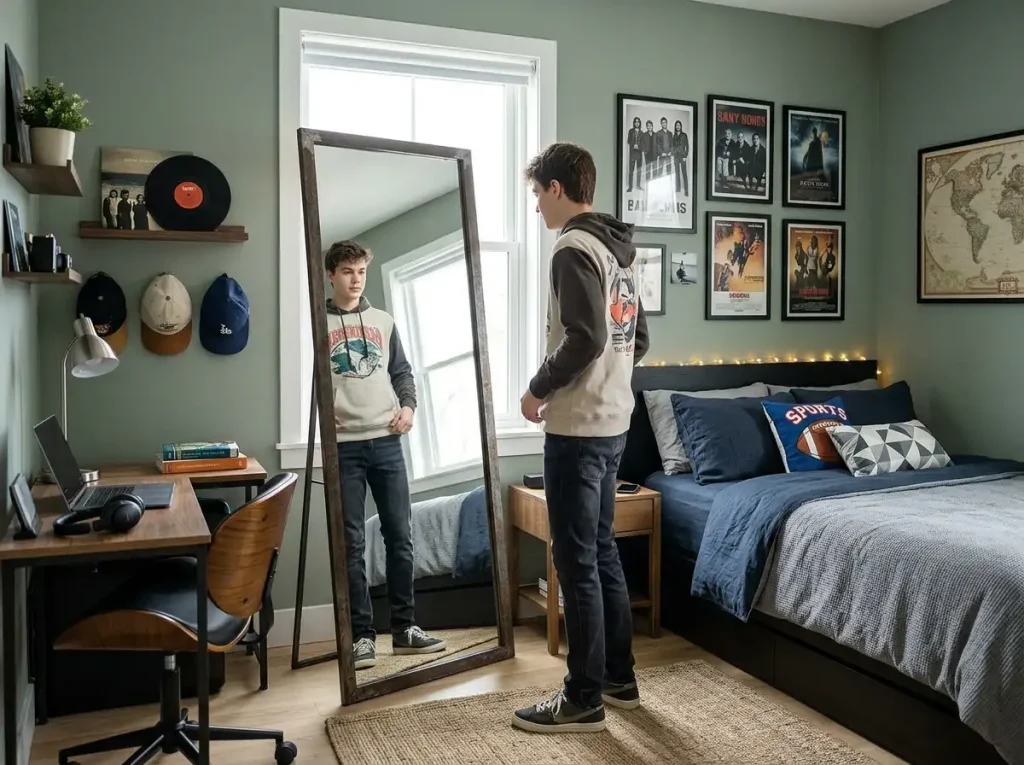
In a young man’s bedroom, a full-length mirror in a dark metal or black frame leaning against the wall or hung on the back of the door is the most practical approach. Door-mounted full-length mirrors are available for $20–$40 and take 10 minutes to install. A freestanding full-length mirror in a matte black frame ($50–$120) is more visually interesting and can be positioned wherever it does the most to open the room.
11. Manage Cables and Tech — It Changes Everything
This is the detail most young men’s bedroom guides completely ignore, but it’s one of the most visible quality-of-life differences in a tech-heavy space. A desk buried in cables — power strips sitting on the floor, charger cables snaking across the desk surface, headphone cables draped over the monitor — makes a well-designed room look chaotic.
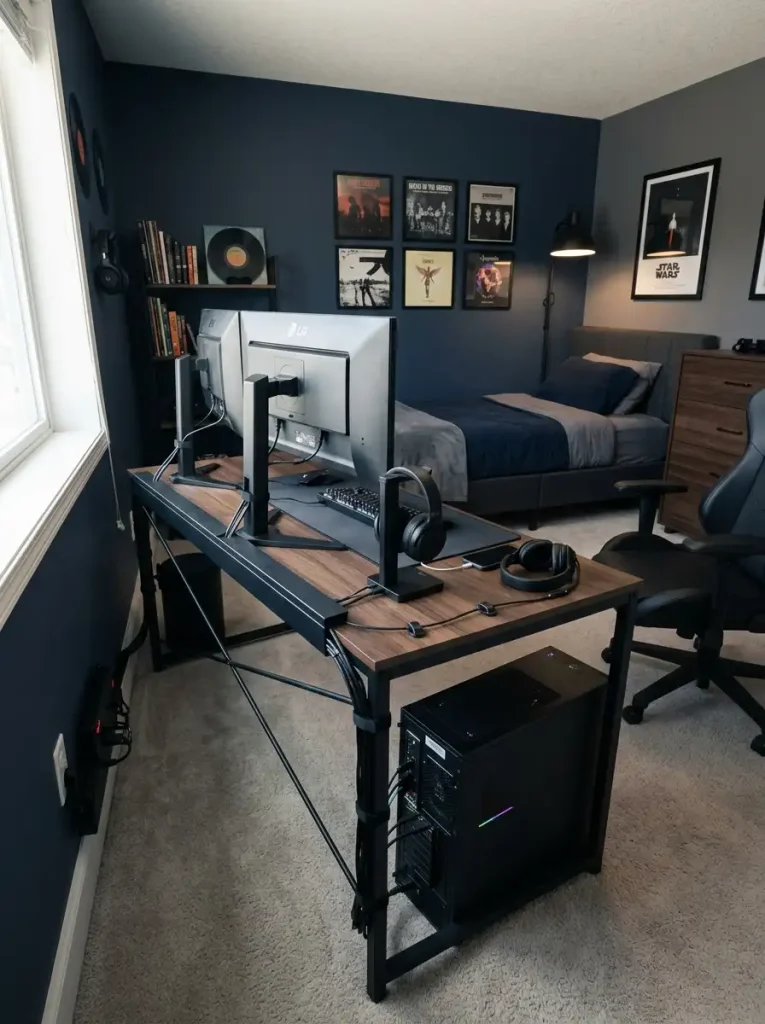
Cable management doesn’t require hours or a big budget. A cable raceway ($10–$20) mounted under the desk edge routes all desk cables invisibly to a power strip mounted underneath. Velcro cable ties ($8 for a pack) bundle cables together cleanly. A wall-mounted power strip ($25–$40) eliminates the floor power brick entirely. Small cable clips adhesively mounted to the desk route individual cables along the desk edge.
Two hours on cable management transforms the desk from visually noisy to visually calm. In a room where the desk is a centerpiece, that’s a significant upgrade.
12. Use a Bookshelf as a Room Divider in Larger Rooms
If the bedroom is large enough — or if it’s a combined bedroom-and-study space — a tall bookshelf positioned perpendicular to a wall creates a visual division between the sleeping zone and the working or gaming zone. This gives the room a more considered, apartment-style layout that feels much more grown-up than a single open rectangle.
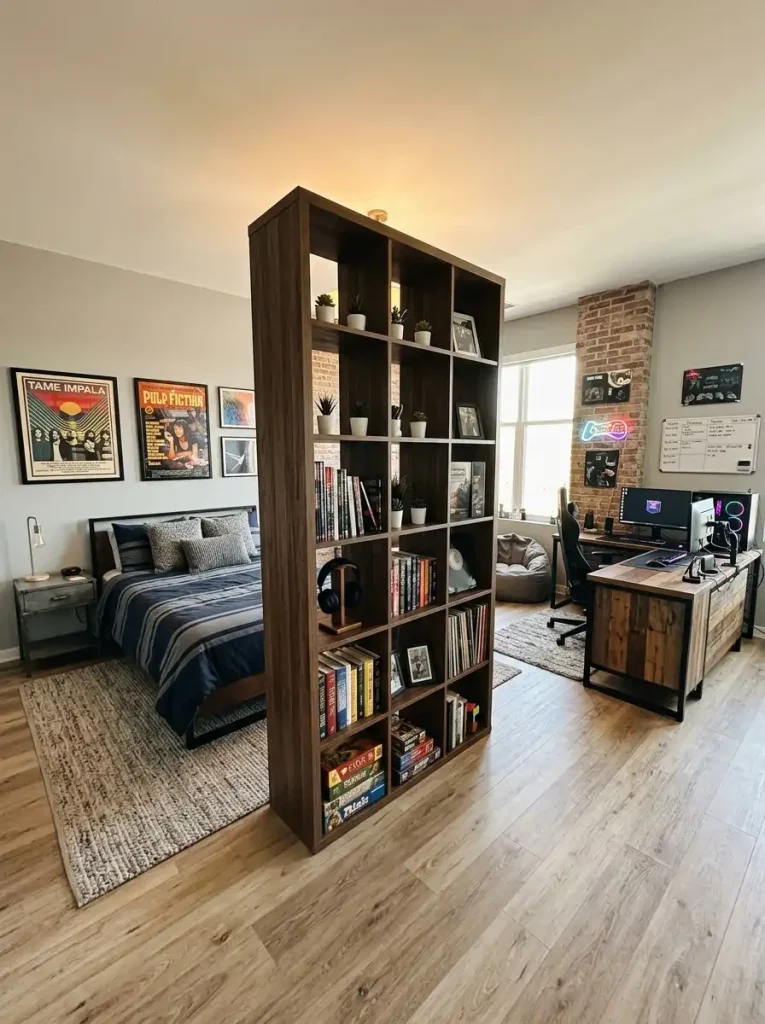
An IKEA KALLAX 4×4 unit ($130) turned perpendicular to the wall between the bed area and the desk area defines two zones clearly. It stores things on both sides simultaneously. It doesn’t reach the ceiling so the room still reads as one space, but the zones feel separate.
This works particularly well in a bedroom that’s being used as a home office or a gaming room as well as a sleeping space — which describes most 18-year-olds’ bedrooms in one way or another.
13. Hang Curtains That Actually Fit the Window
This sounds basic but it’s one of the most commonly wrong things in teenage bedrooms. Curtains hung at the wrong height (too low — at window frame level rather than ceiling level) and in the wrong width (too narrow — exactly the width of the window rather than 1.5–2x the width) make a room look small and unfinished.
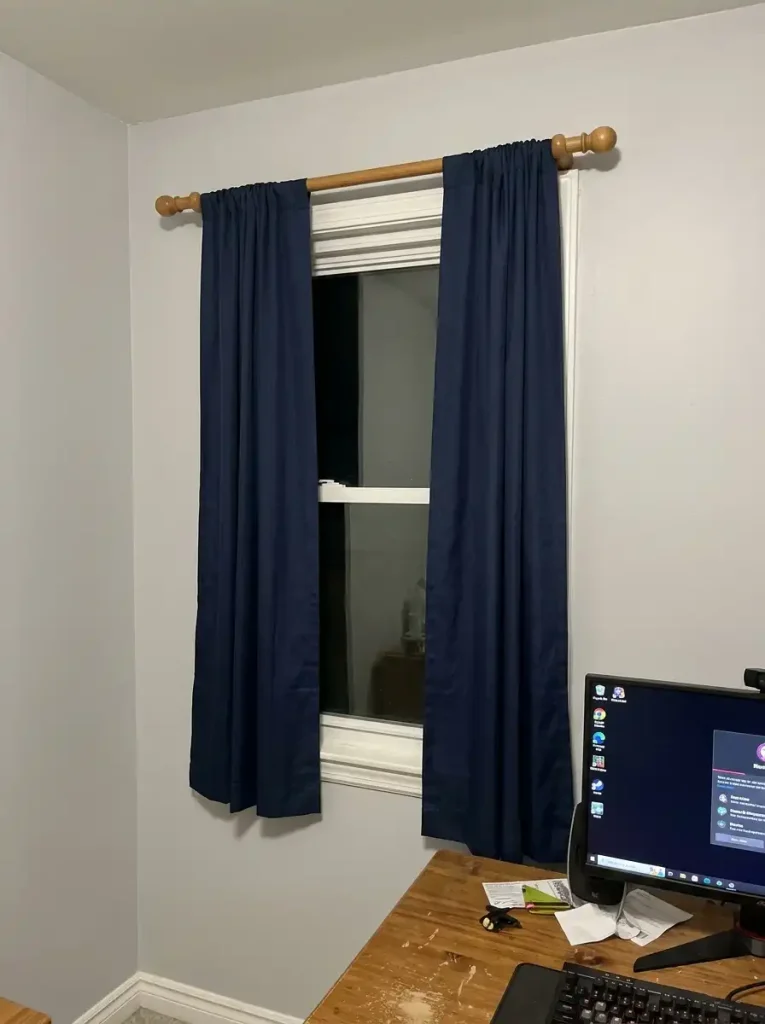
The rules that always apply: mount the rod as high as possible (4–6 inches below the ceiling for maximum effect), and buy curtains that are wider than the window. A window that’s 36 inches wide looks best with curtains that are 72–84 inches total width across both panels. When the curtains are open, they should stack mostly off the glass so the full window is visible.
For an 18-year-old’s bedroom, blackout curtains are almost always the right choice. Being able to fully darken the room matters for both sleep and gaming. Blackout curtains don’t have to look heavy — many come in slim, modern designs in dark colors (charcoal, navy, forest green) that complement the adult color palette.
14. Add a Mini Fridge if the Room Allows
This might sound more practical than design-relevant, but a mini fridge in an 18-year-old’s bedroom is one of the elements that makes the space genuinely function for an adult lifestyle — late study nights, gaming sessions, having friends over. It’s one of the first things young men mention when they describe a room that works for them at this age.
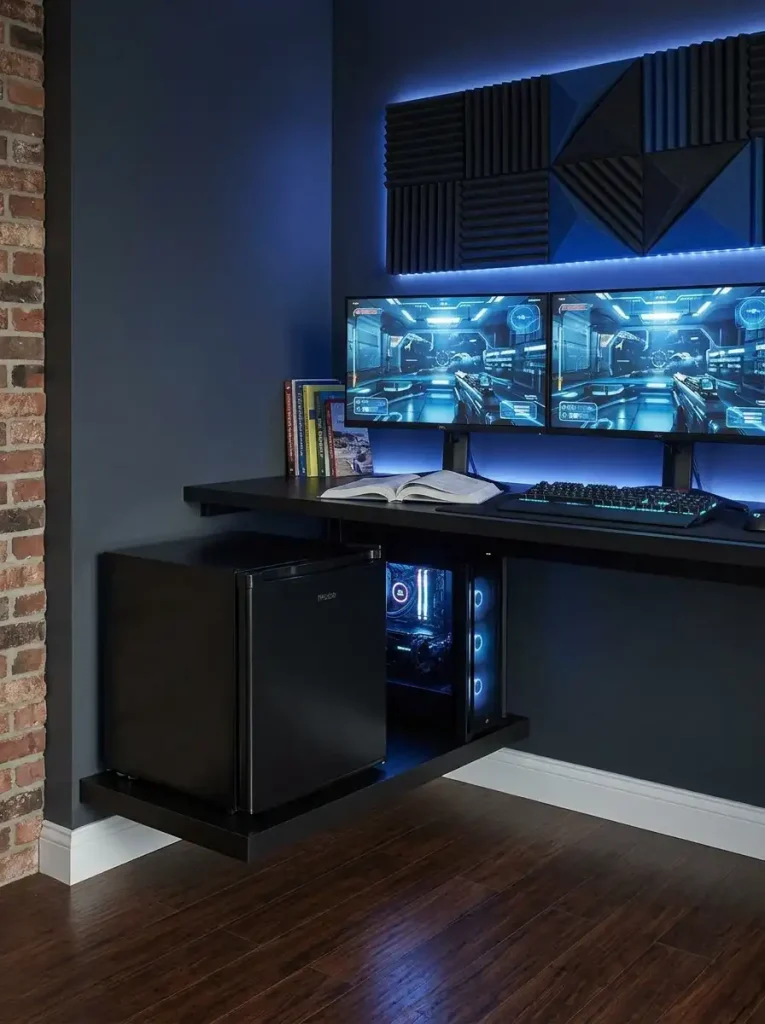
A small countertop mini fridge (1.7 cubic feet, about the size of a large microwave) runs $60–$120. Position it on a dedicated surface — a low shelf, a dedicated corner table, the bottom shelf of a bookcase — rather than directly on the floor. At floor level it reads as an afterthought. At counter height it reads as an intentional element.
15. Create a Music Corner If He Plays or Listens Seriously
For many 18-year-olds, music is central enough to their identity that it deserves its own space in the room. That might be a record player and vinyl collection on top of a KALLAX unit (the KALLAX was practically designed for vinyl storage — each cube holds roughly 65 records). It might be a guitar wall mount that displays instruments as art. It might be a dedicated listening chair with good bookshelf speakers.
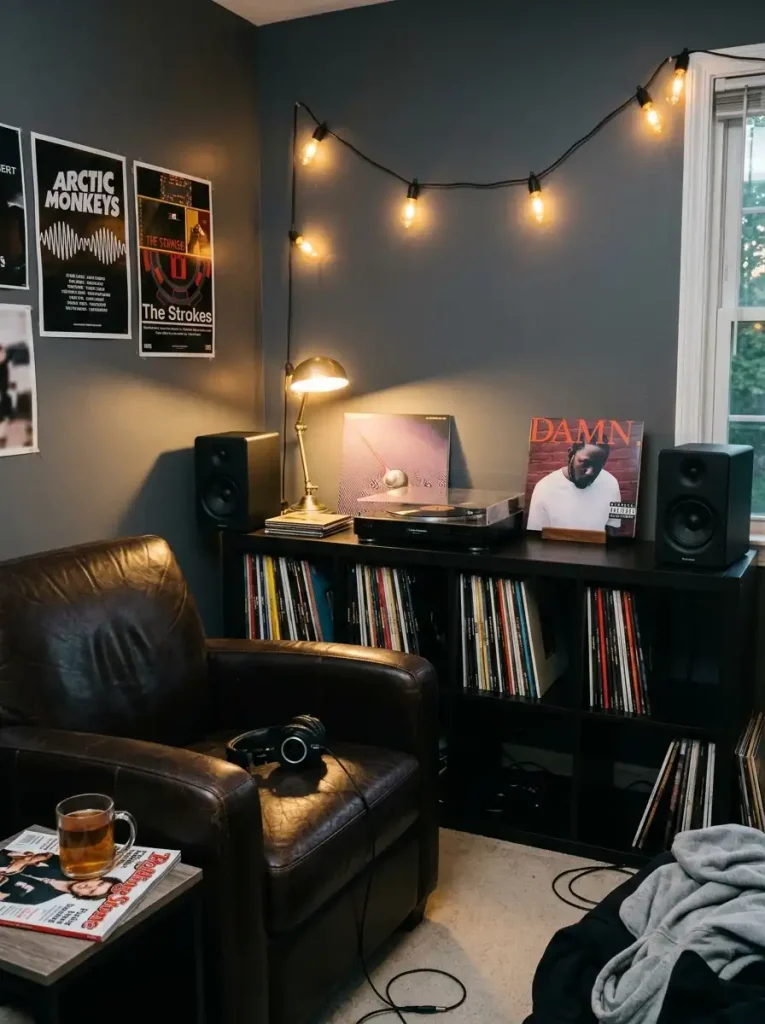
A vinyl record display — records stored in KALLAX cubes with a few favorite album covers displayed facing outward in small stands on top — is one of the most visually interesting and personal features possible in a young man’s bedroom. It’s a conversation piece, a design element, and a genuine reflection of who he is.
Guitar wall mounts: $10–$25 each and they display guitars as art on the wall while keeping them off the floor and immediately playable. Two or three guitars mounted on the wall of a music-interested 18-year-old’s bedroom look incredible and cost almost nothing to execute.
16. Build Storage That Hides Clutter
An 18-year-old’s bedroom accumulates stuff at a rate that any storage system needs to account for honestly. Clothes that didn’t make it to the closet. Gaming accessories. Tech equipment. Sports gear. Shoes. The solution isn’t trying to minimize ownership — it’s having adequate, accessible, visually calm storage for all of it.
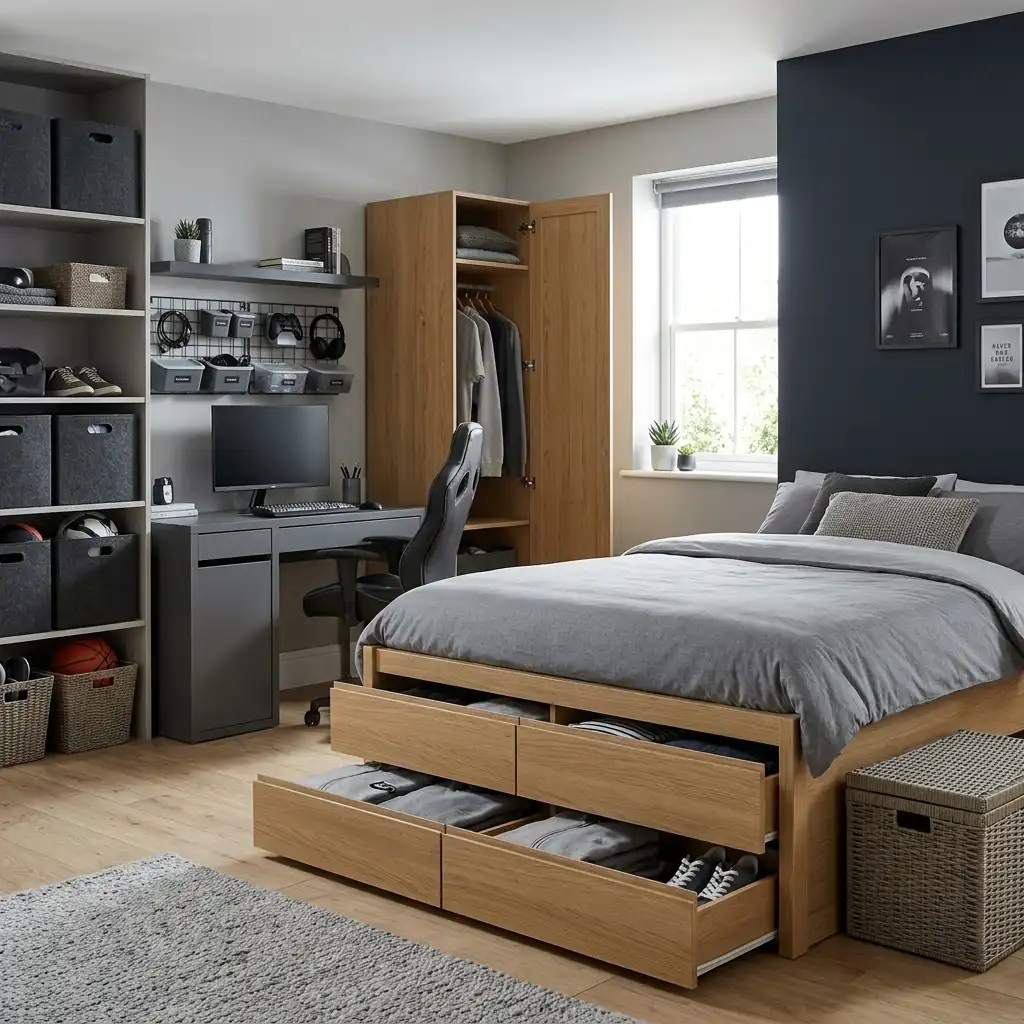
The storage that works: an under-bed storage system (low-profile rolling bins, $20–$40 for a set) for out-of-season clothes and extra bedding. A closed-door wardrobe or dresser for clothes (open shelving for clothes reads as chaotic in a matter of days). A desktop organizer for the desk surface that corrals pens, chargers, and small accessories without needing a drawer for each. A hook rail on the back of the door for bags, headphones, and jackets in daily use.
The general rule: anything that’s used daily can be visible. Anything used weekly or less should have a closed home.
17. Add a Pinboard or Magnetic Board for Ongoing Life
At 18, a bedroom wall often functions as a working surface — somewhere to pin a class schedule, a gym routine, a list of goals, a concert ticket stub, a photo from a trip, a motivational quote, an important receipt, a map of somewhere he wants to go. A proper pinboard or large magnetic whiteboard gives that instinct a home and keeps it off the desk and the floor.
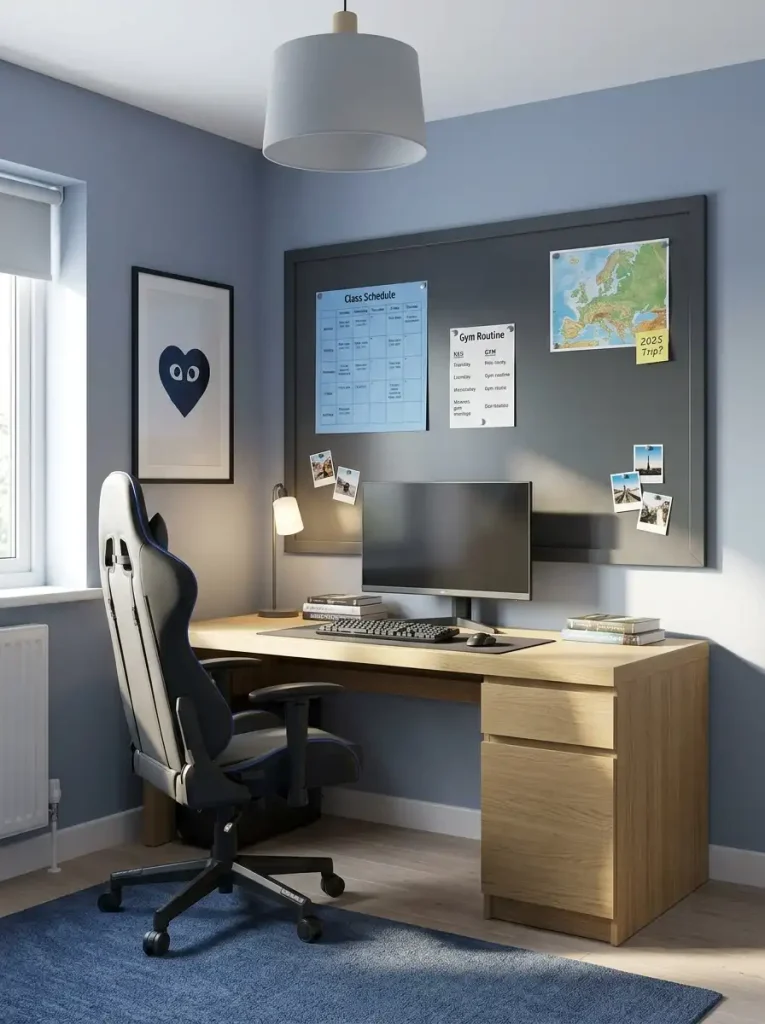
A large corkboard in a frame ($30–$60 at IKEA or Amazon) hung above the desk gives a dedicated surface for everything pinned. A magnetic whiteboard ($40–$80) above the desk works even better for a young man who uses it for planning, lists, or quick notes — the whiteboard function is genuinely useful for studying and the magnetic surface holds photos and ticket stubs with small magnets.
Keep it near the desk, not across the room. A planning surface that’s 15 feet from the desk doesn’t get used.
18. Choose a Rug That Can Handle Real Use
An 18-year-old’s bedroom floor gets used hard — chairs rolling across it, shoes worn indoors, friends sitting on it, gaming equipment on it. A rug that’s too light in color or too delicate in construction will look destroyed within six months.
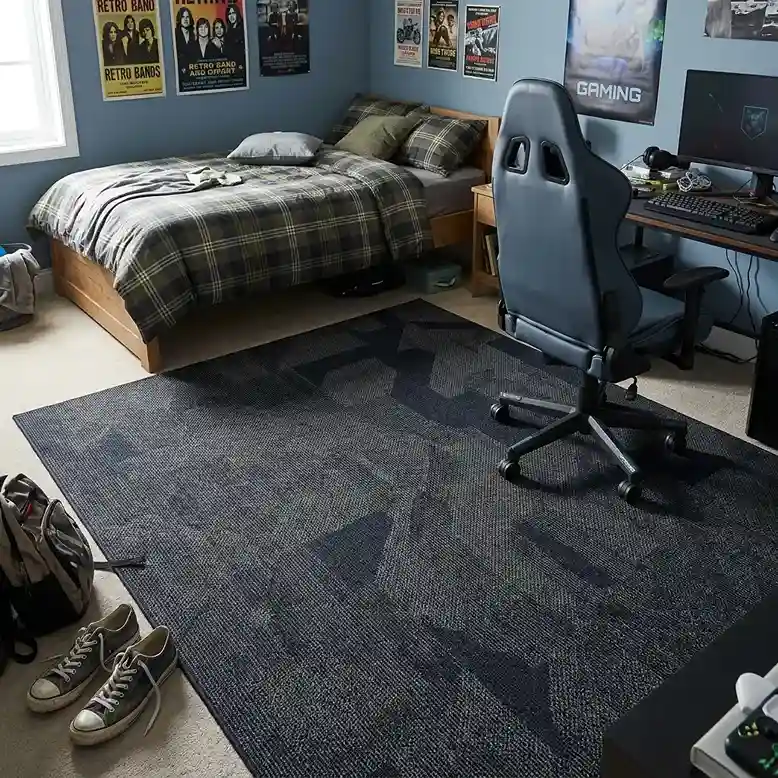
The rugs that work well in this context: a low-pile or flat-weave rug in a darker colorway (charcoal, navy, deep green, brown, black) that doesn’t show every mark and vacuums easily. A geometric or abstract pattern rather than a solid, which shows marks less. A synthetic fiber (polypropylene) rather than wool or cotton for the main rug — it’s more durable and easier to clean.
Size it generously: in a bedroom, a rug should extend at least 18 inches beyond the sides of the bed. A rug that’s too small for the bed floats awkwardly and makes the furniture look random. The most common mistake is buying a 5×7 when the room needs an 8×10.
19. Put the Bed in the Power Position
This sounds like interior design mysticism but it’s based on something real: where you put the bed changes how the room feels and how comfortable the person sleeping in it feels. The “power position” for a bed is facing the door while not being directly in line with it, and ideally against a solid wall.

The bed should never be directly opposite the door (you see the bed first when the door opens — uncomfortable for the person in it, awkward for visitors) or against a window wall (cold in winter, light in the eyes in the morning, impossible to use the window without disturbing the bed). The best position is perpendicular to the door on the longest wall — you can see the door from the bed without being directly opposite it.
Most rooms have a natural “best position” for the bed based on where the doors, windows, and outlets are. If the current layout doesn’t have the bed in that position, moving it — even if it means rearranging everything else around it — is often the single most impactful layout change you can make.
20. Install a Smart Light System for Mood Flexibility
An 18-year-old’s bedroom needs to do a lot of things: bright and focused for studying, dimmed and warm for winding down, dramatic and colored for gaming or hanging out with friends. A single overhead light on a regular switch can’t do all of that. A simple smart light system can.
Philips Hue, Govee, or a basic smart bulb system ($20–$80 for a starter setup) lets the overhead light shift from bright white (studying) to warm amber (relaxing) to a dramatic color (gaming or atmosphere) from a phone or voice command. This isn’t a luxury for this age group — it’s a genuine daily quality-of-life improvement that changes how the room functions across different times of day.
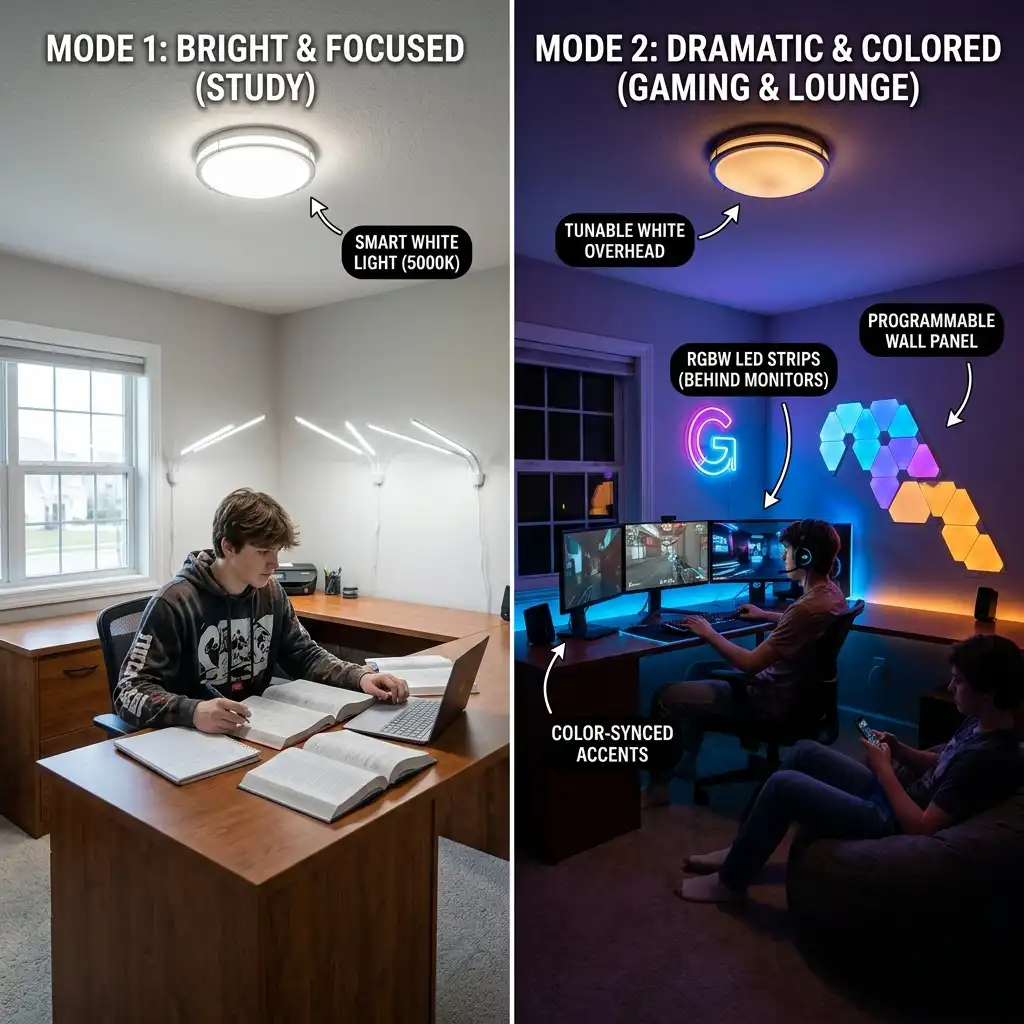
For the desk specifically: a adjustable color-temperature task lamp ($30–$60, available from BenQ or similar brands that make monitor-friendly desk lamps) that shifts from warm to daylight depending on the task makes a meaningful difference in eye comfort during long study or gaming sessions.
21. Make the Closet Actually Work
The most ignored part of an 18-year-old’s bedroom is almost always the closet. An overcrowded, disorganized closet means clothes end up on the floor, on chairs, and on any available surface. A properly organized closet that matches how he actually stores and accesses his clothes keeps everything else in the room cleaner.
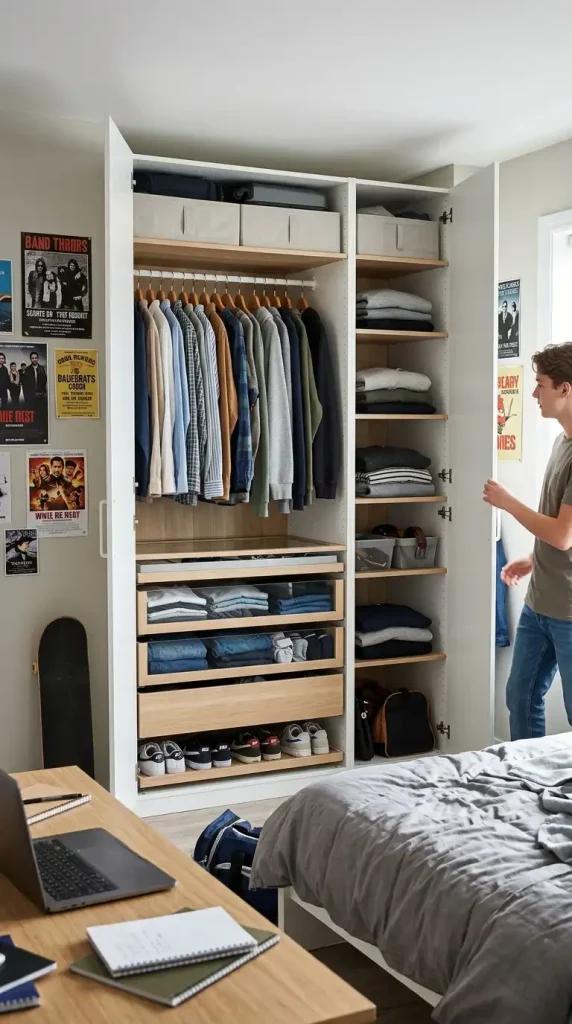
The IKEA PAX wardrobe system ($100–$400 depending on size and configuration) is the most flexible and cost-effective closet organizer available. If there’s already a built-in closet, an IKEA KOMPLEMENT insert kit ($50–$100) adds shelves, a second hanging rod, and pull-out organizers to an existing space.
The organization that works for most young men: double hang rods for shorter items (shirts, jackets), full-length hang for longer items (trousers, suits), open shelving for folded items and sneakers, and a few drawers or bins for accessories and workout gear. The most important thing is that the system matches how he actually puts things away, not an idealized system that requires more discipline than anyone has at 18.
22. Add a Comfortable Seating Option Beyond the Bed
At 18, the bedroom gets used as a social space as well as a sleeping space. Friends come over, and the bed is not ideal as the only seating option. A bean bag, a gaming floor chair, a small loveseat, or a comfortable floor cushion gives the room a second place to sit that isn’t the desk chair or the bed.
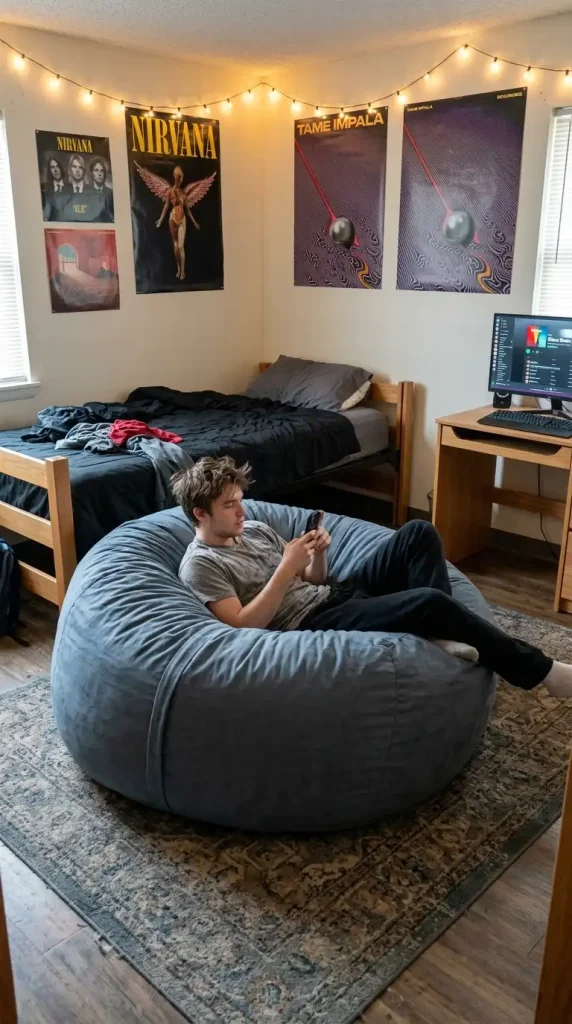
For small rooms: a large bean bag ($40–$80) stores flat when not in use and can be dragged wherever it’s needed. A floor-level gaming chair (not the pedestal kind — just a padded rocker chair that sits directly on the floor, $60–$100) is comfortable for gaming and low-profile enough to not overwhelm a small room. For rooms with more space: a small loveseat or loveseat-sized sofa in a dark, durable upholstery (charcoal microfiber or dark-wash canvas) adds real living-room energy to the space.
23. Display Collections in a Way That Looks Intentional
Most 18-year-olds have collections of something — cards, comics, jerseys, trophies, figurines, tech equipment, sports memorabilia, game cartridges, sneakers. The difference between a room that looks curated and one that looks cluttered often comes down to how the collection is displayed.
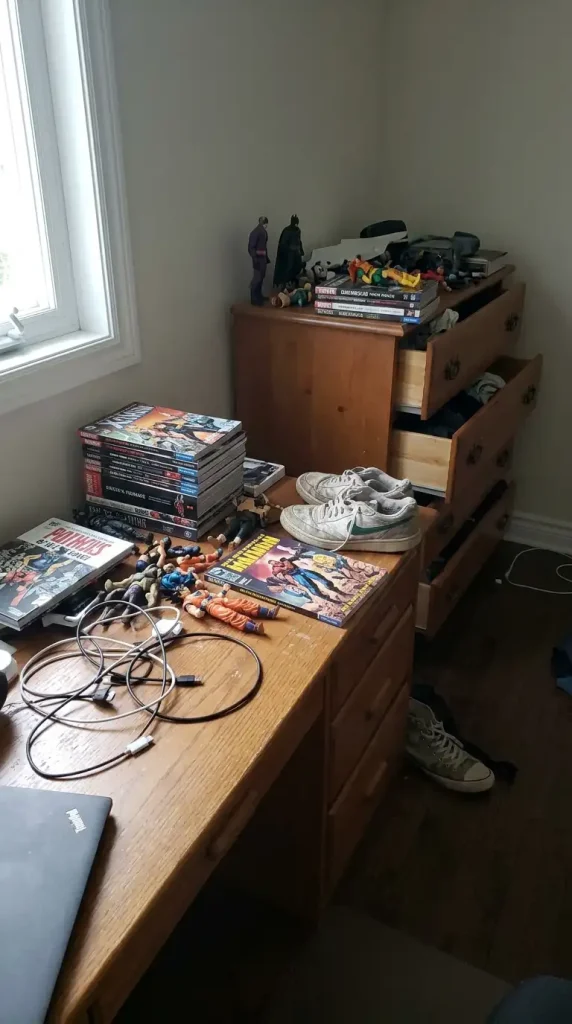
The principles of displaying a collection well: group things together rather than scattering them around the room. Give the collection its own dedicated surface or shelving zone. Use consistent display methods within the collection (all cards in the same type of case, all figures at consistent spacing, all jerseys framed the same way). Leave space around the collection — crowding things together makes even beautiful objects look like clutter.
A framed and mounted sports jersey above the bed: $30–$60 for a jersey display frame, genuinely impressive as a bedroom focal point. A set of floating shelves displaying a figurine or collectible collection with proper spacing and lighting: museum-quality on a bedroom budget.
24. Use a Dark Wood Tone as the Unifying Material
The design element that ties together a young man’s bedroom more reliably than any other is a consistent wood tone across the furniture. Dark walnut, warm oak, or espresso-stained wood in the bed frame, the desk, the nightstand, and the shelving creates a cohesive look even if the pieces are from different sources and different eras.

The trick is to not mix too many wood tones. One warm wood and one dark wood is fine. Three or four different wood tones in the same room creates visual confusion that’s hard to diagnose but easy to feel — the room looks like it was furnished from lost and found.
If existing furniture is a mix of tones and styles: painting mismatched pieces in a consistent dark stain or matte black paint unifies them. A matte black spray-painted bookshelf beside a matte black desk lamp beside a matte black curtain rod reads as a choice. The same bookshelf in a different stain, with a silver lamp, and a white curtain rod reads as random.
25. Bring in One Plant — and Make Sure It Survives
Plants in a young man’s bedroom have a surprisingly large design impact — they add life, color, and a natural element that softens what is often a hard-edged, tech-heavy space. The challenge is finding plants that survive the conditions of an 18-year-old’s room (variable watering schedule, possibly low light, possibly dry air from heating and air conditioning).
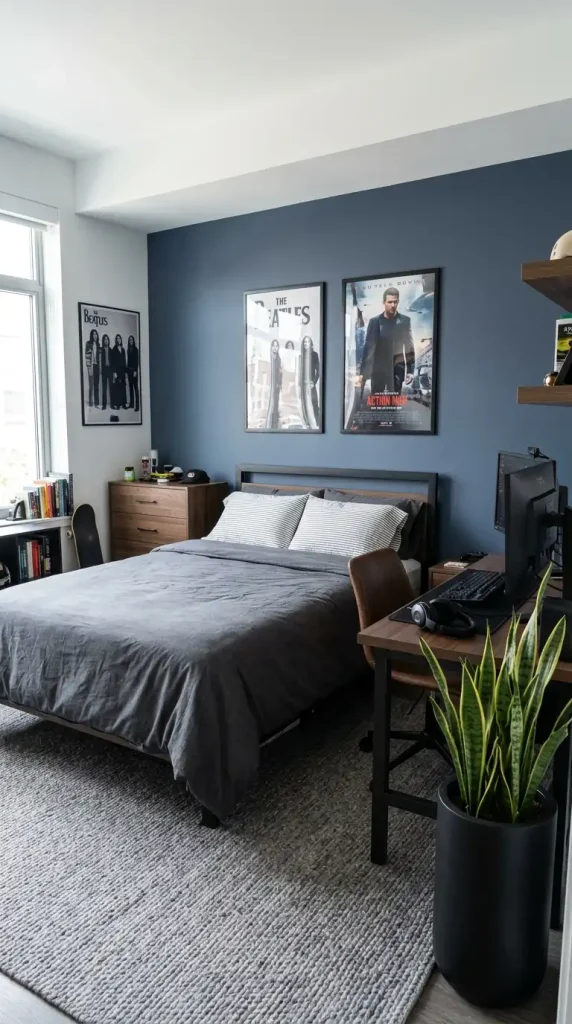
The plants most likely to survive: a snake plant (virtually indestructible, tolerates low light and drought), a pothos (grows in almost any condition, trails beautifully from a shelf), a ZZ plant (thrives on neglect), or a cactus or succulent collection on a sunny windowsill (waters every 2–3 weeks).
One large statement plant in a dark pot or woven basket in the corner of the room adds more than a collection of small ones scattered around. A 4-foot snake plant in a matte black planter in the corner by the desk: $30–$50 and it changes the feel of the room immediately.
26. Soundproof and Acoustically Treat If Music or Gaming Is Important
This one is often overlooked but genuinely matters for the quality of life in an 18-year-old’s room — and for everyone else in the house. A room with bare walls, a hard floor, and no soft furnishings has terrible acoustics: voices boom, bass frequencies build up in corners, and audio from speakers or headphones bleeds through walls.
Acoustic improvement doesn’t require professional treatment. Heavy curtains absorb high frequencies. A large rug on the floor reduces floor reflections and bass buildup. Bookshelves full of books diffuse sound. A tapestry or fabric wall hanging adds absorption on hard walls. These are all things that belong in the room for design reasons anyway — they also happen to improve the acoustics.
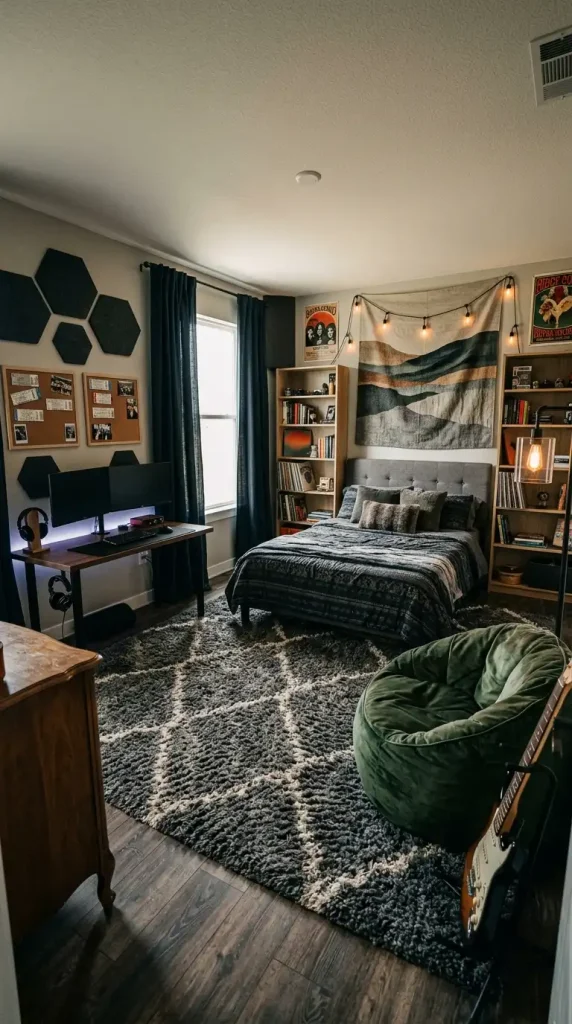
For anyone who takes music production, podcasting, or gaming audio seriously: adding a few acoustic panels to the wall behind the desk or recording area ($20–$40 for a set of 6 panels on Amazon) makes a real difference to recording quality and reduces echo in video calls.
27. Let Him Decide What the Room Actually Is
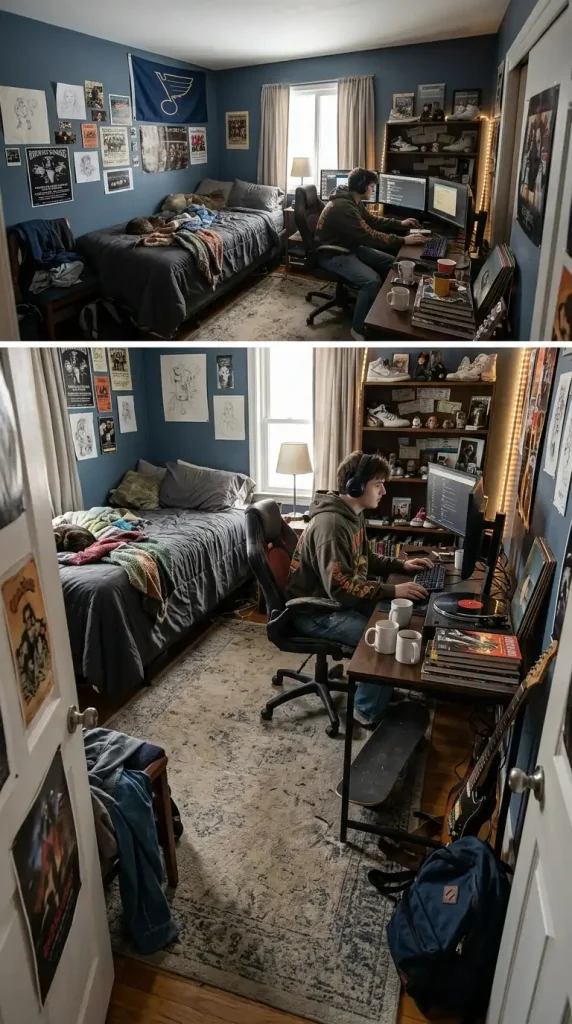
The last and most important idea in this guide isn’t a product or a layout tip. It’s a philosophy, and it applies whether you’re the parent or the 18-year-old himself.
An 18-year-old’s bedroom should look like an 18-year-old’s bedroom — not a showroom, not a Pinterest board, and not what his parents think a bedroom should look like. The room that he’ll actually keep clean, actually spend time in, and actually feel proud of is the one that reflects who he is right now: his interests, his aesthetic, his collections, his personality.
That might mean a darker, moodier color palette than his parents would choose. It might mean a gaming setup that takes up a quarter of the floor space. It might mean vinyl records stacked in a KALLAX unit and band posters on the wall and a guitar hanging where someone else would hang art.
The design ideas in this guide are tools. Which ones are right depends entirely on the specific person living in the room. The best bedroom design advice I know is the simplest: figure out what matters most to him, and design the room around that first. Everything else is furniture placement.
What I’d Do Differently If I Were Doing My Nephew’s Room Again
I’d buy the desk chair before anything else. We picked the desk chair last and spent most of the budget before we got to it, which meant compromising. For a room where studying and gaming happen for 4–6 hours a day, the chair is the most important single purchase. Budget for it first, not last.
I’d paint the accent wall before moving furniture in. We painted after the furniture was positioned, which meant moving the bed twice and carefully cutting in around pieces we couldn’t fully move. Paint first, furniture after. Always.
I’d involve him more in the art selection. I chose most of the framed prints based on what I thought would look good. He likes them, but he would have chosen differently — and his choices would have been more personal. For any room that belongs to someone else, the art is the one category where their specific taste matters more than design cohesion.
I’d add better under-desk cable management from the start. We dealt with cables as an afterthought and spent an irritating afternoon untangling and routing things we should have organized during setup. Cable raceways go in first, before anything is plugged in.
I’d get the curtains longer. We bought 84-inch curtains and the ceiling height was 96 inches. The gap between the curtain hem and the floor was just visible enough to look intentional-but-failed. For 96-inch ceilings you need 96-inch curtains (and most stores carry them — I just didn’t check the ceiling height before buying). Measure the ceiling before ordering curtains, not after.
Frequently Asked Questions
How do you make an 18-year-old’s bedroom look grown-up without it feeling too adult?
The shift from teen to young adult bedroom is mostly about removing juvenile elements rather than adding sophisticated ones. Remove anything that reads as childhood: cartoon or sports character bedding, glow-in-the-dark or stick-on ceiling decorations, mismatched bedroom furniture in bright colors, posters taped directly to the wall. Replace with: adult bedding in a solid dark or subtle pattern, framed art, a full or queen bed frame, and a consistent color palette. The room doesn’t need to look like a hotel. It needs to not look like a kid’s room. Those are two very different thresholds — the second one is much easier to hit.
What’s a realistic budget for redoing an 18-year-old’s bedroom?
A complete refresh — new bedding, paint, curtains, a rug, framed art, and some organizational improvements — can be done for $300–$500. Adding a new bed frame brings it to $400–$700. A full transformation including desk setup, new lighting, and all new furnishings typically runs $800–$1,500 depending on how much is being replaced. The highest-impact low-cost changes: paint one wall ($30–$50 in materials), frame existing posters or buy new prints ($60–$120 for a gallery wall), upgrade the bedding ($60–$100), and swap every bulb for warm LEDs ($15–$30). That $165–$250 of changes accounts for probably 60% of the room’s visual improvement.
How do you design a small bedroom for an 18-year-old with limited space?
Prioritize vertically. In a small bedroom, what goes on the walls and what gets stored upward matters more than what goes on the floor. Wall-mounted floating shelves replace floor-standing bookshelves. An under-bed storage system eliminates the need for an extra dresser. A floor lamp replaces bedside tables on both sides of the bed. Wall-mounted monitor arms replace desk monitor stands. The floor should have as little on it as possible — furniture, rug, and nothing else. Everything else goes up the walls or under the bed. A small room can feel deliberate and designed or cramped and cluttered — the difference is almost entirely about how much ends up on the floor.
Should an 18-year-old have a TV in his bedroom?
This is a parenting decision as much as a design one — it depends on the household, the young man, and the context. From a pure design standpoint: a TV mounted on the wall takes up zero floor space, can be positioned at the right eye height, and becomes a visual anchor for the room if it’s in the right place. A TV on a low dresser or a small stand that it dwarfs looks random and impermanent. If there’s going to be a TV, mount it properly on a wall bracket ($15–$40) at eye level from the bed or seating position, and run the cables through the wall or along a raceway so they’re not visible.
What’s the most important thing to get right in a teenage boy’s bedroom?
Lighting, without question. Most teenage boys’ bedrooms have terrible lighting — one overhead fixture on a switch with no dimming and a cool white bulb. The result is a room that feels harsh and clinical at full brightness and completely dark when it’s off, with nothing in between. Adding a floor lamp, a desk lamp, and warm bulbs throughout — with a dimmer on the overhead if possible — transforms how the room feels across every use case. Study: desk lamp on, overhead dimmed. Gaming: desk lamp off, ambient lighting on. Winding down: floor lamp only, warm and low. A room with flexible, warm lighting feels more like a real living space and less like a holding room, and it costs less than almost any other meaningful upgrade you can make.
How do I design the room with him rather than for him?
Start with three questions: What does he do most in this room beyond sleep? What does he hate about the room right now? Is there any space he’s been in — a friend’s bedroom, a hotel, a store, anywhere — that felt right to him? The answers to those three questions contain most of what you need to know. The first tells you where to invest most (if he studies there, prioritize the desk. If he games, prioritize the setup. If friends come over, prioritize seating and atmosphere). The second tells you what to change first. The third gives you a visual reference point to work from rather than an abstract design goal.
Conclusion
The bedroom we finished for my nephew took one weekend and $587. That included paint, curtains, a new full-size bed frame from IKEA, framed prints from Amazon, a used desk chair from Facebook Marketplace, a floor lamp from Target, and a KALLAX unit to replace the sagging old bookshelf.
He texted me a photo at 11pm the first night he was back in the room. The message just said: “it actually feels like my room now.”
That’s the goal. Not a magazine spread. Not a design scheme. A room that feels like his.
The ideas in this guide are starting points. Some will fit. Some won’t. The specific combination that works is the one he’d choose — the right bed in the right position, art that means something to him, storage that matches how he actually lives, lighting that feels right at every hour of the day.
Design the room around who he is right now. He’ll be different in five years, and the room can change then. Right now, give him somewhere that fits.
Ambar Mitchell covers practical home decor and room design at HomefixTrends.com — the projects that actually work, the purchases worth making, and the mistakes worth learning from before you make them yourself.