Walk into a room furnished with real vintage pieces, and something shifts. It is not the showroom feeling, where everything is new, coordinated, and slightly too perfect. It is quieter than that. The room feels settled. It feels lived in. It feels like it has a story.
That feeling is not just aesthetic. It is biological.
A 2025 study in Emotion Review by nostalgia researchers Constantine Sedikides and Tim Wildschut found that nostalgia is a predominantly positive emotion. It protects us against adverse psychological states and gives us a stronger sense of meaning, social connectedness, and self-continuity. Surrounding yourself with objects that carry the weight of the past is genuinely good for you. A vintage bedroom is not just a design choice. It is a quiet psychological one.
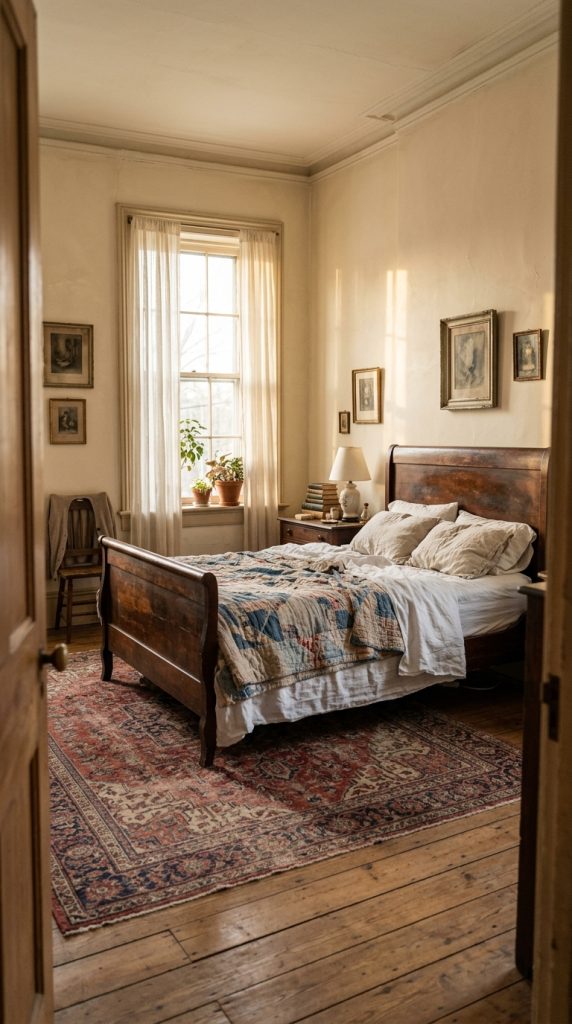
But how do you build one without it looking like a dusty museum or a thrift store explosion? It starts with understanding the rules of the past, and then breaking them just enough to make the room feel like yours.
1. Pick a Lead Era: Choose one period (Victorian, Mid-Century, French Provincial) to anchor the room.
2. Warm the Walls: Antique whites and dusty, sun-faded colors.
3. Let the Bed Speak: The frame is the centerpiece; everything else supports it.
First, You Have to Pick Your Era
The word vintage gets thrown around loosely, but in strict design terms, it refers to items at least twenty years old. More importantly, a vintage bedroom draws from a specific era of design history.
The periods most commonly referenced are:
- Victorian (1837 to 1901)
- Edwardian and Arts and Crafts (early 1900s)
- Art Deco (1920s and 1930s)
- Mid-Century Modern (1950s and 1960s)
- French Provincial, with its carved, curved, ivory-painted furniture
A Victorian bedroom looks nothing like a mid-century one. Picking your era is the first and most important decision, because mixing periods randomly just creates chaos.
That said, the best modern vintage rooms are not strict reconstructions. They mix eras with intelligence. Anchor the room with Victorian antique bed frames, but let a 1960s ceramic lamp or a 1930s mirrored dresser sit beside it. As long as the mood and palette hold, the room works.
The Palette: Sun-Faded and Warm
Color in a vintage bedroom is not about what is trending on Instagram. It is about choosing colors that feel historically grounded and age well. See more bedroom color palette ideas.
The Whites Are Warm
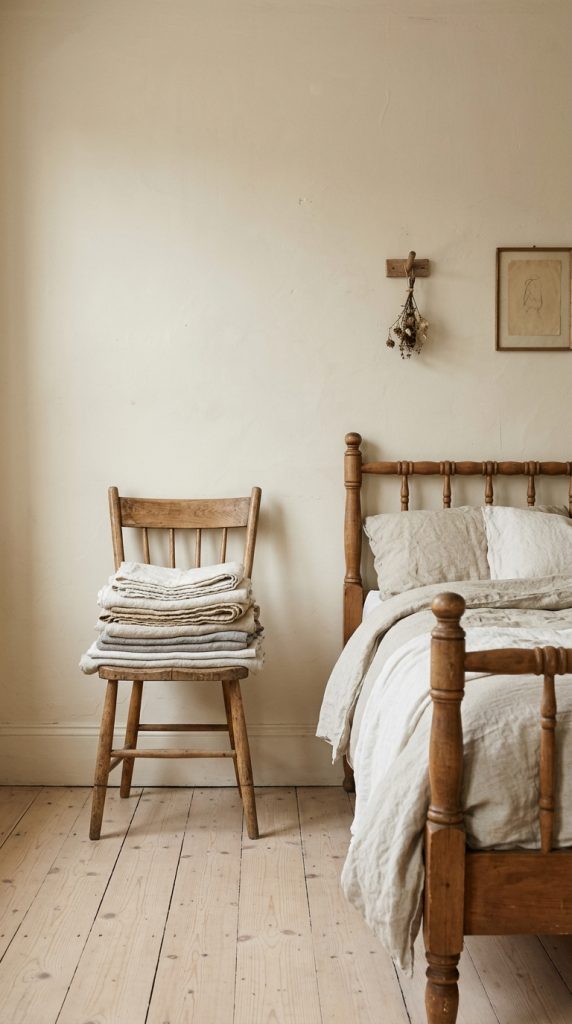
Skip the crisp, cool white of a modern minimal room. You want the warm, slightly yellowed white of old plaster, aged linen, and well-worn wood. Paint companies call these aged white, antique cream, parchment, or linen white. They create a soft background that makes old wood and fabric glow.
The Colors Are Dusty
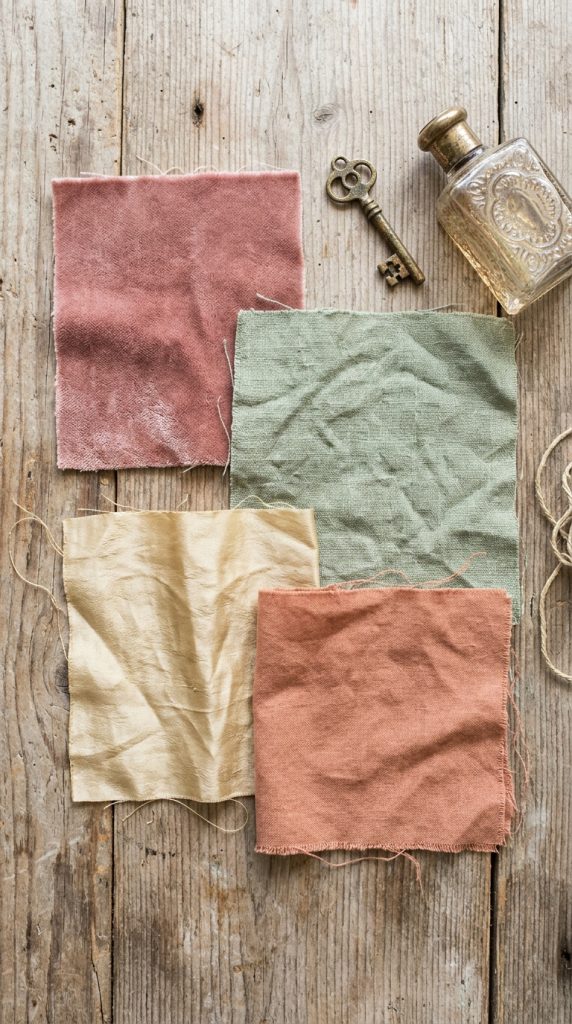
Beyond the white base, vintage rooms use muted, dusty versions of period colors. Dusty rose, sage green, faded lavender, dusty teal, pale gold, and soft terracotta. They should never be bright or saturated. They should look like they have been washed and sunned and aged over decades.
The Wood Tones Are Just as Important as the Paint
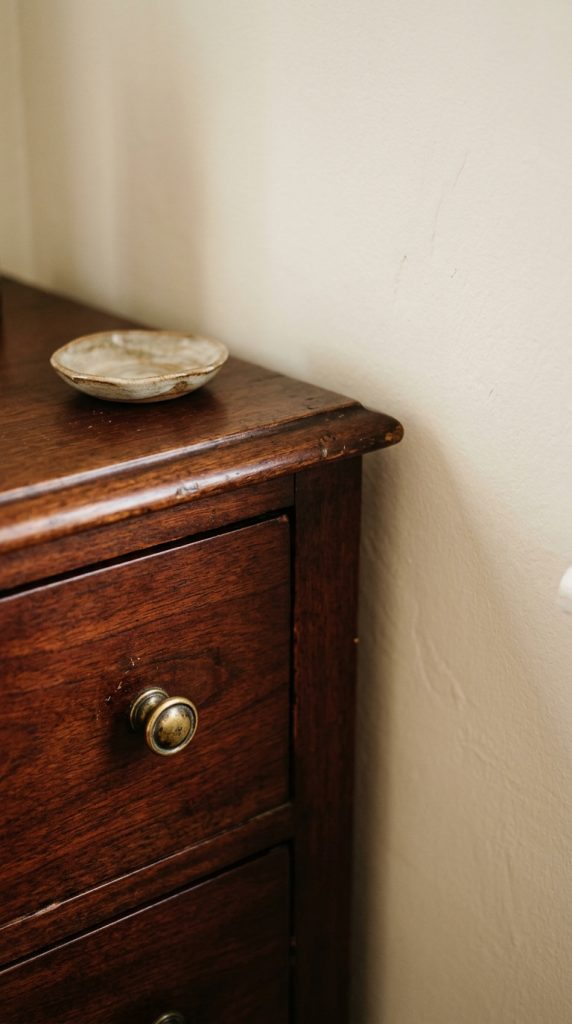
Deep mahogany, warm cherry, aged walnut, and pale honey oak. The wood in antique bed frames is almost always real solid timber, carrying a warmth that no laminate can replicate. You have to factor these wood tones into your color planning from day one.
💡 The Rule of Cool
If your wood is warm (like cherry or mahogany), your walls must be warm (cream, antique white, dusty rose). A cool gray wall will always fight a warm wooden bed frame.
The Bed Is the Centerpiece
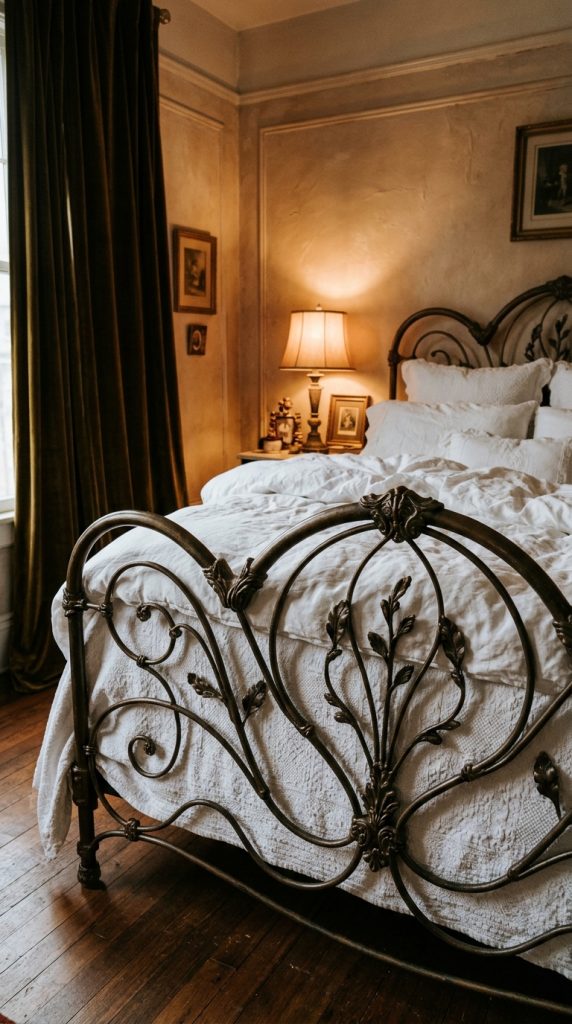
In a vintage bedroom, the bed is where the character is established. Get the bed frame right, and the rest of the room has a direction.
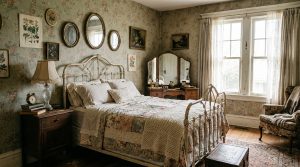
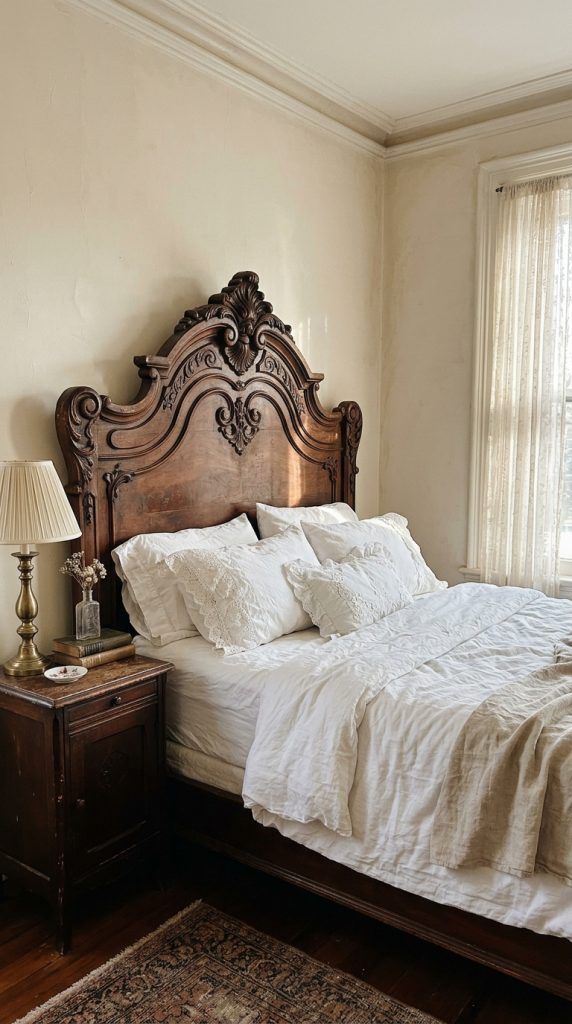
Victorian and Edwardian frames feature high, ornate headboards in carved dark wood or cast iron. The wooden versions have detailed scrollwork and turned spindles. The iron versions have flowing curves and botanical motifs in black or antique bronze.
Vintage queen frames sit in an interesting spot. Because most genuine antiques were made to different sizes, a vintage queen is usually either a vintage-style piece built to modern dimensions or an antique that has been professionally adapted. Either works, as long as it has solid construction and real weight.
Retro king frames in a mid-century modern style are a sophisticated choice. They sit low to the ground with clean horizontal lines and tapered legs. In walnut or cherry with a natural oil finish, they look vintage and contemporary at the same time.
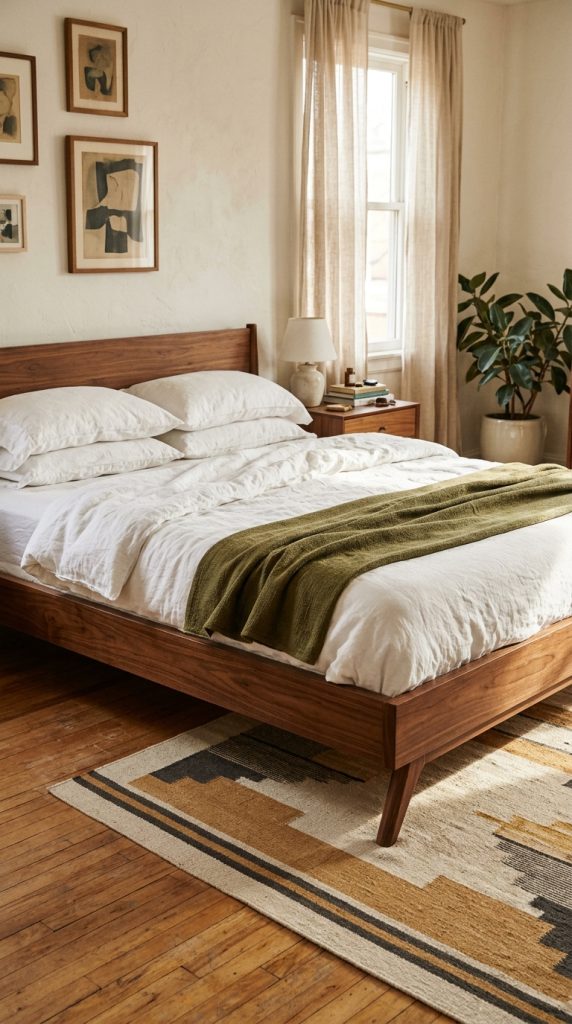
Genuine antiques, those over one hundred years old, require more care and often professional restoration. But the result is a depth of tone and a style of joinery that cannot be manufactured. They have a presence in a room that is felt immediately.
Furniture: Building the Rhythm
Beyond the bed, the furniture defines the period and sets the rhythm of the room.
The Dresser Is the Second Most Important Piece
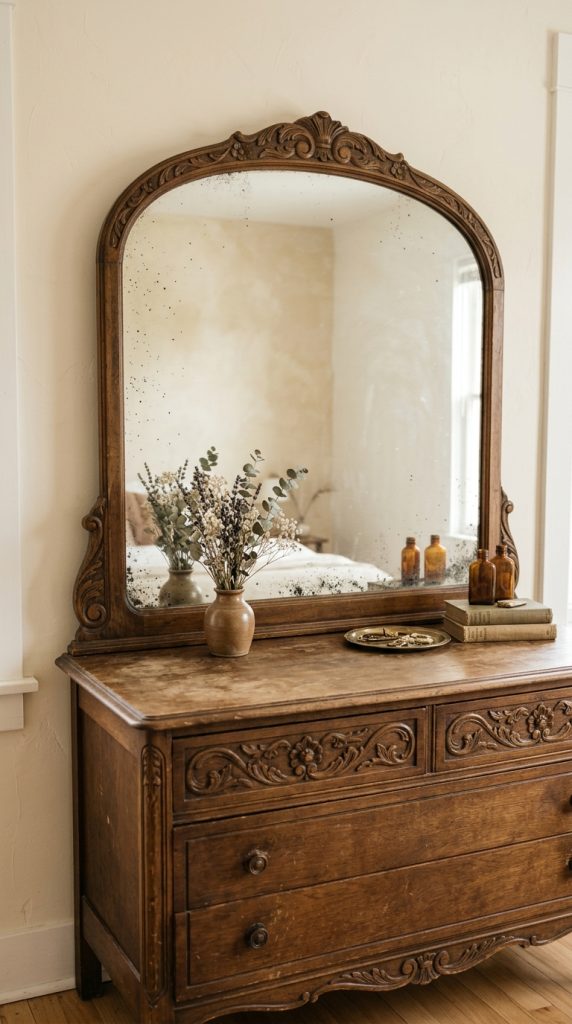
A vintage dresser in solid wood with period-appropriate hardware and deep drawers is both beautiful and functional. The vintage mirrored dresser is particularly striking. The mirror in these pieces is often slightly foxed (small dark spots in the silver backing), which is actually a sign of authenticity and beauty rather than a defect.
The Nightstand Should Have Substance
Antique night tables are different from the minimal surfaces of modern design. They have a drawer for storage, a lower shelf for books, and decorative detailing. They are substantial enough to hold a proper lamp and a stack of books without looking crowded.
The Wardrobe Is Architectural
A vintage wardrobe gives a bedroom an architectural quality that built-in closets lack. Victorian and Edwardian wardrobes are dark solid wood with carved pediments. French Provincial wardrobes are lighter, often painted soft white or cream with curved detailing. It divides the space, adds height, and creates a focal point.
Matching Sets vs. Individual Pieces
This is a genuine debate among vintage lovers. A matching antique bedroom set creates formal completeness. Individual pieces allow for personality. The best rooms often combine both. Start with a matching set as a foundation, then add individual vintage finds for depth.
Where to Source Your Vintage Pieces
The Secret Weapon: The Antique White Dresser
If there is one piece of furniture that deserves a spotlight, it is the antique white dresser. It sits at the intersection of almost every vintage style and works in rooms of any size.
An antique white dresser is typically solid wood painted in warm off-white or cream. The hardware is aged brass, antique bronze, or wrought iron (never chrome or nickel, which read too modern).
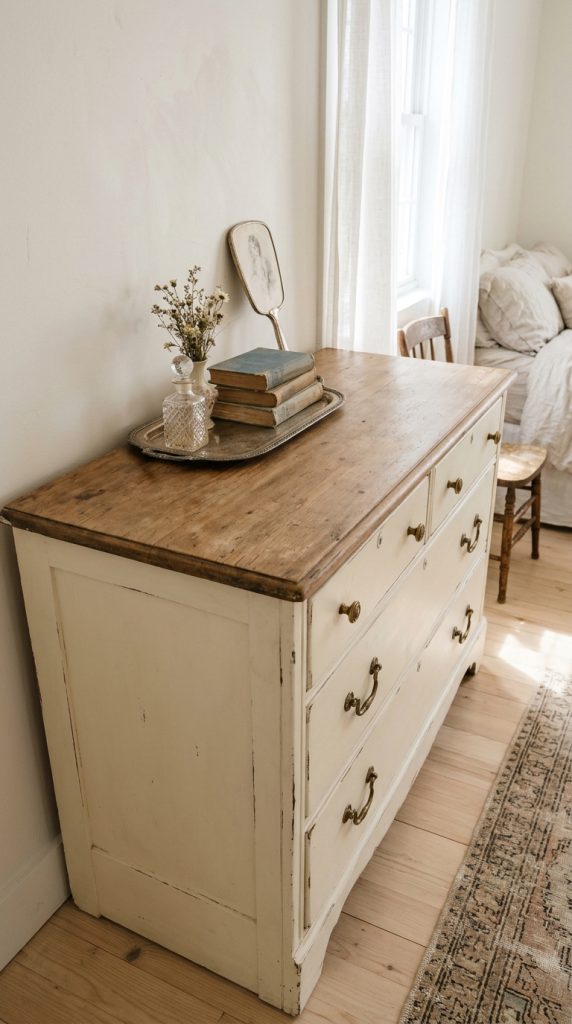
What makes it so powerful is its combination of lightness and substance. It is large enough to anchor a wall, but its pale color keeps it from dominating the room like a dark wood piece would. It reflects light, makes the room feel larger, and its painted finish ages beautifully, with chips and wear marks adding to its charm.
A 2025 study in Buildings journal (MDPI) on emotional design in interior spaces found that furniture plays a unique role in shaping how people feel. It was the only interior design factor significantly linked to both loneliness and emotional state simultaneously. The antique white dresser, with its warmth and historical character, is exactly the kind of piece that contributes positively to the emotional atmosphere of a room.
Dressing the Bed
A vintage bed frame is only as good as the bedding that dresses it.
Start with white as the foundation. Crisp white cotton sheets and a white linen or cotton duvet cover create a clean base that makes the decorative layers look intentional.
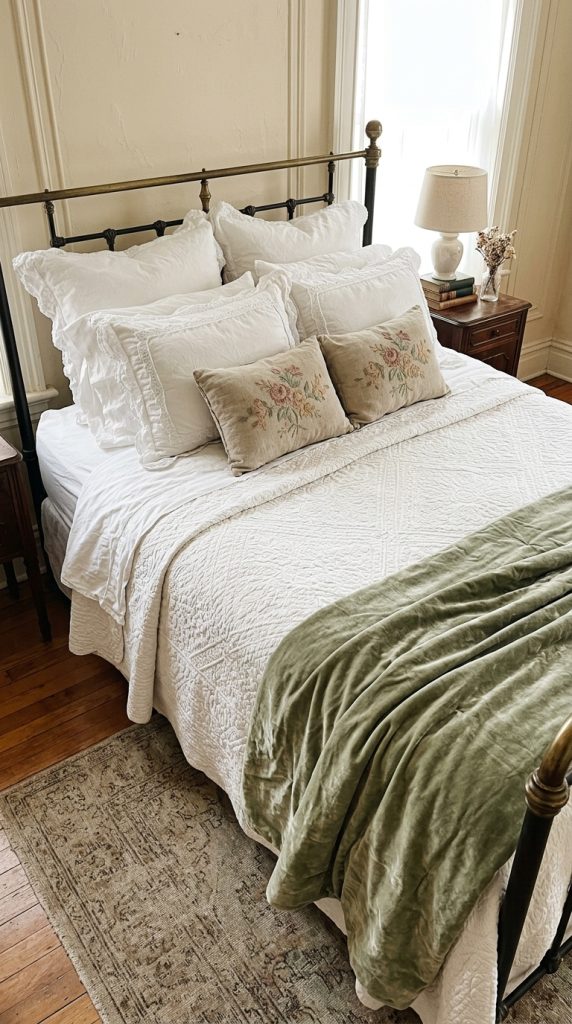
Above that, use a coverlet or quilt. A white cotton matelasse coverlet with a raised pattern is perfect for a Victorian or French Provincial room. A hand-stitched patchwork quilt works beautifully in an Arts and Crafts context.
The pillows should be generous and layered. White cotton shams at the back, European squares in front, and two or three decorative pillows in floral embroidery, vintage toile, or antique lace in the very front.
Finally, fold a throw at the foot of the bed. Aged velvet, vintage brocade, or hand-crocheted cotton laid across the foot adds depth and references the bedspreads of the Victorian era.
The Finishing Details
The final layer is where the room’s personality emerges. A 2026 study in Discover Environment (Springer Nature) on biophilic design found that natural materials and authentic objects create spaces with measurably greater restorative quality.
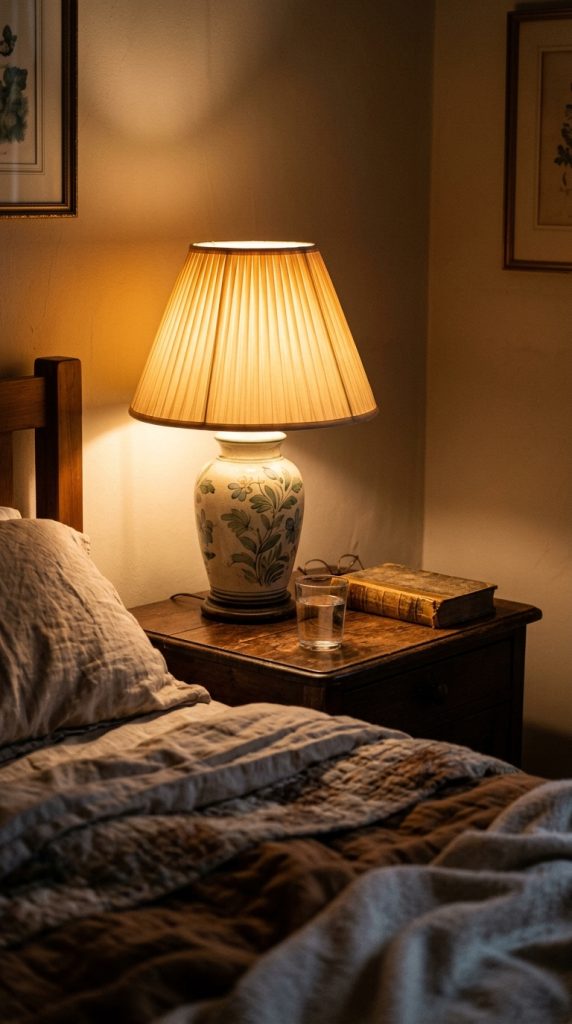
Lighting should be entirely warm and amber. Ceramic lamp bases, glass oil-lamp bases in amber or emerald green, and turned wooden bases. Shades should be white, cream, pleated silk, or aged linen. Overhead lighting should be a period pendant, like a glass globe or a pleated drum.
Rugs matter more here than in almost any other style. Oriental rugs in aged, faded tones for Victorian and Edwardian rooms. Soft Aubusson-style rugs in pale florals for French Provincial. Geometric flat-weave wools for mid-century. They should look like they have been on the floor for decades.
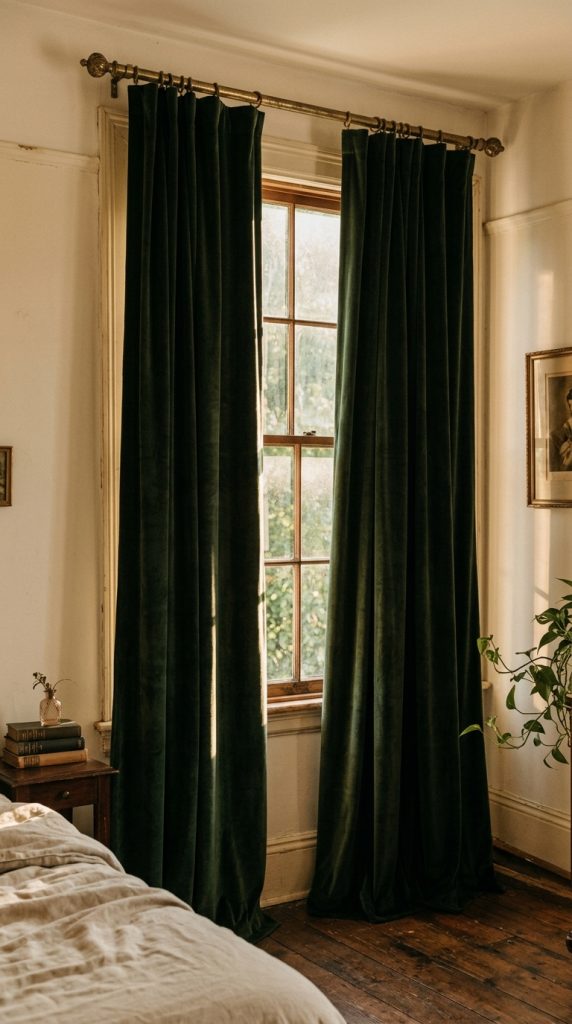
Curtains need to be heavy and floor-length. Velvet in deep jewel tones, cotton toile, aged linen. The curtain rod must be aged brass, wrought iron, or wood with turned finials. Never chrome.
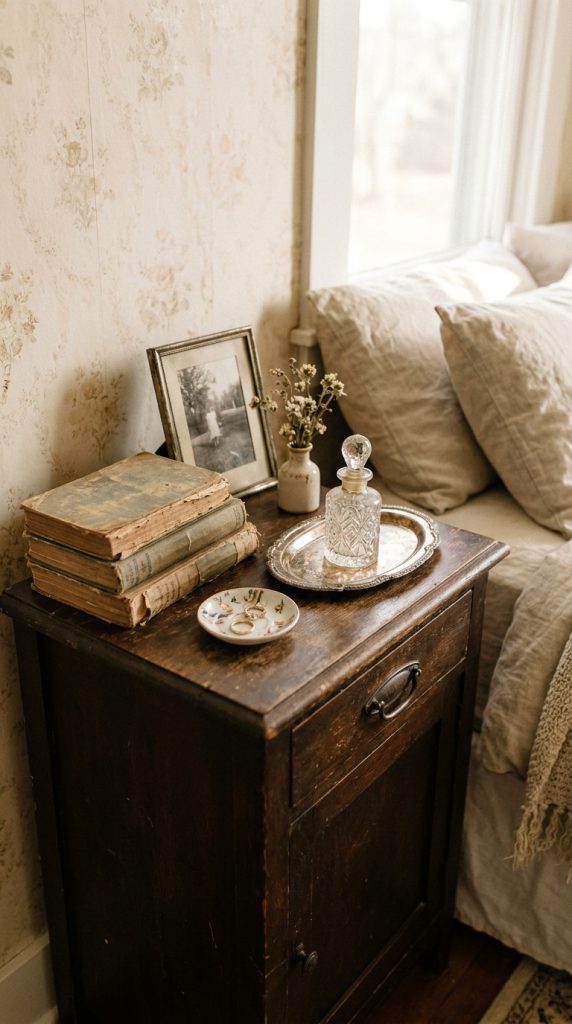
Books and objects are the evidence of a life lived in the room. A stack of old books with faded spines on the nightstand. A collection of small ceramics. A vintage perfume bottle on a silver tray. An old clock with a winding mechanism. These give the room its sense of accumulated time.
Vintage vs. Dated: The Final Test
There is a real difference between a room that looks vintage with intention and one that just looks old.
Pieces are chosen with intention.
Bedding is layered and generous.
Lighting is warm and considered.
Furniture was inherited with no plan.
Bedding ignores the furniture style.
Objects accumulated randomly.
The practical difference between the two is almost entirely a matter of understanding and intention. You do not need to spend more money. You need to spend more time looking, learning, and choosing.
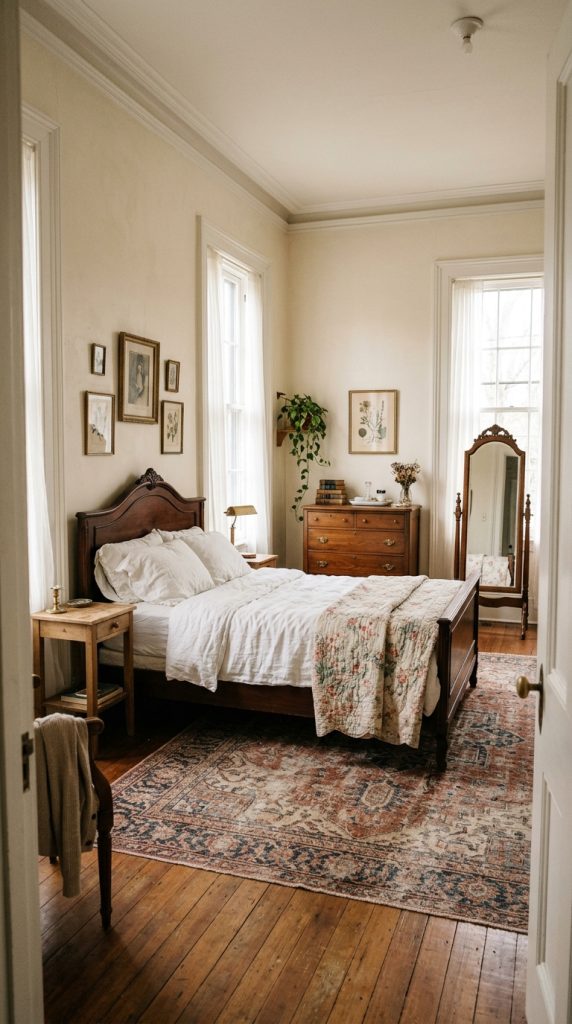
The reward is a room that feels unlike any other, improves with age, and gives you the psychological comfort of being surrounded by objects with real history and real character.
Frequently Asked Questions
How do I start a vintage bedroom if I have a tight budget?
Start with the bed frame, not the accessories. A good vintage or antique frame sets the whole character of the room, and everything else can be added slowly over time. Check estate sales, local auction houses, and online resale sites. A solid wooden frame that needs minor restoration is often cheaper than a new mass-produced one, and it will last far longer.
Can I mix vintage furniture with modern pieces?
Yes, and in most homes you probably should. A room built entirely from antique pieces can feel like a museum. Mixing one or two strong vintage anchors with modern bedding, contemporary lighting, or a clean white wall keeps the room livable. The key is to let the vintage pieces lead and keep the modern additions quiet.
What is the difference between vintage and antique?
In design terms, vintage usually refers to items at least twenty years old, while antique generally refers to items over one hundred years old. A 1970s dresser is vintage. A Victorian wardrobe is antique. Both work in a vintage bedroom, but antiques need more care and often more restoration.
A Room That Earns Its History
A vintage bedroom is not built in a weekend. That is the point. The rooms that feel genuinely settled are the ones that were assembled slowly, piece by piece, with a real understanding of what belongs and what does not.
You start with an era. You let the bed frame set the tone. You warm the walls, layer the bedding generously, and then you wait. The rest arrives over time, through estate sales and inherited pieces and the occasional lucky find.
And if the research is right, that patience is doing more than making the room look good. Surrounding yourself with objects that carry real history gives you something a showroom never can. A sense of continuity, of belonging, of a room that has a story and lets you be part of it.
Learn various other bedrooms details like industrial bedroom, costal bedroom, bedroom organization and many more on homefixtrends.