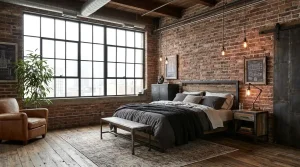
Getting ready in the morning should not feel like a battle against your own space.
But for most people, it does. The makeup is in three different drawers. The mirror has one light source that casts shadows in exactly the wrong direction. There is nowhere to sit that is actually the right height. Products crowd the edges of a surface that was never quite big enough to begin with.
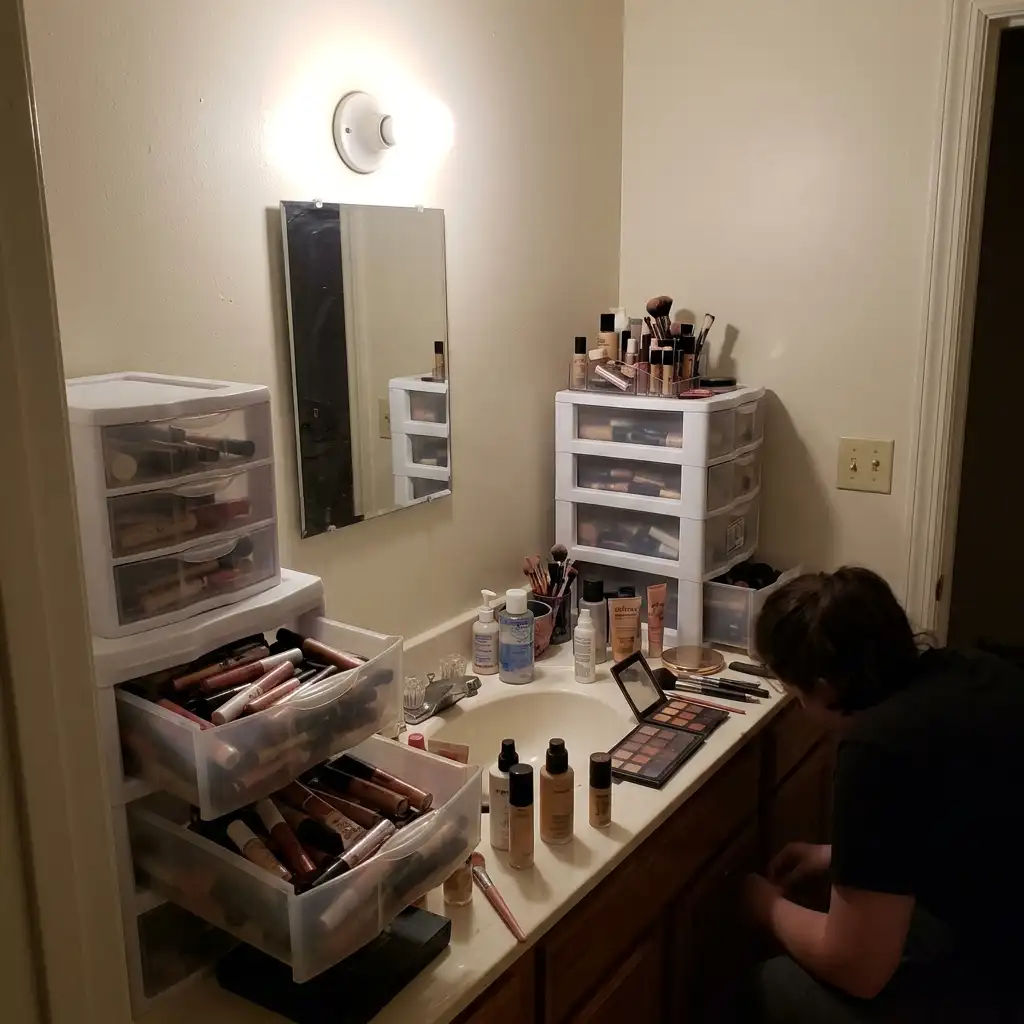
A vanity — a proper, well-designed vanity — solves all of this at once. And the range of what a vanity can look like, what it can cost, and where it can live in your home is considerably wider than most people realize when they start searching.

These are twenty-six of the best vanity ideas and designs worth knowing about, from the humble and practical to the genuinely spectacular.
1. The Classic Hollywood Vanity
Start here because it is where most people picture when they hear the word vanity. A wide surface, a large mirror surrounded by bare bulb lights, a cushioned stool, a drawer on each side. Old Hollywood glamour translated into a piece of furniture.
The Hollywood vanity works because it solves the lighting problem completely. Ring lights and face lights and window positioning are all attempts to replicate what bare bulbs around a mirror achieve naturally — even, flattering illumination from every angle simultaneously that makes applying makeup significantly easier and significantly more accurate.

If you buy or build one of these, the bulb temperature matters more than most people realize. Warm bulbs (2700K) create flattering light but can distort color accuracy when you are trying to match foundation or blend eyeshadow. Daylight bulbs (5000K-6000K) are more accurate for color but less flattering. A dimmer switch or bulbs around 3000K-3500K is a genuinely useful compromise.
2. The Floating Wall-Mounted Vanity
A vanity that mounts to the wall with no legs touching the floor does two things that legs-on-floor designs cannot: it makes the floor appear continuous and uninterrupted, which makes the room feel larger, and it puts the surface at exactly the height you choose rather than the height the manufacturer chose.

That second point matters more than people initially think. Standard vanity heights were designed around standing use. If you sit while doing your makeup — which most people find easier for detail work — the standard height is usually wrong. A wall-mounted vanity lets you set the surface at the height that actually works for you sitting on your specific stool.
These look best in modern and contemporary spaces. The clean line of wall and floor continuing beneath the floating surface has a distinctly architectural quality that suits minimalist interiors particularly well.
3. The Built-In Closet Vanity
This is the one I recommend most often to people who say they do not have room for a vanity.
Almost every bedroom has a closet. Almost every closet has more depth than it uses efficiently. Converting a section of the closet — or the entire closet if it is a walk-in — into a built-in vanity creates a dedicated getting-ready space that disappears completely when the closet door closes.
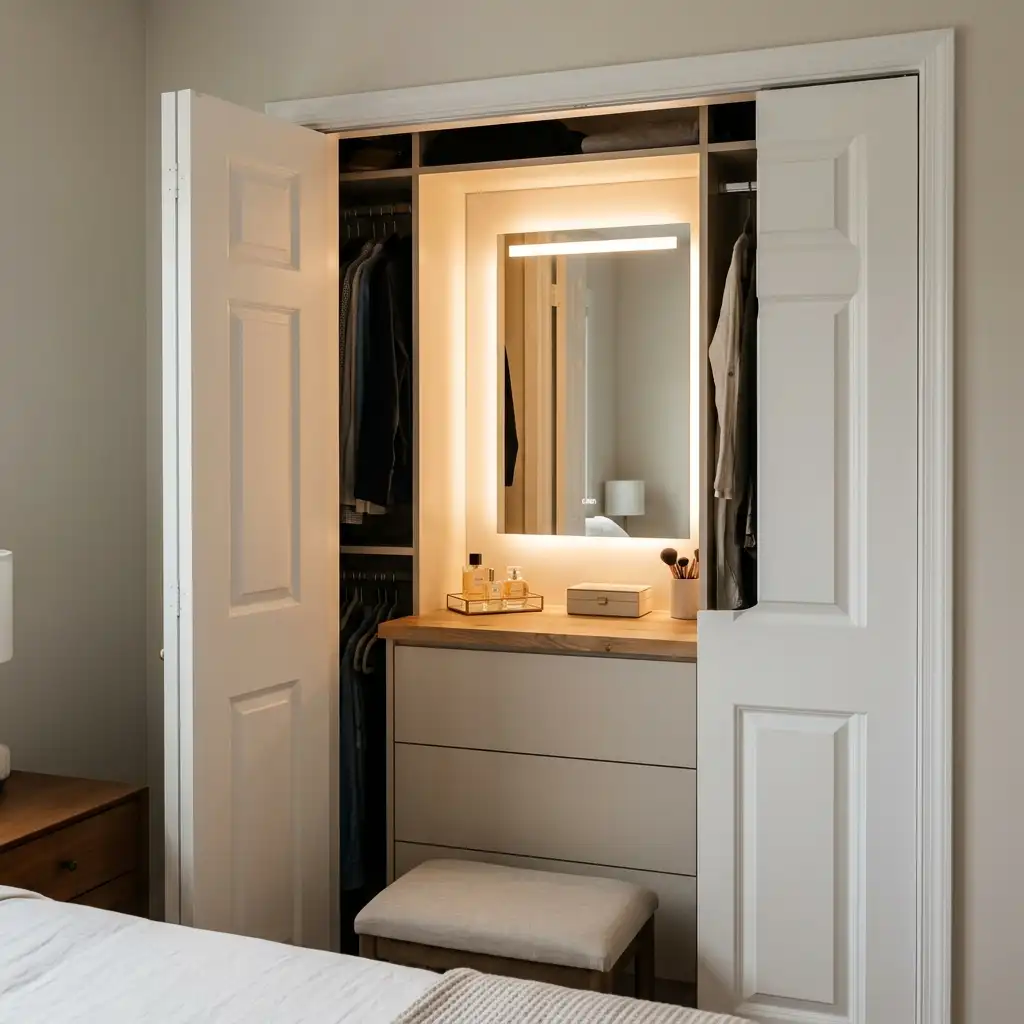
A shallow built-in vanity in a reach-in closet typically requires only 18 to 24 inches of depth. The surface, a mirror mounted on the back wall of the closet, lighting installed along the top or sides of the closet interior, and two or three drawers below — this is the complete setup. When you are not using it, close the closet door. The bedroom looks like a bedroom rather than a dressing room.
Walk-in closets offer considerably more options. A full vanity surface along one wall with a seating nook, mirrors to the ceiling, lighting designed specifically for the space, and all the drawer and cabinet storage you need is achievable within the footprint of most walk-in closets with no additional square footage required.
4. The Repurposed Antique Writing Desk
Here is the thing about buying a dedicated vanity from a furniture retailer: you are paying for a piece of furniture that was designed for a very specific purpose and is not particularly flexible for anything else. And the designs available at most price points are either basic to the point of being boring or ornate in the kind of way that dates quickly.
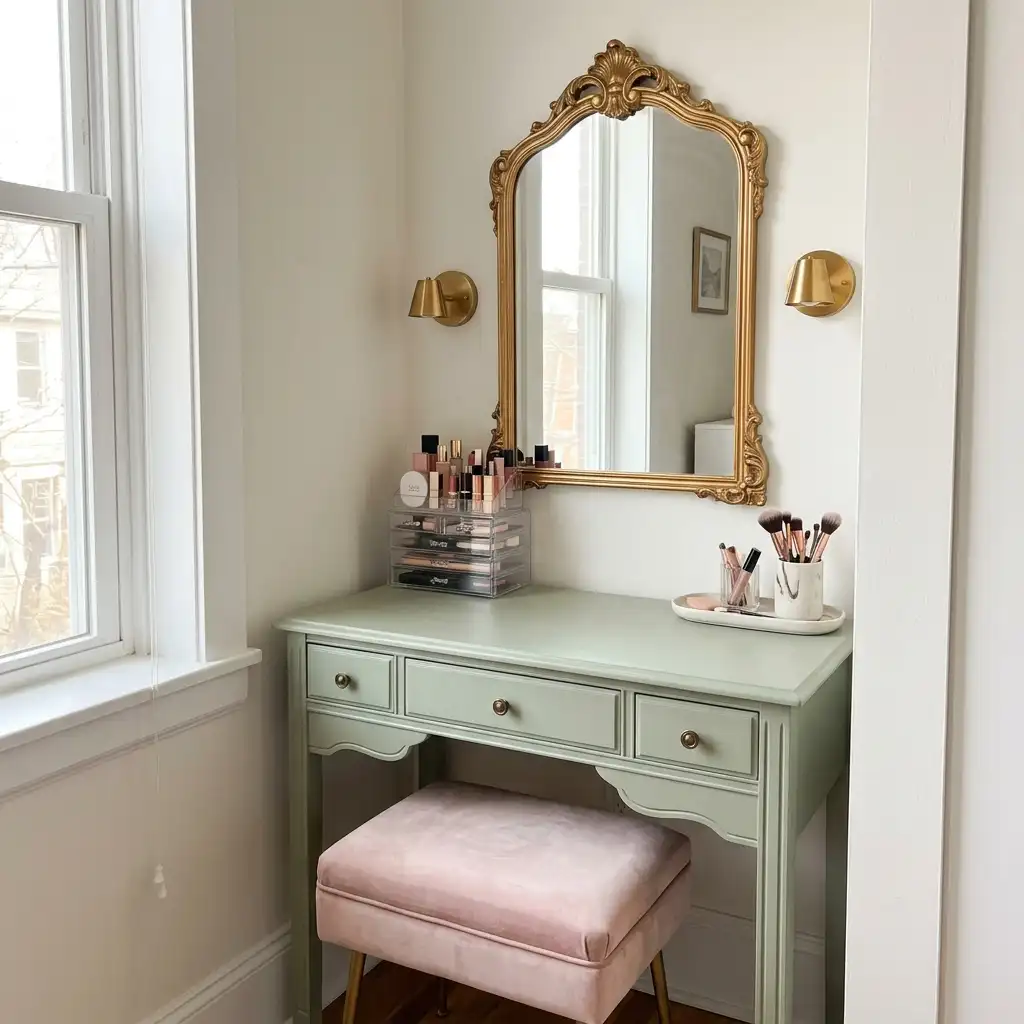
An antique writing desk converted to vanity use solves both problems simultaneously. The surface is usually at a good working height for seated use. The drawers hold products. The surface is typically substantial. And the piece itself has the specific beauty of furniture that was well-made at a time when furniture was expected to last for generations.
Add a mirror above it — either mounted to the wall or a freestanding mirror resting on the desk surface — and appropriate lighting, and you have a vanity that looks like it belongs in a beautiful room rather than a piece that has been inserted into one.
Specifically worth looking for: French provincial writing desks, mid-century modern secretary desks, Edwardian writing tables. All of these have proportions that translate beautifully to vanity use.
5. The Corner Vanity
Corners are the most underused real estate in any bedroom, and a corner vanity exploits them perfectly.
An L-shaped corner vanity wraps around the corner with one wing going each direction, creating considerably more surface area than a straight vanity in the same footprint. The corner itself — the section where the two wings meet — is ideal for the mirror, positioned so that light from two windows (if available) or two light sources can illuminate the face from an angle on both sides.
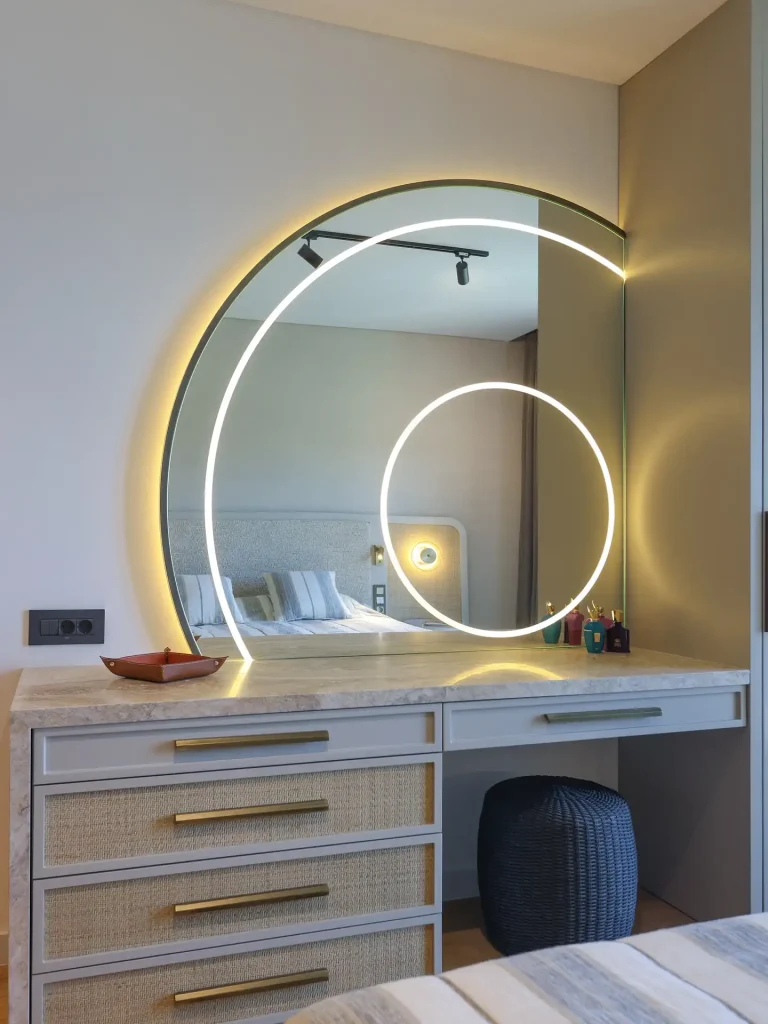
The challenge with corner vanities is the corner section itself. A mitered corner joint where the two surfaces meet requires more precise construction than a straight vanity. Some approaches use a small triangular corner piece. Some use a curved corner that rounds the transition. Both work; the curved corner is slightly more elegant but more expensive to build.
6. The Bathroom Vanity That Doubles as a Beauty Station
Many people do their makeup in the bathroom rather than in a separate vanity space, and many bathroom vanities are genuinely terrible for this purpose. The counter is too low, the mirror is above the sink rather than at face level, and the lighting is behind the head rather than in front of it.
Some targeted upgrades can turn a standard bathroom vanity into a genuinely functional beauty station without replacing the vanity itself.

The most impactful single change: add lighted strips along the sides of the mirror rather than relying on overhead bathroom lighting. A mirror with built-in side lighting, or adhesive LED lighting strips applied to the sides of an existing mirror, moves the light source to where it actually needs to be for accurate makeup application.
A counter-height stool that fits beneath the vanity surface creates a seated option without requiring the installation of a separate vanity. If the bathroom counter is too low for comfortable seated use, a raised platform or a separate mirror at a height that works for seated application resolves this without any construction.
7. The Mid-Century Modern Vanity
Clean lines, tapered legs, warm wood tones, simple hardware. The mid-century modern vanity is having a consistent moment in interior design and the reasons are not complicated: it suits an enormous range of interior styles, it is available at a wide range of price points, and the design is genuinely handsome rather than merely fashionable.

The defining details to look for: a surface in walnut, oak, or teak veneer with a warm finish. Tapered legs, usually in a slightly contrasting tone to the surface. Simple round or rectangular pulls in brass or aged brass. A mirror with a thin frame, either round or slightly rectangular with soft corners.
Mid-century vanities tend to have less drawer storage than more traditional designs, which matters if you have an extensive product collection. Consider the storage requirement honestly before committing to a design that prioritizes aesthetics over drawer count.
8. The Full-Length Mirror Vanity Setup
Not every vanity needs to be a piece of furniture with drawers and a stool. For people whose getting-ready routine is primarily about clothing and overall appearance rather than detailed makeup application, a well-positioned full-length mirror with a small shelf or ledge for daily essentials is a complete vanity setup.

A full-length mirror mounted on the wall at the right height, a small floating shelf at a comfortable standing height beside it for a few products, and a hook or two for bags and accessories creates a functional getting-ready zone that costs very little and takes up minimal floor space.
The positioning matters enormously. The mirror should be in a location where the lighting falls on your face rather than from behind. A wall between two windows is genuinely ideal — natural light from both sides illuminating you evenly as you face the mirror.
9. The Ikea Hack Vanity
The Ikea hack vanity deserves a proper mention because the results people achieve with it are genuinely impressive and the cost is genuinely accessible.
The Alex drawer unit — a narrow set of drawers with a smooth top surface — is the most commonly used base for Ikea vanity builds. Two of them placed side by side with a countertop piece spanning across the top creates a surface wider and more storage-rich than most purpose-built vanities at a fraction of the price.

The countertop is where the hack gets interesting. A piece of marble or quartz cut to the right width transforms the Ikea base into something that looks considerably more expensive and considerably more custom than the parts individually suggest. Butcher block works beautifully for a warmer look. A glass top adds lightness.
The mirror above is typically where people add their own character — Hollywood bulb mirrors, an ornate antique find, custom-made light strips around an existing mirror. The Ikea base is the structure; the mirror and lighting choices are the expression.
The result, done well, is a vanity that photographs beautifully, functions excellently, and cost a third or less of a comparable purpose-built piece.
10. The Farmhouse Vanity
Shiplap or beadboard backing. A surface in butcher block or whitewashed wood. Painted in white or soft cream. Mason jar organizers. A round mirror with a wood or black metal frame. Hardware in matte black or aged iron.
The farmhouse vanity is warm, accessible in cost, easy to build or to find at mid-price points, and suits the enormous range of homes that carry some version of the modern farmhouse aesthetic.

The challenge with farmhouse vanity design is avoiding the cliché version that looks like a checklist of farmhouse signifiers rather than a genuinely beautiful piece of furniture. The details that elevate it: quality of the wood surface, the specific proportion of the mirror relative to the surface below it, and the restraint to not over-accessorize what should ultimately be a functional working surface.
11. The Glamorous Maximalist Vanity
Some people have been waiting their whole lives for a vanity and when they finally get one, they want it to be unambiguous about its intentions.
The maximalist vanity does not pretend to be anything other than a dedicated space for beauty, pleasure, and the particular joy of getting ready in a room that takes the activity as seriously as you do.

Think: Hollywood mirror at considerable scale, large enough that your entire face and at least your shoulders are visible simultaneously. Surface in marble — real or convincing replica. Velvet stool in a jewel tone. Perfume bottles displayed as the decorative objects they genuinely are. A small tray for brushes and palettes. Fresh flowers in a low vase because why not.
If this sounds like too much: it is right for exactly the person it is right for. The maximalist vanity is not for everyone. For the person it suits, a room without one feels like something important is missing.
12. The Shared Vanity for Two
For couples who share a bathroom or dressing space and both need vanity access, the shared vanity design is worth thinking through specifically rather than just making one person’s ideal setup and asking the other person to fit in around it.
A wide surface — 60 inches or longer — with mirror sections for each person, organized storage on each side, and lighting that works from both positions creates a genuine shared vanity rather than two people competing for one setup.

The key design detail is keeping the two sides distinct even within a unified overall design. A slightly different mirror shape on each side, or different organizers, or even just different lighting positions, communicates that the surface belongs to two people rather than one person who has generously allowed the other to use it.
13. The Vanity in a Small Bedroom: Making It Work
The most common objection to installing a vanity is space. The bedroom is not large enough. There is no dedicated room. There is no corner that is not already used.
The honest response to this is that a vanity takes up less space than most people assume when it is designed specifically for a small room.

A narrow wall-mounted surface — 18 to 20 inches deep, 30 to 36 inches wide — provides a workable vanity surface in a genuinely compact footprint. Mount it at seated height. Use a folding stool that slides under the surface when not in use. Install a mirror directly above it on the wall. Add lighting on the sides or top of the mirror.
This setup can fit in a corner, along a wall between two pieces of furniture, or in a small alcove. The total wall width required can be as little as 3 feet. Most small bedrooms have 3 feet of usable wall somewhere.
14. The Professional-Level Lighted Mirror Vanity
If the mirror and the lighting are the working heart of any vanity, the most practical investment for someone who applies makeup regularly — especially professional makeup artists and those who wear makeup daily — is a professional-quality lighted mirror rather than a Hollywood-style surrounding light setup.
Large lighted mirrors with CRI (color rendering index) ratings above 90 are the standard in professional makeup artist setups. CRI above 90 means the light renders colors accurately enough that what you see in the mirror is very close to what you will see in natural daylight, which is the entire point when matching foundation or blending complexion products.

These mirrors are available in sizes from table-top to full-wall and at price points from surprisingly accessible to considerable. For daily makeup users, the improvement in the quality and accuracy of application that comes from good CRI lighting is immediate and significant.
15. The Vanity Table With Skirt
There is a specific type of vanity table — surface, turned legs, and a fabric skirt around the base that hides the legs and creates a full-length draped effect — that appears in French country and cottage-style interiors and photographs beautifully while serving a practical purpose.
The skirt provides closed storage for products, tools, and supplies that do not need to be accessible at arm’s reach during use. Everything can be kept in small baskets or bins beneath the skirted table, invisible and organized, while the surface itself remains clear.

The fabric choices matter considerably for how the finished piece reads. A toile print skirt creates a very French country effect. White linen reads as coastal or Hamptons-adjacent. A pattern in house colors or a solid in a complementary tone can make the skirted vanity feel like a custom piece that was designed specifically for the room.
16. The Standing Vanity for No-Stool Households
Not everyone wants to sit while getting ready. Many people’s routines happen primarily standing up, and designing a vanity for standing use rather than trying to make a seated-height vanity work for a standing person produces significantly better results.

A standing vanity surface sits at approximately 36 inches from the floor — the same height as a standard kitchen counter. The mirror should be positioned slightly lower than a seated-use mirror to accommodate the different eye level. Lighting should be at face height when standing.
A standing vanity is also better suited to quick routines. If getting ready means a few minutes in front of the mirror rather than a detailed makeup application, a standing surface with good lighting and accessible storage for a small number of daily products is a more efficient setup than a full seated vanity.
17. The Trifold Mirror Vanity
The trifold mirror — three panels hinged together, the outer two angling in toward the center — allows you to see the sides and back of your head simultaneously, which is useful for hair styling in a way that a flat single mirror is not.
Antique trifold vanity sets often came with a matching dresser and a small adjustable stool at a height specifically designed for the mirror. These sets, when found in good condition, are beautifully proportioned pieces of furniture that work extremely well for their intended purpose.

Modern trifold mirrors are available in freestanding and tabletop versions. The tabletop version placed on a surface of appropriate height creates a functional trifold vanity without requiring a matched set — the mirror can be used on an existing dresser, a desk, or any surface at the right height.
18. The Vanity With Exceptional Drawer Organization
The drawer situation inside a vanity is where the difference between a frustrating vanity and a genuinely functional one lives. A beautiful surface and a gorgeous mirror mean nothing if every getting-ready session starts with fishing through a disorganized drawer for the lip liner.

Velvet-lined drawer organizers — small compartments of varying sizes that keep individual products in dedicated spots — are the standard solution and they work extremely well when the compartment sizes are matched to the actual products being stored. Most drawer organizer sets come with interchangeable sections specifically for this reason.
The organizing logic that makes the most sense: the drawer closest to the dominant hand holds the products used most frequently in the daily routine. Everything you reach for every morning lives in that drawer, organized so that each item is visible and reachable without moving anything else.
Less frequently used products go in lower drawers or in the closed storage below the surface. Special occasion products, seasonal items, and backup stock go in the least accessible storage. The surface itself holds only the items used that specific morning.
19. The Bedroom Vanity Nook
When the bedroom has an alcove, a recess, a chimney breast with space on either side, or any architectural feature that creates a sheltered section of wall, a vanity nook built into that space is almost always more beautiful than a freestanding vanity placed against an unbroken wall.
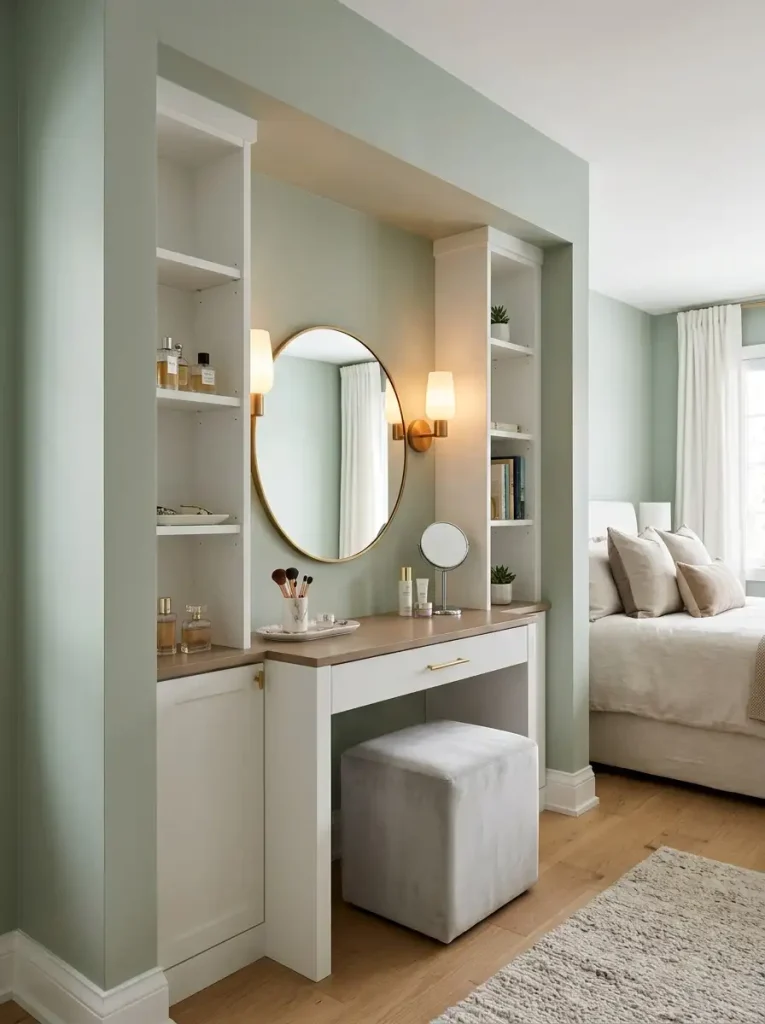
The nook creates a sense of enclosure that a freestanding vanity lacks. It feels more private, more dedicated, more intentional. The walls of the nook can be used for shelving on either side of the mirror, for lighting along the sides, for a small cabinet above. The nook becomes a complete zone within the room rather than a piece of furniture that has been placed in it.
Built-in nook vanities are the most expensive version of any vanity because they involve custom construction. But the result is consistently the most satisfying — the room looks like it was designed for the person who lives in it rather than furnished from available options.
20. The Minimalist Vanity
For the person whose getting-ready routine is efficient, whose product collection is small, and whose aesthetic tends toward the simple and the uncluttered, the minimalist vanity is genuinely the right choice and it is a significant mistake to try to create the maximalist version just because it photographs better.
A clean surface — stone, lacquered wood, or matte white — with a frameless or thin-framed mirror, integrated or recessed lighting, and two or three shallow drawers for a modest product collection. Nothing on the surface except what is used that day. Everything else stored away.

The challenge with minimalist vanities is the discipline required to maintain them. A minimalist vanity that has accumulated product bottles, Q-tip containers, stray brushes, and three items that do not belong there is no longer a minimalist vanity. The design intention requires a commitment to putting things away that some people find natural and some people find difficult.
21. The DIY Pipe and Wood Vanity
The industrial aesthetic has reliable appeal in home interiors, and a pipe-and-wood vanity — a surface of reclaimed or raw wood supported on black iron pipe legs — captures this look at a cost that beats almost any purpose-built vanity option.
Black iron pipe fittings and flanges are available at hardware stores. A section of reclaimed wood, sanded smooth and sealed, creates the surface. A pipe frame assembled from standard plumbing fittings supports the surface at seated or standing height. The result is distinctive, genuinely handsome in the right interior context, and achievable over a single weekend with basic tools.

A round black iron mirror above it and a pendant light or Edison bulb on a cord as task lighting complete the setup. This vanity reads as intentional and creative rather than budget-constrained, which is one of the more useful qualities any DIY piece can have.
22. The Vintage Dresser Converted to Vanity
Similar in principle to the antique writing desk but different in practice. A vintage dresser — one of those solid, wide, four-or-five-drawer pieces that turns up at estate sales and thrift stores regularly — converted to vanity use provides more storage than almost any purpose-built vanity at a fraction of the cost.
The conversion is minimal: add a mirror above it (mounted to the wall or standing on the surface), improve the lighting situation, and organize the top two drawers for makeup and daily products. Everything else was already there — the surface, the storage, the drawer pulls.

What you get: a piece with genuine history and character, considerably more drawer space than a standard vanity, and a surface at a usable height. What you sometimes give up: the specific height or proportion that would be ideal. Most vintage dressers are slightly higher than an ideal seated-use vanity, which a slightly higher stool can compensate for.
23. The Vanity With Charging and Technology Integration
The modern getting-ready routine involves a phone for music, a tablet or laptop for watching something, possibly a hair tool that needs a nearby outlet, and a device for tracking routines or following tutorials. None of this was considered in vanity designs from twenty years ago.

A vanity with integrated charging solves the wire situation that otherwise creates clutter on what should be a clean surface. USB charging ports built into the surface or into a drawer. A discreet cable management channel running down the back of the unit to a power strip below. A small recessed area in the surface where a phone can rest face-up while charging, positioned where it is visible without being in the way.
These features can be added to existing vanities with retrofit charging kits. They are increasingly available as standard features on new vanity purchases at mid-price points and above.
24. The Outdoor-Inspired Natural Vanity
This is a direction in vanity design that I find genuinely beautiful and relatively uncommon: a vanity that references natural materials and outdoor aesthetics rather than the traditional bedroom or bathroom contexts.
A surface in live-edge wood — the irregular natural edge preserved rather than cut straight — has a quality that manufactured surfaces cannot replicate. Each piece is unique. The material itself is the design. A round mirror in a thin metal frame above it. Woven rattan baskets on a small shelf below for organized storage. A ceramic or terracotta container for brush storage on the surface.

The aesthetic works particularly well in rooms that have other natural material references — rattan, linen, wood floors, plants. It creates a vanity that reads as part of the room’s design language rather than a separate piece with its own separate aesthetic.
25. The Children’s and Teen Vanity
Two distinct categories that are often incorrectly conflated.
A children’s vanity — for young children learning about grooming and getting themselves ready independently — should be small, low, durable, and simple. A small surface at the child’s height, a mirror they can see themselves in, one or two drawers for their things. It should look like it was designed for them rather than a smaller version of an adult piece. Many children’s vanities are painted in soft colors, have rounded rather than sharp corners, and include a small stool at exactly the right height.
A teenager’s vanity is a completely different proposition. A teenager’s vanity is often the first piece of furniture that is genuinely theirs — chosen to reflect their own aesthetic rather than the aesthetic of the adults who designed the rest of the room. It should take that seriously. Give a teenager genuine choice about the design. A Hollywood-glam teenager and a minimalist teenager need completely different vanities, and both deserve to have a vanity that feels like it belongs to them specifically.
26. The Vanity That Grows With You
The last and perhaps the most practically useful vanity idea is not a specific design or aesthetic direction but a principle: design the vanity for the life you actually have rather than the life you imagine having, and make it adaptable enough to change as your routine and your space change.
The vanity that is too small for your current routine because you bought the smaller version for a theoretical future when you would use less product — this is a frustrating vanity to own. The vanity that is correct for today’s routine and has enough storage to grow with you is the one that earns the space it takes in the room.
Think about it practically. How many products do you actually use daily? Weekly? Occasionally? What is the longest amount of time you realistically spend getting ready on a regular day, and what is the most you spend on an occasion that matters? Does your getting-ready routine include hair styling, nail care, skincare, full makeup application, or some combination?
The answers to these questions tell you the surface size you need, the storage capacity you need, the lighting quality you need, and the stool or no-stool decision. Design around the real answers rather than the idealized ones, and build in a little extra capacity for where the routine goes next, and the vanity you end up with is the one you will use happily for years rather than the one you will want to replace in eighteen months.
A Few Things Worth Knowing Before You Commit
Height matters. Standard seated-use vanity surfaces are typically 28 to 32 inches from the floor. Standard standing-use is 34 to 36 inches. If you have a vanity that is the wrong height for how you use it, no amount of good lighting or storage will fully compensate.
The stool or chair is not an afterthought. It should be chosen alongside the vanity rather than after. The seat height should allow your forearms to rest comfortably on the vanity surface with your shoulders relaxed. Too low and you hunch. Too high and your shoulders rise. The wrong stool makes the right vanity frustrating to use.
Storage capacity is almost always underestimated. Whatever drawer space you think you need, add one more drawer. Products accumulate. Routines expand. The vanity that has more storage than you currently need is significantly better than the one you will outgrow in two years.
Good lighting is not negotiable. A beautiful vanity with poor lighting is still a bad getting-ready experience. Prioritize the lighting solution even if it means a slightly simpler surface or less elaborate mirror. The light quality determines whether the vanity is actually usable or merely decorative.
The right vanity for your space, your routine, and your aesthetic is out there. These twenty-six directions are a starting point, not a prescription. Use what resonates, ignore what does not, and design something that makes the part of your day that happens in front of that mirror genuinely good.
If you are designing a complete dressing space, our guide on linen closet organization covers the storage principles that apply beautifully to a closet-adjacent vanity setup, and our piece on bathroom counter decor has ideas for the products and accessories that make any vanity surface look intentional.