
The question I kept asking myself was: what actually makes a room Nancy Meyers? And more importantly — can an ordinary person with an ordinary budget in an ordinary house actually achieve it?
The answer, I am happy to tell you, is yes. Mostly. With caveats. Read on.
What the Nancy Meyers Aesthetic Actually Is (It Is More Specific Than You Think)
Here is where most attempts to recreate this look go wrong: they confuse “all white” with “Nancy Meyers.” They paint the walls white, buy a white duvet, add some white pillows, and wonder why the room looks sterile rather than dreamy.
The Nancy Meyers bedroom is not white. It is warm. There is a meaningful difference.

Look closely at the bedrooms in her films. The walls are not bright white. They are warm whites — creamy, soft, with slightly yellowed or sandy undertones that photograph beautifully in natural light. The same quality of warm whiteness that you see in old French farmhouses and New England beach cottages and the kind of rooms that appear in American magazines from the 1990s that everyone’s mothers had stacked in bathroom baskets.
The wood is not dark and heavy. It is pale and aged — the kind of wood that has been worn smooth by decades of use, or that was chosen specifically because it looked like it had. Bleached oak. Driftwood grey. Honey-toned pine that has been left unstained and simply sealed.
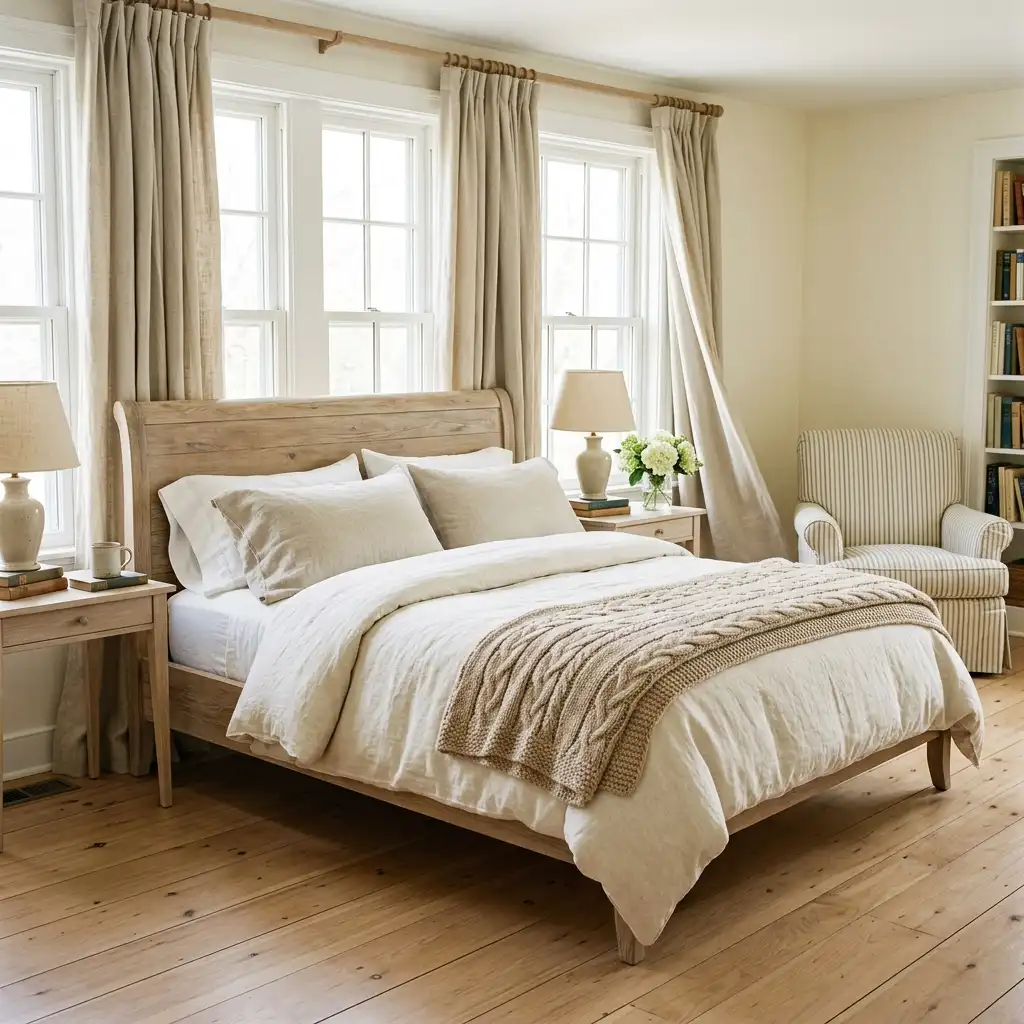
The fabrics are natural and they have weight. The linen curtains are not cheap sheer panels — they are thick enough to have real drape, to move slowly in a breeze rather than floating. The duvet is filled with actual goose down. The throw blanket at the foot of the bed is cashmere or chunky cotton or something that you would genuinely want to wrap around yourself at 6 AM on a January morning.
And here is the thing nobody says directly but that accounts for so much of why the rooms look the way they do: everything in a Nancy Meyers set is slightly oversized. The sofas are deeper than normal sofas. The beds have more pillows than beds need. The bathtubs are larger than standard bathtubs. The kitchen islands are wide enough to sit across from each other and still have room for a cutting board and a bowl of fruit in the middle.
Scale is the secret nobody talks about. Generosity of scale is what makes the rooms feel luxurious rather than merely decorated.
The Bed: Where This Aesthetic Lives or Dies
I am going to spend more time on the bed than on anything else because I think the bed is where most people either nail the Nancy Meyers bedroom or completely lose it.
The bed frame itself should be either upholstered in a neutral linen or cotton, or made of aged/pale natural wood. Not dark walnut. Not black iron. Not anything that photographs as a heavy, dominant, dark object in the frame of the room. The bed should feel like it is floating in the room slightly — present but not dominating.

Upholstered beds in warm white, oatmeal, or natural linen with a simple tufted or channel-stitched headboard are the closest you can get to the actual Nancy Meyers visual. The headboard should be tall — taller than standard. In Amanda’s cottage bedroom in The Holiday, the headboard rises substantially above the sleeping surface. It creates a sense of enclosure around the pillows that makes the bed look like a destination rather than just a piece of furniture.
If an upholstered bed is not in the budget or not your preference, a natural wood bed frame in a pale finish — white oak, natural ash, washed pine — works beautifully. The key is that the wood reads as light and warm rather than heavy.
The bedding is everything. This is where I will be direct with you: cheap bedding ruins this look completely. It is the one area where spending the money makes an objective, visible difference.
What you are looking for is a white or warm-off-white duvet cover in 100% linen or high-thread-count cotton. Linen is the more typically Nancy Meyers of the two — the slight texture of linen, the way it drapes and wrinkles slightly (which is part of the aesthetic, not a flaw), the way it gets softer with every wash — all of this contributes to a bed that looks like it has been slept in by someone who has excellent taste and also excellent sleep.

The pillow situation in a Nancy Meyers bed tends toward abundance. There are typically two to four sleeping pillows in standard or Euro sizes behind two or three decorative pillows, and possibly a bolster or a lumbar pillow in front. The arrangement looks plentiful without looking obsessively fluffed and arranged. It looks like someone made the bed thoughtfully but did not do it in a hotel concierge’s approach to pillow geometry.
A throw at the foot of the bed is non-negotiable. Chunky knit, cashmere, waffle cotton — something with real texture that is casually folded rather than precisely positioned. The throw communicates that this bed is for actually being in, not just for looking at.

The Color Palette: Specifically and Exactly
Because I think this is the single most useful thing I can give you, I am going to be very specific.
The Nancy Meyers bedroom palette is built from a very particular group of neutrals:
Walls: Warm whites in the Benjamin Moore White Dove / Swiss Coffee / Antique White range. Or, for a slightly earthier reading, something like Sherwin-Williams Navajo White or Accessible Beige. The key is warm undertone. Yellow or pink undertone, not grey or blue.
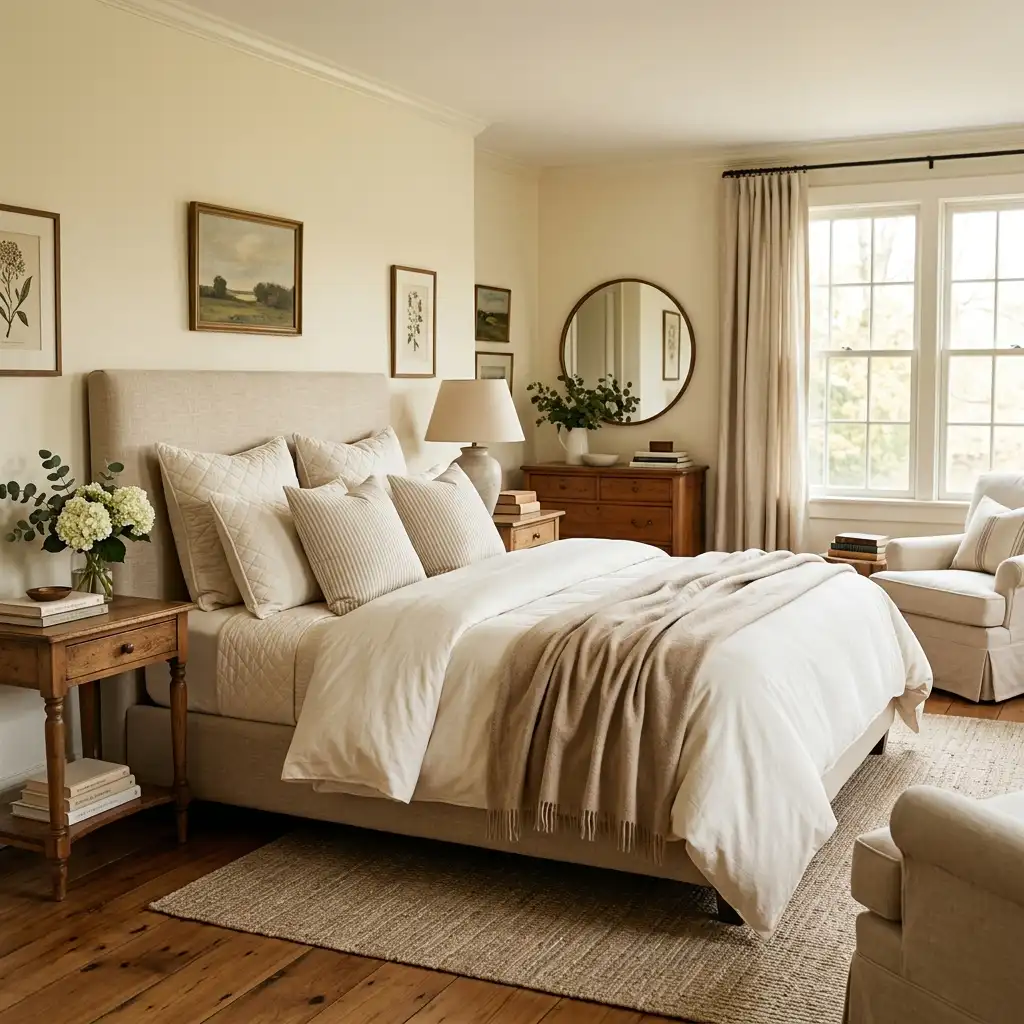
Trim and ceilings: Brighter white than the walls, which creates the light-catching, crisp-edge quality that makes the rooms feel fresh rather than yellowed. Standard white trim against warm-white walls is a very specific combination that I think accounts for more of the look than people realize.
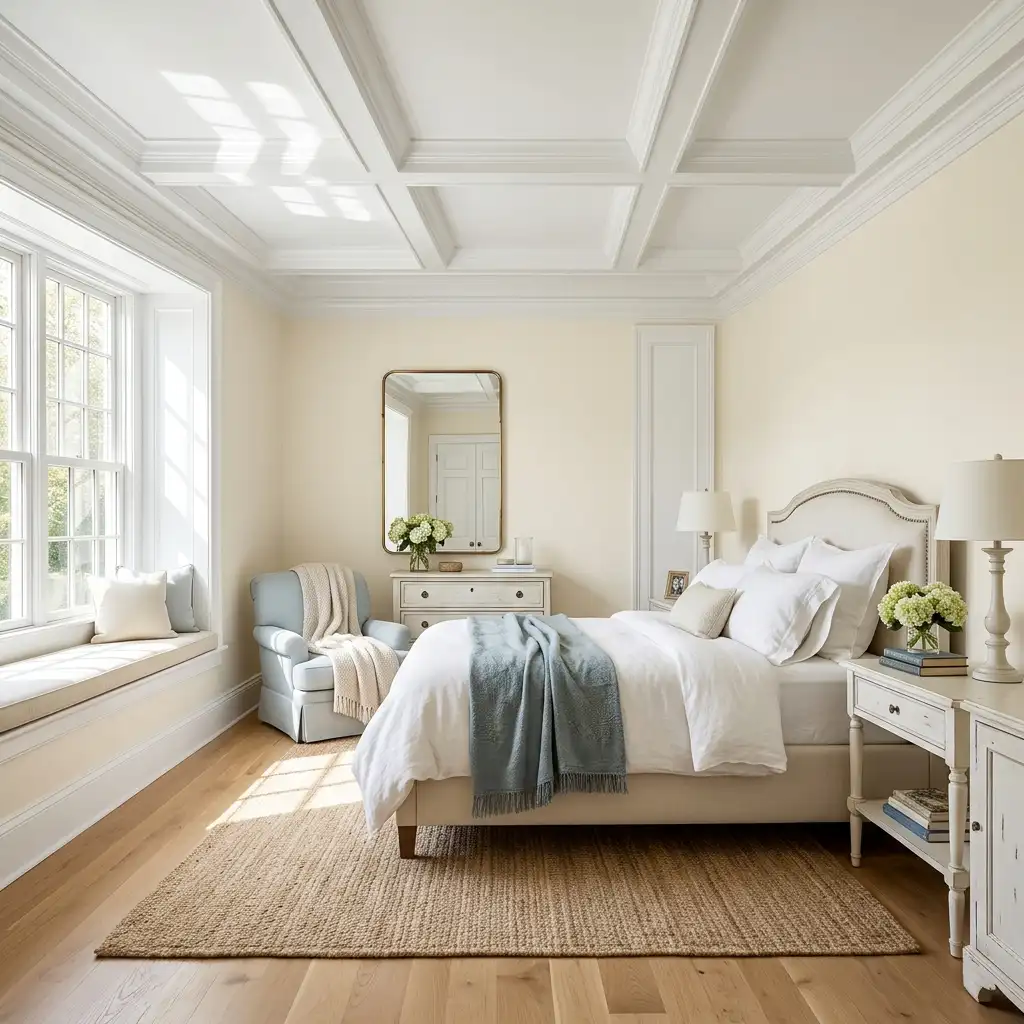
Wood tones: Pale honey, driftwood grey, whitewashed finishes, or natural unstained oak. Stay away from anything in the walnut-to-mahogany range. The wood should read as light and organic, not dark and formal.

Textiles: All warm neutrals — cream, oatmeal, flax, warm taupe, soft greige. A very muted sage or a barely-there dusty blue can work as an accent, but only if they read as almost-neutral in context. Nothing vibrant. Nothing saturated. Nothing that would look wrong in afternoon light streaming through white-curtained windows.
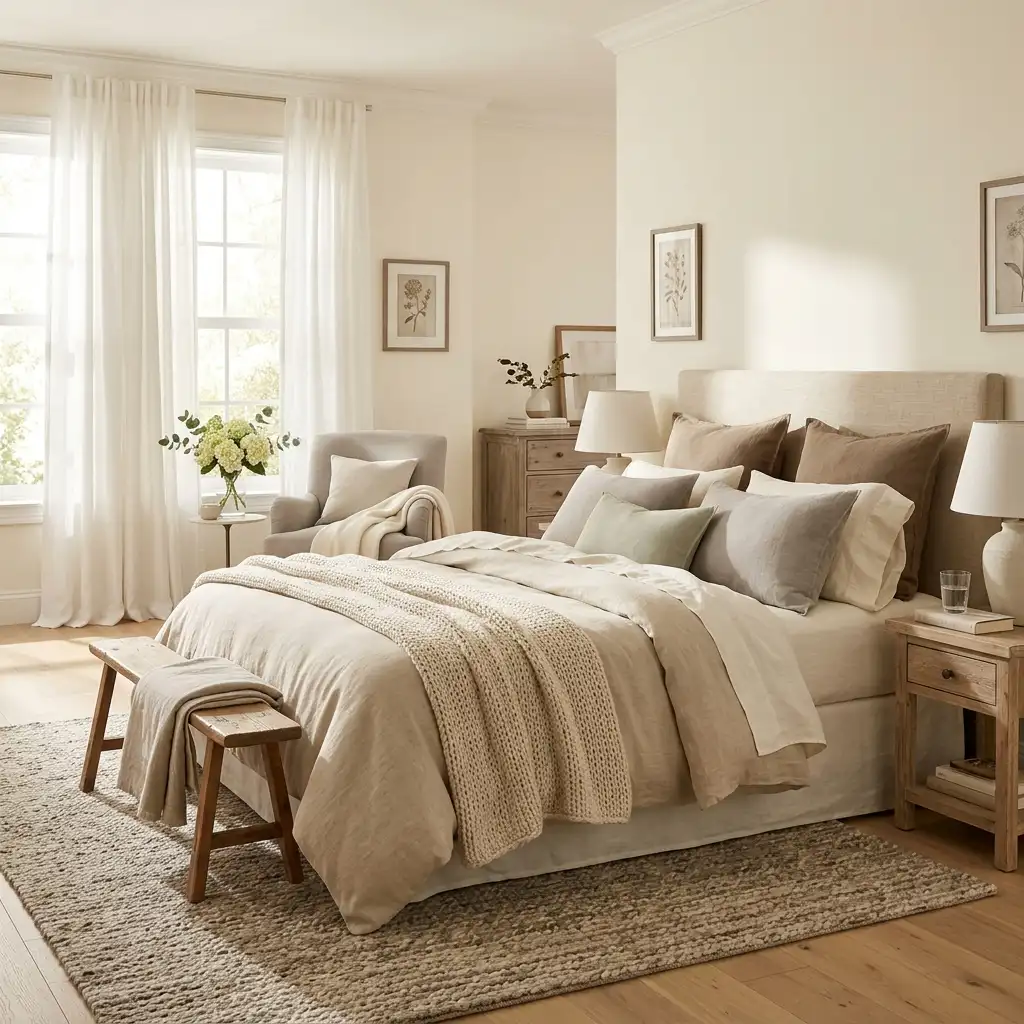
Metals: Aged brass or brushed gold, warm silver (not cool chrome), matte black used sparingly. The hardware on bedside tables and dressers, the curtain rod, the lamp base — these should all sit in the warm metal range.

The Curtains: Get These Right and Half the Work Is Done
Curtains in a Nancy Meyers bedroom do two things simultaneously: they filter and soften the incoming natural light, and they add significant visual height and warmth to the room.
They should be floor-length. Not almost-to-the-floor. Not hovering an inch above the floor. Either exactly touching the floor or pooling slightly on the floor. Curtains that end an inch above the floor look like a mistake in this aesthetic context even when that is technically the correct length recommendation for curtains that are easy to open and close.

They should hang from as high as possible. Mount the curtain rod at ceiling height or as close to it as the architecture allows. Not at the window frame. Not a few inches above the window frame. At the ceiling, or close enough that the distinction does not matter. This makes every room look taller than it is and creates the enveloping, high-ceilinged quality that Nancy Meyers sets consistently have.

The fabric should have weight and texture. Linen is the canonical choice. Belgian linen, pre-washed so it has that slightly rumpled, deeply lived-in quality. If linen is too expensive for the window count, a linen-look fabric in cotton or cotton-blend works well — the texture read from across the room is similar enough. What does not work is anything sheer, lightweight, or with a shiny finish.

The color should be the same family as the walls. Warm white, cream, oat, flax. The curtains should feel like a continuation of the wall, not a contrast to it. This is what creates the sense that the windows are part of the room architecture rather than a decorative element applied to it.
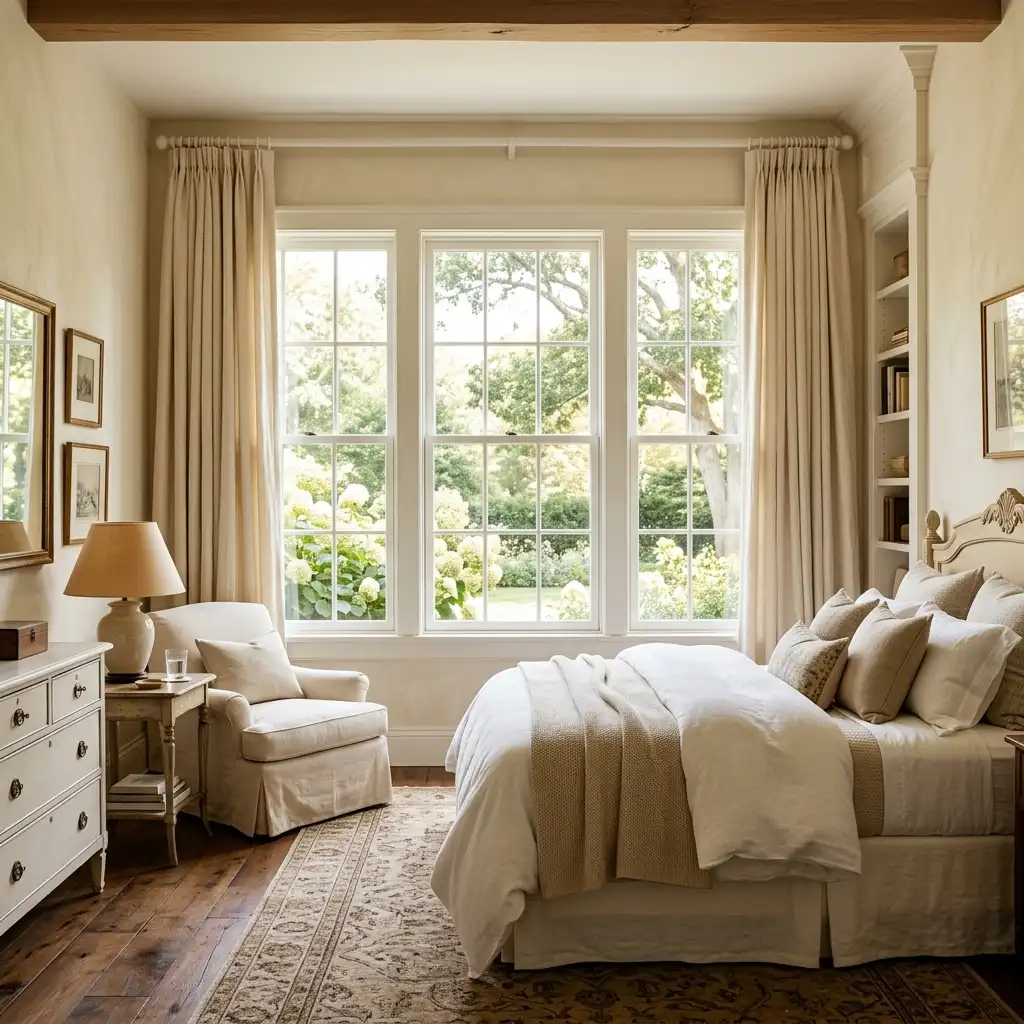
One small detail that matters: curtain rings in aged brass or matte gold. The hardware on the curtain rod is visible at eye level and the warm metal reads much better than chrome or nickel in this aesthetic context.
Furniture: Fewer Pieces, Better Quality, Slightly Larger Scale
Nancy Meyers sets are not minimalist. But they are not cluttered either. They hit a specific middle ground that I would describe as spacious abundance — there is clearly enough furniture in the room to support a real life, but each piece has room to breathe around it.
The rule I apply: fewer pieces than you think you need, each one slightly larger than the standard version, and always in a light wood or linen upholstery.
Bedside tables should be substantive — not flimsy, not the kind that tips if you lean a book against them. A small dresser repurposed as a bedside table works beautifully and gives you considerably more surface and drawer space than a standard bedside table. The surface should be large enough for a lamp, a glass of water, a book, and something decorative without looking jammed.

A dresser or chest of drawers in aged or painted wood. Light in color. Wide drawers rather than many small drawers. A simple mirror above it, round or slightly arched — not an ornate frame, not a frameless rectangle, but something with a warm edge that reads as slightly found-and-beautiful rather than purchased-new.

A reading chair if the room size allows. A linen-upholstered armchair in warm neutral fabric positioned near the window. This is one of the most Nancy Meyers things you can put in a bedroom and it costs considerably less than the bed in terms of total investment. An estate sale armchair recovered in oatmeal linen can look as good as something purchased new at significant expense.
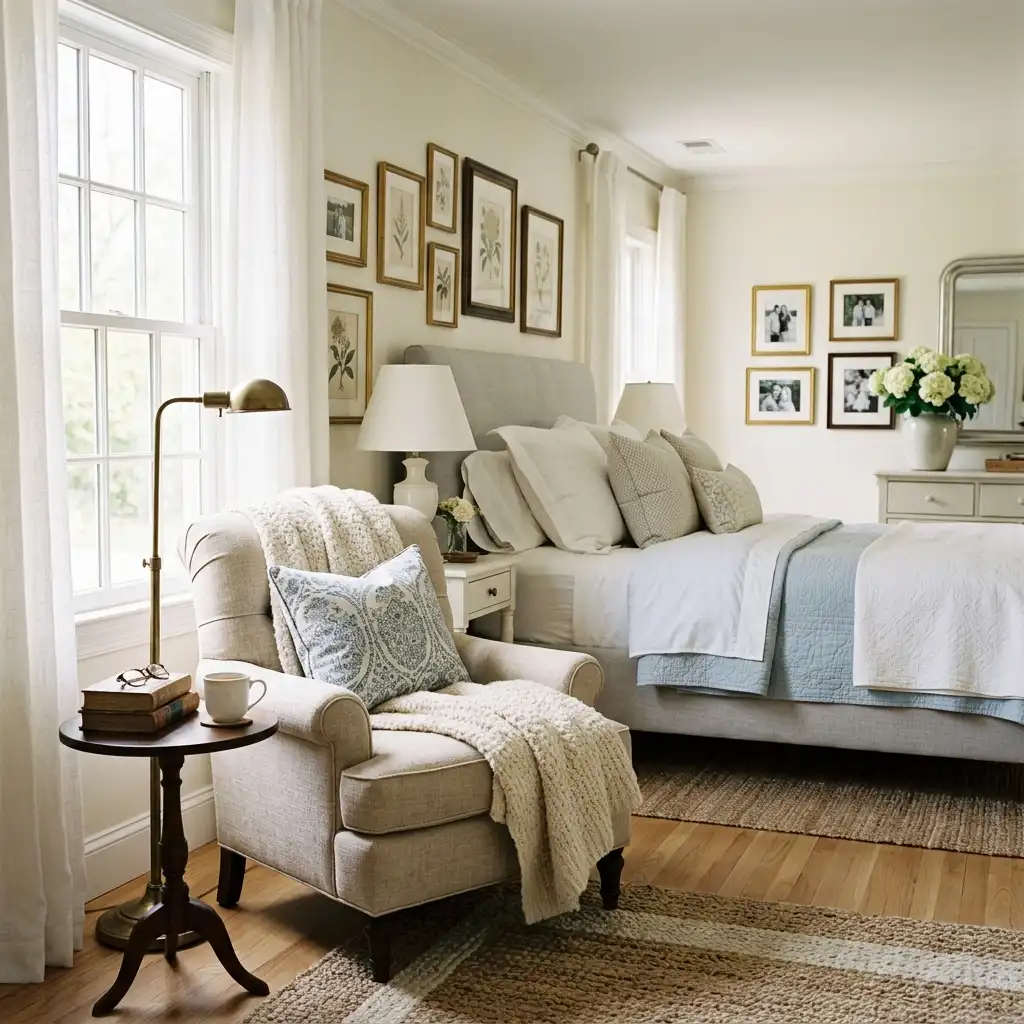
A small table or tray beside the chair. A lamp. A stack of two or three books. This is the complete reading corner and it takes up perhaps 4 by 4 feet of floor space.

The Lighting: Every Source Should Be Warm
Above ground pool and Nancy Meyers bedroom lighting are about as far apart on the spectrum as two topics can be. I say this because the lighting in Nancy Meyers films is doing an enormous amount of the heavy lifting that people attribute to the furniture and the paint colors.
The rooms always look golden. Sometimes literally — those afternoon-sun-through-white-curtains scenes where everything glows amber and the whole room seems to exhale. You cannot control when the sun does that. But you can control the artificial lighting and the way the room responds to natural light.
No overhead lighting as primary light. Recessed can lights and flush-mounted ceiling fixtures make bedrooms feel like offices. If you have overhead lighting in the bedroom, put it on a dimmer and use it only when getting dressed or cleaning. The primary lighting in a Nancy Meyers bedroom is lamps.
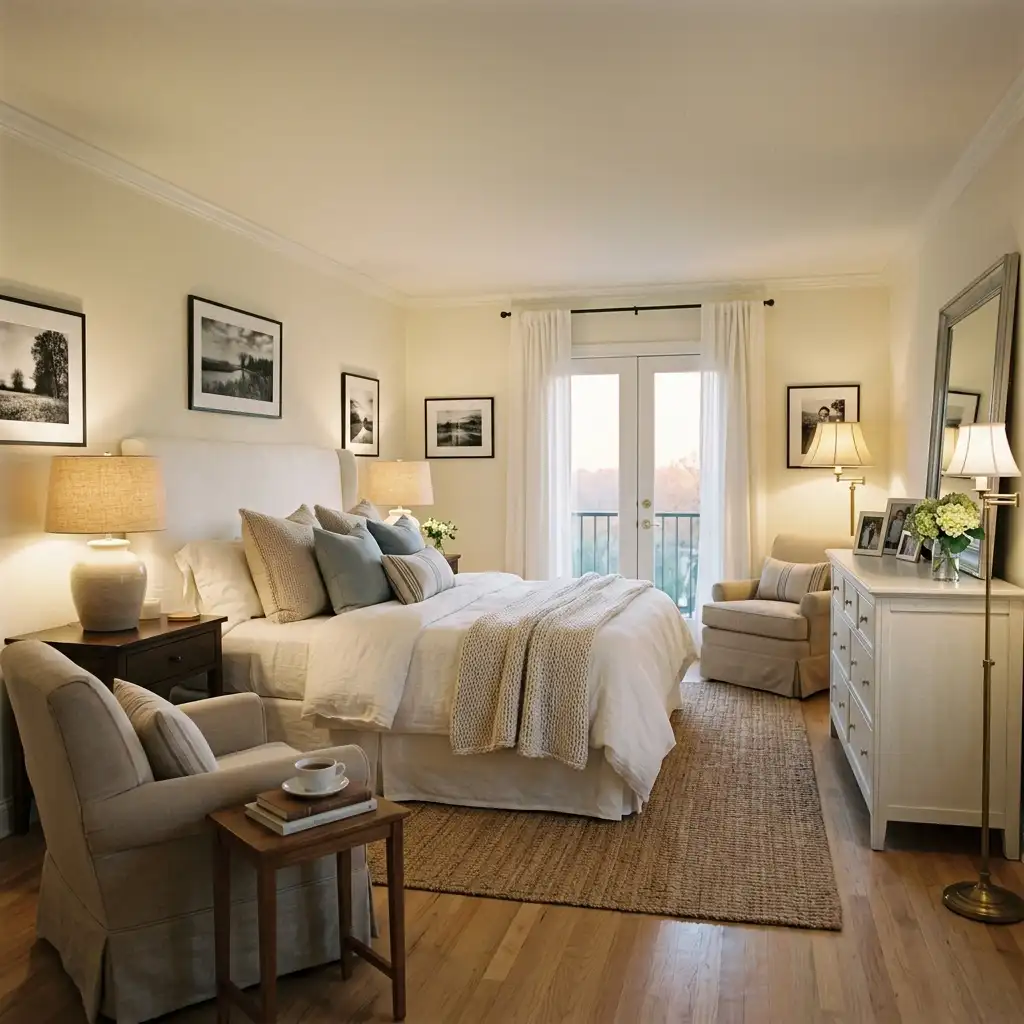
Table lamps on both bedside tables. These are the primary light source for the room during evening hours and they should be warm — 2700K or warmer, never the cool daylight bulb that comes in the lamp when you buy it from the hardware store. The lampshade should be either white or warm linen — a slightly drum or slightly tapered drum shape. The lamp base in ceramic, aged brass, or natural wood.

A floor lamp beside the reading chair. This completes the soft multiple-light-source effect that makes bedrooms look lit from within rather than illuminated from above.

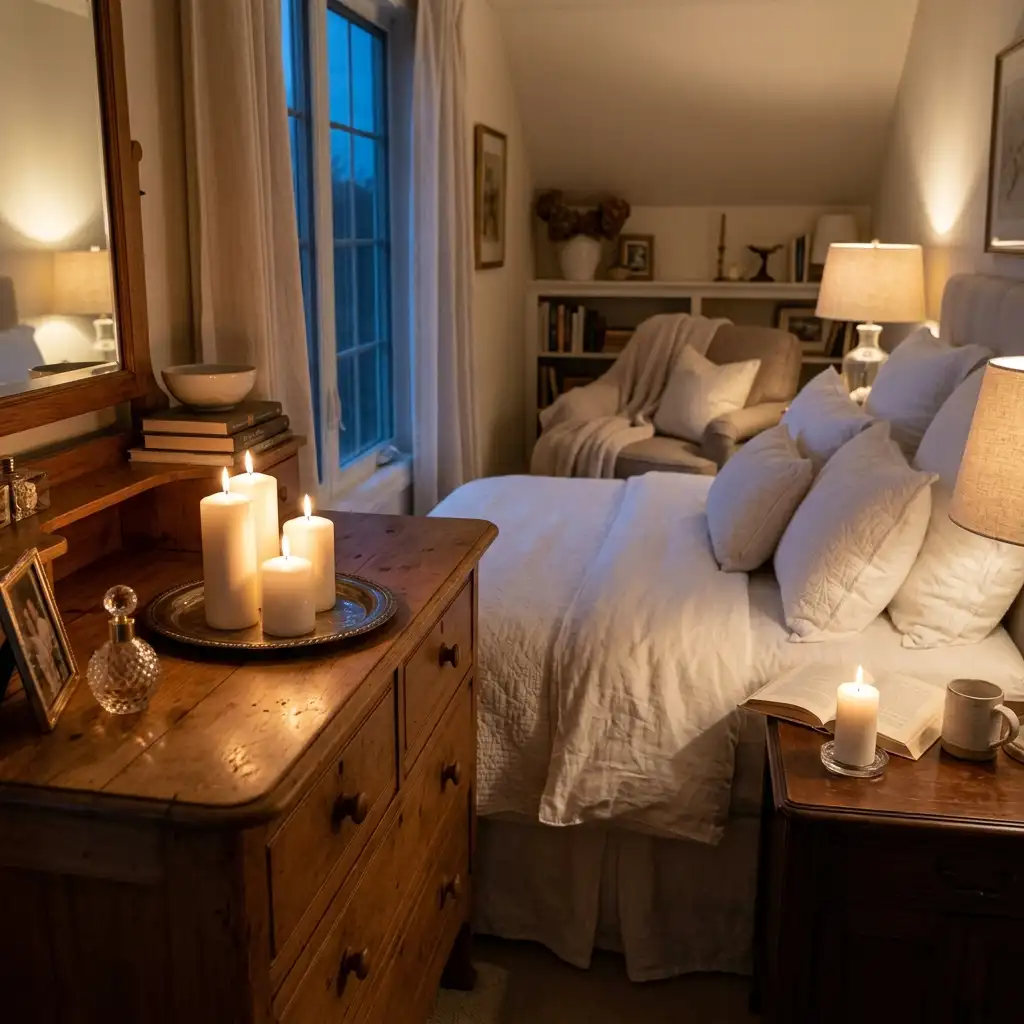
Candles. Not as primary light but as atmosphere. A cluster of three white pillar candles on the dresser. A single candle on the bedside table. The specificity of real candlelight cannot be replicated by Edison bulbs or warm LEDs — it moves, it is inconsistent, it behaves differently second to second. For evenings when the room should feel genuinely romantic rather than simply warm, candles earn their place.
The Details: Small Things That Add Up to Something Real
This is the section where I resist the urge to give you a list of specific products and instead try to explain the underlying quality that the details are aiming at.
The Nancy Meyers bedroom detail is found, beautiful, and slightly imperfect. It is not the perfect matching set from a home decor retailer. It is a ceramic vase purchased at a pottery market. A stack of books that are actually being read or have been. A framed photograph of somewhere real. A tray on the dresser that is slightly tarnished silver or aged wood. A small plant that is actually alive and actually being cared for.
The objects in the room should all feel like they arrived by different routes and have chosen to coexist beautifully. A bedroom that looks like it was styled by a store display tends not to capture this quality even when every individual element is beautiful.

Books belong in the Nancy Meyers bedroom. On the bedside table. Stacked on the dresser. A small shelf of them if there is wall space. Not as decoration (though they are decorative) but because the rooms in these films belong to people who read and who regard books as furniture — as essential to a room as a chair is.
Fresh flowers or a simple botanical on the bedside table or dresser. A single stem in a bud vase. Three stems in a simple ceramic jug. Not a large, elaborate arrangement — something that looks like you cut it from the garden or picked it up at the market.
A mirror that does not match the dresser. This sounds counterintuitive. But the look of the matching dresser-and-mirror set from a furniture showroom is specifically what you are not going for. A round mirror above a rectangular dresser. An arched mirror leaning against the wall beside the wardrobe. A vintage mirror with a slightly distressed frame propped on the dresser surface rather than hung on the wall. The mismatch reads as collected and personal rather than purchased.
What It Costs to Actually Do This
I want to address the budget question directly because the Nancy Meyers aesthetic has a reputation — partly deserved, partly not — for being expensive.
The expensive version exists. A 14-foot ceiling bedroom in a Hamptons beach house with custom linen furniture and Belgian linen curtains and a Restoration Hardware bed and a cashmere throw and an original oil painting above the dresser will cost a very large amount of money and will look absolutely extraordinary.
The accessible version also exists, and this is the more interesting conversation.
The paint costs the same regardless of whether you are painting a Hamptons house or a suburban bedroom. The specific warm white that makes a room look like a Nancy Meyers set costs exactly the same as any other paint color.
Curtains in a linen-look fabric from any number of online retailers start at prices that are genuinely reasonable, particularly considering how much they change the room. Mount them at ceiling height and the effect is immediate and significant.
An upholstered bed frame in linen or linen-look fabric at a mid-price point looks considerably more expensive than it costs because the aesthetic earns its sophistication from the material and the scale rather than from the brand.
The bedding is the place to invest. High-quality duvet and pillowcases hold up, wash better, and genuinely look different from lower-quality alternatives in ways that matter in this aesthetic. This is the area where I would spend more if I had to prioritize.
Estate sales, thrift stores, and online resale platforms are genuinely excellent sources for the furniture pieces — the dresser, the reading chair, the lamp, the mirror — that give the room its collected, found quality. Buying these secondhand and refinishing or reupholstering where needed produces results that are often more beautiful than buying new equivalents at higher cost, and the provenance gives each piece a story.
The most expensive element of achieving the Nancy Meyers bedroom is not any individual purchase. It is the quality of the natural light in your specific room. North-facing bedrooms, small windows, or windows that face another building create different baseline conditions than east-facing windows in a room that gets morning sun. You can maximize whatever natural light you have with pale walls and strategic mirror placement, but you cannot fully compensate for limited natural light. Choose the bedroom with the best light when you have the option.
The Version I Would Build
If I were starting from zero in a standard bedroom, here is exactly what I would do in the order I would do it.
Start with the paint. Warm white walls, bright white trim. This single decision changes the room before another dollar is spent.
Add the curtains. Ceiling-height rods, linen or linen-look fabric in warm white or cream, floor-length. The room now looks significantly taller and the light has the quality that everything else builds from.
Get the bedding right. White linen duvet cover, quality pillow inserts, an abundance of pillows, a textured throw. The bed is the room’s main event and it should look like it belongs in a room better than the current one — this creates upward pressure on everything else in the room to rise to the bed’s level.
Add the lamps. Both bedside tables, warm bulbs, linen or white shades. The room now has the light quality in the evening that the curtains create in the daytime.
Then the furniture, sourced over time rather than all at once. A better dresser. A reading chair. A mirror that is found rather than purchased new. Books. A plant. Flowers when you remember to buy them.
The room does not have to arrive complete. The Nancy Meyers bedroom is precisely the kind of room that looks better for having been assembled gradually, each piece chosen with attention, than it does when everything arrives in the same delivery window.
That is, I think, part of what those rooms are actually communicating to us every time we watch those films. Not that the perfect life requires a perfect room all at once. But that a life lived with attention and some aesthetic care produces, over time, rooms that feel like genuine expressions of who you are.
The dream is achievable. It just takes time.
Frequently Asked Questions
What is the Nancy Meyers aesthetic?
The Nancy Meyers aesthetic is a warm, soft, abundantly comfortable interior style characterized by warm white walls, aged natural wood furniture, linen and cotton textiles in cream and oatmeal tones, layered bedding, ceiling-height curtains in natural fabrics, and warm lamp lighting. It feels simultaneously effortlessly casual and quietly luxurious. The rooms in her films consistently look like they belong to people who live well, read a lot, and have good taste without announcing it.
What paint color creates a Nancy Meyers look?
Warm whites with cream or slightly yellow undertones are the foundation of the Nancy Meyers interior palette. Benjamin Moore White Dove, Swiss Coffee, and Antique White are frequently cited as close matches. Sherwin-Williams Navajo White and Accessible Beige work beautifully for walls with more warmth. The consistent principle is warm undertone — never cool, grey, or blue-white.
How do you get the Nancy Meyers bedroom look on a budget?
Paint is the highest-impact lowest-cost change — warm white walls transform a room immediately. Ceiling-height curtain rods with affordable linen-look fabric in cream or white create the height and softness the look requires. Quality bedding in white linen or cotton is worth investing in. Everything else — the dresser, the mirror, the reading chair — can be sourced secondhand and refinished or recovered to achieve the right look at significantly lower cost than buying new.
What bedding is used in Nancy Meyers films?
The bedding in Nancy Meyers films is consistently white or warm off-white, with the layered appearance of down-filled duvets and multiple pillow layers in linen or high-thread-count cotton. The beds look genuinely soft and genuinely plentiful in their pillows — not a styled minimal approach but an abundance that communicates real comfort.
Is the Nancy Meyers look only for large rooms?
No. The scale of the original sets is generous but the principles — warm whites, natural fabrics, layered textiles, warm lighting — work in any size room. In smaller rooms, ceiling-height curtains and pale walls help maximize the sense of space. Fewer, better pieces rather than trying to include everything the look calls for at full scale allows a smaller room to achieve the same atmospheric quality at an appropriate scale.
I watched The Holiday again recently. Different wine, same couch, same moment of pausing at the cottage bedroom scene.
What I notice now that I did not notice before: the room is not perfect. There are books stacked a little haphazardly. The duvet is not precisely straightened. There is a quality of real habitation to it — not the pristine staging of a showroom but the lived-in softness of a room that someone actually sleeps in and reads in and thinks in.
That is what I was always reaching for without quite knowing it. Not a room that looks expensive. A room that looks loved.
There is a difference, and it matters, and you can make it happen.
For more inspiration on creating warm, beautiful interiors, our guide on French country decor ideas covers a related aesthetic with some of the same material warmth, and our piece on vintage cottage decor goes deep on the found, collected quality that makes the Nancy Meyers look feel genuinely personal rather than designed.